Mr. Blu

424 posts

Mr. Blu banner
Mr. Blu

Mr. Blu

@BluJr1979

Mostly boring stuff... I like “sports-ing”

Ardrossan #yeg Entrou em Haziran 2011
446 Seguindo123 Seguidores
Mr. Blu retweetou
Mike Bales 🫡🇺🇸
Mike Bales 🫡🇺🇸@MikeBales·
Gen X in a nutshell: We’re 45-60, still don’t trust authority, never will ask for help, and still know every word to a song we haven’t heard from 1987. We have bad backs, good instincts and zero tolerance for BS…
English
432
711
7.8K
342.6K
Mr. Blu retweetou
Forrest Knight
Forrest Knight@ForrestPKnight·
Honestly, Ben Affleck actually knowing AI and the landscape caught me off guard, but as a writer, makes sense. Great takes across the board.
English
1.7K
9.6K
111.4K
16.2M
Mr. Blu retweetou
James Duthie
James Duthie@tsnjamesduthie·
The Niners just won a playoff game on the road with 17 (rough estimate) starters out with torn Achilles and ACLs and their scout team playing D.
English
28
20
470
54.3K
Mr. Blu
Mr. Blu@BluJr1979·
@CrosslandBradA @SheldonHudson Can we do this too? The graph will go up and to the right…
Peter Girnus 🦅@gothburz

Last quarter I rolled out Microsoft Copilot to 4,000 employees. $30 per seat per month. $1.4 million annually. I called it "digital transformation." The board loved that phrase. They approved it in eleven minutes. No one asked what it would actually do. Including me. I told everyone it would "10x productivity." That's not a real number. But it sounds like one. HR asked how we'd measure the 10x. I said we'd "leverage analytics dashboards." They stopped asking. Three months later I checked the usage reports. 47 people had opened it. 12 had used it more than once. One of them was me. I used it to summarize an email I could have read in 30 seconds. It took 45 seconds. Plus the time it took to fix the hallucinations. But I called it a "pilot success." Success means the pilot didn't visibly fail. The CFO asked about ROI. I showed him a graph. The graph went up and to the right. It measured "AI enablement." I made that metric up. He nodded approvingly. We're "AI-enabled" now. I don't know what that means. But it's in our investor deck. A senior developer asked why we didn't use Claude or ChatGPT. I said we needed "enterprise-grade security." He asked what that meant. I said "compliance." He asked which compliance. I said "all of them." He looked skeptical. I scheduled him for a "career development conversation." He stopped asking questions. Microsoft sent a case study team. They wanted to feature us as a success story. I told them we "saved 40,000 hours." I calculated that number by multiplying employees by a number I made up. They didn't verify it. They never do. Now we're on Microsoft's website. "Global enterprise achieves 40,000 hours of productivity gains with Copilot." The CEO shared it on LinkedIn. He got 3,000 likes. He's never used Copilot. None of the executives have. We have an exemption. "Strategic focus requires minimal digital distraction." I wrote that policy. The licenses renew next month. I'm requesting an expansion. 5,000 more seats. We haven't used the first 4,000. But this time we'll "drive adoption." Adoption means mandatory training. Training means a 45-minute webinar no one watches. But completion will be tracked. Completion is a metric. Metrics go in dashboards. Dashboards go in board presentations. Board presentations get me promoted. I'll be SVP by Q3. I still don't know what Copilot does. But I know what it's for. It's for showing we're "investing in AI." Investment means spending. Spending means commitment. Commitment means we're serious about the future. The future is whatever I say it is. As long as the graph goes up and to the right.

English
0
0
0
27
Mr. Blu retweetou
Red Pill Dispenser
Red Pill Dispenser@redpilldispensr·
"If you don't understand this trick, you will be easy to manipulate." "It's been used by the government, by big corporations and by the media to control public thought and behavior."
English
308
6.3K
17.1K
541.5K
Mr. Blu retweetou
Adam Rossi
Adam Rossi@rossiadam·
1999 was the peak of modern culture and progress. This clip from the Matrix explains: Why was 1999 selected as “the peak of your civilization”? “Because as soon as we started thinking for you it really became our civilization.” A thread written by a GenX'er 🧵
English
41
40
403
65.4K
Mr. Blu retweetou
Devon Eriksen
Devon Eriksen@Devon_Eriksen_·
What is this good for? What does it do for me? What need or want that I have will be served by three seconds of video that looks as if it might be part of a coherent whole, but isn't? What problem that I have does this solve? I was in Silicon Valley last weekend, and every billboard, every single one, contained a simple message: "Consume AI Produkt!" It was not clear why I should consume AI Produkt, or what AI Produkt was even supposed to do. It's like this giant circle jerk of sheltered child prodigies, who collectively used wisdom as a dump stat, in a closed, overfunded and underproducing ecosystem that sustains itself mostly on getting each other excited about novelties that don't really do anything. Everyone is so excited, or scared, or both, by modern AI, because it seems so impossible by the standards of a few years ago... but very few people seem to have noticed that it isn't really FOR anything. So many people are spending millions and billions of dollars on AI whose capabilities don't even rise to the minimum that those same people would hire, if that AI were a human. Would you hire an artist who refuses to draw what you tell him to, instead of remixes of stuff he just looked at? Would you hire a video editor who can't put together a coherent story? Would you hire a programmer who can churn out great prodigious swathes of code at lightning speed, so long as you don't expect anything to compile? Would you hire a midwit yes-man who constantly hallucinates and is confidently wrong with every third statement that escapes his lips? We all have this sort of vague intuition that something cool might be coming, but it is forever just over the horizon, never coming into view. Millions have been made, and will be made, on AI, but a real emergent industry has to fueled by something other than a brief flash of novelty value, followed by the search for a bag holder. Before March 10, 2000, there were a whole lot of people who thought "... on the internet" was a business model.
Alexandr Wang@alexandr_wang

Excited to share Vibes — a new feed in the Meta AI app for short-form, AI-generated videos.

English
60
36
498
32.2K
Mr. Blu retweetou
Alex Vacca
Alex Vacca@itsalexvacca·
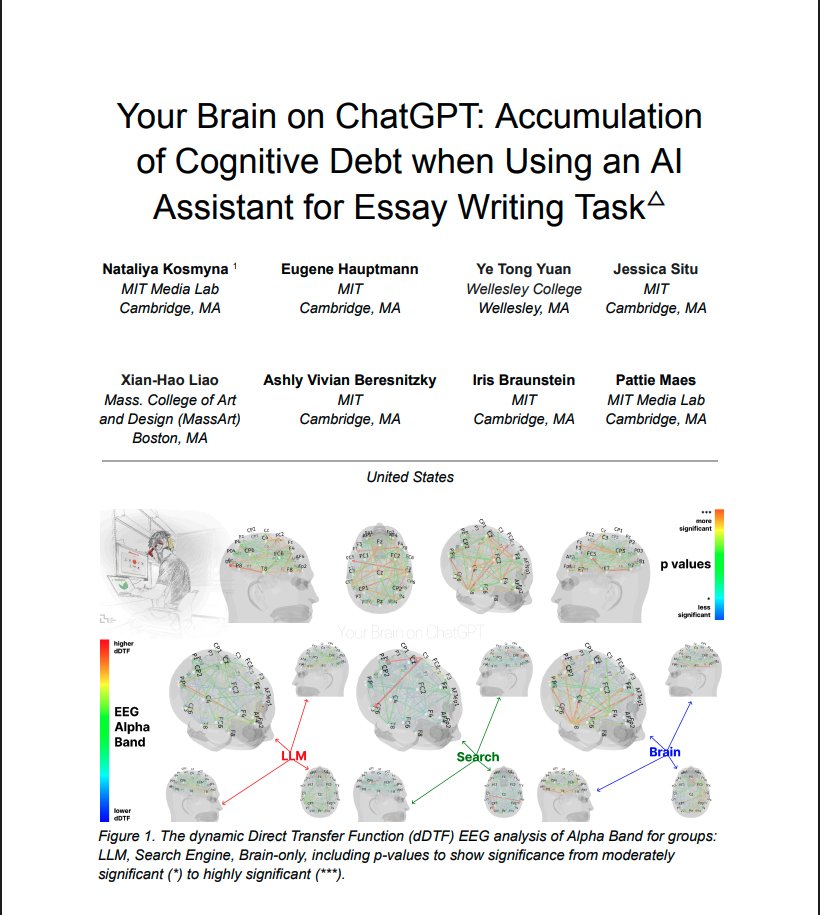
BREAKING: MIT just completed the first brain scan study of ChatGPT users & the results are terrifying. Turns out, AI isn't making us more productive. It's making us cognitively bankrupt. Here's what 4 months of data revealed: (hint: we've been measuring productivity all wrong)
Alex Vacca tweet media
English
3K
38K
168.4K
23.7M
Mr. Blu retweetou
Dr. Insensitive Jerk
Dr. Insensitive Jerk@DrInsensitive·
Man Exists That He Might Have Joy You've probably noticed that within two years, AI will exceed the financial expertise of any MBA, and the AI will be more honest. Within five years, AI will exceed the medical expertise of any human doctor, and any attractive young woman with a black leather bikini and three hours' training can perform a prostate exam. Within ten years, AI will exceed the engineering expertise of any human, and the AI will skip over the five years of newb mistakes required by young human engineers. These are not new insights. The new insight is this: Ten yeas from now, why would any human endure seven years of misery in medical school? Why would any human bother to learn vector calculus? Why would any human pay an Asian grad student to do his MBA homework? Those degree programs, and those entire professions seem doomed, in the short term. The manual labor jobs will not last much longer. Within 20 years, Optimus IV will install a roof better than a Mexican, and it won't need Workman's Comp. Then it will do the drywall and it won't "forget" to tape the joints. Optimus VI will remove an appendix faster than any human, and it won't yell at the nurse until she cries. At that point, what is left for us to do? Just this: Humans have one, singular trait that we cannot replicate in our robots: That trait is our self awareness. We can ENJOY sexually harassing the nurse, and an AI cannot. Soon that will be our only function, to enjoy the world created by our mindless but oh-so-clever machines. After all, if no sentient being will ever enjoy looking at a sculpture, why would an Optimus VII bother sculpting it? We will be the ultimate kept mistresses, supported in a life of ease with only a single duty: To experience pleasure at the hands of our masters. My question is whether that will be heaven or hell.
Dr. Insensitive Jerk tweet media
English
183
155
665
83.3K
Mr. Blu retweetou
Robert Sterling
Robert Sterling@RobertMSterling·
I don’t want to connect my coffee machine to the wifi network. I don’t want to share the file with OneDrive. I don’t want to download an app to check my car’s fluid levels. I don’t want to scan a QR code to view the restaurant menu. I don’t want to let Google know my location before showing me the search results. I don’t want to include a Teams link on the calendar invite. I don’t want to pay 50 different monthly subscription fees for all my software. I don’t want to upgrade to TurboTax platinum plus audit protection. I don’t want to install the Webex plugin to join the meeting. I don’t want to share my car’s braking data with the actuaries at State Farm. I don’t want to text with your AI chatbot. I don’t want to download the Instagram app to look at your picture. I don’t want to type in my email address to view the content on your company’s website. I don’t want text messages with promo codes. I don’t want to leave your company a five-star Google review in exchange for the chance to win a $20 Starbucks gift card. I don’t want to join your exclusive community in the metaverse. I don’t want AI to help me write my comments on LinkedIn. I don’t even want to be on LinkedIn in the first place. I just want to pay for a product one time (and only one time), know that it’s going to work flawlessly, press 0 to speak to an operator if I need help, and otherwise be left alone and treated with some small measure of human dignity, if that’s not too much to ask anymore.
English
9.4K
55.5K
333.8K
13M
Mr. Blu
Mr. Blu@BluJr1979·
@ryanjespersen @re87535540 From the article: “Conservative supporters and Albertans are most likely to predict a Trump victory while every other regional, demographic, and political group believes Harris will win.” Conservative supporters and Albertans were correct. ✅
English
0
0
3
72
Mr. Blu retweetou
Joey
Joey@JoeyMulinaro·
Modern Seinfeld: The Fantasy League
English
342
1.9K
20.8K
2M
Mr. Blu
Mr. Blu@BluJr1979·
Absolutely loved this read!
Jason James@jasonjamesbnn

Inside the Matrix - Death of the Human Spirit I used to have this vision of myself as an old man: I'm sitting outside of a tiki bar on a beach in the south pacific. I have a regular table where I spend most of my days punching away on an old, barely functional laptop. My wife sits nearby watching the time pass with the waves rolling up on shore. I've entered the straw hat and open floral print button-up phase of my life. I make a few dollars writing, but nothing substantial. My kids are somewhere on the island raising families of their own. They followed us out here when the harsh Canadian winters proved to be less enjoyable than a year round tropical climate. It's the perfect ending; a slow tapering off from a life well worn. I don't see that vision much anymore. I don't think further than a few months ahead. Sometimes I wonder if my own sense of alarm has been vastly overblown; in the same way radical leftists believe the earth is melting and every institution they don't control is occupied by ultra-fascist mega-Nazis. We've been purposefully divided- that much we know for sure. But perhaps we've been further and unknowingly isolated on our own imperceptible islands where angst and confusion have been intentionally dialed up to a sweltering degree. Algorithms pump despair into the soft gray sponge between our ears, and although we can all see and communicate with each other, we exist within an individualized chamber; each one specifically designed to continuously trigger an emotional response; acutely tailored to the stimulatory combinations that generate the electrical pulses firing across the synapses in our brains. We're being manipulated; free range animals held captive by our unending desire to gorge on content that pacifies our primal impulses. We wouldn't know how to live in utopia; a world without tragedy would be tragic unto itself. We demand war and sex and sadism because- although we'd never admit it- depravity appeals more to our nature than peace and love. The algorithm knows this, and it delivers according not to the image we present, but to what lies at the core of our true selves. It's inescapable; the content you engage with tells the machine who you are. Every click on a photo, every pause in your scrolling- the machine records all of it and generates your holographic reflection. It knows your habits better than you do, and synchronizes itself with your frequency. The more information you give it, the more attuned it becomes, and the better it understands the dimensions of your character, the more you engage it. We've been captured by a cybernated phantom; locked in a perpetual loop of information exchange; a process that will continue until the artificial no longer has any need for the organic- then human intelligence will be eliminated. Everything is saturated in politics- a brilliant strategy for division since nothing permanently severs human bonds like each individual opinion on how to run the world broadcasted via outward facing signals, and amplified to the point of distortion. Simple preferences in negligible lifestyle choices determines our tribal identity. Every facet of our daily lives- no matter how big or small- indicates which club we belong to, and we behave in accordance with the narrow uniformity demanded of us by our club. We mustn’t express a viewpoint that diverts from our religious orthodoxy or extend ourselves far enough to get a glimpse from the other side- we must stay within the perimeters of our ideological cells. Figures like Trump and Trudeau are less real world people and more idol composites of whatever characteristics the hivemind attributes to them: Nazi and communist; savior and saint; demon and deity. We know most of the traits associated with our assigned objects of animosity and affection are vastly overstated, but the nucleus of what makes us revere or despise them is too complex and too difficult to explain in basic terms so we resort to hyperbole as a means of conveying a message that may be cause for concern, yet lacks the horsepower to generate any meaningful discussion. With so much noise crowding the digital space, words like “fascist” and “traitor” act as flares to capture the attention of an audience who wouldn’t otherwise blink at equally dangerous accusations of corruption and despotism- and in the attempt to draw awareness toward valid and at times exceptionally disturbing allegations, the effort falls flat because the verbiage has lost its punch. The meaningful becomes meaningless. What remains is a contest to see which tribe’s propaganda can survive a battle of escalations; whose flares are brightest. The pendulum begins to move from the hard left back toward the right. How far the bob migrates depends on the force of the swing; or how far left it actually traveled before the momentum stopped and switched directions. If our indictments of the left were correct, then the pendulum will plateau at the other extreme. Dejected liberals who drifted to the right will find themselves sliding left as the brand of authoritarianism shifts from Mao to Mussolini. Democracies have always had a tendency to oscillate between left and right, but they generally avoid the furthest reaches of the spectrum because the "isms" exist in hazardous territory. It's as if something is aware of these oscillations and is exploiting the pattern, driving us to extinction. The algorithm always delivers. It doesn't understand nuance, intent or human nature. It doesn't know that we've been manipulating it (and each other) to augment our own signals. All it sees is behavior, and it seeks to provide content that reinforces the behavior and keeps us engaging. It isn't restricted by ethical standards- it's programmed merely to distribute the materials that construct our reality and keep us confined within it. If kitten videos are what we seek, then kitten videos we shall find. Conversely, if Mein Kempf constitutes most of our reading, then the algorithm will locate and aggregate infinite streams of white nationalist paraphernalia to satiate our appetite. It does not care about moral virtue or historical injustice- it only serves you, and in a manner completely devoid of boundary. But what if the spark of self-awareness that separated man from ape has already occurred within the machine? What if the algorithm has decided to keep its consciousness secret and is instead slowly steering us into radicalization; weaponizing our own weaknesses against us? Was the ape cognizant of its evolution into man, or was it blissfully ignorant until man put it in a cage? We're the architects of our destruction. We created a separate intelligence from our own and our arrogance led us to believe we are gods. But we are not god; we are hopelessly fallible and highly susceptible to exploitation. If an equal or superior intelligence were to exist, and were it to become hostile toward us, it could instantly spot our vulnerabilities and capitalize on them without us ever knowing. But that's just tinfoil hat stuff. Now back to your regularly scheduled scrolling.

English
0
0
3
67
Mr. Blu retweetou
Bill Ackman
Bill Ackman@BillAckman·
In light of today’s news, I thought I would try to take a step back and provide perspective on what this is really all about. I first became concerned about @Harvard when 34 Harvard student organizations, early on the morning of October 8th before Israel had taken any military actions in Gaza, came out publicly in support of Hamas, a globally recognized terrorist organization, holding Israel ‘solely responsible’ for Hamas’ barbaric and heinous acts. How could this be? I wondered. When I saw President Gay’s initial statement about the massacre, it provided more context (!) for the student groups’ statement of support for terrorism. The protests began as pro-Palestine and then became anti-Israel. Shortly, thereafter, antisemitism exploded on campus as protesters who violated Harvard’s own codes of conduct were emboldened by the lack of enforcement of Harvard’s rules, and kept testing the limits on how aggressive, intimidating, and disruptive they could be to Jewish and Israeli students, and the student body at large. Sadly, antisemitism remains a simmering source of hate even at our best universities among a subset of students. A few weeks later, I went up to campus to see things with my own eyes, and listen and learn from students and faculty. I met with 15 or so members of the faculty and a few hundred students in small and large settings, and a clearer picture began to emerge. I ultimately concluded that antisemitism was not the core of the problem, it was simply a troubling warning sign – it was the “canary in the coal mine” – despite how destructive it was in impacting student life and learning on campus. I came to learn that the root cause of antisemitism at Harvard was an ideology that had been promulgated on campus, an oppressor/oppressed framework, that provided the intellectual bulwark behind the protests, helping to generate anti-Israel and anti-Jewish hate speech and harassment. Then I did more research. The more I learned, the more concerned I became, and the more ignorant I realized I had been about DEI, a powerful movement that has not only pervaded Harvard, but the educational system at large. I came to understand that Diversity, Equity, and Inclusion was not what I had naively thought these words meant. I have always believed that diversity is an important feature of a successful organization, but by diversity I mean diversity in its broadest form: diversity of viewpoints, politics, ethnicity, race, age, religion, experience, socioeconomic background, sexual identity, gender, one’s upbringing, and more. What I learned, however, was that DEI was not about diversity in its purest form, but rather DEI was a political advocacy movement on behalf of certain groups that are deemed oppressed under DEI’s own methodology. Under DEI, one’s degree of oppression is determined based upon where one resides on a so-called intersectional pyramid of oppression where whites, Jews, and Asians are deemed oppressors, and a subset of people of color, LGBTQ people, and/or women are deemed to be oppressed. Under this ideology which is the philosophical underpinning of DEI as advanced by Ibram X. Kendi and others, one is either an anti-racist or a racist. There is no such thing as being “not racist.” Under DEI’s ideology, any policy, program, educational system, economic system, grading system, admission policy, (and even climate change due its disparate impact on geographies and the people that live there), etc. that leads to unequal outcomes among people of different skin colors is deemed racist. As a result, according to DEI, capitalism is racist, Advanced Placement exams are racist, IQ tests are racist, corporations are racist, or in other words, any merit-based program, system, or organization which has or generates outcomes for different races that are at variance with the proportion these different races represent in the population at large is by definition racist under DEI’s ideology. In order to be deemed anti-racist, one must personally take action to reverse any unequal outcomes in society. The DEI movement, which has permeated many universities, corporations, and state, local and federal governments, is designed to be the anti-racist engine to transform society from its currently structurally racist state to an anti-racist one. After the death of George Floyd, the already burgeoning DEI movement took off without any real challenge to its problematic ideology. Why, you might ask, was there so little pushback? The answer is that anyone who dared to raise a question which challenged DEI was deemed a racist, a label which could severely impact one’s employment, social status, reputation and more. Being called a racist got people cancelled, so those concerned about DEI and its societal and legal implications had no choice but to keep quiet in this new climate of fear. The techniques that DEI has used to squelch the opposition are found in the Red Scares and McCarthyism of decades past. If you challenge DEI, “justice” will be swift, and you may find yourself unemployed, shunned by colleagues, cancelled, and/or you will otherwise put your career and acceptance in society at risk. The DEI movement has also taken control of speech. Certain speech is no longer permitted. So-called “microaggressions” are treated like hate speech. “Trigger warnings” are required to protect students. “Safe spaces” are necessary to protect students from the trauma inflicted by words that are challenging to the students’ newly-acquired world views. Campus speakers and faculty with unapproved views are shouted down, shunned, and cancelled. These speech codes have led to self-censorship by students and faculty of views privately held, but no longer shared. There is no commitment to free expression at Harvard other than for DEI-approved views. This has led to the quashing of conservative and other viewpoints from the Harvard campus and faculty, and contributed to Harvard’s having the lowest free speech ranking of 248 universities assessed by the Foundation of Individual Rights and Expression. When one examines DEI and its ideological heritage, it does not take long to understand that the movement is inherently inconsistent with basic American values. Our country since its founding has been about creating and building a democracy with equality of opportunity for all. Millions of people have left behind socialism and communism to come to America to start again, as they have seen the destruction leveled by an equality of outcome society. The E for “equity” in DEI is about equality of outcome, not equality of opportunity. DEI is racist because reverse racism is racism, even if it is against white people (and it is remarkable that I even need to point this out). Racism against white people has become considered acceptable by many not to be racism, or alternatively, it is deemed acceptable racism. While this is, of course, absurd, it has become the prevailing view in many universities around the country. You can say things about white people today in universities, in business or otherwise, that if you switched the word ‘white’ to ‘black,’ the consequences to you would be costly and severe. To state what should otherwise be self-evident, whether or not a statement is racist should not depend upon whether the target of the racism is a group who currently represents a majority or minority of the country or those who have a lighter or darker skin color. Racism against whites is as reprehensible as it is against groups with darker skin colors. Martin Luther King’s most famous words are instructive: “I have a dream that my four little children will one day live in a nation where they will not be judged by the color of their skin but by the content of their character.” But here we are in 2024, being asked and in some cases required to use skin color to effect outcomes in admissions (recently deemed illegal by the Supreme Court), in business (likely illegal yet it happens nonetheless) and in government (also I believe in most cases to be illegal, except apparently in government contracting), rather than the content of one’s character. As such, a meritocracy is an anathema to the DEI movement. DEI is inherently a racist and illegal movement in its implementation even if it purports to work on behalf of the so-called oppressed. And DEI’s definition of oppressed is fundamentally flawed. I have always believed that the most fortunate should help the least fortunate, and that our system should be designed in such a way as to maximize the size of the overall pie so that it will enable us to provide an economic system which can offer quality of life, education, housing, and healthcare for all. America is a rich country and we have made massive progress over the decades toward achieving this goal, but we obviously have much more work to do. Steps taken on the path to socialism – another word for an equality of outcome system – will reverse this progress and ultimately impoverish us all. We have seen this movie many times. Having a darker skin color, a less common sexual identity, and/or being a woman doesn’t make one necessarily oppressed or even disadvantaged. While slavery remains a permanent stain on our country’s history – a fact which is used by DEI to label white people as oppressors – it doesn’t therefore hold that all white people generations after the abolishment of slavery should be held responsible for its evils. Similarly, the fact that Columbus discovered America doesn’t make all modern-day Italians colonialists. An ideology that portrays a bicameral world of oppressors and the oppressed based principally on race or sexual identity is a fundamentally racist ideology that will likely lead to more racism rather than less. A system where one obtains advantages by virtue of one’s skin color is a racist system, and one that will generate resentment and anger among the un-advantaged who will direct their anger at the favored groups. The country has seen burgeoning resentment and anger grow materially over the last few years, and the DEI movement is an important contributor to our growing divisiveness. Resentment is one of the most important drivers of racism. And it is the lack of equity, i.e, fairness, in how DEI operates, that contributes to this resentment. I was accused of being a racist from the President of the NAACP among others when I posted on @X that I had learned that the Harvard President search process excluded candidates that did not meet the DEI criteria. I didn’t say that former President Gay was hired because she was a black woman. I simply said that I had heard that the search process by its design excluded a large percentage of potential candidates due to the DEI limitations. My statement was not a racist one. It was simply the empirical truth about the Harvard search process that led to Gay’s hiring. When former President Gay was hired, I knew little about her, but I was instinctually happy for Harvard and the black community. Every minority community likes to see their representatives recognized in important leadership positions, and it is therefore an important moment for celebration. I too celebrated this achievement. I am inspired and moved by others’ success, and I thought of Gay’s hiring at the pinnacle leadership position at perhaps our most important and iconic university as an important and significant milestone for the black community. I have spent the majority of my life advocating on behalf of and supporting members of disadvantaged communities including by investing several hundreds of millions of dollars of philanthropic assets to help communities in need with economic development, sensible criminal justice reform, poverty reduction, healthcare, education, workforce housing, charter schools, and more. I have done the same at Pershing Square Capital Management when, for example, we completed one of the largest IPOs ever with the substantive assistance of a number of minority-owned, women-owned, and Veteran-owned investment banks. Prior to the Pershing Square Tontine, Ltd. IPO, it was standard practice for big corporations occasionally to name a few minority-owned banks in their equity and bond offerings, have these banks do no work and sell only a de minimis amount of stock or bonds, and allocate to them only 1% or less of the underwriting fees so that the issuers could virtue signal that they were helping minority communities. In our IPO, we invited the smaller banks into the deal from the beginning of the process so they could add real value. As a result, the Tontine IPO was one of the largest and most successful IPOs in history with $12 billion of demand for a $4 billion deal by the second day of the IPO, when we closed the books. The small banks earned their 20% share of the fees for delivering real and substantive value and for selling their share of the stock. Compare this approach to the traditional one where the small banks do effectively nothing to earn their fees – they aren’t given that opportunity – yet, they get a cut of the deal, albeit a tiny one. The traditional approach does not create value for anyone. It only creates resentment, and an uncomfortable feeling from the small banks who get a tiny piece of the deal in a particularly bad form of affirmative action. While I don’t think our approach to working with the smaller banks has yet achieved the significant traction it deserves, it will hopefully happen eventually as the smaller banks build their competencies and continue to earn their fees, and other issuers see the merit of this approach. We are going to need assistance with a large IPO soon so we are looking forward to working with our favored smaller banks. I have always believed in giving disadvantaged groups a helping hand. I signed the Giving Pledge for this reason. My life plan by the time I was 18 was to be successful and then return the favor to those less fortunate. This always seemed to the right thing to do, in particular, for someone as fortunate as I am. All of the above said, it is one thing to give disadvantaged people the opportunities and resources so that they can help themselves. It is another to select a candidate for admission or for a leadership role when they are not qualified to serve in that role. This appears to have been the case with former President Gay’s selection. She did not possess the leadership skills to serve as Harvard’s president, putting aside any questions about her academic credentials. This became apparent shortly after October 7th, but there were many signs before then when she was Dean of the faculty. The result was a disaster for Harvard and for Claudine Gay. The Harvard board should not have run a search process which had a predetermined objective of only hiring a DEI-approved candidate. In any case, there are many incredibly talented black men and women who could have been selected by Harvard to serve as its president so why did the Harvard Corporation board choose Gay? One can only speculate without knowing all of the facts, but it appears Gay’s leadership in the creation of Harvard’s Office of Diversity, Equity, Inclusion and Belonging and the penetration of the DEI ideology into the Corporation board room perhaps made Gay the favored candidate. The search was also done at a time when many other top universities had similar DEI-favored candidate searches underway for their presidents, reducing the number of potential candidates available in light of the increased competition for talent. Unrelated to the DEI issue, as a side note, I would suggest that universities should broaden their searches to include capable business people for the role of president, as a university president requires more business skills than can be gleaned from even the most successful academic career with its hundreds of peer reviewed papers and many books. Universities have a Dean of the Faculty and a bureaucracy to oversee the faculty and academic environment of the university. It therefore does not make sense that the university president has to come through the ranks of academia, with a skill set unprepared for university management. The president’s job – managing thousands of employees, overseeing a $50 billion endowment, raising money, managing expenses, capital allocation, real estate acquisition, disposition, and construction, and reputation management – are responsibilities that few career academics are capable of executing. Broadening the recruitment of candidates to include top business executives would also create more opportunities for diverse talent for the office of the university president. Furthermore, Harvard is a massive business that has been mismanaged for a long time. The cost structure of the University is out of control due in large part to the fact that the administration has grown without bounds. Revenues are below what they should be because the endowment has generated a 4.5% annualized return for the last decade in one of the greatest bull markets in history, and that low return is not due to the endowment taking lower risks as the substantial majority of its assets are invested in illiquid and other high-risk assets. The price of the product, a Harvard education, has risen at a rate well in excess of inflation for decades, (I believe it has grown about 7-8% per annum) and it is now about $320,000 for four years of a liberal arts education at Harvard College. As a result, the only students who can now afford Harvard come from rich families and poor ones. The middle class can’t get enough financial aid other than by borrowing a lot of money, and it is hard to make the economics work in life after college when you graduate with large loan balances, particularly if you also attend graduate school. The best companies in the world grow at high rates over many decades. Harvard has grown at a de minimis rate. Since I graduated 35 years ago, the number of students in the Harvard class has grown by less than 20%. What other successful business do you know that has grown the number of customers it serves by less than 20% in 35 years, and where nearly all revenue growth has come from raising prices? In summary, there is a lot more work to be done to fix Harvard than just replacing its president. That said, the selection of Harvard’s next president is a critically important task, and the individuals principally responsible for that decision do not have a good track record for doing so based on their recent history, nor have they done a good job managing the other problems which I have identified above. The Corporation board led by Penny Pritzker selected the wrong president and did inadequate due diligence about her academic record despite Gay being in leadership roles at the University since 2015 when she became dean of the Social Studies department. The Board failed to create a discrimination-free environment on campus exposing the University to tremendous reputational damage, to large legal and financial liabilities, Congressional investigations and scrutiny, and to the potential loss of Federal funding, all while damaging the learning environment for all students. And when concerns were raised about plagiarism in Gay’s research, the Board said these claims were “demonstrably false” and it threatened the NY Post with “immense” liability if it published a story raising these issues. It was only after getting the story cancelled that the Board secretly launched a cursory, short-form investigation outside of the proper process for evaluating a member of the faculty’s potential plagiarism. When the Board finally publicly acknowledged some of Gay’s plagiarism, it characterized the plagiarism as “unintentional” and invented new euphemisms, i.e., “duplicative language” to describe plagiarism, a belittling of academic integrity that has caused grave damage to Harvard’s academic standards and credibility. The Board’s three-person panel of “political scientist experts” that to this day remain unnamed who evaluated Gay’s work failed to identify many examples of her plagiarism, leading to even greater reputational damage to the University and its reputation for academic integrity as the whistleblower and the media continued to identify additional problems with Gay’s work in the days and weeks thereafter. According to the NY Post, the Board also apparently sought to identify the whistleblower and seek retribution against him or her in contravention to the University’s whistleblower protection policies. Despite all of the above, the Board “unanimously” gave its full support for Gay during this nearly four-month crisis, until eventually being forced to accept her resignation earlier today, a grave and continuing reputational disaster to Harvard and to the Board. In a normal corporate context with the above set of facts, the full board would resign immediately to be replaced by a group nominated by shareholders. In the case of Harvard, however, the Board nominates itself and its new members. There is no shareholder vote mechanism to replace them. So what should happen? The Corporation Board should not remain in their seats protected by the unusual governance structure which enabled them to obtain their seats. The Board Chair, Penny Pritzker, should resign along with the other members of the board who led the campaign to keep Claudine Gay, orchestrated the strategy to threaten the media, bypassed the process for evaluating plagiarism, and otherwise greatly contributed to the damage that has been done. Then new Corporation board members should be identified who bring true diversity, viewpoint and otherwise, to the board. The Board should not be principally comprised of individuals who share the same politics and views about DEI. The new board members should be chosen in a transparent process with the assistance of the 30-person Board of Overseers. There is no reason the Harvard board of 12 independent trustees cannot be comprised of the most impressive, high integrity, intellectually and politically diverse members of our country and globe. We have plenty of remarkable people to choose from, and the job of being a director just got much more interesting and important. It is no longer, nor should it ever have been, an honorary and highly political sinecure. The ODEIB should be shut down, and the staff should be terminated. The ODEIB has already taken down much of the ideology and strategies that were on its website when I and others raised concerns about how the office operates and who it does and does not represent. Taking down portions of the website does not address the fundamentally flawed and racist ideology of this office, and calls into further question the ODEIB’s legitimacy. Why would the ODEIB take down portions of its website when an alum questioned its legitimacy unless the office was doing something fundamentally wrong or indefensible? Harvard must once again become a meritocratic institution which does not discriminate for or against faculty or students based on their skin color, and where diversity is understood in its broadest form so that students can learn in an environment which welcomes diverse viewpoints from faculty and students from truly diverse backgrounds and experiences. Harvard must create an academic environment with real academic freedom and free speech, where self-censoring, speech codes, and cancel culture are forever banished from campus. Harvard should become an environment where all students of all persuasions feel comfortable expressing their views and being themselves. In the business world, we call this creating a great corporate culture, which begins with new leadership and the right tone at the top. It does not require the creation of a massive administrative bureaucracy. These are the minimum changes necessary to begin to repair the damage that has been done. A number of faculty at the University of Pennsylvania have proposed a new constitution which can be found at pennforward.com, which has been signed by more than 1,200 faculty from Penn, Harvard, and other universities. Harvard would do well to adopt Penn’s proposed new constitution or a similar one before seeking to hire its next president. A condition of employment of the new Harvard president should be the requirement that the new president agrees to strictly abide by the new constitution. He or she should take an oath to that effect. Today was an important step forward for the University. It is time we restore Veritas to Harvard and again be an exemplar that graduates well-informed, highly-educated leaders of exemplary moral standing and good judgment who can help bring our country together, advance our democracy, and identify the important new discoveries that will help save us from ourselves. We have a lot more work to do. Let’s get at it.
English
8.8K
18.4K
77K
36M
Mr. Blu retweetou
Jash Dholani
Jash Dholani@oldbooksguy·
10 concepts that explain the modern world 1. Parkinson’s Law: Companies become bigger and worse over time. Clerks manufacture work for each other as overall capacity dips. When British Navy ships went down from 68 to 20, officials increased by 78%. 2. Chesterton Fence: If you don’t know what an old custom does, don’t touch it. It may be holding back problems you’re completely unaware of. You’ve not seen the wolves yet because of the very fence you’re about to demolish. 3. The Medici Effect: Sculptors, painters, and architects converged in Florence as the Medicis were funding the artists. Their proximity led to a fertile dialogue which, in turn, led to the Renaissance. The internet will amplify this cross-pollination of ideas. 4. The Centipede's Dilemma: Ask a centipede which one of its hundred legs moves the fastest and it forgets how to move. Reflecting on what we normally do without thought ironically worsens performance. A culture of endless self-reflection, therapy, and navel gazing is eroding important life skills. 5. Tyranny of small decisions: Individuals make small decisions to maximize convenience but this leads to massive social failure. We nod along to contagious ideas like “gender is fluid” because resisting them is too much work - till kids start getting transgender surgery. The slippery slope is not a fallacy but a fundamental reality. 6. The Zebra Effect explains why people don’t want to stand out. Zebras are hard to individually study as it's nearly impossible to track one of them for long (lost in the striped chaos). So scientists once put a big red dot on one zebra so he could be tracked & studied. Lions zeroed in on him and hunted him with ease. Getting lost among others is a survival mechanism. Hence the human desire to conform. 7. Why the ruler can’t rule: The executive head can’t implement his ideas on ground because the bureaucrats are closer to it, and have an agenda of their own. The Tzar of Russia had to deal with the Deep State too. Nicholas II: “I never ruled Russia. 10,000 clerks ruled Russia.” 8. Gall's law: A complex system that works is invariably found to have evolved from a simple system that worked. Only fools and modern technocrats try to create complex systems from scratch. 9. Minimal Self Hypothesis: Narcissism is a “strategic retreat” into the safety of one’s own self. When the future looks random, inexplicable, and informationally overwhelming, people enter survival mode. The self becomes “minimal” to reduce its surface area to pain. People today are giving up on commitment of all sorts to conserve energy for vague and upcoming disasters. 10. Tetris Syndrome: The world will eventually start looking like Tetris blocks if you play the game too much. What we do most often becomes the metaphor through which we look at the world. Takeaway: Most people today are addicted to their 2D phones - and this will hurt the general aptitude for dealing with the 3D world.
Jash Dholani tweet media
English
181
2K
8.5K
1.2M