Capac

26 posts

Capac banner
Capac

Capac

@CapacPartners

Macro investing

🌍 Entrou em Haziran 2023
103 Seguindo30 Seguidores
Capac
Capac@CapacPartners·
The degree of certainty with which you speak @ylecun is incredibly arrogant. You don’t know any more than the rest, and you are more poorly placed to assess this than Dario, Altman, and Musk, who are all saying variations of the same thing (along with various economists who agree with them). Are you saying they’re acting in bad faith? Do you know more than they do?
English
0
0
1
181
Yann LeCun
Yann LeCun@ylecun·
"one economist Nobel laureate was wrong once about one thing, therefore all economists are wrong" is not good logic. The whole history of technological progress is one in which people became more productive and some professions were progressively displaced or eliminated. Yet this has never caused long-term mass unemployment. AI is just another one of those technological revolutions. People like Dario present it as qualitatively different from previous revolutions. It's not.
English
28
11
364
22.1K
Yann LeCun
Yann LeCun@ylecun·
Dario is wrong. He knows absolutely nothing about the effects of technological revolutions on the labor market. Don't listen to him, Sam, Yoshua, Geoff, or me on this topic. Listen to economists who have spent their career studying this, like @Ph_Aghion , @erikbryn , @DAcemogluMIT , @amcafee , @davidautor
TFTC@TFTC21

Anthropic CEO Dario Amodei: “50% of all tech jobs, entry-level lawyers, consultants, and finance professionals will be completely wiped out within 1–5 years.”

English
1.1K
2.5K
19.2K
3.2M
Capac
Capac@CapacPartners·
@P_Remarks Suno, but it’s a private company.
English
0
0
1
1.3K
Prepared Remarks
Prepared Remarks@P_Remarks·
I was wrong about AI music. I’m super bullish now. Any pure play long for an explosion in this?
English
19
0
68
20.9K
Capac
Capac@CapacPartners·
@programmer_ke @buccocapital Gov’t is his biggest customer. He is already highly influential there, despite what they may say publicly.
English
0
0
0
42
BuccoCapital Bloke
BuccoCapital Bloke@buccocapital·
The vibes are turning against Dario. I expect this to accelerate until he changes his messaging Why? Because AI broke the social contract of the internet. For the last 20 years, people shared their data with tech companies as part of a *symbiotic* relationship. The services got better. Traffic went to your site. Network effects made transactions liquid and simple. AI broke that contract. AI sucked in the collective IP of civilization and paid out nothing for the inputs. And now Dario goes on TV every day to tell us he is going to break the economy and our children will be poor. But he did that. It’s economic gaslighting. Dario is the embodiment of the “We’re all trying to find the guy who did this” meme and people are not going to sit there and take it AI needs a better, more inclusive message. I expect he will realize this eventually. The question is whether he will realize it before it’s too late.
English
240
291
4.5K
371.7K
Capac
Capac@CapacPartners·
Respectfully, I’d strongly encourage you to talk with firms that use AI and regularly make substantial hiring/firing decisions. In aggregate, demand for entry-level candidates is eroding daily without an end in sight. And demand for senior employees is now frozen at current levels. Moreover, take a look at Jerome Powell’s recent comments on this subject.
English
0
0
4
1.4K
Garry Kasparov
Garry Kasparov@Kasparov63·
Indeed. The history of tech impact on labor is well-documented, including by those named. It's unpredictable, but usually improves productivity and leads to expansion. Law & white-collar workers aren't horse-buggy drivers or elevator operators. They will use AI and adapt.
Yann LeCun@ylecun

Dario is wrong. He knows absolutely nothing about the effects of technological revolutions on the labor market. Don't listen to him, Sam, Yoshua, Geoff, or me on this topic. Listen to economists who have spent their career studying this, like @Ph_Aghion , @erikbryn , @DAcemogluMIT , @amcafee , @davidautor

English
92
121
1.3K
308.4K
Capac
Capac@CapacPartners·
@KavvaOlive @ylecun @Ph_Aghion @erikbryn Of course it’s not. That still required human operation and maintenance. The technologies we’re dealing with now are self-operating and self-maintaining to an unprecedented extent. Having some experience with self-driving cars, for example, really helps one to understand this.
English
0
0
0
20
Kavva Olive
Kavva Olive@KavvaOlive·
@CapacPartners @ylecun @Ph_Aghion @erikbryn A machine that sews 100 pieces of clothing per second using a conveyor belt instead of a tailor is not a worker? First check who is author of the thought above before asking "how do you not understand this" :) his level of thinking on this subject is a way higher than you and me
English
1
0
0
29
Capac
Capac@CapacPartners·
@ianbremmer It’s a good point, but perhaps the market is looking forward. The admin is privately telling ppl a durable resolution for Hormuz is in the works. Ofc we’ll see if that materializes or not.
English
0
0
1
808
ian bremmer
ian bremmer@ianbremmer·
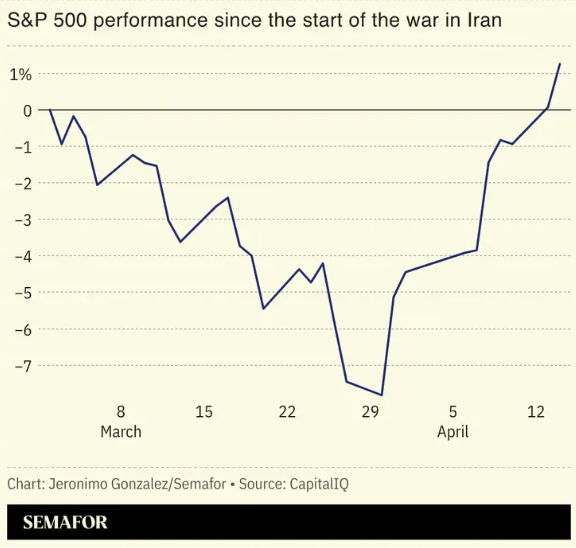
the s&p 500 has fully recovered to pre-iran war levels. the strait of hormuz is still effectively closed, disrupting global supply chains. oil is still near $100. inflation just hit a three-year high. the market has decided none of that matters. ai doing a lot of lifting here.
ian bremmer tweet media
English
110
246
1.2K
111.5K
Capac
Capac@CapacPartners·
@DrJStrategy Could you please stop writing these with AI or edit them more thoughtfully. The level of somewhat vague jargon is a dead giveaway and not helpful.
English
0
0
4
395
James E. Thorne
James E. Thorne@DrJStrategy·
Food for thought. Wall Street still thinks AI is a productivity story. It just became a fragility and trust story, and that shift ties Anthropic’s Mythos, the Clarity Act, and Bitcoin together in a way investors are badly underpricing. Anthropic’s Mythos model did more than showcase clever capabilities. It forced policymakers to acknowledge, in public, that the core software of the financial system is now one well‑aimed AI exploit away from systemic risk. When Scott Bessent and Jerome Powell are in emergency meetings with the heads of Wall Street banks to discuss AI‑driven cyber threats, the conversation has moved beyond sandbox innovation and into the realm of financial stability. The implicit message is clear: the incumbent architecture is not built for an adversarial, model‑driven world. Bessent’s op‑ed arguing that the Clarity Act must pass as a matter of national security is the political counterpart of that realization. If AI can pierce legacy rails, then the United States needs clear, durable rules for digital assets and blockchain infrastructure, not so it can speculate on tokens, but so it can deliberately integrate cryptographic, verifiable, tamper‑resistant rails into the heart of its financial system. Clarity on custody, stablecoins, and blockchain‑based settlement is no longer a regulatory luxury; it is a defence priority. Put together, Mythos, the Bessent–Powell Wall Street meetings, and the Clarity Act op‑ed point in the same direction: the centre of gravity is shifting from “AI will boost earnings” to “AI will test the integrity of our money pipes.” In that world, open, auditable, cryptographic infrastructure stops being a fringe experiment and starts looking like the logical upgrade path. Public blockchains, and Bitcoin in particular, offer precisely the properties an AI‑exposed system now needs: transparent rules, global replication, adversarial testing at scale, and settlement that does not depend on a single compromised database or trusted intermediary. The connection investors are missing is that the AI shock and the regulatory turn are not separate stories. Mythos revealed how fragile the old code base is; Bessent’s call to pass the Clarity Act is an attempt to give the US a legal framework to adopt stronger, blockchain‑based rails; and the emergency meetings between Fed, Treasury, and Wall Street are the first visible signs that the establishment knows it cannot patch its way through this era with 1980s technology. When AI flips from a productivity narrative to a fragility and trust narrative, Bitcoin and blockchains stop competing with Wall Street, and start becoming the architecture Wall Street is forced to build on.
Bloomberg@business

EXCLUSIVE: Treasury Secretary Scott Bessent and Federal Reserve Chair Jerome Powell summoned Wall Street leaders to an urgent meeting on concerns that the latest AI model from Anthropic will usher in an era of greater cyber risk. bloomberg.com/news/articles/…

English
23
56
296
45K
qm
qm@quantymacro·
a lot of students reached out to me asking for resources to break into quant finance. thought I would compile my favourite quantfin authors so everyone can benefit. in no particular order: 1) Jim Simons 2) Steven Shreve 3) Garry Tan 4) Peter Thiel 5) Marco Di Maggio good luck
English
19
24
577
32.8K
Capac
Capac@CapacPartners·
@MattWalshBlog Tactical retirements are a precedent SCOTUS does not want to set + there are other variables/unknowns you’re not considering.
English
0
0
0
999
Matt Walsh
Matt Walsh@MattWalshBlog·
Clarence Thomas is a brilliant man and one of the greatest justices of all time. He also needs to retire immediately. He's 77 years old. If Democrats win the midterms and then the presidency, which they very likely could, there's a significant chance they will get to replace him with another Kentanji Brown Jackson. That would be a disaster for the country. We need to get young conservatives on the court right now. Alito, too. He's 76.
English
2.2K
1.6K
24.7K
1.4M
Raoul Pal
Raoul Pal@RaoulGMI·
We are getting to that point of doom on Iran where X got to on Ukraine. Back then without gas and food we were going to be cholipping frozen, starved, dead Europeans of the streets. This time it's oil, gas, fertilizer and helium all about to bring about the end of humanity as we know it....
English
320
86
1.9K
305.9K
Capac
Capac@CapacPartners·
@tanvi_ratna It’s called prosecuting a war based on market timing and it’s deeply at odds with competent military strategy… sorry to not play along but his approach to this war is infuriating for supporters and detractors alike.
English
2
0
3
1.5K
Tanvi Ratna
Tanvi Ratna@tanvi_ratna·
We got TACO… But what do we call the pattern where the biggest moves drop after Friday’s close—and get “resolved” before Monday open? If there’s no name yet, internet—do your thing.
English
26
7
62
27.2K
Capac
Capac@CapacPartners·
Strongest part of this argument is the notion that this war cannot be understood through the stale “Iran plus proxies” lens alone. It is generally persuasive that the “Shia axis” is a distributed system that runs through states rather than sitting outside them, and that there is a progression from an inherited old order to the structure that grew inside it. Serious recent research makes a similar point: Iran-aligned groups are embedded in state structures, connected through formal and informal economic networks, and often adapt when one node is hit rather than simply collapsing. In that sense, I agree with your structural lens and with the idea that the war feels diffuse because the network itself is diffuse. Where I part company is in how totalizing the frame seems to become. The claim that “nothing” about the war makes sense unless you start with this system gives the axis too much explanatory monopoly. The region has also changed in ways that complicate any image of a single, smoothly functioning machine: Assad’s regime has fallen, Hezbollah and Hamas have suffered major blows, and some credible analysts argue the core groups are now retrenching toward local power rather than acting as one tightly coordinated regional formation. So yes, the network is real, resilient, and harder to uproot than many assumed. But no, that does not mean it remains equally coherent, equally centralized, or equally capable across all arenas. I also disagree with the implied historical neatness of the “old order built this, Trump tried to replace it” framing. It makes for a compelling narrative, but it risks turning a messy region into a story of grand design, as if local agency, domestic politics, sectarian competition, regime survival, Israeli strategy, Gulf strategy, and plain contingency all slot cleanly into one system-transition arc. The better version of this argument would be narrower: the axis is best understood as a shape-shifting coalition built over decades, partly coordinated by Tehran but also driven by local actors pursuing their own authority. So I agree with your push for a systems view, but I disagree with the degree of coherence and inevitability the framing appears to assign to that system.
English
1
0
0
885
Capac
Capac@CapacPartners·
Massive oversimplification. $200 oil would cause an EM debt crisis, appetite for UST would crater, the dollar shortage would be astronomical, and the standard of living in the US and elsewhere would absolutely feel like the 70s — if not worse because of our unprecedented debt levels.
English
1
0
0
548
Anna Wong
Anna Wong@AnnaEconomist·
Too bad @LHSummers is not participating in today’s debate —so now I have to do it for him. Here is his CPI chart, with the red part the forecast out to 2027 under the scenario that oil goes to $200/bbl. It will take a lot to get a 1970s redux. Even $200/bbl oil won’t do it.
Anna Wong tweet media
English
32
39
274
36.3K
Capac
Capac@CapacPartners·
@nntaleb Wish I could still say Thich Nhat Hanh, RIP.
English
0
0
1
1.1K
Capac
Capac@CapacPartners·
@Jkylebass Respectfully, fuck off. You are far out of your depth here and it’s dangerous.
English
0
0
17
536