The next wave of blockchains is built to settle payments instead of tokens.
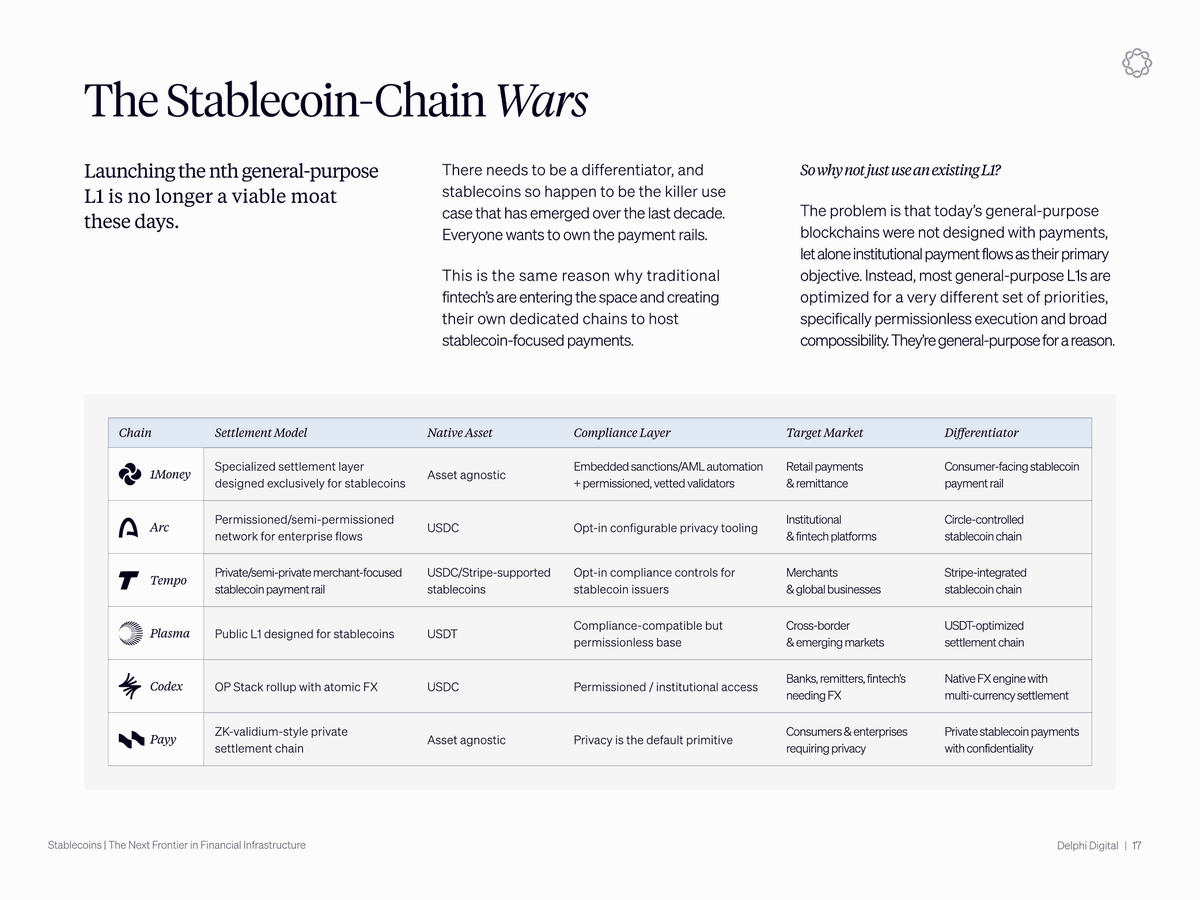
General purpose chains weren't designed for institutional payment flows. A new wave of chains built for stablecoin payments is filling that gap, and none of them are going after the same market.
The two biggest stablecoin issuers are building their own chains. Circle launched Arc as a permissioned network for institutional flows. Tether is backing Plasma, a public L1 optimized for USDT in cross border and emerging market corridors.
Fintechs are doing the same. Stripe and Paradigm built Tempo as a merchant focused settlement layer. Stripe then acquired Bridge, Privy, and Metronome to own the issuance, wallet, and billing layers alongside it.
Then there are the more specialized plays. Codex is an OP Stack rollup with a native FX engine for banks and remitters that need multi-currency settlement. 1Money is targeting retail payments and remittance with sanctions and AML automation at the protocol level. Payy is built around confidential settlement for institutions that need privacy by default.
The settlement layer is fragmenting by use case, and the race isn't just about launching a chain. It's about who owns the full stack from settlement to compliance.
Venice just shipped end-to-end encrypted AI inference.
Every major AI platform today runs on the same basic trust assumption. You have to trust the provider to handle your data responsibly.
@AskVenice has operated with a slightly different architecture. Conversations are stored locally on your device and prompts are not persisted server-side. When you use frontier models, Venice proxies the request so the provider never receives your identity data. However, the same trust assumptions still apply here. If Venice or a partner wanted to intercept data, nothing in the architecture would prevent it.
The new launch introduces two hardware-enforced privacy modes.
TEE runs inference inside secure hardware enclaves operated by NEAR AI Cloud and Phala Network, isolating computation from the host OS and infrastructure operator. Remote attestation ties a cryptographic certificate to the physical hardware so anyone can independently verify the model is running inside a genuine enclave. You no longer need to trust the GPU operator but you are still trusting Venice's transit layer.
E2EE removes that remaining trust assumption. Prompts are encrypted on device before transmission, stay encrypted through Venice's infrastructure, and only decrypt inside the verified enclave. Venice cannot see your data at any point during normal operation. The tradeoff is that responses may be slower, web search and memory are disabled since they would require decryption outside the enclave.
Both modes currently run on a handful of open source models through NEAR AI Cloud and Phala Network and are exclusive to Pro subscribers.
How robust these guarantees are in practice depends on the attestation implementation and whether independent audits confirm the claims.
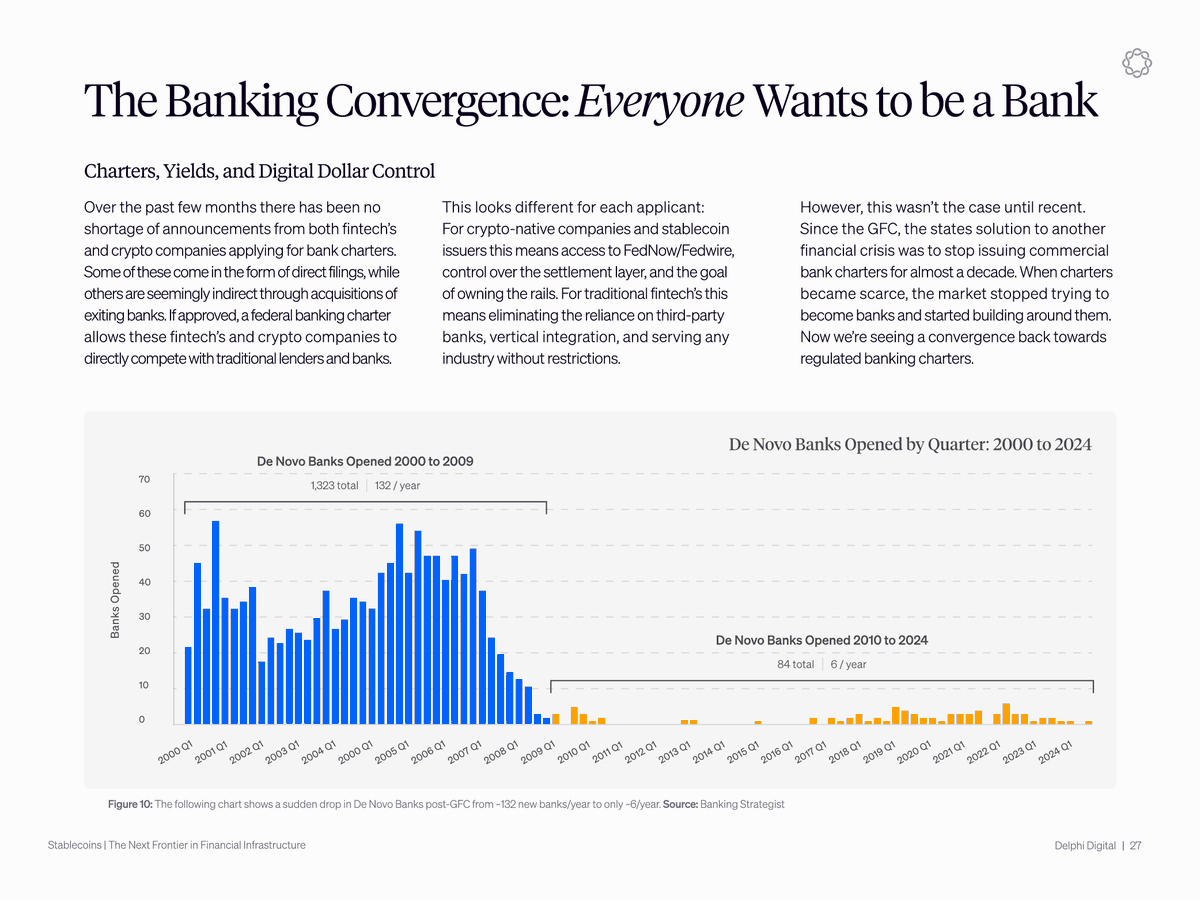
Critics frame stablecoins as a threat to national security, but the real threat is to the banking profit model.
Treasuries yield roughly 3.89% while a standard savings account pays 0.39%. Banks capture that entire spread on deposits that could otherwise be earning closer to the risk-free rate.
Stablecoins are backed by the same treasuries, and issuers are increasingly exploring ways to pass that yield directly to holders.
If that happens at scale, deposits could migrate out of the banking system. Banks may lose their cheapest source of funding and their ability to offer cheap credit along with it.
Ceteris on why everyone still feels behind on AI adoption.
"A lot of people internally are using OpenClaw now. People are vibe coding their own things. We still feel behind, but then the banks and financial firms are still not even allowed to use ChatGPT for compliance reasons. The usage is accelerating, but there's another part that is just lagging due to compliance or just slow-moving corporations."
Tether is building an AI platform that runs on your own hardware.
QVAC provides a modular SDK that lets developers build AI micro-modules for virtually any device. Those modules connect and collaborate through a peer-to-peer encrypted network without centralized servers, API keys, or gatekeepers.
QVAC Fabric just added support for Microsoft's BitNet architecture to enable LoRA fine-tuning and inference of 1-bit large language models directly on consumer devices. What previously required dedicated NVIDIA GPUs and expensive server infrastructure can now run on everyday devices.
Tether's benchmarks show BitNet models using up to 77.8% less VRAM than comparable 16-bit models, with GPU inference running between 2x and 11x faster than CPU on mobile devices. Fabric has been released as open source.
AI development today depends on the same kind of centralized infrastructure that crypto was designed to move away from. Training and fine-tuning models still rely on NVIDIA hardware and cloud providers, which concentrates control over a small number of companies.
Fabric aims to change this by making consumer hardware a viable platform for real model development.
Tether is building several applications on QVAC. Translate handles offline transcription and translation across text, audio, and images. Health uses an on-device AI agent to track health data locally. Keet is integrating QVAC AI to enable on-device conversational features.
Tether's development of QVAC suggests decentralized AI is becoming a serious priority for them.
Bitcoin cooperation signals posted the fastest recovery in 5.5 years of data.
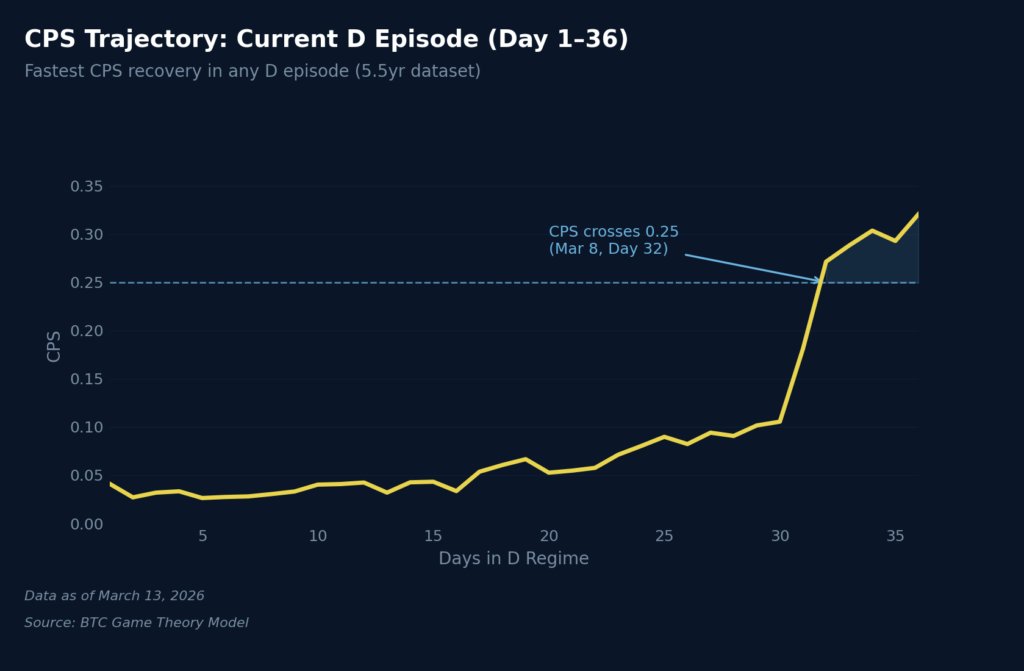
BTC has been in a Defection regime for 41 days. Defection is when speculative activity overpowers patient capital. The violent moves in these regimes happen early, with drawdowns concentrating in the first 15 days.
By Day 30, the speculative impulse is largely spent. Every Defection regime that survived past that point has seen max additional drawdown of roughly 3%.
The Composite Patience Score (CPS) measures the balance between cooperation and defection forces across onchain and derivatives data. CPS crossed 0.25 on March 8, a level where downside has historically become contained during Defection regimes.
CPS went from 0.03 to 0.32 in 5 days, the fastest move in the model's history and 15% above the prior record from June 2022.
There are caveats to this. Sample sizes are small, and one prior CPS crossing in September 2024 did briefly exceed the equivalent drawdown distance before recovering. The fastest CPS move on record also means least precedent to work with.
Defection pressure is fading while patient capital rebuilds faster than anything in the model's history. The conditions that have historically preceded deep drawdowns in these regimes aren't present in the current data.
Strategy's STRC preferred stock is converting fixed-income capital into spot Bitcoin demand at an accelerating rate.
STRC is a variable-rate perpetual preferred stock with a $100 par value. Strategy adjusts the dividend monthly to keep it pinned near par. When it trades at or above $100, Strategy sells new shares through its ATM program and uses the proceeds to buy spot BTC.
Yield investors buying STRC don't care about Bitcoin sentiment. They care about getting 11.5% on a low-volatility credit instrument. But every dollar they put in becomes a dollar of spot BTC demand on the back end.
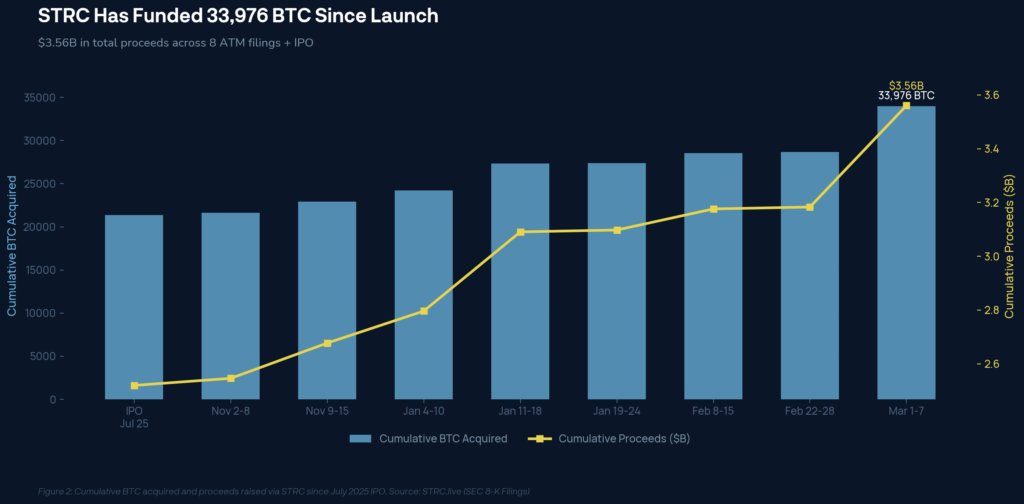
STRC funded $119M in BTC purchases in January. By the first week of March that hit $377M in a single week. Since July 2025 STRC has funded 33,976 BTC worth $3.56B across 8 ATM filings.
To put the scale in perspective, daily mining output runs about $30-35M in new supply. During the March 1-7 filing period STRC funded 5,315 BTC. That's 1.7x total mining output over the same window.
STRC is competing directly with treasuries and money market funds for income capital, and that's a massive market to be pulling from.
Annual dividend obligations are now running around $442M and seven consecutive hikes show the cost of maintaining this flow is going up.
But if income capital keeps entering STRC at this pace, Bitcoin picks up a durable bid that compounds independently of the crypto cycle.
Jason on the signal he's watching for on risk assets.
"I'm cautiously optimistic. VIX is elevated. If we get a VIX blowout, an actual one, I'd probably just shove most of the cash I have into risk assets because the general backdrop is still relatively strong."
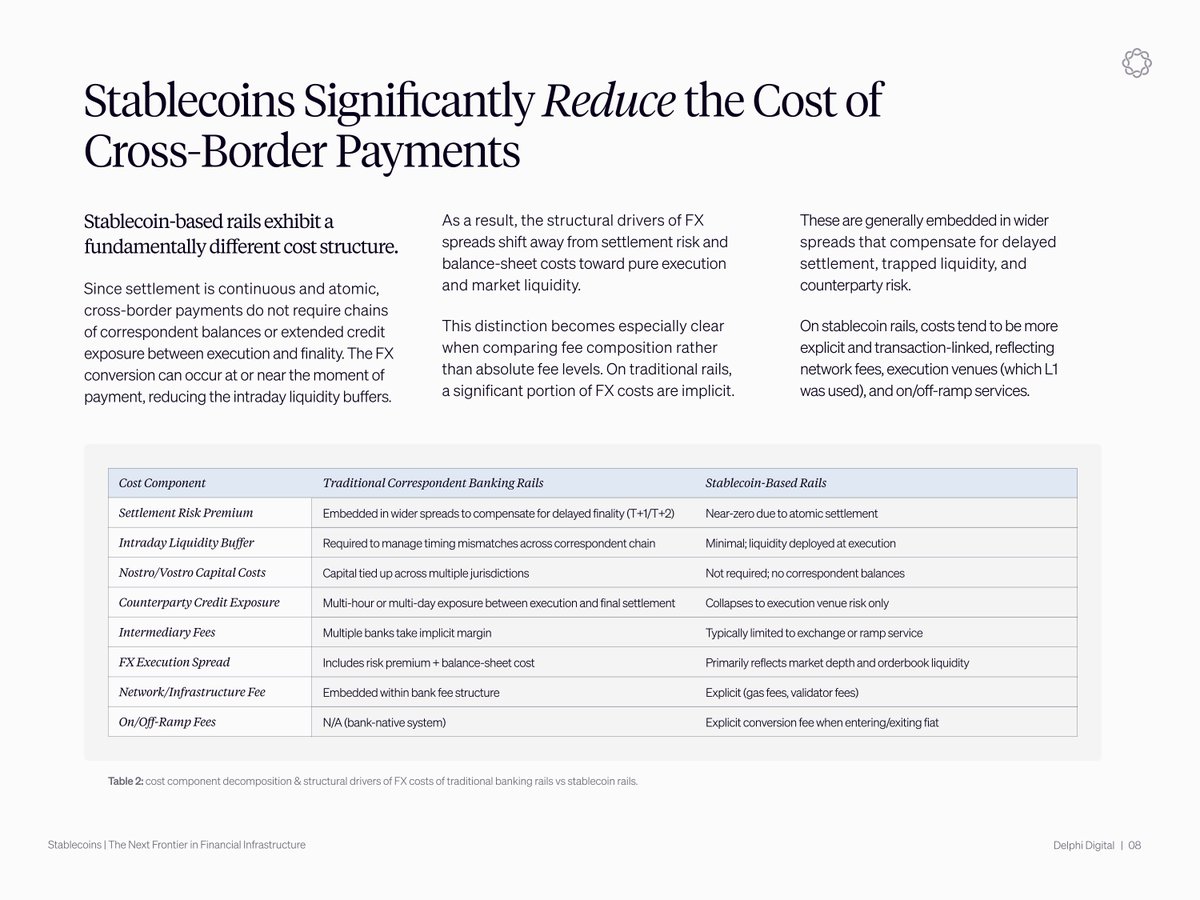
Most people think FX costs come down to currency risk. The bigger cost is the infrastructure keeping the whole system running.
In emerging market corridors, over 80% of the cost to send money has nothing to do with currency conversion. It's the cost of maintaining the correspondent banking infrastructure underneath.
Stablecoins collapse that entire cost structure. Settlement is instant, liquidity doesn't need to be pre-funded, and you don't need a chain of intermediaries to move dollars from one country to another.
That's why stablecoins aren't starting with EUR/USD. They're winning the corridors where banks gave up competing a long time ago.