Doc Dee

17 posts

Doc Dee

Doc Dee

@DocDeeZw

Chef|Public Speaker

Kadoma Entrou em Haziran 2026
23 Seguindo13 Seguidores
Doc Dee retweetou
TheNewsHawks
TheNewsHawks@NewsHawksLive·
CA3’s absolute majority threshold is the provision that structurally widens the base of presidential support any aspirant must secure, and it is what distinguishes CA3’s model from Botswana’s. The opposition’s argument holds that removing the direct presidential vote removes a public signal of minority dissent, or in other words that even a marginal minority vote registers nationally and constitutes meaningful democratic participation. The relationship between electoral mechanism and minority inclusion is structural, not automatic: it depends on what the mechanism incentivises (Norris, Electoral Engineering, Chapter 9, Cambridge University Press, 2004). A signal that registers nationally and produces no change in campaign behaviour or executive attention across four consecutive election cycles is visibility without consequence. A parliamentary vote that an aspirant seeking an absolute majority has a structural reason to court is political weight that the direct presidential arithmetic never assigned. The difference is between 69,723 votes absorbed into a national contest decided elsewhere, and two parliamentary votes that carry equal weight to every other seat in the chamber. Zimbabwe is choosing between two architectures for how democratic power is distributed across a heterogeneous society. The 2018 polling station data, the four-cycle presidential itinerary record, and the admission at Siabuwa High School on 19 March 2022 document what the first architecture has produced. Whether Clause 3’s logic is realised in practice depends on whether Zimbabwe’s Parliament retains the genuine political competition that prevents any single party from bypassing the breadth the absolute majority threshold demands. But the arithmetic of that threshold, and what it requires of any presidential aspirant who wants to govern, represents the first structural opportunity in Zimbabwe’s post-independence electoral history for communities like Binga to move from the margin of the presidential calculus to its centre. 🟢Tafadzwa Wakatama is a political communications consultant based in Zimbabwe, with a focus on constitutional law, electoral systems, and public advocacy. Suggested citation: Tafadzwa Wakatama, Presidential Selection and Zimbabwe’s Minority Communities, Int’l J. Const. L. Blog, June 5, 2026, at iconnectblog.com/presidential-s…
TheNewsHawks tweet media
English
1
21
22
2K
Doc Dee retweetou
TheNewsHawks
TheNewsHawks@NewsHawksLive·
The district is not inaccessible: Morgan Tsvangirai held a rally at Binga Rest Lodge in June 2013, confirming the district can be reached when the political calculus justifies the visit. On 19 March 2022, at a by-election rally at Siabuwa High School in Binga, President Mnangagwa was widely reported to have stated: “Since independence in 1980, we did not visit this area under President Mugabe.” The campaign record is not a commentary on the character of successive administrations. Among the structural factors that shaped it, the arithmetic of a direct popular vote stands out: Binga could not deliver a margin that justified the visit. The ZEC data produces one further finding that the current debate has not engaged. Binga’s registered electorate is 60.46% female, 6.51 percentage points above the national average of 53.96%. Harare Metropolitan sits at 50.78%. The community most structurally invisible to direct presidential campaign arithmetic is simultaneously a community where women constitute a registered voter supermajority. Under Clause 3, the MPs representing those women carry votes no aspirant can discount. Grindle’s comparative analysis of how political executives shape public resource allocation in developing states, the central argument of Jobs for the Boys (Harvard University Press, 2012), and Burgess et al.’s empirical demonstration that expenditure follows executive selection arithmetic establish that when the incentive structure changes, the allocation pattern follows. For Binga’s two MPs, the structural consequence is direct: a presidential aspirant who must court their votes has, for the first time, an institutional reason to engage the constituency’s infrastructure deficit, healthcare access, and development needs as a matter of executive priority rather than electoral afterthought. This argument operates on different terrain from the legal debate about Section 328 and the referendum requirement, but it connects to the same constitutional moment. The distinction between Section 95(2)(b), which governs how long a term lasts, and Section 91(2), which limits how long a person may serve, is the legal architecture within which CA3’s minority representation consequence becomes possible: the cycle changes, the two-term ceiling does not, and the parliamentary selection mechanism that results from that combination creates the incentive architecture this piece documents. The government’s citation of Botswana as a positive precedent requires direct engagement. Botswana has operated a parliamentary selection model since 1966, but the Botswana Democratic Party held an unbroken parliamentary majority from independence to 2024, meaning the president emerged automatically from the dominant party’s internal choice without any requirement to secure support beyond its own caucus. The Basarwa and San communities, roughly 3% of Botswana’s population and dispersed across the Kalahari, have been systematically excluded from political representation under this model, as the 2001 Kamanakao High Court ruling on the Wayeyi paramount chief’s exclusion from the House of Chiefs and the subsequent Balopi Commission process confirm. CA3’s absolute majority threshold creates a different structural condition from Botswana’s automatic majority mechanism. Lijphart’s framework, developed across Patterns of Democracy (Yale University Press, 1999; 2nd ed. 2012) and his 1996 analysis in the American Political Science Review, explains why: territorially concentrated minorities can be protected through federal and territorial arrangements, but geographically dispersed minorities require consensus institutions. In Zimbabwe, the Tonga, Kalanga, Venda, Nambya, Shangani and Khoisan communities hold constitutional language recognition under the 2013 Constitution. But they have neither territorial autonomy nor proportional representation.
TheNewsHawks tweet media
English
1
20
20
3.7K
Doc Dee retweetou
TheNewsHawks
TheNewsHawks@NewsHawksLive·
Presidential Selection and Zimbabwe’s Minority Communities By Tafadzwa Wakatama On 16 February 2026, the Constitution of Zimbabwe (Amendment No. 3) H.B.I. Bill 2026, CA3, was gazetted for a 90-day public consultation period constitutionally required before parliamentary consideration. Among its 21 amendments, the Bill proposes replacing the direct popular election of the President with selection by a joint sitting of both houses of Parliament. The government’s stated precedents are Botswana and South Africa. Among the concerns the opposition has placed before the public consultation process is the claim that parliamentary selection diminishes the voice of minority communities. In this post, I examine that claim using the Zimbabwe Electoral Commission, ZEC, polling station record for 2018, and find that it does not hold up to empirical scrutiny. Executive selection systems tend to produce their distributive consequences not through the intentions of candidates but through the rational calculus that governs where political attention, campaign investment, and eventually public resources flow. Burgess, Jedwab, Miguel, Morjaria and Padro i Miquel demonstrated this with road expenditure data across six decades of Kenyan electoral history: districts whose populations aligned with the sitting president received roughly three times the road investment of those that did not (American Economic Review, 105(6), 2015). Van de Walle’s survey of 87 African multiparty elections identifies the same logic as the defining characteristic of African presidentialism: resources follow the arithmetic that produced the executive, and that arithmetic determines which communities receive attention and which do not (Journal of Modern African Studies, 2003). Clause 3 of CA3 changes that arithmetic. Under a direct popular vote, the rational calculus of a presidential candidate concentrates attention where registered voter populations are large enough to determine the national outcome. Under Clause 3, a presidential aspirant must secure an absolute majority across both Houses. The vote of every MP carries equal weight regardless of the population of the constituency they represent. Binga district’s 69,723 voters are represented by two MPs, Binga North with 33,716 registered voters and Binga South with 36,007. Under Clause 3, each carries one vote equal in weight to the MP from Harare South, whose single constituency holds 76,425 registered voters. The community that was invisible as a district in a national popular contest holds two votes in a selection process where every vote carries equal weight. The structural incentive this produces is not that any single minority community MP becomes uniquely decisive. It is that an aspirant seeking an absolute majority cannot afford to concentrate attention narrowly. The threshold requires breadth, and that breadth is the mechanism through which historically bypassed communities enter the presidential calculus for the first time. ZEC’s 2018 polling station data establishes what the current mechanism has produced. Binga district, the geographic heartland of the Tonga community, one of Zimbabwe’s 16 constitutionally recognised language groups and a population displaced from the Zambezi River plains by the construction of Kariba Dam in the late 1950s, held 69,723 registered voters in 2018. The national electorate stood at 5,695,706. That is 1.22% of the vote in an election decided by a margin of 313,027. At maximum mobilisation, Binga’s entire registered electorate could contribute 22% of that winning margin: meaningful in a judicial recount, insufficient to determine a national popular outcome. The rational campaign calculus produced by that arithmetic is confirmed by the itinerary record. Across four consecutive presidential election cycles, 2002, 2008, 2013, and 2018, no ZANU-PF presidential candidate held a primary star rally in Binga. In each cycle, the Matabeleland North event was held in Lupane.
TheNewsHawks tweet media
English
25
88
71
5.4K
Doc Dee retweetou
Audrey Kangara
Audrey Kangara@audkays·
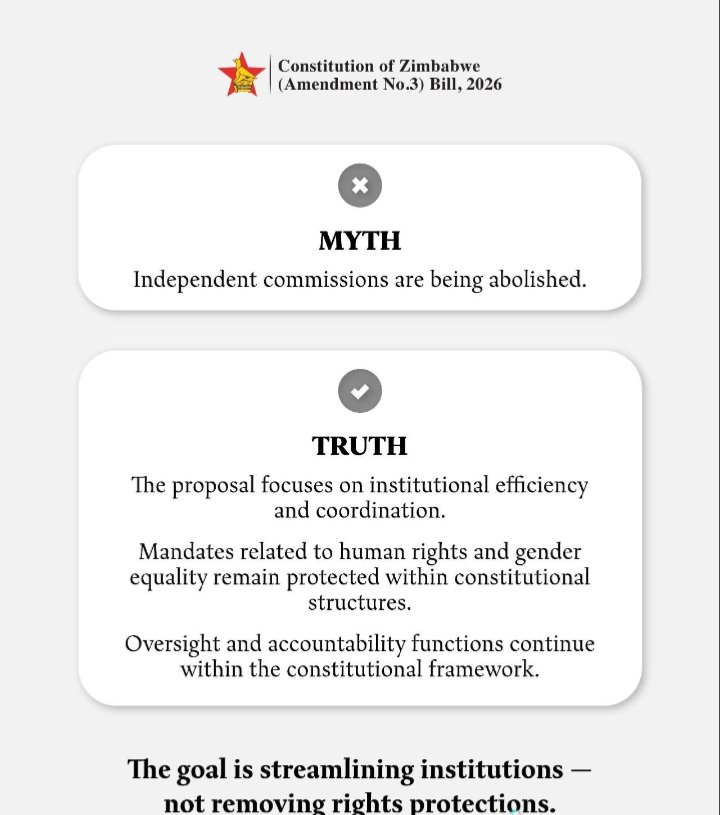
Much of the debate around #CA3 has been driven by claims that independent commissions are being abolished and constitutional safeguards weakened. A careful reading of the proposed amendment tells a different story. The objective of the Bill is not to remove rights, accountability or oversight. Rather, it seeks to improve institutional efficiency, coordination and the effective functioning of constitutional structures. The mandates relating to human rights, gender equality and public accountability remain protected within the constitutional framework, while oversight functions continue to exist through established constitutional mechanisms. Constitutional reform should be assessed on the basis of what the text actually provides, not on speculation, slogans or political narratives. Streamlining institutions is not the same as dismantling them. Improving coordination is not the same as removing protections. The real question is whether the amendment strengthens governance and improves the delivery of constitutional responsibilities. That debate should be guided by facts, law and evidence rather than fear and misinformation. #CA3 #ConstitutionalReform #FactsMatter #RuleOfLaw
Audrey Kangara tweet media
English
0
1
0
19
Doc Dee
Doc Dee@DocDeeZw·
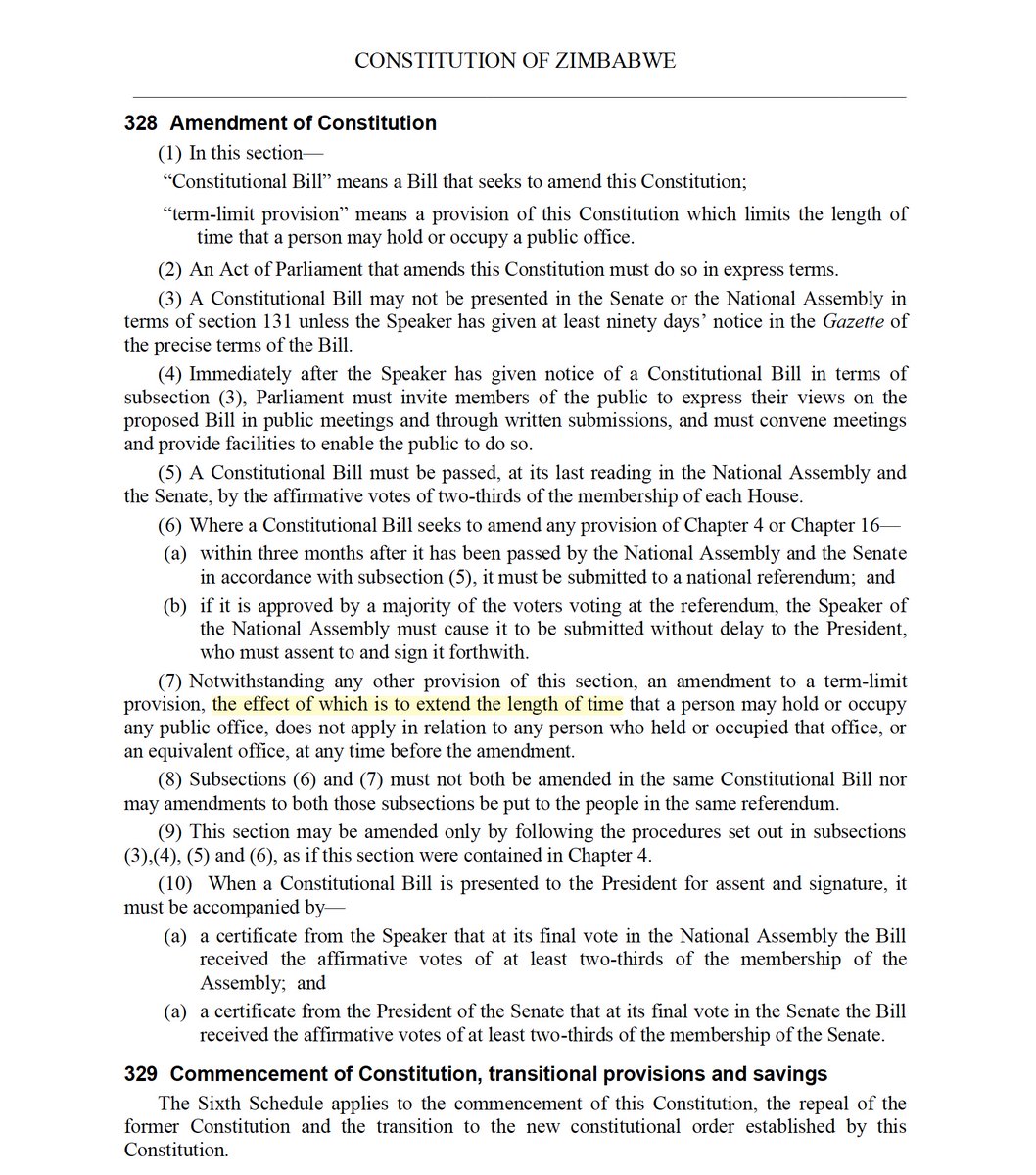
@ProfJNMoyo @peterndoro In Ziyambi's words,"Extending the runway doesn't give the airline another contract " Extending term length that is 2yrs is not equal to Extending 3yrs that is required to a term, giving the president extra 2 years doesn't amount to a term
Doc Dee tweet media
English
0
0
0
7
Doc Dee retweetou
Prof Jonathan Moyo
Prof Jonathan Moyo@ProfJNMoyo·
The "effect" has to be of "an amendment to a term-limit provision"; not of ANY amendment. There are many provisions in the Constitution of Zimbabwe that deal with (or provide for) time but they're not all "term limit provisions". Once you use an indiscriminate "effect basis" without being clear about the premise or cause of that effect, you end up with a bambazonke interpretation, which by definition would be unworkable and untenable in terms of its practical application. The ConCourt resolved this in the landmark Mupungu case, when it rejected a precisely similar argument that the "effect" of raising the retirement age of judges of the apex courts from 70 to 75 years amounted to triggering the "non-benefit" rule in section 328(7). The ConCourt held that an age limit is not a term limit. That logic or legal reasoning employed by the ConCourt regarding an age limit, applies to a term length (such as in sections 95(2)(b) and 143(1). Various versions of term-lengths or institutional durations of the elective public offices of the President, Parliament and Local Government have been in the Constitution of Zimbabwe since 1980; and they have never been treated as term limits; because they're not. All constitutions have term lengths for elective public offices; but not all have term limits. President Mugabe stayed in office for 37 years under term-lengths with no term limits. In North America Franklin D. Roosevelt served four terms as President of the United States. Elected in 1932, 1936, 1940, and 1944, he remains the only U.S. president in history to be elected to more than two terms. Before Roosevelt's presidency, there was no legal or constitutional term limit a US president could serve until the 22nd Amendment was passed in 1951. Prior to that, US presidents had only four-year term lengths which were open to unlimited tenure or re-election. Similarly, in Zimbabwe, the various term length provisions in place since 1980 did not suddenly become term limit provisions by the introduction of section 91(2) in 2013 under the new Constitution; the true and only term limit provision governing a term limit provision for an elective public office in Zimbabwe. Notably, there's still no term limit provision in the Constitution for Members of Parliament or Local Authority Councillors. Only the President is subject to a term limit provision; and only under section 91(2) and nowhere else in or under the Constitution
English
37
100
90
7K
Peter Ndoro
Peter Ndoro@peterndoro·
This is a fair observation, and some would say a clever legal argument. However, the Constitution appears to anticipate precisely this point by focusing on the EFFECT of an amendment rather than merely its label. If the current constitutional framework provides for two five-year terms, the maximum period a President may hold office is 10 years. If that framework is amended to two seven-year terms, the maximum period becomes 14 years. While the term limit remains "two terms", the EFFECT of the amendment is to increase the length of time a person may hold office from 10 to 14 years. That is exactly the type of benefit the Constitution's "no-benefit rule" was designed to prevent an incumbent from enjoying. The real constitutional question is not what the amendment is called, but what it allows an incumbent office-holder to DO in practice.
Peter Ndoro tweet media
Mambo Herodhi@MamboHerodhi

A vital distinction for constitutional clarity: term length dictates the duration of a single period in office, whereas term limits cap the total number of periods an individual may serve. ​Because CA3 modifies only the former, it does not necessitate a referendum.

English
15
28
67
17.4K
Doc Dee retweetou
Cde Trabablas
Cde Trabablas@CdeTraba·
Congratulations to Reverend Amon Madawo, President of the Apostolic Faith Mission in Zimbabwe, on being honoured by the President of the Republic of Zimbabwe, HE Dr. @edmnangagwa. As a mark of recognition, he was presented with a Toyota Land Cruiser 300 Series ZX SUV -a generous gift that reflects the value placed on his leadership and the important role of the church in national development.
Cde Trabablas tweet mediaCde Trabablas tweet media
English
87
20
127
60.1K
Doc Dee
Doc Dee@DocDeeZw·
Difference between a term length and term limit is in the numbers. According to the constitution of Zimbabwe a term equals 3 years or more & in this #CA3 has proposed to add only 2 years which is not equal to a term thus no refrendum needed @VaMabhena263 @stendai_gondwe
Doc Dee tweet mediaDoc Dee tweet media
English
0
2
1
14
Doc Dee
Doc Dee@DocDeeZw·
Chinamasa yesterday in Mutare urges everyone to use social media wisely. Mentioning that there are some individuals abusing other people's rights through social media. His empasis was they are taking measures to deal with the issue @MamboHerodhi @Tererai89 @stendai_gondwe
English
0
1
1
10
Doc Dee
Doc Dee@DocDeeZw·
@Footballtweet Let the man go be with his family. His dream inlines with his family. Whats the point of scoring plenty goals when you can't fulfill only one goal to be there for your wife and child. This can be debated unless you don't have kids
English
0
0
0
31
Football Tweet ⚽
Football Tweet ⚽@Footballtweet·
🚨👶 Jérémy Doku could temporarily leave Belgium's World Cup camp to be present for the birth of his son, and the debate has exploded across Europe. 🇧🇪 French journalist France Pierron didn't hold back: 🗣️ Pierron: "Are you seriously telling me these players have sacrificed everything to come to the World Cup, and you're leaving just to cut an umbilical cord? 😳 You're lucky enough to play in a World Cup. It's an incredible privilege, and hundreds of footballers would do anything to be in your position. That opportunity might never come around again in your life. And you're going to throw it all away just to attend your child's birth? It's a moment where the father isn't really needed. He has a symbolic role. You hold her hand and take a photo. And then what? You're going to miss 10 hours, experience an emotional high, and be exhausted afterwards. You can't miss a World Cup. Some people may have gone into debt just to get to the World Cup, maybe sacrificed everything to be there, and you're leaving to cut an umbilical cord..." 😳 The reaction has completely split fans. Some believe family comes before everything, while others see the World Cup as an opportunity that may never come around again. 🌍 What would you do: stay with your national team or be there for your son's birth? 🤔
Football Tweet ⚽ tweet media
English
5.2K
915
10.3K
12.1M
Doc Dee
Doc Dee@DocDeeZw·
@WestHam_Central Once one has kids you will understand.One can stay for the team but its the same nation that ignores the call for your family if anything happens to you. We cant hide that fact others Doku go and be with your family its more important than any goal you can score my guy
English
0
0
0
78
Doc Dee
Doc Dee@DocDeeZw·
Every mature democracy requires a mind like this one
Senator Sengezo Tshabangu@SengezoTsh17075

Good Morning, Fellow Zimbabweans, I trust that I find you well today. I wish to address two important matters of national interest concerning the Constitution of Zimbabwe Amendment Bill No. 3, which is currently undergoing the legislative process in the 10th Parliament of Zimbabwe. Firstly, I would like to update all interested stakeholders on the current status of the Bill. I'm pleased to formally announce, in my capacity as the Leader of Opposition Business in the 10th Parliament, that the Constitution of Zimbabwe Amendment Bill No. 3 successfully passed through the National Assembly yesterday with the required two-thirds majority following a peaceful, transparent, and democratic voting process. I would like to commend all MPs for conducting themselves in a mature, professional, and responsible manner throughout the debate and voting proceedings. Their conduct demonstrated the strength of our democratic institutions and reinforced Zimbabwe's commitment to constitutionalism and parliamentary democracy. Such orderly proceedings are a testament to the competence and effectiveness of our Parliament, which I believe ranks among the most capable legislative bodies in Sub-Saharan Africa. I also extend my appreciation to the Speaker of Parliament for his leadership in ensuring that the process was conducted in accordance with parliamentary procedures and established democratic principles. Following the successful passage of the Bill in the National Assembly, Parliament adjourned yesterday and will resume next Tuesday. On that day, the Minister of Justice Hon Ziyambi, will introduce the Bill in the Senate through its First Reading. This stage will mark the formal introduction of the Bill into the Senate, where it will begin a legislative process similar to the one recently completed in the National Assembly. As always, I will continue to provide updates on every stage of the Bill's progress in the Senate to ensure that the public remains informed. Secondly, I wish to address allegations currently circulating on various social media platforms concerning opposition MPs of who voted in support of the Bill during yesterday's proceedings. It is important for all Zimbabweans to remember that ours is a democratic nation governed by a Constitution that guarantees fundamental rights and freedoms, including the freedom of conscience, and participation in democratic processes. Every elected representative is entitled to exercise their judgment when voting on matters before Parliament, guided by personal conviction, the interests of constituents, and their interpretation of what best serves the nation. Therefore, opposition MPs who voted in favour of the Bill exercised a constitutional right afforded to them as elected representatives of the people. Allegations that they were coerced, intimidated, or improperly influenced by ZANU-PF to support the Bill remain unsubstantiated and, at present, amount to mere speculation. Such claims should be supported by credible evidence before they are accepted as fact. I therefore unequivocally reject these accusations as false, malicious, and potentially damaging to the democratic principles that underpin our constitutional order. Attempts to delegitimise the decisions of elected representatives without evidence risk undermining the rights and freedoms guaranteed under Chapter 4 of the Constitution of Zimbabwe, particularly those contained within the Declaration of Rights. As citizens, we may hold differing political opinions, but we must always respect democratic processes, the rule of law, and the constitutional rights of others, even when we disagree with the outcomes. I thank you, fellow Zimbabweans, for your continued interest in parliamentary affairs. I remain committed to keeping the nation informed as the legislative process progresses, and I will continue to provide updates on any significant developments regarding this Bill. I wish you all a peaceful and enjoyable weekend. Thank you.

English
0
0
0
0
Doc Dee retweetou
ZANU PF
ZANU PF@ZANUPF_Official·
5 days to go
ZANU PF tweet media
English
8
15
26
1.7K
Doc Dee retweetou
News Central TV
News Central TV@NewsCentralTV·
Zimbabwe’s lower house of parliament has approved a bill extending presidential and parliamentary terms from five to seven years, potentially allowing President Emmerson Mnangagwa to remain in office until 2030. newscentraltv.com/zimbabwe-appro…
English
0
3
3
222
Doc Dee
Doc Dee@DocDeeZw·
@LynneStactia But why guys ,have we totally forgotten our respect because of politics. Lets just mourn with those who mourn and try not to use the face of others for political affiliation, people die all the time my condolences to the family
English
0
0
0
33
LynneM 💕💝💎
LynneM 💕💝💎@LynneStactia·
Matamandanda has passed away … aaah 😦. Firstly, they will make you an ambassador to get rid of you. If you continue to be a threat, then they will take you out. Trust this Zvigananda Cabal at your own peril! RIP Ambassador Matemadanda🙏🏽
LynneM 💕💝💎 tweet media
English
71
78
397
47.2K
Doc Dee retweetou
TheNewsHawks
TheNewsHawks@NewsHawksLive·
Billboards Bring Zimbabwe’s Constitution Back To The Streets BY Nomuzikayise Ngwenya and Karabo Ngoepe A modest billboard has done something the political class has not managed in months: it has put the constitutional text back in front of public discourse. Drive through Kuwadzana Roundabout in Harare this week and a billboard meets you, plain and unadorned, with a question and an answer. The question is whether you know that term length is not the same as term limit. The answer is in the small print, two section citations beneath the headline: section 95(2)(b) and section 91(2) of the Constitution. It is a modest piece of out-of-home advertising. It is also one of the more interesting interventions in our public life in recent months, and it is worth pausing on why. For the better part of a year, the conversation about the Constitution of Zimbabwe (Amendment No.3) H.B.1. Bill, 2026 has been conducted almost entirely in slogans. Supporters and detractors alike have reached for the easy phrase, the political shorthand, the conclusion without the working. What has been missing is the text. Not the text in summary, but the text itself: the actual words of the Constitution, the section numbers, the provisions in their precise wording. The billboard at Kuwadzana asks the passing motorist to do something unusual. It asks them to read. Two provisions sit at the heart of the question the billboards raise. Section 95(2)(b) governs how long a single term of office of the President, as an institution, lasts. Section 91(2) governs how many terms a President may serve, and the minimum length of each term. The two work together, but they do different things. One sets the duration of the electoral cycle. The other caps or limits the number of the cycles. A change to the first is not, by definition, a change to the second, and vice versa. That distinction is not a clever lawyerly trick or semantic sophistry. It is the architecture the Constitution itself has put in place, and the Constitutional Court has read provisions of this kind in precisely those terms. In Mupungu v Minister of Justice, Legal and Parliamentary Affairs and Ors CCZ 7/21, the Court approached the textual relationship between provisions like these with a discipline that supports the reading the billboards make visible. A term length provision and a term limit provision are not interchangeable. They are different drafting tools, doing different constitutional work. That is the affirmative case. What the billboards do, with admirable economy, is put that affirmative case in front of the public so that the public can read it for themselves. The reaction has been instructive. The conversation on the streets On one side of the response, ordinary commuters and online observers have begun, perhaps for the first time in this debate, to refer to sections by number. Posts have appeared on social media in which passing motorists describe the billboard, name the sections, and conclude that the constitutional argument has finally come to the streets. A working lawyer's thread, widely shared, walked through the distinction without prompting and without ambiguity. Term length is one thing, the thread observed; term limit is another; the two-term cap stays where it is. The billboards have surfaced, rather than supplied, the legal answer. A parliamentary contribution from one of the Bill's supporters captured the same point in a different register, suggesting that the legacy of the liberation struggle was secured by universal franchise, not by any specific term structure. That argument is for the parliamentary record, and the speaker can carry it. The narrower point to make is that the billboards themselves do not enter the sovereignty debate at all. They draw a distinction. The distinction is between two provisions in the same Constitution. That is all.
TheNewsHawks tweet mediaTheNewsHawks tweet media
English
25
86
69
11.8K