
VaMabhena retweetledi
VaMabhena
789 posts


VaMabhena
@VaMabhena263
Political and social analyst and commentator
Johannesburg Katılım Nisan 2026
388 Takip Edilen202 Takipçiler


VaMabhena retweetledi

@ParliamentZim Character will take you where talent alone cannot @CremoraOnTop @1Mhizha @VaMabhena263 @SiphoNkosi22 @thandazanieikk
English
VaMabhena retweetledi

Presidential Selection and Zimbabwe’s Minority Communities
By Tafadzwa Wakatama
On 16 February 2026, the Constitution of Zimbabwe (Amendment No. 3) H.B.I. Bill 2026, CA3, was gazetted for a 90-day public consultation period constitutionally required before parliamentary consideration. Among its 21 amendments, the Bill proposes replacing the direct popular election of the President with selection by a joint sitting of both houses of Parliament.
The government’s stated precedents are Botswana and South Africa. Among the concerns the opposition has placed before the public consultation process is the claim that parliamentary selection diminishes the voice of minority communities.
In this post, I examine that claim using the Zimbabwe Electoral Commission, ZEC, polling station record for 2018, and find that it does not hold up to empirical scrutiny.
Executive selection systems tend to produce their distributive consequences not through the intentions of candidates but through the rational calculus that governs where political attention, campaign investment, and eventually public resources flow. Burgess, Jedwab, Miguel, Morjaria and Padro i Miquel demonstrated this with road expenditure data across six decades of Kenyan electoral history: districts whose populations aligned with the sitting president received roughly three times the road investment of those that did not (American Economic Review, 105(6), 2015).
Van de Walle’s survey of 87 African multiparty elections identifies the same logic as the defining characteristic of African presidentialism: resources follow the arithmetic that produced the executive, and that arithmetic determines which communities receive attention and which do not (Journal of Modern African Studies, 2003).
Clause 3 of CA3 changes that arithmetic. Under a direct popular vote, the rational calculus of a presidential candidate concentrates attention where registered voter populations are large enough to determine the national outcome.
Under Clause 3, a presidential aspirant must secure an absolute majority across both Houses.
The vote of every MP carries equal weight regardless of the population of the constituency they represent.
Binga district’s 69,723 voters are represented by two MPs, Binga North with 33,716 registered voters and Binga South with 36,007. Under Clause 3, each carries one vote equal in weight to the MP from Harare South, whose single constituency holds 76,425 registered voters.
The community that was invisible as a district in a national popular contest holds two votes in a selection process where every vote carries equal weight.
The structural incentive this produces is not that any single minority community MP becomes uniquely decisive.
It is that an aspirant seeking an absolute majority cannot afford to concentrate attention narrowly. The threshold requires breadth, and that breadth is the mechanism through which historically bypassed communities enter the presidential calculus for the first time.
ZEC’s 2018 polling station data establishes what the current mechanism has produced.
Binga district, the geographic heartland of the Tonga community, one of Zimbabwe’s 16 constitutionally recognised language groups and a population displaced from the Zambezi River plains by the construction of Kariba Dam in the late 1950s, held 69,723 registered voters in 2018. The national electorate stood at 5,695,706.
That is 1.22% of the vote in an election decided by a margin of 313,027.
At maximum mobilisation, Binga’s entire registered electorate could contribute 22% of that winning margin: meaningful in a judicial recount, insufficient to determine a national popular outcome.
The rational campaign calculus produced by that arithmetic is confirmed by the itinerary record. Across four consecutive presidential election cycles, 2002, 2008, 2013, and 2018, no ZANU-PF presidential candidate held a primary star rally in Binga. In each cycle, the Matabeleland North event was held in Lupane.

English
VaMabhena retweetledi

@joylene9 @NomalangaG1 @stendai_gondwe @VaMabhena263 A presidential term is the period assigned to a particular office (for example, five years under Section 95(2)(b) before the proposed amendment). A person is considered to have served a full term if they are in office for 3 years or more.
English
VaMabhena retweetledi

@Tererai89 @nickmangwana @2030Resolution1 @AwakhiweTs50450 @VaMabhena263 May His Dear Soul Rest In Peace
English
VaMabhena retweetledi

#SUNDAYREFLECTION:
Facts, law, and history stand independent of—and are in no way determined by—any individual’s political affiliation or attachment to a party or personality. To imagine otherwise, to believe that political affiliation alone makes one factually, legally, or historically correct, is the very definition of self-indulgent folly. This is why a cardinal methodological canon of political science is that theory follows practice. Only dilettantes suppose the opposite, that practice must follow theory. Those who claim to occupy the “right side of history” or to stand “with the people” solely by virtue of their political affiliation are delusional. History admits of no right side, no wrong side, and no single side. It comprises multiple sides, all embodied in and expressed through society’s always inclusive self-interpretation!
English
VaMabhena retweetledi

Difference between a term length and term limit is in the numbers. According to the constitution of Zimbabwe a term equals 3 years or more & in this #CA3 has proposed to add only 2 years which is not equal to a term thus no refrendum needed
@VaMabhena263
@stendai_gondwe


English
Such is the nature of democracy: you debate issues intensely, you will win some and lose others. I for one believe the amendment to the role of the armed forces was progressive and removed ambiguity on the role of the military. Some misguided elements in the opposition fought for the wording to remain unchanged in the hope that the military would remove the current government, but it's not going to happen! This shortsighted action, however, will cause ambiguity on the role of the military to linger over Zimbabwean politics long after the current administration
English

Those asking how the amendment to remove UPHOLD THE CONSTITUTION on the roles of the Military after more than an hour of debate and a 20min adjournment we won and the constitution was largely left unchanged save for minor changes
English
VaMabhena retweetledi
The "effect" has to be of "an amendment to a term-limit provision"; not of ANY amendment. There are many provisions in the Constitution of Zimbabwe that deal with (or provide for) time but they're not all "term limit provisions".
Once you use an indiscriminate "effect basis" without being clear about the premise or cause of that effect, you end up with a bambazonke interpretation, which by definition would be unworkable and untenable in terms of its practical application.
The ConCourt resolved this in the landmark Mupungu case, when it rejected a precisely similar argument that the "effect" of raising the retirement age of judges of the apex courts from 70 to 75 years amounted to triggering the "non-benefit" rule in section 328(7). The ConCourt held that an age limit is not a term limit.
That logic or legal reasoning employed by the ConCourt regarding an age limit, applies to a term length (such as in sections 95(2)(b) and 143(1). Various versions of term-lengths or institutional durations of the elective public offices of the President, Parliament and Local Government have been in the Constitution of Zimbabwe since 1980; and they have never been treated as term limits; because they're not. All constitutions have term lengths for elective public offices; but not all have term limits. President Mugabe stayed in office for 37 years under term-lengths with no term limits.
In North America Franklin D. Roosevelt served four terms as President of the United States. Elected in 1932, 1936, 1940, and 1944, he remains the only U.S. president in history to be elected to more than two terms.
Before Roosevelt's presidency, there was no legal or constitutional term limit a US president could serve until the 22nd Amendment was passed in 1951. Prior to that, US presidents had only four-year term lengths which were open to unlimited tenure or re-election.
Similarly, in Zimbabwe, the various term length provisions in place since 1980 did not suddenly become term limit provisions by the introduction of section 91(2) in 2013 under the new Constitution; the true and only term limit provision governing a term limit provision for an elective public office in Zimbabwe.
Notably, there's still no term limit provision in the Constitution for Members of Parliament or Local Authority Councillors. Only the President is subject to a term limit provision; and only under section 91(2) and nowhere else in or under the Constitution
English
VaMabhena retweetledi


English
Within the discourse surrounding CA3, it is widely recognized that the non-benefit provision of Section 328(7) is only triggered when a term limit clause is explicitly altered. Crucially, Section 91(2) remains entirely untouched. CA3 does not modify any term limit provisions, and to be absolutely precise, Section 95(2)(b) governs the duration of a term, not its limitation.
A holistic reading of Sections 91, 95, and 328 provides unmistakable clarity on this distinction—a legal reality that both the Attorney General and the Parliamentary Legal Committee independently arrived at upon their review.
English

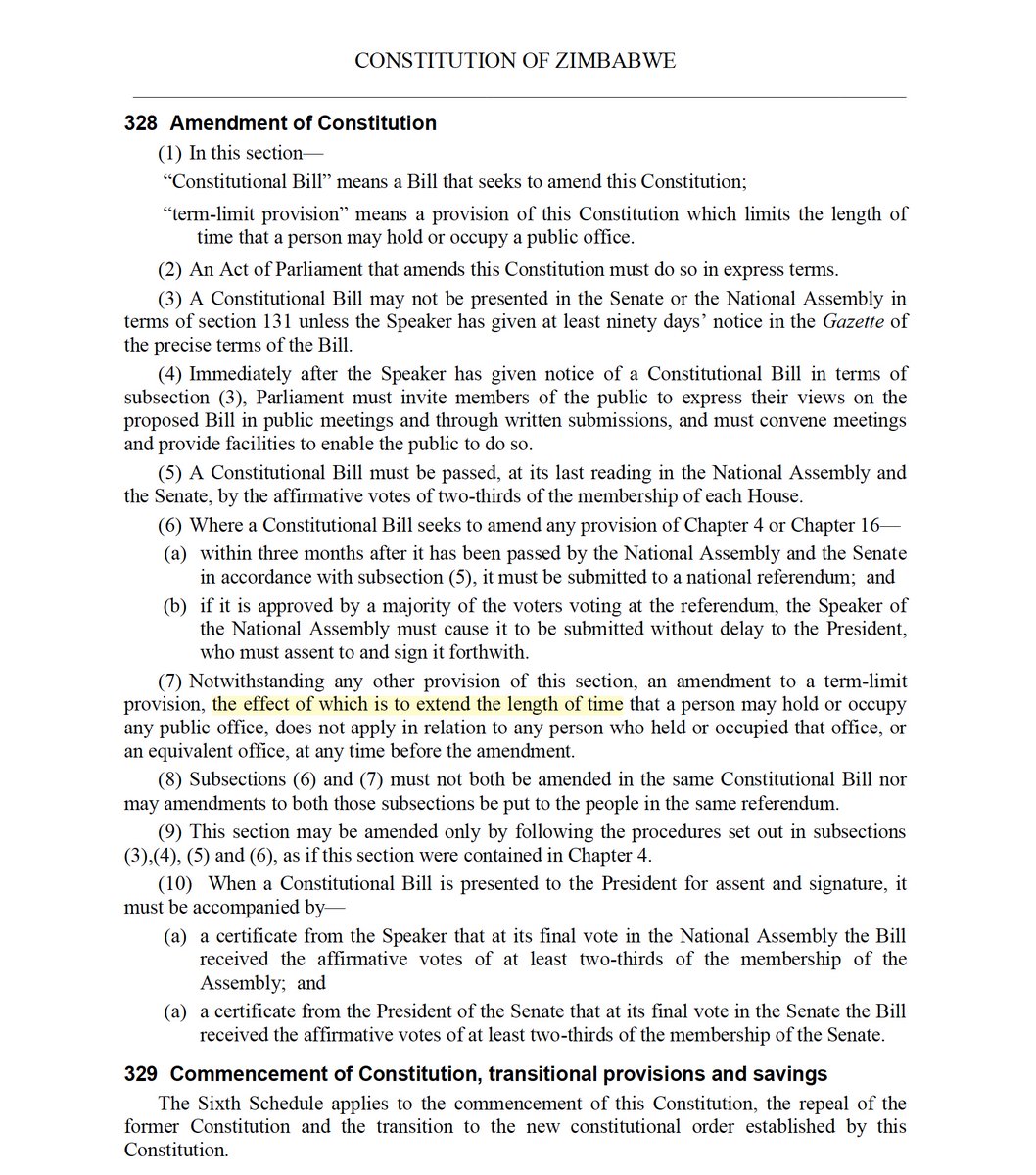
This is a fair observation, and some would say a clever legal argument. However, the Constitution appears to anticipate precisely this point by focusing on the EFFECT of an amendment rather than merely its label.
If the current constitutional framework provides for two five-year terms, the maximum period a President may hold office is 10 years. If that framework is amended to two seven-year terms, the maximum period becomes 14 years.
While the term limit remains "two terms", the EFFECT of the amendment is to increase the length of time a person may hold office from 10 to 14 years. That is exactly the type of benefit the Constitution's "no-benefit rule" was designed to prevent an incumbent from enjoying.
The real constitutional question is not what the amendment is called, but what it allows an incumbent office-holder to DO in practice.
Mambo Herodhi@MamboHerodhi
A vital distinction for constitutional clarity: term length dictates the duration of a single period in office, whereas term limits cap the total number of periods an individual may serve. Because CA3 modifies only the former, it does not necessitate a referendum.
English


Constitutional Amendment 3 (CA3) doesn't abolish "one man, one vote"—it honors it.
The liberation struggle was fought to guarantee equal voting rights for all. CA3 reinforces this by moving the presidential choice to a parliamentary vote, ensuring your voice is fully represented through the leaders you elect. 🗳️🇿🇼 #CA3

English
VaMabhena retweetledi

Dear Honourable @HonJMuswereJnr,
When Parliament voted on #CA3, you were absent.
In politics, absence is a vote in itself.
You have sent a clear message to Zimbabweans about your commitment and position on the Bill and on President @edmnangagwa 's #Vision2030 agenda.

English
@peterndoro The downside about being a public figure like @peterndoro is that when you go on a public platform and speak about subjects that you don't have an indepth knowledge about, you are going to get corrected in a very public way
English
Section 328(7) contains the “no-benefit rule.” It states that where a constitutional amendment extends the length of time a person may hold a public office, the amendment does not apply to anyone who held that office before the amendment was made. In other words, even if Parliament lawfully extends presidential terms from five to seven years, the incumbent President cannot benefit from that extension.
Wellington Marowa@Wettomr
@peterndoro @ZANUPF_Official The constitution has a clause which allows the parliament to amend it. Zvimwe muchinyara asi
English
VaMabhena retweetledi

Dear Honourable @TateMavetera,
When Parliament voted on #CA3, you were absent.
In politics, absence is a vote in itself.
You have sent a clear message to Zimbabweans about your commitment and position on the Bill and on President @edmnangagwa 's #Vision2030 agenda.

English
VaMabhena retweetledi

TERM LENGTH and TERM LIMIT are not one and the same. A longer term does not automatically mean more terms, because duration and limitation are separate constitutional matters.
@stendai_gondwe @VaMabhena263 @bashi92178


English