Evolved🅰️

2.9K posts

Evolved🅰️

Evolved🅰️

@Evolved80

Entrou em Nisan 2012
198 Seguindo82 Seguidores
Evolved🅰️ retweetou
Leo Edge
Leo Edge@LeoCapital_01·
Yesterday I flagged the space rotation - operators up, $SPCX down. That was real. Today the picture is different, and intellectual honesty matters: both fell. ASTS ~-6%, SPCX ~-5%. Here's why. ASTS today = mechanics + macro, not fundamentals. Think of it like a trampoline under the stock. All month, traders bought calls betting $ASTS would jump after the launch. The dealers who sold those calls had to buy and hold ASTS shares to stay hedged - that buying was a cushion holding the stock up. Today was opex (options expiry). All those bets expired at once, the dealers no longer need the hedge, and the trampoline got pulled away. The stock dropped to where gravity wanted it. Then add a cold front: yesterday's hawkish Fed. When the Fed signals higher-for-longer, investors dump risky, not-yet-profitable growth names first. ASTS sits right in that bucket, so it caught an extra gust that hit every high-beta name - not just ASTS. Neither has anything to do with the company. The satellites are in orbit. The contracts are intact. One was the trampoline being removed (options mechanics), the other a market-wide cold front (the Fed). Both pass. SPCX today = its own bubble deflating. It ran $135 → $225 in four days on pure float-driven hype. Today it's mean-reverting from that spike - its own story, not rotation into ASTS. So the thesis isn't broken. Two stocks fell for two unrelated reasons on the same red day - one on mechanics, one on overextension. What matters: satellites in orbit and healthy, opex pressure ends at today's close, Russell reconstitution next week brings mechanical buying. The difference between a mechanics problem (temporary) and a thesis problem (business breaking)? Today was 100% mechanics. Know the difference and you won't get shaken out by either. $ASTS 🛰️
English
9
10
140
6.8K
Evolved🅰️ retweetou
PhotonBull
PhotonBull@PhotonBull·
This guy is spot on here about the current selloff $ASTS is one of my favorite buys at current levels A future cash machine on sale @CKCapitalxx laid it out for you Probably worth a read
CK Capital@CKCapitalxx

$ASTS down 8% today as people sell the launch news. They are stepping over dollars to pick up pennies. The launch yesterday was a clean success. BlueBirds 8, 9, and 10 went up on a Falcon 9, bringing the constellation to nine operational satellites. These are Block 2 birds with 2,400 square foot arrays, the largest commercial communication arrays ever deployed in low earth orbit, delivering close to 200 Mbps directly to a normal unmodified smartphone. The thing everyone said could not be done is flying right now. So the drop is just classic sell the news. The catalyst hit, traders took profits, and they are forgetting what this company turns into on the other side. This is a cash cow in the making. Look at the model. Every major US carrier is signed. AT&T, Verizon, T-Mobile. 3.3 billion addressable subscribers sitting inside global partner networks. AST does not spend a dollar acquiring a single one of them. The carrier brings the customer, AST provides the coverage from space, and they split high margin recurring subscription revenue. No stores. No marketing. No customer acquisition cost. Now think about the numbers that come with that. If even a small fraction of 3.3 billion addressable users convert to a few dollars a month each, you are talking about billions in recurring revenue on infrastructure that is already paid for once the satellites are up. The incremental cost of serving one more subscriber from orbit is almost nothing. That is the kind of margin profile that prints money. A satellite network that becomes a subscription toll on global connectivity. And they are funding it from strength. $3.9 billion in cash. Over $1.2 billion in contracted revenue commitments already locked. Manufacturing up to six satellites a month, racing toward the 45 to 60 birds that flip on continuous commercial service. A near monopoly on direct to device connectivity for the entire planet, every major carrier already signed, trading at a fraction of what that future cash flow is worth. People are selling a successful launch. I am watching a future cash machine go on sale. $ASTS

English
5
7
129
22.8K
Evolved🅰️ retweetou
intali🅰️51
intali🅰️51@intalia51·
Look at how quickly the BB8-10 satellites were detumbled and under control.
intali🅰️51 tweet media
English
4
3
64
2.4K
Evolved🅰️ retweetou
Ben R🅰️tcliffe
Ben R🅰️tcliffe@benrattyio·
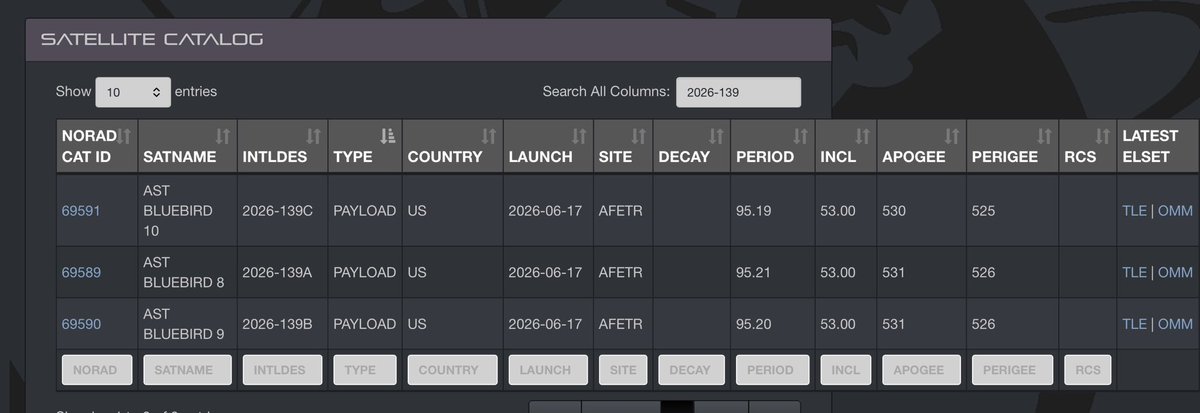
Bluebird 8, 9 and 10 now live on the original bluebird tracker! After a long wait, the API provider I use has finalised the NORAD IDs and users can now start tracking the satellites. Happy birdwatching! $ASTS
Ben R🅰️tcliffe tweet media
English
16
23
314
28K
Evolved🅰️ retweetou
C🅰️tSE
C🅰️tSE@CatSE___ApeX___·
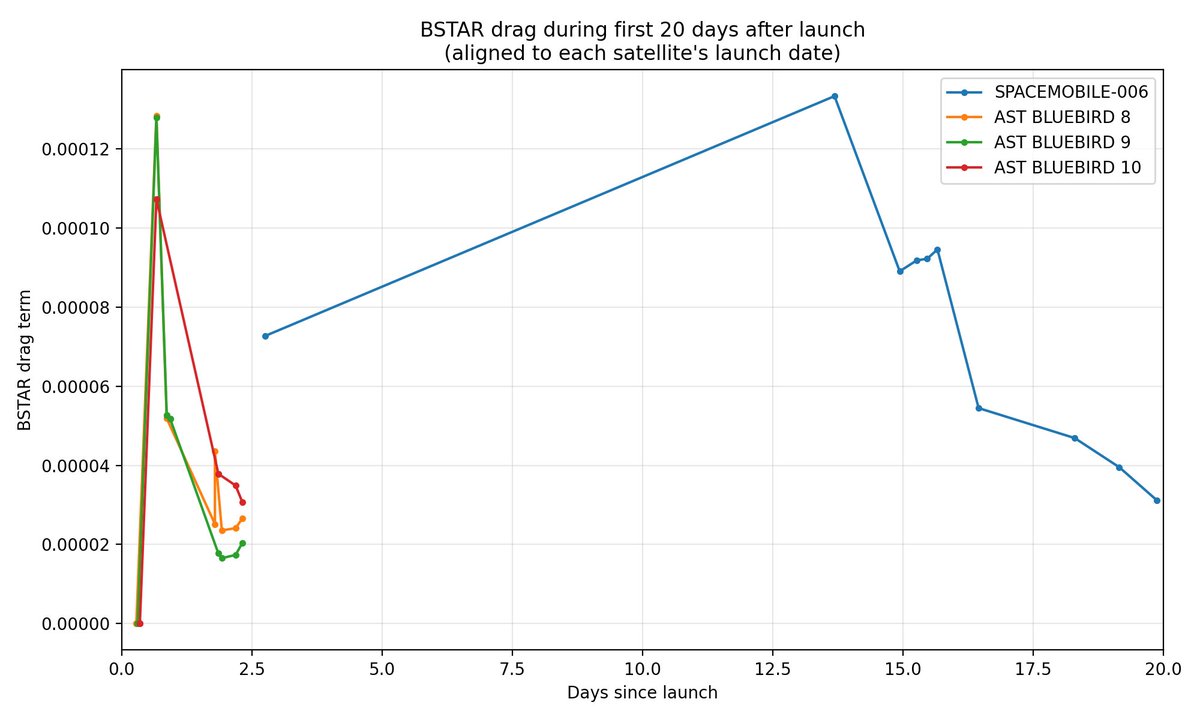
Unsurprisingly $ASTS is getting better at this. Early data of Bluebird006 is sparse but this level of stable flight seems to have taken 14 days more to achieve with Block2 Flight Model 1, compared to Bluebirds 8-10
C🅰️tSE tweet media
English
13
10
184
7K
Evolved🅰️
Evolved🅰️@Evolved80·
@CatSE___ApeX___ That was really fast, didn't that take a lot longer for BB6? But as far as I remember, we had quite some solar activity at that time, and they waited until the solar storm blew off.
English
1
0
19
1.1K
Evolved🅰️ retweetou
C🅰️tSE
C🅰️tSE@CatSE___ApeX___·
Drag data on the three $ASTS BLUEBIRD satellites (launched June 17) shows they have already achieved successful detumble and orbital stabilization. Very good look!👀
C🅰️tSE tweet mediaC🅰️tSE tweet media
English
28
48
518
32.8K
Evolved🅰️
Evolved🅰️@Evolved80·
@Novariv_ I agree with almost everything you wrote but what insider selling do you mean? The levels we see are normal and very far from "insiders selling right before the ship sinks", and Abel hasn't sold a single one, at least as far as I know...
English
1
0
1
93
Novariv
Novariv@Novariv_·
1/ $ASTS dropped almost 16% the same week they literally put 3 more satellites in orbit. Think about how dumb that is for a second. The company is hitting the biggest milestones in its history and the stock is getting smoked. I keep seeing people asking what happened and if the thesis is dead, so let me actually break this whole thing down. Spoiler, Im not selling a single share 🛰️ 2/ The drop has almost nothing to do with the company. On June 12 SpaceX IPO'd at $1.77T, biggest listing ever, and basically every dollar that was parked in small speculative space names got yanked out and thrown at the new shiny thing. The whole sector bled, not just us. $ASTS just got hit the hardest, and theres a reason for that. SpaceX literally named $ASTS as a competitor in their IPO filing. So when the big dog goes public and points at you, you become the first thing people sell. Add in the index funds being forced to buy SpaceX and you get a giant capital vacuum. None of that is $ASTS doing anything wrong. 3/ Then on top of the rotation, we did the classic sell the news. They launched BlueBirds 8, 9 and 10 on June 17, clean success, and the stock faded anyway cause everyone bought the rumor and dumped the event. And look, Im not gonna sit here and pretend theres zero real overhang. Q1 revenue came in soft, insiders have been selling, and $SPCX just did a $17B spectrum deal with EchoStar that makes their direct to cell push stronger. That EchoStar one actually matters and I'm watching it. But none of this is the business falling apart. Its sentiment, rotation, and one competitor headline. 4/ Now heres what everyone forgets the second the candle turns red. $ASTS is the ONLY company building a cellular network in space that talks straight to a normal phone. No special case, no dish, no extra hardware. The phone already in your pocket. Each BlueBird Block 2 is a 2,400 sq ft monster antenna, one of the biggest commercial arrays ever flown, and it can push up to 120 Mbps down to a regular handset. Thats the moat. Nobody else is doing this at scale. 5/ And before anyone calls it a meme stock burning to zero, look at the actual balance sheet. $3.5B in cash. Over $1.2B already contracted. 2026 revenue guided at $150M to $200M. 50 carrier agreements covering close to 3 billion subscribers, were talking AT&T, Verizon, Vodafone, T-Mobile. Plus 8 development contracts with the US DoD. This is a funded company with the biggest carriers on earth already signed, not some hope and prayer ticker. 6/ The part that actually gets me excited is the model flipping on. Right now its mostly a build story. But as they get sats up and turn on commercial service, the carrier revenue share kicks in, and you go from burning cash on a constellation to actually printing recurring revenue off 3 billion potential subs. Theyre at 9 operational sats now and targeting around 45 by year end. That cadence is the entire game. 7/ Am I ignoring the risks? Absolutely not, thats how you blow up an account. Starlink direct to cell plus that EchoStar spectrum is a legit competitive threat. They HAVE to hit the ~45 satellite cadence by year end or the whole multiple comes down. Theyre still deeply unprofitable and burning $1.6B+ in free cash this year. And the insider selling isnt a great look. If they miss on launches, I'll be the first one to say the thesis cracked. But missing hasnt happened yet. 8/ So heres where I land. I never thought this thing rips straight up, its a high beta build and you have to be able to stomach 40% drawdowns like the one were in right now. But the core didnt change this week. First mover in direct to phone satellite broadband, fully funded through the build, carriers already locked, sats going up on schedule. The price got caught in the SpaceX flush. The story didnt. Down 40% from the high and Im still holding every share. What are you guys doing here? 🛰️
Novariv tweet media
AST SpaceMobile@AST_SpaceMobile

A milestone worth lighting up New York City.🚀🚀🚀🚀🚀🚀🚀🚀🚀🚀 BlueBirds 8, 9, and 10, the largest commercial communications arrays ever in LEO, are now successfully orbiting Earth. #ASTSpaceMobile #ConnectingTheUnconnected #Nasdaq

English
10
15
89
10K
Evolved🅰️ retweetou
Anp🅰️nman
Anp🅰️nman@spacanpanman·
$ASTS: SpaceX Criticizes EU Proposal for Satellite Spectrum Tender By Gian Volpicelli and Paula Doenecke 06/18/2026 18:14:54 (Bloomberg) -- SpaceX criticized the European Union’s plans for the distribution of satellite spectrum, a key element in the growth plans for the Elon Musk-led company’s Starlink service following its record-setting initial public offering. Rules proposed by the EU that govern satellite technology put the bloc at risk of being left without satellite services working directly with mobile devices, according to a statement by Musk’s space company that was published before a European spectrum management conference in Brussels on Friday. The European Commission in May published plans to offer a third of its available 2 gigahertz frequency band to companies outside of the EU, while reserving the rest for operators based in the bloc. The plan effectively excludes foreign firms from offering satellite services to governments. Those services are becoming cheaper and more widely available as SpaceX deploys more of its Starlink satellites and expands its offering of so-called direct-to-device services. US companies including SpaceX and AST Spacemobile Inc. have partnered with European telecommunications operators to offer the plans because they still lack rights to the necessary spectrum to offer the services on their own. The new rules would split the relevant spectrum in “virtually unusable sub-divided parts,” SpaceX said. It added the proposed rules are inconsistent with prior international regulations and potentially incompatible with “Europe’s international obligations and economic reality.” A representative from the European commission didn’t immediately respond to a request for comment. A hybrid system with airwaves reserved for the European IRIS² constellation could also cause interference with Starlink services currently offered in Ukraine, according to SpaceX. The EU proposal, which must still clear negotiations with local governments and lawmakers, reflects the bloc’s attempt to meet growing demand for advanced satellite connectivity while limiting reliance on foreign operators for critical infrastructure.  The Commission has also proposed a two-year extension for incumbent providers Viasat Inc. and EchoStar Corp. SpaceX said it has invested extensively in Europe, including procurements from STMicroelectronics NV and future orders the company said are expected to reach a billion euros. It also struck partnerships for fiber infrastructure and direct-to-device services with European network operators including Deutsche Telekom AG and Orange SA. Europe is developing its IRIS² network through a consortium led by Eutelsat Communications SA, SES SAand Hispasat SA. However, the system isn’t expected to be operational until 2029 and it’s geared toward broadband services rather than direct-to-device connectivity.
English
16
24
207
21.5K
Evolved🅰️ retweetou
Peter LINDM🅰️RK
Peter LINDM🅰️RK@peterlindmark·
$ASTS The three new BlueBirds keep on marching.
English
13
29
533
39K
Evolved🅰️ retweetou
Peter LINDM🅰️RK
Peter LINDM🅰️RK@peterlindmark·
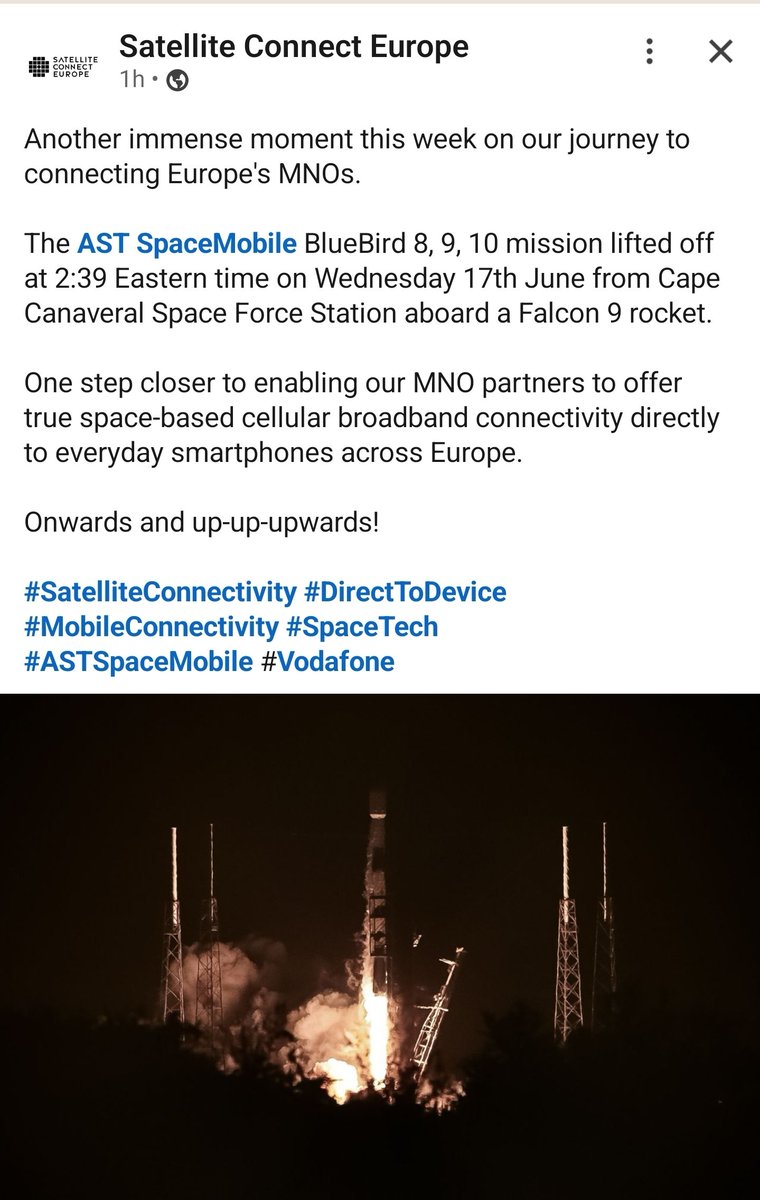
$ASTS | Satellite Connect Europe 《Another immense moment this week on our journey to connecting Europe's MNOs. The @AST_SpaceMobile BlueBird 8, 9, 10 mission lifted off at 2:39 Eastern time on Wednesday 17th June from Cape Canaveral Space Force Station aboard a Falcon 9 rocket. One step closer to enabling our MNO partners to offer true space-based cellular broadband connectivity directly to everyday smartphones across Europe. Onwards and up-up-upwards!》
Peter LINDM🅰️RK tweet media
English
2
18
211
7.2K
Evolved🅰️ retweetou
C🅰️tSE
C🅰️tSE@CatSE___ApeX___·
🚨HAMMER TIME A THREAD ON $ASTS VS $SPCX PAIR TRADE REVERSING 🚨 The AST chart just printed two hammers on the relative chart vs SpaceX. 🧶🐈‍⬛ CatSE: ”You should read this thread as it contains financial advice.” 1/
C🅰️tSE tweet media
English
20
33
268
23.2K
Evolved🅰️ retweetou
DVD
DVD@deepvaluedude·
$ASTS “A central defense the Big Three will use to clear antitrust scrutiny is that partnering with AST SpaceMobile actively increases competition in the satellite sector” The commercial angle mirrors the international / sovereign government and defense angle as well. Increasing competition to Starlink and diversifying the ecosystem is why AST will win the Japan J-LEO contract and many others across Europe/Asia/Middle East/Africa.
Anp🅰️nman@spacanpanman

$ASTS: 🚨 AT&T/VERIZON/T-MOBILE JOINT VENTURE POLICY ISSUES AND IMPLICATIONS - NEW STREET RESEARCH 5/15/26 New Street Research spoke with AT&T, Verizon, T-Mobile and AST SpaceMobile in putting together this research report. I had Gemini summarize the key implications for AST SpaceMobile in the first section below as well as summarize the report itself which is further down. FWIW, New Street seems to be closely aligned with my view of the JV's impact on ASTS. 👉Key Implications for AST SpaceMobile: Based on the provided analysis in "New Street Research T/VZ/TMUS JV Policy Issues and Implications", the proposed joint venture carries significant positive implications for AST SpaceMobile: ✅ Validated as the Unified Carrier Choice: The text explicitly notes that the Big Three are "doing the deal with AST". This positions AST SpaceMobile as the primary satellite partner chosen to anchor a unified platform serving all three major U.S. wireless carriers. ✅Positioned as the Regulatory Counterweight to SpaceX: A central defense the Big Three will use to clear antitrust scrutiny is that partnering with AST SpaceMobile actively increases competition in the satellite sector. The report highlights that policymakers strongly desire to establish "three viable satellite providers" to challenge SpaceX/Starlink's current market dominance. ✅Expanded Scale and Reach: The joint venture aims to pool limited spectrum resources to "help satellite providers reach more customers through a unified platform". For AST, this provides an immediate, streamlined path to scale its direct-to-device (D2D) services across the combined subscriber bases of AT&T, Verizon, and T-Mobile simultaneously. ✅Shifted Industry Leverage: By capturing a combined commitment from the Big Three—who previously resisted or hesitated over satellite MVNO models—AST transitions from a speculative add-on to a core, defensive infrastructure component that carriers are utilizing to lower their traditional rural cell tower costs. 👉A longer AI summary of the report: Executive Summary On May 14, 2026, "the Big Three" carriers announced an agreement in principle to form a joint venture. The initiative aims to eliminate U.S. wireless dead zones—particularly in rural and underserved areas—by pooling limited spectrum resources to facilitate next-generation direct-to-device (D2D) satellite communications. New Street Research views this as a strategic use of game theory by the carriers to bolster their buying power, defend rural market shares, and lower their cost structures. Key Implications 1. Increased Leverage Over Rural Infrastructure Tower Lease Negotiations: In the long term, the JV gives the Big Three significant leverage when renegotiating terms with rural cell tower owners. Cost Shifting: D2D satellite connectivity is cheaper than maintaining physical cell towers in ultra-rural areas and along highways. The carriers can threaten to rely on satellite coverage if tower companies do not lower their pricing. As a result, capital expenditures (capex) may redirect away from rural areas and toward urban/suburban network densification. 2. Reduction in Rural Capex Eased Political and Competitive Pressures: While carriers face no legal obligation to build networks in unserved, low-profit areas, they previously faced competitive and political pressures to do so. The JV provides an alternative to continuing physical network builds, effectively reducing these pressures. 3. A "Mixed Blessing" for Rural Customers Pros vs. Cons: Rural Americans will obtain broader coverage much sooner, but terrestrial cellular networks may never fully expand to their areas. Higher Costs: To achieve the same level of coverage that urban and suburban users get under basic plans, rural customers will likely have to pay an extra fee for D2D service on top of their standard monthly charge. This could spark political backlash from rural representatives regarding legal mandates for "reasonably comparable" pricing and services. 4. Impact on Federal Funding The 5G Fund for Rural America: The FCC's Universal Service Fund (USF) program designed to improve rural wireless connectivity has faced severe delays. The emergence of this JV calls into question whether the fund remains necessary, and if so, how it should be restructured. Antitrust & Regulatory Risks Bottom Line on Federal Scrutiny: New Street Research believes the odds favor the Department of Justice (DOJ) declining to challenge the deal. The Antitrust Concern: Unlike historical cable industry JVs, the Big Three directly compete against one another in both product and geographic markets. The JV technically reduces competition for mobile services in unserved rural sectors. The Efficiency Defense: The carriers will argue the JV is a highly efficient way to bring coverage to areas they otherwise would never have built out. Furthermore, collaborating with a satellite provider like AST increases competition in a satellite market currently dominated by SpaceX/Starlink. Policymakers favor having multiple viable satellite providers, which acts as a strong counter-argument to antitrust concerns. The SpaceX Caveat: If SpaceX/Musk uses political influence to push for a serious investigation, the DOJ may pivot to a more rigorous review. State Attorneys General: While federal clearance is likely, state AGs may investigate or challenge the JV over concerns that rural residents will pay higher rates than urban residents. However, New Street expects state AGs will use the threat of litigation to negotiate lower costs for rural customers rather than block the deal entirely.

English
1
5
86
7.1K