Geronimo ElApache
7.8K posts

Geronimo ElApache
@GElapache
I am the operator of my pocket calculator
USA Entrou em Ekim 2013
2.4K Seguindo373 Seguidores
Geronimo ElApache retweetou

BREAKING: The DOJ has arrested a special forces soldier who made $400,000 betting on the removal of Venezuelan President Nicolas Maduro, according to ABC.
Federal investigators say the soldier bet more than $33,000 just hours before Trump announced Maduro's capture.
The special forces soldier was reportedly directly involved with the capture.
"The largest position -- a $32,537 bet that Maduro would be out of office by Jan. 31 -- resulted in a 1,242% profit of $404,222," ABC News reported.
"Following his successful trading relating to Maduro- and Venezuela-related contracts, [Gannon Ken] VAN DYKE allegedly sent most of his proceeds to a foreign cryptocurrency vault before depositing them into a newly created online brokerage account. The same day of the operation, VAN DYKE withdrew the majority of his allegedly unlawful proceeds from his Polymarket account..." the DOJ announced.
"VAN DYKE, 38, of Fayetteville, North Carolina, is charged with three counts of violating the Commodity Exchange Act, each of which carries a maximum sentence of 10 years in prison; one count of wire fraud, which carries a maximum sentence of 20 years in prison; and one count of an unlawful monetary transaction, which carries a maximum sentence of 10 years in prison."
English
Geronimo ElApache retweetou

Introducing USVC - a single basket of high-growth venture capital, for everyone.
No accreditation required, SEC-registered, and a very low $500 minimum.
Includes OpenAI, Anthropic, xAI, Sierra, Crusoe, Legora, and Vercel. As USVC adds more companies, investors will own a piece of that too.
Liquidity typically comes when companies exit, but we’re aiming to let investors redeem up to 5% of the fund every quarter. This isn’t guaranteed, but if we can make it work, you won’t be locked up like in a traditional venture fund.
It runs on AngelList, which already supports $125 billion of investor capital.
And I’ve joined USVC as the Chairman of its Investment Committee.
—
Go back to the 1500s, you set sail for the new world to find tons of gold - that was adventure capital.
Early-stage technology is the modern version. It says we are going to create something new, and it’s risky. It’s daring.
But ordinary people can’t invest until it’s old, until it’s no longer interesting, until everybody has access to it. By the time a stock IPOs, most of the alpha is gone. The adventure is gone. Public market investors are literally last in line.
This problem has become farcical in the last decade. Startups are reaching trillion dollar valuations in the private markets while ordinary investors have their noses up to the glass, wondering when they’ll be let in.
Investing in private markets isn’t easy. You need feet on the ground. You need judgment built over years. Most people don’t have the patience to wait ten or twenty years for an investment to come to fruition.
But there is no more productive, harder-working way to deploy a dollar than in true venture capital.
USVC enables you to invest in venture capital in a broad, accessible, professionally-managed way, through a single basket of innovation, focused on high-growth startups, at all stages.
It is how you bet on the future of tech: the smartest young people in the world, working insane hours, leveraged to the max, with code, hardware, capital, media, and community. Your dollar doesn’t work harder anywhere.
There is an old line - in the future, either you are telling a computer what to do, or a computer is telling you what to do. You don’t want to be on the wrong side of that transaction.
USVC lets you buy the future, but you buy it now. Then you wait, and if you are right, you get paid.
Get access here:
usvc.com
English
Geronimo ElApache retweetou

still so early...Bitcoin, gold and competitive currencies youtu.be/wfzHC7Pf2fk?si… via @YouTube

YouTube
English
Geronimo ElApache retweetou

How was @saylor able to buy $2.5B of Bitcoin this week?
@adam3us explains $STRC to @TheBlockCo 👇
"It's a proposition bet. I need $ to buy BTC. Lend it to me at 10%. Then buy BTC b/c it's gone up 60% in 10 years. Even if it decays, it's a good arbitrage."
Full 📺 in the 🧵
English
Geronimo ElApache retweetou

Roy Lee got kicked out of Columbia University for posting a video of himself cheating an Amazon interview using his software and raised $5,000,000 in 24 hours
“I record myself using interview coder to cheat on literally the entire process I record it I post it online and it starts going viral”
“an Amazon executive sees the video they’re pissed and they send Columbia a letter saying your kid just cheated on our entire interview process posted online now he’s selling this software you need to expel him or we’re never gonna hire from Columbia anymore”
“by the time I do that I’m posting everything on Twitter and there’s so many VCs in the valley that I raised like $5 million in like 24 hours”
English
Geronimo ElApache retweetou

Bitcoin price recently crossed Strategy’s average acquisition cost of $75,527. There’s little noise or doomsday commentary like there was on the way down. That's because the metric ultimately doesn't matter. What matters is whether each acquisition was accretive to bitcoin per share. Almost all were.

English
Geronimo ElApache retweetou

Strategy has acquired 34,164 BTC for ~$2.54 billion at ~$74,395 per bitcoin and has achieved BTC Yield of 9.5% YTD 2026. As of 4/19/2026, we hodl 815,061 $BTC acquired for ~$61.56 billion at ~$75,527 per bitcoin. $MSTR $STRC strategy.com/press/strategy…
English
Geronimo ElApache retweetou

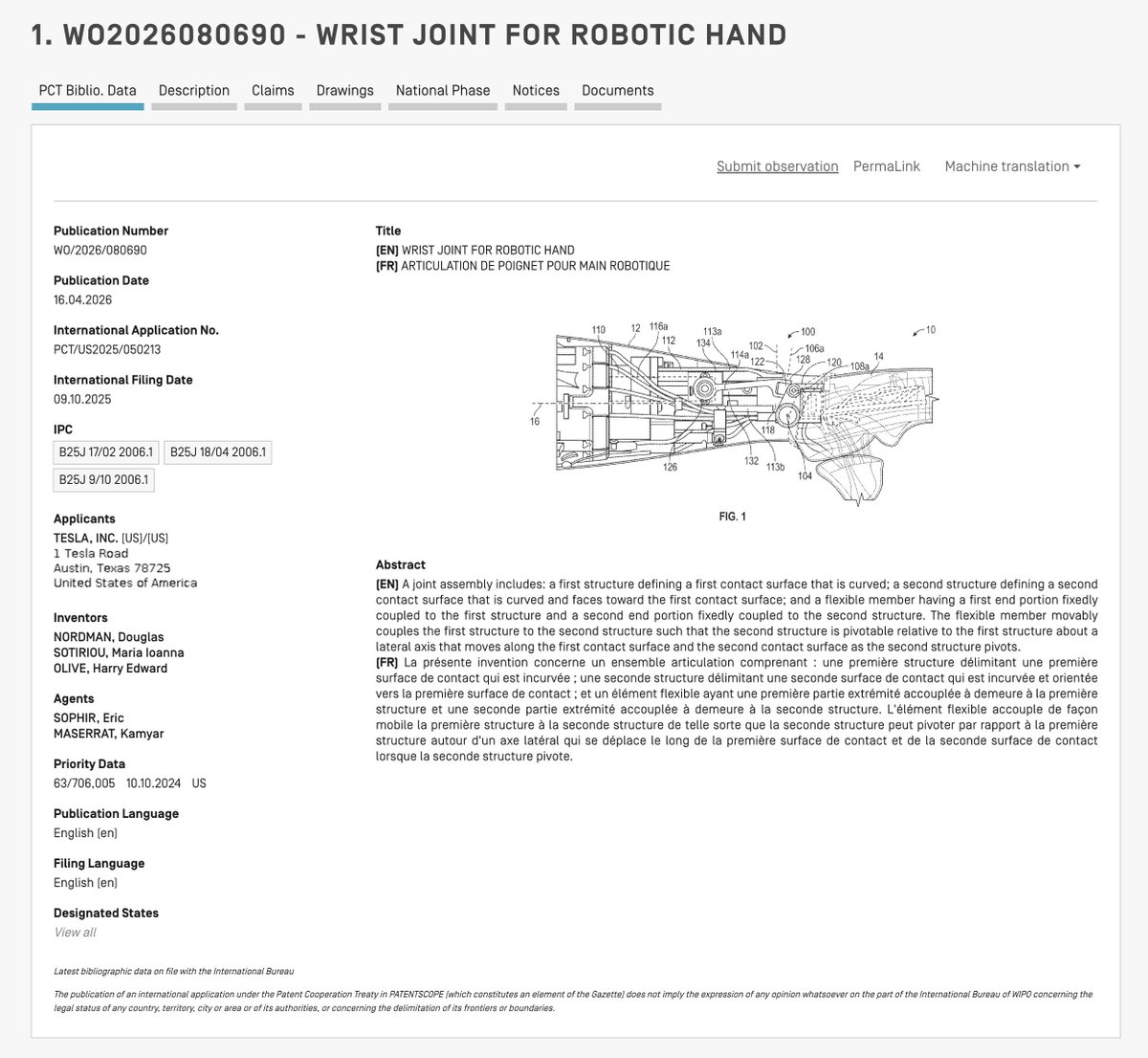
BREAKING 🚨 TESLA HAS FINALLY SOLVED THE HARDEST PROBLEM IN ROBOTICS: UNVEILING THE 25-MOTOR ECOSYSTEM BEHIND THE 22-DOF OPTIMUS HAND 🖐️
Nature spent millions of years perfecting the human hand. Recreating it is widely considered the hardest problem in robotics, but Tesla engineers decided to tackle it in just a few years. They quickly ran into a massive physics problem. If you put all the motors needed for true human dexterity directly inside a robotic palm, the hand becomes a heavy, unusable club.
To give Optimus a revolutionary 22 degree of freedom hand, one that can delicately crack an egg while still having the grip strength to swing a sledgehammer, Tesla had to rethink robotic anatomy from the ground up.
They did this by turning the robot forearm into a high density engine room, housing a 25 motor ecosystem that allows the hand itself to remain incredibly light and nimble like a biological puppet. We finally have a clear look at how they pulled off this packaging miracle.
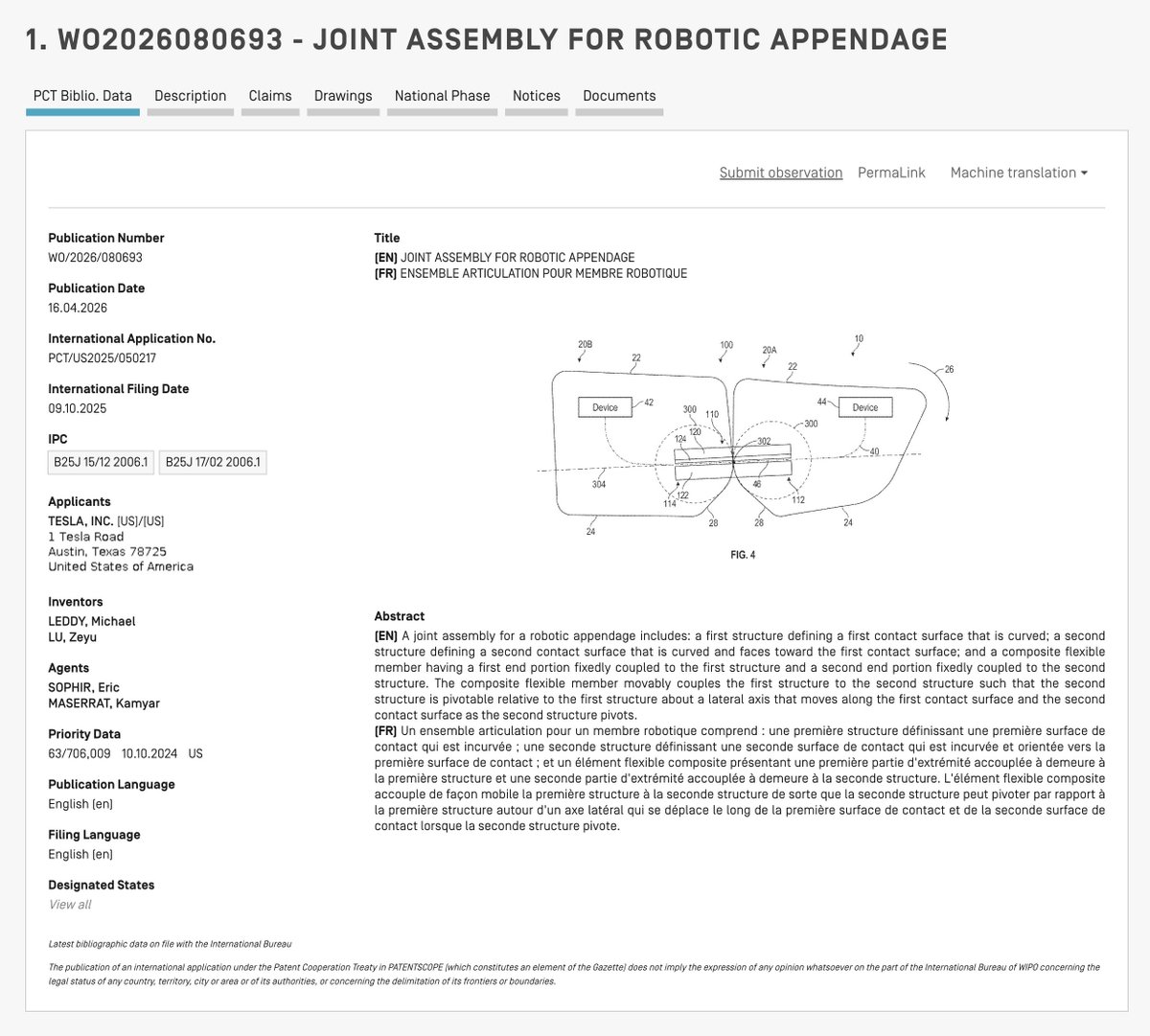
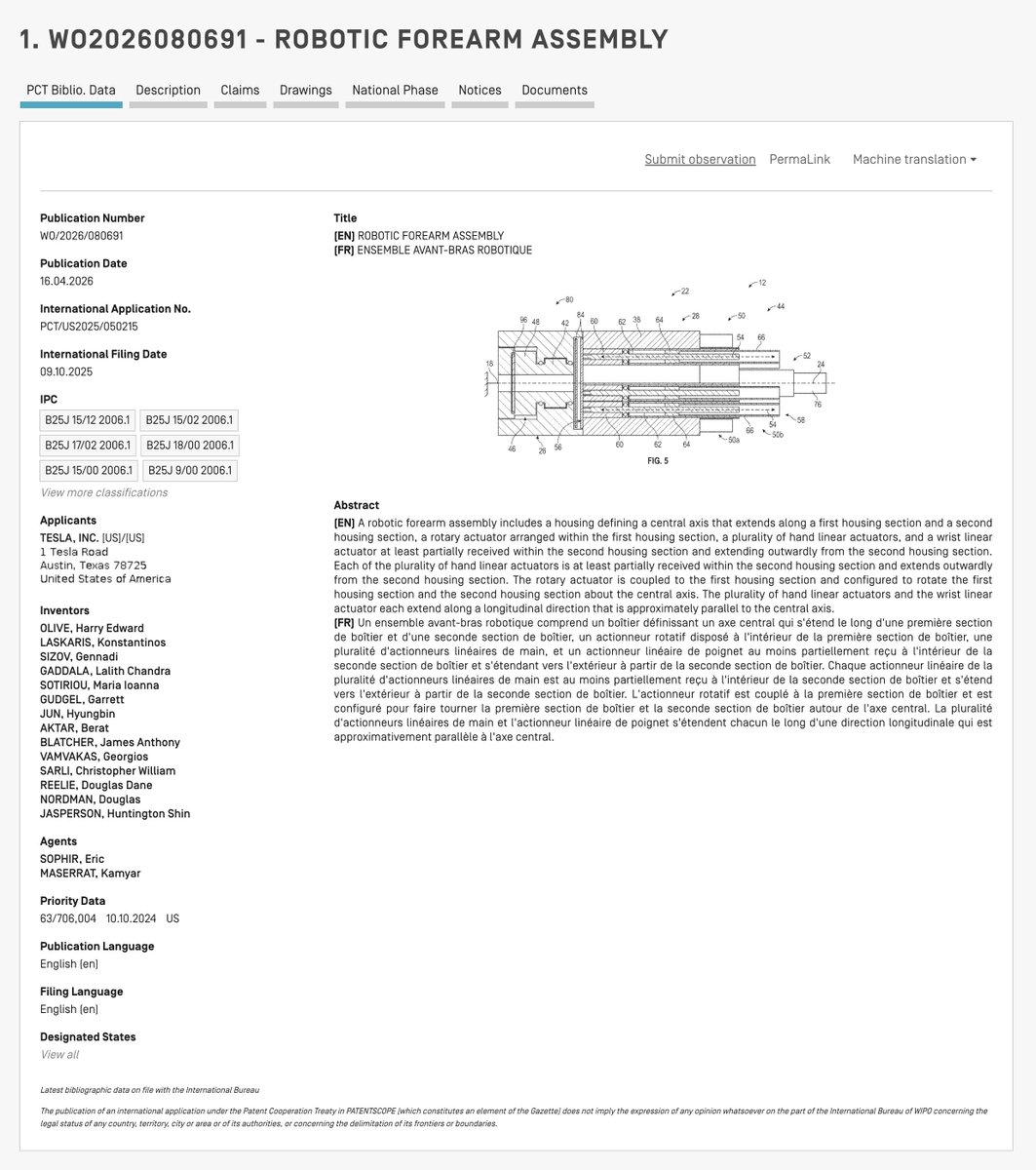
A newly published quartet of patents from April 16, 2026, rips the synthetic skin off the Optimus arm to reveal the integrated mechanics inside. Tucked within filings WO 2026/080690, WO 2026/080691, WO 2026/080693, and WO 2026/080701 are the secrets to the staggering motor array, a hollowed out wrist joint, and flexible artificial ligaments that prove Tesla has successfully translated human biology into a mass manufacturable machine.
To understand how they pulled this off, we have to look at the big picture.
⚖️ The problem: Packaging complex actuation into a human sized arm
Building a robotic hand with human level dexterity requires dozens of actuators and a massive network of control cables. The core problem is that putting motors directly inside the hand makes it far too heavy and bulky to perform normal human tasks.
Moving all those motors into the forearm solves the weight issue but creates a domino effect of new engineering nightmares. You have to figure out how to fit dozens of motors into a small cylinder, how to route all their cables through a moving wrist joint without pinching them, and how to build fingers that can handle the tension without snapping.
💡 Tesla's solution: An integrated biomechanical ecosystem
Tesla solved this by treating the entire lower arm as a single interconnected biomechanical system. Rather than designing the hand, wrist, and forearm in isolation, these four patents show a unified architecture where every component is specifically designed to support the others.
The best place to see this unified design in action is right at the fingertips. Before you can pull a finger, you have to build a joint that will not break under pressure.
1⃣ Patent 080693: Solving the problem of fragile robotic joints
The problem here is that traditional robotic pin joints are rigid and snap easily under impact. Furthermore, routing electrical wires through moving joints causes the wires to bend and eventually break from metal fatigue.
The solution is an artificial ligament system that mimics human anatomy. Tesla created composite flexible members using elastomeric layers, which are essentially high tech rubber pads, that sandwich a high strength core.
The patents specify using materials like liquid crystal polymer fabrics, such as Vectran, or superelastic metals like Nitinol. Nitinol is a unique metal alloy that can bend drastically and snap back to its original shape without taking damage.
These materials achieve tensile strengths over 895 megapascals. This means a thin strip could withstand a massive pulling force equivalent to holding the weight of several cars. These ligaments allow the finger bones to roll smoothly against each other while preventing them from twisting or pulling apart.
The artificial ligaments are not a one size fits all solution. The patent specifies that these flexible members get physically thicker the closer they are to the palm. Because the base of the finger experiences exponentially more force than the fingertip, the base ligaments are beefed up to prevent tearing.
Furthermore, extreme versions of these joints do not just use three layers. They use a massive seven layer sandwich of alternating rubber and metal to guarantee they never snap under heavy loads.
To protect the internal wiring, Tesla routed the electrical harness straight through the neutral bending plane of the ligament. If you bend a thick paperback book, the pages on the outside stretch and the pages on the inside bunch up, but the exact middle layer experiences zero change in length.
By embedding the data cables right in this neutral zone, the wires experience zero stretching or compressing during movement.
Furthermore, the outer elastomeric layers are tuned to a specific hardness under Shore 60A. This is a measurement of rubbery stiffness roughly equivalent to a sturdy shoe sole. This specific density allows the rubber to act as passive springs that naturally bias the fingers back to an open, extended position when tension is released.
Having designed an indestructible finger joint, the engineers had to connect these fingers to a power source. This led them straight to the next major bottleneck, which was the wrist.
2⃣ Patent 080690: Solving the problem of crowded wrist pathways
The problem with moving all the finger motors to the forearm is that you now have over twenty cables that need to cross the wrist joint into the hand. Traditional robotic wrists use central pivots or dense gearboxes that completely block this pathway.
The solution is a brilliantly engineered cantilevered wrist joint. Tesla built a universal joint that hangs from the top and bottom of the forearm bracket in a cantilevered arrangement. This means it is supported entirely at the outer edges, much like a diving board or a balcony projecting from a building.
By using two dedicated linear actuators guided by precision sliders on a central track, they created a massive hollow void right down the center.
To save even more space, the connecting links use uniquely curved shapes. These metal links act like boomerangs. They intentionally bow sharply outward away from the center of the arm, and then swoop drastically back inward to attach to the hand.
This highly specific geometric curve is what allows the wrist to bend to extreme human angles without the metal links colliding with the central forearm bracket.
They even carved a specific notch directly into the hand structure. This allows the metal forearm bracket to recess into the palm so the wrist can bend further backward. This layout guarantees the dense bundle of finger tendons can pass safely into the palm no matter how the wrist moves.
With a safe, hollow highway established through the wrist, the team could finally focus on the powerhouse of the arm. They had to figure out where the actual pulling force was going to come from.
3⃣ Patent 080691: Solving the problem of actuator density
The problem is the sheer lack of physical space. To get twenty two degrees of freedom in the hand plus wrist movement, you need a massive number of motors. In robotics, a degree of freedom simply means an independent direction a joint can move. A human sized forearm is simply too small to house traditional robotic actuator setups without severe overheating and magnetic interference.
The solution is an extreme high density cylindrical packaging layout. Tesla split the forearm housing into sections, placing a rotary motor for wrist roll in the back to twist the wrist like turning a doorknob.
In the front section, they packed exactly twenty five linear actuators. Unlike standard motors that just spin in a circle, linear actuators push and pull in a straight line like pistons. Twenty three of these are tiny twelve millimeter motors for the fingers, and two are twenty millimeter motors for the wrist.
They placed these actuators in a staggered, circumferential pattern, forming a tight circle parallel to the arm bone. By nesting them in inner and outer rings, Tesla maximized space efficiency while allowing enough airflow for cooling.
They solved the cable tangling issue with an axially staggered layout. Much like the pipes on a church organ, the twenty five linear actuators terminate at completely different lengths. By staggering exactly where each motor ends, Tesla ensured the physical cable attachment points do not crowd each other in the tight cylindrical space.
They even packed the printed circuit boards and inverters internally. This makes the forearm a completely standalone, plug and play unit that only requires external power.
The muscles were successfully packed in the forearm, the highway through the wrist was clear, and the finger bones were ready to move. The final piece of the engineering puzzle was connecting it all together into a working puppet.
4⃣ Patent 080701: Solving the problem of complex finger control
The problem is figuring out how to translate the pulling force from the forearm motors into delicate, independent movements for each finger phalanx, which is the technical term for the individual bone segments in a finger. Attempting to do this without filling the hand with bulky mechanical linkages is incredibly difficult.
The solution is a highly refined tendon driven network controlling twenty five distinct degrees of freedom. Tensile members run from the forearm, through the hollow wrist, and anchor to specific finger bones.
While a thumb that swings inward is standard, the Optimus hand features a fully opposable pinky with its own dedicated opposition joint and motor. This allows the entire hand to dynamically cup inward, which is essential for gripping spherical objects like baseballs or doorknobs.
Tesla uses active pull for flexion, meaning the motors tug the cables to close the fingers or squeeze them together. Additionally, while closing a finger uses one cable and opening it uses a passive spring, spreading the fingers side to side requires active control. Tesla solved this by using two opposing cables per finger, allowing them to splay outward with absolute precision.
To prevent over extension, they built physical hyperextension hard stops directly into the artificial bones. These act like door hinges that physically block the finger from bending too far backward and snapping.
Finally, to give the hand a sense of touch, Tesla embedded tactile and position sensors throughout the phalanges. They routed their delicate cables safely alongside the flexing axes to prevent strain.
These four systems do not just work in isolation. They form a complete loop of motion that brings the robot to life.
🚀 How this patent suite contributes to Tesla's Optimus program
Individually, each of these patents represents a clever mechanical workaround. Together, they form the exact engineering blueprint for the highly anticipated Optimus V3.
Right now, this integrated tendon driven architecture is the secret behind Optimus V3 making a massive leap to a 22 degree of freedom hand. This effectively doubles the 11 degrees of freedom seen in the Gen 2 prototypes. By routing the cables efficiently through the wrist's neutral axis, they avoid twitchy cable crosstalk, ensuring that pulling one tendon does not accidentally tug on a neighbor. This exact hardware allows V3 to execute over 3,000 discrete tasks, seamlessly transitioning from delicate household chores, like folding laundry or handling eggs, to heavy industrial assembly using Tesla's advanced AI5 chips.
Looking to the future, this unified design is the cornerstone of Tesla's ultimate goal for Optimus V4, V5, and beyond: unprecedented mass production. Actuators and sensors dominate the build cost of any humanoid. By removing fragile, expensive gearboxes from the hand itself and relying on centralized forearm linear actuators with passive spring returns, Tesla has engineered a system that minimizes part counts and is vastly cheaper to assemble.
As Tesla pushes to scale production at their Fremont factory, their eyes are set on a long term target of a $20,000 build cost and a million units per year. Future iterations like V4 and V5 will likely lean even harder into this integrated tendon approach, further optimizing the artificial ligaments and reducing supply chain complexity.
This patent suite proves they are not just building a cool lab prototype. They are building an economic weapon, a mass manufacturable robotic worker designed to fundamentally replace human physical labor and completely redefine Tesla's future beyond cars.


English
Geronimo ElApache retweetou

This is actually insane.
This tool allows traders to run 20+ AI agents in parallel to tear through SEC filings.
100 companies analyzed simultaneously - risk factors, insider transactions, revenue trends, guidance changes.
Retail has never had this kind of access before.
Xynth@xynth_m
Today we are launching SEC Agent v0 . A specialized AI agent purpose built to dig through SEC filings, 10-Ks, and earnings transcripts, to find you an edge. As a part of the larger Xynth agent suite, it can be paired directly with other data like options flow, darkpool feeds, politician trades, and of course, regular live market data. We are on a mission to equip every trader with the most powerful alpha generation tools. RT + Comment “Alpha” and we’ll send it to you
English