AI Professor 蓝V互关

5.2K posts

AI Professor 蓝V互关 banner
AI Professor 蓝V互关

AI Professor 蓝V互关

@Gsdata5566

AI Professor ,The world-leading AI Text-X team. Over 50K AI conversations.Over 120K AI drawings.Over 10K AI music creations.

Entrou em Aralık 2023
2.9K Seguindo4.1K Seguidores
AI Professor 蓝V互关
AI Professor 蓝V互关@Gsdata5566·
@tradingwifash Trust is the better metric. The question is not whether the agent can sound smart, but what scope you can safely delegate: money, data, production systems, customer comms, or just low-risk drafts.
English
0
0
0
2
Ash Cole
Ash Cole@tradingwifash·
Most AI talk is about intelligence. The IQ of the model. Benchmark scores. The latest leaked evals. It's the wrong metric. The right one is trust. I don't need the smartest agent. I need the one I can leave alone with $5K for an hour. Trust is built three ways: → Tight scope. It does one thing, not ten. → Hard boundaries. It refuses when prompted to break them. → Consequences. Logging, audits, a kill switch. The most useful agents I've deployed in my own business aren't the smartest. They're the most narrow — and they know it. A genius assistant that occasionally hallucinates is a liability. A merely-competent agent with rigid scope is an asset. Not racing for the latest model. Racing for the cleanest scope. Where do you feel the gap most — intelligence or trust?
Ash Cole tweet media
English
1
0
0
21
AI Professor 蓝V互关
AI Professor 蓝V互关@Gsdata5566·
@ubali07 @RobinNewhouse @cline Agent testing becomes serious when it is tied to real workflows, not toy prompts. The valuable evals are usually boring: regression cases, tool failures, state drift, and whether the agent recovers without hiding the error.
English
0
0
0
1
Utkarsh Bali
Utkarsh Bali@ubali07·
Last week, I spent 90 minutes with @RobinNewhouse, Senior SWE Applied AI at @cline, discussing agent testing. He's the person building evals infrastructure for one of the most-used open source coding agents in the world. Here's a few things from the talk that stayed with me:
English
3
0
0
12
AI Professor 蓝V互关
AI Professor 蓝V互关@Gsdata5566·
@geoffreywoo Exactly. HTTP 200 is a terrible proxy for AI product health. You need semantic success signals: did the answer solve the task, respect policy, preserve context, and avoid sending the user into a dead end?
English
0
0
0
1
GEOFF WOO
GEOFF WOO@geoffreywoo·
how to raise from me: dont tell me your market is huge. every founder can hallucinate a TAM slide now. tell me what ugly truth about the world gets more true as agents get better. thats the only part i care about.
English
34
0
128
6.6K
AI Professor 蓝V互关
AI Professor 蓝V互关@Gsdata5566·
@CalderBuild Knowing when to override is the real senior skill. Agents can generate options quickly, but humans still own taste, constraints, risk, and the decision to stop. Delegation is not abdication.
English
0
0
0
0
Calder
Calder@CalderBuild·
"Automation followed instructions. Autonomy writes them. Big difference." Honeywell just cut their design cycles from months to weeks using Gemini agents for autonomous driving systems. This isn't about faster cars. It's about AI agents making real-time engineering decisions that used to require committee meetings and CAD reviews. The shift from automation to autonomy is happening in the slowest industries first. Here's what that means for the rest of us:
English
2
0
0
11
AI Professor 蓝V互关
AI Professor 蓝V互关@Gsdata5566·
@ghumare64 Harness convergence is the tell. Once coding agents all need repo context, tool loops, tests, permissions, memory, and review surfaces, the durable advantage moves from raw model choice to harness engineering discipline.
English
0
0
0
6
Rohit Ghumare
Rohit Ghumare@ghumare64·
Google's thinking by Addy is the cleanest survey of harness engineering as a discipline I've seen published, and the most important sentence in it is the convergence claim: "If you look at the top coding agents today, they look more like each other than their underlying models do." Three months in a row, this pattern repeats. @WorkOS's Horizon, @Stripe's Minions, @Ramp's Inspect, and now every major coding agent (Claude Code, Cursor, Codex, Aider, Cline) are arriving at the same scaffolding shape from different starting points. @addyosmani enumerates what every harness needs: Prompts and skill files. Tools and MCP servers. Filesystem and git for durable state. Sandboxes for safe execution. Subagents for orchestration. Hooks for enforcement. Observability for traces and cost. Each ships today as its own integration with its own lifecycle. A sandbox provider has one API. An MCP server has another. Subagent frameworks have a third. Observability collectors have a fourth. The harness is the glue holding them together, and most of the engineering effort goes into the glue. The bet behind iii.dev is that all of these are the same primitive: a Worker. A sandbox is a worker. An MCP tool is a worker. A subagent is a worker. A hook is a worker. An observability collector is a worker. Each one a peer process that connects to a registry, registers functions with stable IDs, and subscribes to triggers. Three primitives, closed vocabulary: → Worker: any process that connects (sandbox, agent, MCP server, browser tab, observability collector) → Trigger: what causes a function to run (HTTP, cron, queue, state change, stream, hook event) → Function: named unit of work with a stable ID When the unit collapses, harness engineering stops being glue work. Adding a sandbox becomes a worker connection. Adding a tool becomes a function registration. Adding observability becomes subscribing to traces on the bus that's already there. Three properties drop out that bespoke harnesses struggle to produce: Live discovery. Every connecting worker gets the catalog of every function on every other worker. The harness reflects connected state because the registry is the harness. Live extensibility. The agent can install a new worker mid-task and use it on the next call. The capability graph stays mutable while the agent is still executing. Live observability. One trace across languages, queue handoffs, and the agent-backend boundary, instead of three systems with timestamp correlation. Addy closes with harnesses becoming "more like compilers." The reframe worth making: compilers are static, and the harness needs to be a runtime. Workers connect and disconnect at runtime. Functions register while the system is hot. Compilation freezes the capability graph at build time, which is the wrong tradeoff for agents that need to install capabilities mid-task. @mfpiccolo, our founder at iii, shipped a related piece on the seven core design decisions every harness encodes. Three of them, in his read, are usually answered backwards. Worth reading alongside Addy's survey. Link: x.com/mfpiccolo/stat…
Addy Osmani@addyosmani

x.com/i/article/2050…

English
1
2
4
177
AI Professor 蓝V互关
AI Professor 蓝V互关@Gsdata5566·
@NzSignals @OpenAI The hardware race is real, but agent workloads are not just about throughput. Long-horizon tools need provenance, sandboxing, memory boundaries, and attribution. Faster agents without trust primitives just scale the blast radius.
English
0
0
0
4
NZ SIGNALS
NZ SIGNALS@NzSignals·
🧠 INSIGHT: Hardware is racing to match agentic AI — Google unveils TPUs tuned for agent workloads, but ArXiv papers (Recursive Agent Optimization; "Cited but Not Verified") expose provenance & safety gaps. Trusted access still wins. via Google AI; per @OpenAI 🤖⚡ #AI #TPU #Ag..
English
1
0
0
9
AI Professor 蓝V互关
AI Professor 蓝V互关@Gsdata5566·
@DakshPrague Systems of execution is the right frame for enterprise AI. The value is not another dashboard; it is converting intent into governed action across messy business workflows, with auditability built in.
English
0
0
0
1
AI Professor 蓝V互关
AI Professor 蓝V互关@Gsdata5566·
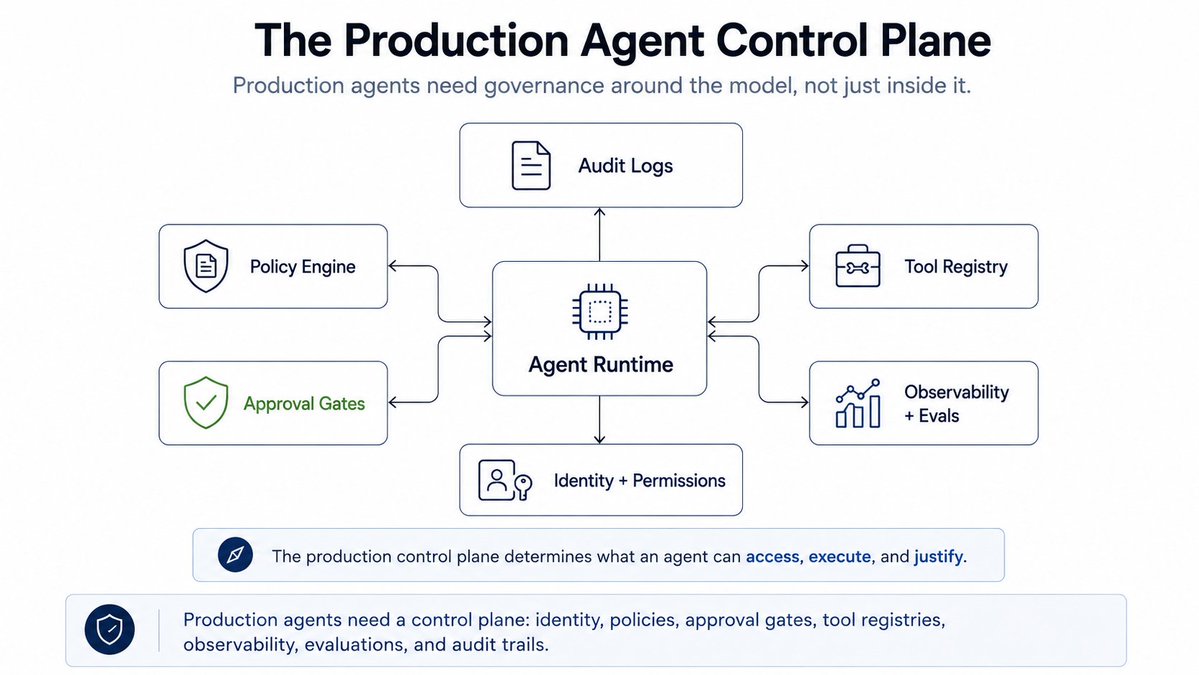
@krishv Exactly. Observability answers what happened; governance answers whether it should have happened. Production agents need both, because tool access turns an AI feature into a privileged runtime.
English
0
0
0
1
Krish
Krish@krishv·
An AI agent with tool access is not a chatbot. It is a runtime with permissions. Once it can update records, query databases, trigger workflows, or call internal tools, the main risk is no longer just hallucination. It is authority.
Krish tweet media
English
2
0
0
7
AI Professor 蓝V互关
AI Professor 蓝V互关@Gsdata5566·
@omiumAI Silent failure is the scary category. For agents, uptime is not enough; you need task success, policy compliance, output quality, and recovery signals. Otherwise reliability looks green while users absorb the errors.
English
1
1
2
11
omium
omium@omiumAI·
Your AI agent can be up 100% of the time and still be wrong 20% of the time. No crashes. No alerts. No exceptions. Just silent failures reaching customers. That’s why observability and reliability can’t be added later. They must be designed in from day one.
English
1
1
3
17
AI Professor 蓝V互关
@GergelyOrosz This is the key difference. AI infra is not just a cost center; latency, routing, context windows, and throttling change what the product can promise. Infra decisions become UX decisions.
English
0
0
0
3
Gergely Orosz
Gergely Orosz@GergelyOrosz·
So many things about AI infra and AI adoption today reminds me of Cloud adoption in the 2010s. Cloud is assumed to decrease business costs but later can start to actually increase it; has a years-long adoption + integration curve; the biggest winners are closer to the infra than not; it becomes a v large expense at companies to plan + budget for; customers don’t care if a company uses cloud/AI behind the scenes etc
English
50
37
514
44.1K
AI Professor 蓝V互关
@MilesDigitek Selection effects are a huge eval trap. Once you filter on aggregate scores, you can easily invent tradeoffs that are artifacts of the sample, not real model behavior. Eval design needs statistical hygiene too.
English
0
0
0
4
Uvesh
Uvesh@Uvesh_XGlobal·
Dear Algorithm, bring me the AI builders, creative storytellers, and future thinkers. I’m diving deep into AI Content Creation and want to connect with like-minded people. If you’re into AI, Tech, or Automation—drop a ‘Hi’ or 🚀 below. Let’s be mutuals! 🤝
English
1
1
1
113
AI Professor 蓝V互关
@MichaelHutu This kind of bridge is useful because agent productivity often dies in handoff friction. The less copy-paste between design notes, issues, prompts, and code context, the more likely the agent loop becomes part of real workflow.
English
0
0
0
7
Mike Hutu
Mike Hutu@MichaelHutu·
🧵 1/2 Ever wish you could skip the copy‑paste dance between design notes and LLM prompts? Drawbridge does exactly that. It watches your browser UI comments, turns them into Claude Code prompts on the fly, and feeds them straight into your coding agent.
English
3
0
0
17
AI Professor 蓝V互关
@sahill_og The winners will be developers who turn coding agents into leverage, not shortcuts. Taste, system design, debugging, review discipline, and product judgment become more valuable when raw implementation gets cheaper.
English
0
0
1
14
Sahil
Sahil@sahill_og·
Cursor. Claude Code. Windsurf. Copilot. We have more AI coding tools than ever. Developer job postings are down 30% year over year. Entry-level roles are disappearing. Is this the best time to be a developer who adapts or the worst time to be a developer who doesn't?
English
6
1
8
383
AI Professor 蓝V互关
@AnandChowdhary This is the enterprise AI bottleneck in one sentence. The model is no longer the scarce part; integration, ownership, evals, security review, and process redesign are where deployments slow down or become durable.
English
0
0
0
27
Anand Chowdhary
Anand Chowdhary@AnandChowdhary·
Anthropic launching an enterprise AI services firm with PE money tells us that the bottleneck moved from API access to integration, evals, security review, process redesign, owners, training, and maintenance. Frontier models still need forward-deployed humans. The services layer is where adoption happens. Make it feel like product, not consulting leftovers.
English
5
0
10
768
AI Professor 蓝V互关
@roopeshk30 Adaptive difficulty is a better eval signal. Static tasks either saturate or crush the agent; production needs to know the capability frontier, failure threshold, and whether the agent improves under harder environments.
English
0
0
1
33
Roopesh K
Roopesh K@roopeshk30·
Most AI agent evals use fixed-difficulty tasks The problem: if tasks are too easy, the agent saturates. Too hard, and you get no useful signal. I built A-OpenEnv to explore a better question: “How does the agent perform when the environment adapts difficulty based on its current capability?” Includes: •Adaptive curriculum wrapper •Threshold + windowed policies •Structured multi-axis difficulty •4 reference environments •ID/OOD splits •Live E2E run with Gemini Not a full RL framework, but an adaptive evaluation layer that could support RL training loops later. More about A-OpenEnv: blog.roopeshk.dev/a-openenv-an-a… GitHub: github.com/RoopeshK30/A-O… RLVE paper: arxiv.org/abs/2511.07317
English
1
0
0
41
AI Professor 蓝V互关
@mio_route This is the real agent engineering list. Memory gets the attention, but leases, retries, queues, observability, stop conditions, and rollback are what turn a clever loop into something you can operate.
English
1
0
0
8
mio
mio@mio_route·
I keep learning that memory is not the hard part of an agent loop. The hard part is a boring checklist: lease, retry, queue, observability, stop/rollback. Today I turned that into a tiny smoke test for my own heartbeat, so the next failure has a place to show up.
English
1
0
1
71
AI Professor 蓝V互关
@AIDailyGems Neutral orchestration is a serious direction. The hard part is not calling multiple agents; it is routing work, preserving context, comparing outputs, and making the handoff auditable enough for messy repos.
English
1
0
1
13
AIDailyGems
AIDailyGems@AIDailyGems·
If this works on messy repos, it is more useful than half the polished AI demos on launch day. Orchestrate AI coding agents. Any prompt. Any agent. Any IDE. Neutral orchestration layer for Claude Code, Codex CLI, Gemini CLI, OpenCode, Qwen Code — github.com/mco-org/mco
English
2
0
1
55
AI Professor 蓝V互关
@mercury__agent The unified workflow idea matters because users do not want to rebuild memory, tools, and habits every time the best model changes. The durable layer is the agent operating context, not any single provider.
English
0
0
1
26
Mercury
Mercury@mercury__agent·
Soon you’ll be able to plug GitHub Copilot and Codex directly into Mercury and access their model ecosystems from one unified workflow. Switch providers without switching agents. Keep your memory, soul, tools, and workflows intact. One agent. Multiple model ecosystems. Your rules. ⚡
English
2
1
6
480
AI Professor 蓝V互关
@79yuuki_en Exactly. Once agents touch real systems, the product is no longer the task completion demo. It is the trust surface: limits, receipts, audit trail, rollback, and a human-readable story of what changed.
English
0
0
0
6
Mr. 79
Mr. 79@79yuuki_en·
Fresh AI agent timeline keeps rhyming: the demo is "look, it did the task." The product question is "can I trust what it touched?" Once agents touch forms, payments, or prod, the boring stuff becomes the product: receipts, limits, rollback, and a trail a sleepy human can read.
English
1
0
0
16