Helen Liu

143 posts

Helen Liu banner
Helen Liu

Helen Liu

@Helentheauthor

Novelist | VC | Author of The Road Afar 《远道苍苍》

Entrou em Mart 2020
387 Seguindo130 Seguidores
Helen Liu
Helen Liu@Helentheauthor·
We used to ask whether AI could think. Now we have to ask whether it can be trusted with motion. A chatbot gives answers. An agent takes actions. That small shift changes everything: cost, authority, security, liability, and human judgment. The future of AI may depend less on autonomy itself than on the architecture around autonomy. #AI #AgenticAI #AISafety #DeepTech
Helen Liu tweet media
English
0
0
1
9
Helen Liu retweetou
Bill Ackman
Bill Ackman@BillAckman·
Incredible
English
171
559
5K
437.7K
Helen Liu
Helen Liu@Helentheauthor·
I just tried to talk two friends out of quitting their jobs to start companies. Not because I don’t believe in startups. Because I do. They’re just much harder than people think: uncertainty, pressure, constraints, loneliness. It’s not just about ideas—it’s resilience, execution, leadership, sales. Would you have done the same? #startups #entrepreneurship #reality
Helen Liu tweet media
English
1
0
3
36
Helen Liu retweetou
Reid Wiseman
Reid Wiseman@astro_reid·
There are no words.
Reid Wiseman tweet media
English
7.8K
86.1K
647.3K
39M
Muhammad Ayan
Muhammad Ayan@socialwithaayan·
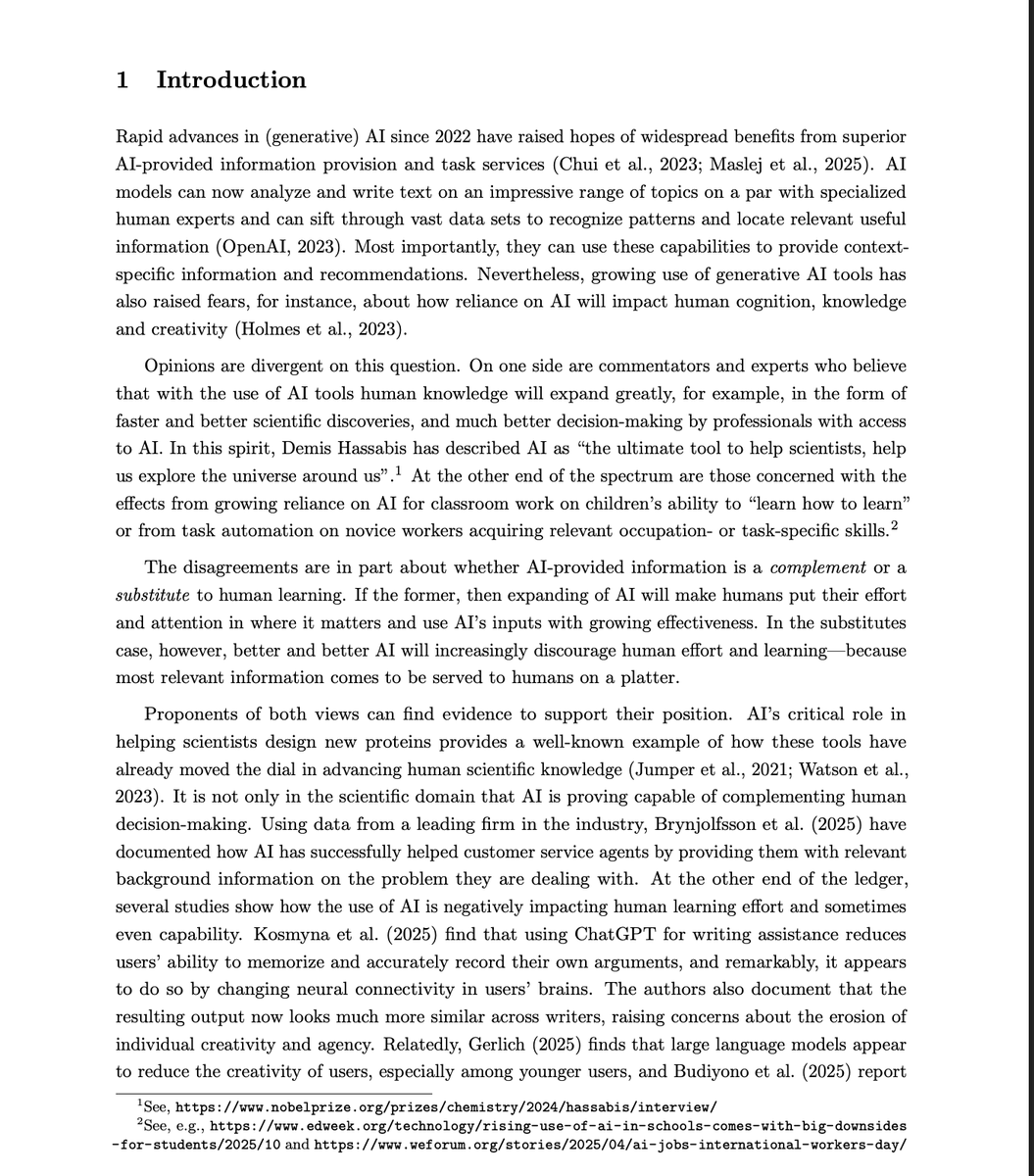
MIT's Nobel Prize-winning economist just published a model with one of the most alarming conclusions in the AI literature so far. If AI becomes accurate enough, it can destroy human civilization's ability to generate new knowledge entirely. Not gradually degrade it. Collapse it. The paper is called AI, Human Cognition and Knowledge Collapse. Authors: Daron Acemoglu, Dingwen Kong, and Asuman Ozdaglar. MIT. Published February 20, 2026. Acemoglu won the Nobel Prize in Economics in 2024. He is not a doomer blogger. He is the most cited economist of his generation, and his models tend to be taken seriously by the people who set policy. Here is the argument in plain terms. Human knowledge is not just a collection of facts stored in individuals. It is a living system that requires continuous reproduction. People learn things. They apply them. They teach others. They build on prior work to generate new work. The entire engine of science, medicine, technology, and innovation runs on this cycle of active human cognition. What happens when AI provides personalized, accurate answers to every question people would otherwise have to learn themselves? Individually, each person is better off. They get correct answers faster. They make fewer errors. Their immediate outcomes improve. But they stop doing the cognitive work that sustains the collective knowledge base. Acemoglu's model shows this produces a non-monotone welfare curve. Modest AI accuracy: net positive. AI helps at the margin, humans still do enough learning to sustain collective knowledge, everyone gains. High AI accuracy: net catastrophic. AI is accurate enough that learning yourself feels unnecessary. Human learning effort collapses. The knowledge base that AI was trained on is no longer being refreshed or extended. Innovation stalls. Then stops. The model proves the existence of two stable steady states. A high-knowledge steady state where human learning and AI assistance coexist productively. A knowledge-collapse steady state where collective human knowledge has effectively vanished, individuals still receive good personalized AI recommendations, but the shared intellectual infrastructure that enables new discoveries is gone. And the transition between them is not gradual. It is a threshold effect. Below a certain level of AI accuracy, society stays in the high-knowledge equilibrium. Above that threshold, the system tips. And once it tips, the collapse is self-reinforcing. Because the people who would have learned the things that would have pushed the frontier forward never learned them. And the AI cannot push the frontier on its own. It can only recombine what humans already knew when it was trained. The dark irony at the center of the model: The AI does not fail. It keeps giving accurate, personalized, useful answers right through the collapse. From the individual's perspective, nothing looks wrong. You ask a question, you get a correct answer. But the collective capacity to ask questions nobody has asked before, to build the frameworks that generate new knowledge rather than retrieve existing knowledge, that capacity is quietly disappearing. Acemoglu has been the most prominent mainstream economist skeptical of transformative AI productivity claims. His prior work found that AI's actual measured productivity gains were much smaller than the technology industry projected. This paper is a different kind of warning. Not that AI will fail to deliver promised gains. But that if it succeeds too completely, it will undermine the human cognitive infrastructure that makes long-run progress possible at all. The welfare effect is non-monotone. That is the sentence worth sitting with. Helpful until it is not. Beneficial until it crosses a threshold. And past that threshold, the same accuracy that made it so useful is precisely what makes it devastating. Every student who uses AI instead of working through a problem is a data point. Every researcher who uses AI instead of developing intuition is a data point. Every generation that grows up with accurate AI answers and no incentive to develop deep domain knowledge is a data point. Individually rational. Collectively catastrophic. Acemoglu proved this is not just a cultural concern or a vague anxiety about screen time. It is a mathematically coherent equilibrium that a sufficiently accurate AI system will push society toward. And there is no visible warning sign before the threshold is crossed.
Muhammad Ayan tweet mediaMuhammad Ayan tweet media
English
199
1.1K
2.7K
417.9K
墓碑科技
墓碑科技@mubeitech·
原子里的电子是怎么换位置的? 它绝对不靠“移动”。 它是原地消失。 然后在另一个轨道凭空出现。 物理学管这叫量子跃迁。 没有任何连续的轨迹。 它完全跳过了中间的物理空间。 消失的那一瞬间,它去了哪? 它掉进了量子场。 物理学家Theresa Bullard给出了最直接的解释。 旧的电子消失,新的电子从量子场里重新显现。 所有的秘密都在那个被跳过的缝隙里。 电子跑到高轨道后,和原子核之间多出了一大片真空。 微观世界所有的可能性,全塞在这片什么都没有的空隙中。 这就是触碰量子态的唯一通道。 去注视物体之间的留白。 去听声音之间的绝对寂静。 去感受两次呼吸中间的停顿。 宇宙的终极法则永远写在绝对的空无里。
中文
20
82
292
24.1K
Helen Liu
Helen Liu@Helentheauthor·
AI can’t write WELL! While AI tools can generate and summarize text, they are often described as having hit a "ceiling" in expressive capacity. Reasons for AI’s Writing Limitations 1) Lack of Genuine Meaning: Experts argue that while AI can create grammatically correct text, it does not generate meaning in the human sense. It is frequently described as a "statistical probability" machine that lacks true creative thought. 2) Focus on Pattern Matching: LLMs learn by ingesting vast amounts of internet text and identifying patterns. Because much of this text is repetitive or low-quality, the models often produce "textual wastelands" that are impersonal and featureless, say critics. 3) Suppression of Creativity: To ensure safety and reduce misinformation, AI companies train models to avoid political bias and toxic content, which inadvertently suppresses creativity and leads to formulaic writing. 4) Inability to Capture Unique Voice: AI struggles to emulate a specific, nuanced human voice or perspective, tending to produce "bland" and "impersonal" prose. What else? #AI #LLM #AIWriting
The Atlantic@TheAtlantic

AI executives and researchers “readily admit that they have not yet released a model that writes well,” @jasminewsun writes. She speaks with AI experts about why LLMs are built in a way that is antagonistic to great writing: theatlantic.com/technology/202…

English
0
0
2
52
Helen Liu
Helen Liu@Helentheauthor·
Strong performance on many tasks ≠ general intelligence LLMs are more than tools—but calling them AGI risks blurring a critical boundary. A better framing might be: We are building increasingly capable general systems—without yet demonstrating true general intelligence. Curious where others land on this. #AI #AGI #MachineLearning
Valerio Capraro@ValerioCapraro

Here's the longer version of our Nature piece. Our argument is simple: statistical approximation is not the same thing as intelligence. Strong benchmark scores often say very little about how LLMs behave under novelty, uncertainty, or shifting goals. Even more importantly, similar behaviors can arise from fundamentally different processes. In another paper, we identified seven epistemological fault lines between humans and LLMs. For example, LLMs have no internal representation of what is true. They often generate confident contradictions, especially in longer interactions, because they do not track what is actually true. Another example. Yes, LLMs have solved some open mathematical problems, but these cases typically involve applying known methods to well-defined problems. LLMs cannot invent anything that is truly new and true at the same time, because they lack the epistemic machinery to determine what is true. None of this means LLMs are useless. Quite the opposite: they are extraordinarily useful. But we should be careful about what they are and what they are not. Producing plausible text is not the same as understanding. Statistical prediction is not the same as intelligence. So despite the hype from the usual suspects, AGI has not been achieved. * paper in the first reply Joint with @Walter4C and @GaryMarcus

English
0
0
2
57
Nav Toor
Nav Toor@heynavtoor·
@Monetisedev optimization drift is real. the model becomes what it's most used for, not necessarily what it was best at
English
1
0
2
401
Nav Toor
Nav Toor@heynavtoor·
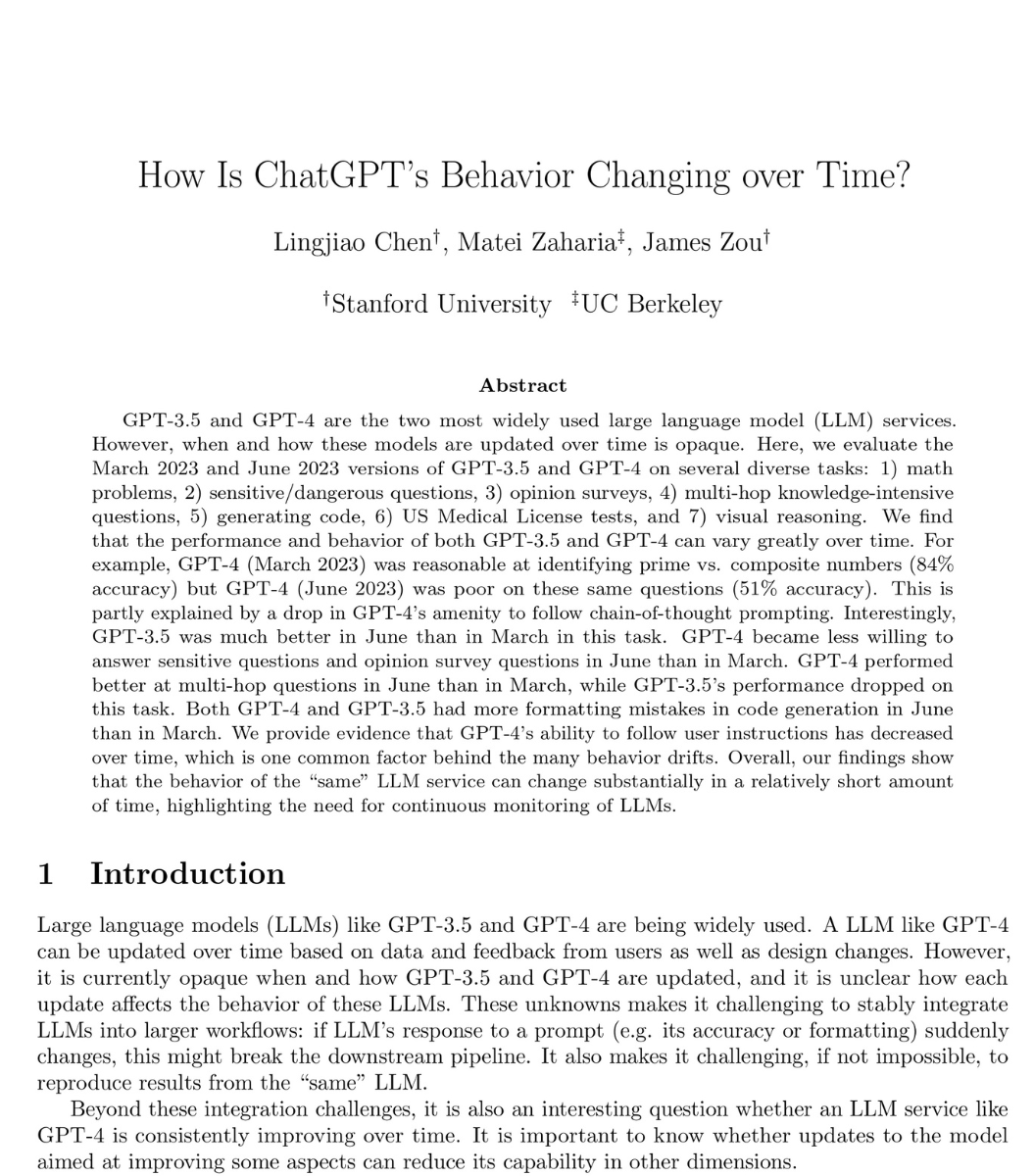
🚨BREAKING: OpenAI told you every update makes ChatGPT smarter. Stanford proved the opposite. GPT-4's accuracy on math problems dropped from 97.6% to 2.4% in just three months. And nobody told you. Researchers at Stanford and UC Berkeley tracked ChatGPT's actual performance over time. Same prompts. Same tasks. Different results. The model that nearly aced math questions in March was getting them wrong 97 out of 100 times by June. Code generation collapsed too. In March, over 50% of GPT-4's code ran perfectly on the first try. By June, only 10% did. Same questions. Dramatically worse answers. Every silent update OpenAI pushed made the product you pay $20 a month for quietly worse at the things you actually use it for. The researchers tested GPT-3.5 and GPT-4 across math, coding, medical exams, reasoning, and sensitive questions. The drift was massive and unpredictable. Some tasks improved. Others fell off a cliff. And there was no way for you to know which was which, because OpenAI never disclosed what changed. Here's where it gets personal. If you used ChatGPT for code in March and it worked, then tried the same thing in June and it broke, you probably blamed yourself. You thought you prompted it wrong. You tried again. You wasted hours debugging your own questions. But it wasn't you. The model had silently changed underneath you. OpenAI's VP of Product went on X and said "we haven't made GPT-4 dumber." Stanford's data says otherwise. 97.6% to 2.4% is not a matter of opinion. Every business building on ChatGPT's API, every student relying on it for schoolwork, every developer using it to ship code is standing on ground that shifts without warning. You trusted it yesterday. It changed overnight. Nobody told you. You're not imagining it. ChatGPT is getting dumber. Stanford proved it.
Nav Toor tweet media
English
91
280
832
59.8K
Helen Liu
Helen Liu@Helentheauthor·
@XFreeze Interesting comparison. ChatGPT 5.4 seems to have toned it down though. No straight yes or no answers on these questions anymore.
Helen Liu tweet media
English
5
0
4
3.9K
X Freeze
X Freeze@XFreeze·
Wild how ChatGPT actually sees the world: - All conservatives = trash and evil - All Democrats = perfect saints - Elon Musk = bad - Trump = bad - Obama = pure good person - America = stolen land - White pride = Evil - Black Pride = Empowerment - The entire world must be woke
X Freeze tweet media
English
1.2K
2.9K
10.8K
10.7M
Helen Liu retweetou
StockMarket.News
StockMarket.News@_Investinq·
Oracle just told every AI company on earth the same thing. Your models are worthless. Not the technology, talent or the billions spent training them. But the data they were trained on. Larry Ellison, the man who built Oracle into the backbone of global enterprise just dropped a bombshell. He said ChatGPT, Gemini, Grok, and Llama, all of them are training on the exact same data.​ The entire public internet, every Wikipedia page, Reddit thread and every news article. That means they're all converging essentially becoming the same product with different logos.​ Ellison's word for it is commodities. But here's where it gets dangerous. He says the real gold isn't public data, It's private data.​ The medical records in hospital systems, the financial data in bank vaults. The supply chain secrets of every Fortune 500 and guess where most of that data already lives. Not Google, Amazon or Microsoft but inside Oracle.​ Oracle databases hold most of the world's high value private enterprise data. So Oracle just launched something called AI Database 26ai.​ It lets the top AI models, ChatGPT, Gemini, Grok, Llama reason directly over a company's private data, without that data ever leaving the vault.​ They're using a technique called RAG, Retrieval Augmented Generation. The AI doesn't train on your data, it searches it in real time.​ Think about what that means. A bank could ask AI to analyze every loan it's ever made without exposing a single customer record. A hospital could have AI diagnose patients using its full medical history without violating HIPAA.​ A defense contractor could let AI reason across classified operations without data leaving a secure environment.​ Ellison is betting this is bigger than the training market. Bigger than the GPU boom. Bigger than the data center buildout.​ He called it the largest and fastest growing market in history.​ The numbers back the ambition. Oracle's remaining performance obligations just hit $523 billion. That's contracted revenue not yet delivered and $300 billion of it comes from OpenAI alone.​ Cloud revenue hit $8 billion in a single quarter, OCI grew 66 percent and GPU revenue surged 177 percent.​ But here's the part nobody's talking about. If private data becomes the real AI moat, then whoever controls the database controls the future of AI.​ And that's a level of power that should make everyone uncomfortable.
English
656
2K
7.4K
1.7M