Dean N Onyambu

5.3K posts

Dean N Onyambu

Dean N Onyambu

@InfinitelyDean

Fund Leadership & Multi-Asset Trading | Global Macro & Capital Strategy | Canary Compass | Structure Before Sentiment | Not Investment Advice

Entrou em Temmuz 2010
4.2K Seguindo3.1K Seguidores
Tweet fixado
Dean N Onyambu
Dean N Onyambu@InfinitelyDean·
Anyone who knows me knows this is my favourite photo. President Frederick Titus Jacob Chiluba leaned in, I stood tall, and my mother watched as power shook hands. It was one of those fully parent driven events. I just knew my mum was excited that the Zambian president was coming to Kenya. This was in the early 1990s, not long after Chiluba had succeeded Kenneth Kaunda. At that time he represented hope, a fresh chapter for Zambia after nearly three decades of one party rule. For Zambians living in Nairobi it was a moment of pride, a chance to meet the new leader who carried so much promise. My mum, working at the British Council, insisted I be there. She had come to Kenya for further studies, met my dad, and built a life here, but her roots and her pride in Zambia’s future carried her to the airport that day with me in tow. I did not grasp the gravity. I was just a child being taken to meet a visiting head of state. Yet today, when I look back, I see more. I see posture, symbolism, and history in a single frame. Chiluba leans forward, extending authority. I stand upright, unintimidated, hand outstretched. My mum looks on, smiling, the bridge between heritage, identity, and a moment of recognition. This photo reminds me that we rarely understand the weight of moments while we are in them. Their meaning unfolds years later when life teaches us how to see. For my mother, this was pride. For me, it became perspective. Power bends, youth rises, and the witness in the background holds both stories together. Sometimes leadership is exactly that: recognising when to lean in, when to stand tall, and when to simply bear witness so that others can remember.
Dean N Onyambu tweet media
English
25
42
421
22.7K
Dean N Onyambu
Dean N Onyambu@InfinitelyDean·
The Economist's latest cover reads: "Operation Blind Fury." The implication: irrational, dangerous, blind. Pause on that word. Blindness in public analysis is rarely accidental. It is structural. It comes from incentives, from habit, and from the cost of interrogating the framework that gives an institution its authority. The Economist spent two decades advocating open capital accounts as a condition for growth. The countries that achieved the most significant poverty reduction, China, South Korea, Taiwan, were integrated into global trade from the start. What they sequenced was capital account opening: directed credit first, coordinated industrial policy, financial flows last. Where capital accounts opened prematurely, as in 1997, it produced crisis. The Economist framed the Asian crisis as crony capitalism, not a failure of the capital mobility framework it promoted. That framing protected the prescription. Publications invested in a conclusion have structural reasons to defend it. The same condition operates closer to home. In Ghana, Bank of Ghana data shows manufacturing's share of domestic credit fell from 24.9 per cent in 1999 to 11.4 per cent by 2023. Agriculture fell from 11.8 per cent to 4.1 per cent. Capital crowded into government securities. The fiscal dominance that preceded the 2022 debt crisis was visible in that allocation data for years. It was reported as a banking statistic, not interrogated as structural dysfunction. The Bank of Central African States (BEAC) introduced foreign exchange regulations in 2019 to rebuild reserves that had fallen to roughly three months of import cover, well below the IMF's recommended five. Reserves rose to 4.95 months in 2022 on oil prices, then fell to 4.12 months in 2023. The majority of Cameroonian businesses cited foreign currency access as a critical constraint. When confronted with the outcome, the BEAC governor blamed oil and gas operators. Coverage reported the regulation. It did not interrogate the result. In Zambia, the February 2026 MPC cut rates by 75 basis points. The direction was defensible. The magnitude assumed confidence in a CPI instrument where food carries a 53.5 per cent basket weight. When harvest cycles drive measured disinflation, the headline cleans up faster than household reality. The press release did not address it. What connects these cases is that too much financial coverage treats the announcement as the analysis. Publications like Business Daily Africa do the harder work. They remain the exception. The Economist's blind spots are partly ideological. African journalism's are largely structural. Both produce the same outcome: the arithmetic goes unexamined. The blindness stays where the incentives are. Structure Before Sentiment. Sources: BoG credit data; BEAC MPC communiqués; IMF CEMAC Staff Reports; ZamStats CPI Bulletin; Canary Compass, "The Forecast Is Not the Evidence" (2026).
Dean N Onyambu tweet media
English
0
0
2
78
Ne Nlaza
Ne Nlaza@MuisiNza·
@InfinitelyDean Very long cosmetic claim. For 65 yrs who held power and was making decisions: pro western like you. Who signed treaty upon treaty and systematically dismantled african capabilities to conform to IMF/WB policies and adjustment plans: people like you. But still lecturing 🙂‍↔️
English
1
0
0
36
Dean N Onyambu
Dean N Onyambu@InfinitelyDean·
Unfortunately, this is the default African technocratic position, particularly among those who went to university in the 1970s, 1980s, and 1990s. Many of them studied in the West. The niche, elite, reformist intellectual position of that era was to be anti-West, and they seem to have kept it. They came home and taught the same thing. That is why anti-imperialism, which in African economic discourse is functionally anti-Western, has such deep roots. It is also grievance-led, to the extent that it has not yet recognised that the imperialist extracting value from Africa right now is China. David lists "responsiveness, value for money, customer service" as the reason Chinese contractors dominate. The framing is emotionally satisfying. It is structurally incomplete. Chinese dominance in African infrastructure is vendor financing. Chinese policy banks fund the project. Chinese contractors build it. Chinese equipment fills it. Chinese supply chains service it. Africa owns the road. The industrial learning curve stays in Guangzhou. The "value for money" is a tied procurement model where the money circulates back to Chinese firms before the ribbon is cut. The "conditionality" that African elites resent, competitive tendering, transparency, enforceable standards, is precisely what lowers the cost of capital. African Eurobonds yield 9.1 per cent. Latin America pays 6.5 per cent. Asia pays 5.3 per cent for comparable ratings [Feb 2026]. That premium reflects governance risk, not Western interference. Chinese financing avoids the lecture but delivers inflated prices through tied procurement, not improved creditworthiness. The deeper question: what happens after the road is built? China's household consumption sits at 39.9 per cent of GDP. Its goods trade surplus exceeded USD1.19 trillion in 2025. 89 per cent of Africa's exports to China are extractives. 94 per cent of China's exports to Africa are manufactured goods. Africa exchanges rocks for finished products. If Africa wants to move beyond extraction, to process its own cobalt, refine its own copper, it needs markets that can purchase what it makes. Those are absorber economies: the US at 68 per cent household consumption, the EU at 52 per cent. China cannot absorb African manufactures because its own industrial capacity already exceeds domestic demand. Selling value-added goods to a competitor whose policy is designed to dominate those same markets is a dead end. Chinese contractors are not treating Africa as valued customers. They are treating Africa as a valued input. One builds capacity. The other feeds an export machine that sells finished goods back to the continent it extracted from. The question is not who builds the road cheaply. It is whether the road leads to industrial capacity, or to a port where unprocessed minerals leave and finished goods arrive. I wrote about this in "The Forced Choice." canarycompass.com/p/the-forced-c…
David Ndii@DavidNdii

Why they dominate? Responsiveness, value for money, customer service. Chinese contractors engage us as valued customers. Western ones engage us as aid recipients.

English
12
64
118
12.3K
Hooman
Hooman@hoomansv·
What’s going on here
Hooman tweet media
English
86
28
592
90.3K
Dean N Onyambu
Dean N Onyambu@InfinitelyDean·
Dean N Onyambu@InfinitelyDean

Bloomberg reports African governments are approaching Dangote to secure fuel supplies after the Iran war disrupted flows. Good reporting. A few layers underneath are worth examining. The article says 25 per cent of Dangote's 650,000 bpd capacity is available for export. That is nameplate capacity. Dangote receives roughly five crude cargoes per month from NNPC against the thirteen it needs to run at full utilisation. It sources the remainder internationally, with Nigerian grades running USD3 to 6 above Brent. The constraint is feedstock. Export capacity that cannot be fed is not export capacity. Bloomberg also notes South Africa holds 8 million barrels of strategic crude stocks, then acknowledges the country has virtually no dedicated fuel reserves. That distinction matters more than either sentence alone. Crude stocks without refining capacity is inventory you cannot deploy. South Africa has lost about half its refining capacity in recent years. The wider story is the downstream cascade most commentary has not yet reached. Sulphur, sulphuric acid, fertiliser, mining inputs, food systems. Half of global seaborne sulphur trade transits the Strait. When Gulf refineries shut, the acid supply chain breaks. Urea prices have surged nearly 40 per cent. More than 1.1 million metric tons of fertiliser cargo are stranded in the Gulf. China has restricted exports. Northern Hemisphere planting season is weeks away. We published our structural analysis of this full cascade yesterday, covering Nigeria, Kenya, and Zambia, including the insurance architecture that determines when and whether flows resume. Structure before sentiment. canarycompass.com/p/quick-take-t…

QME
0
0
0
600
Chis
Chis@chischans·
@InfinitelyDean What could have precipitated this willingness to talk? They have a winning hand insofar as I can tell and they are going to make a ton of money.
English
1
0
0
11
Dean N Onyambu
Dean N Onyambu@InfinitelyDean·
This reading is supported by emerging reports. US officials have indicated there is "room to negotiate" on returning frozen Iranian assets, suggesting the reported terms are a starting position.
Dean N Onyambu@InfinitelyDean

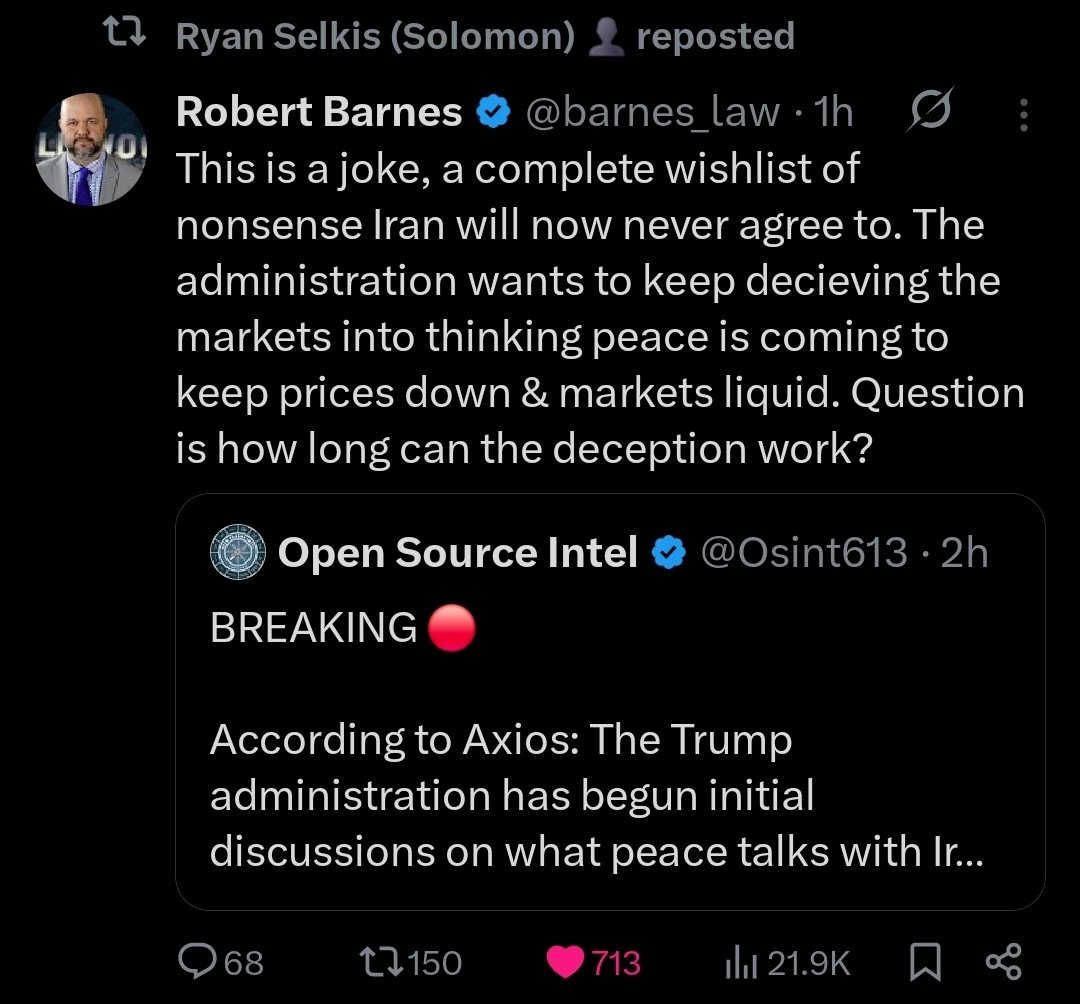
The Trump Administration has begun initial discussions on what a potential peace deal with Iran might look like, per Axios. The Kobeissi Letter summarised six reported terms. These are not the full proposal. The actual text has not been published. The six terms: no missile programme for five years, zero uranium enrichment, decommissioning of Natanz, Isfahan and Fordow, strict observation protocols on centrifuges, regional arms control treaties with a 1,000 missile cap, and an end to proxy financing. Four questions structure how nuclear agreements should be assessed, each requiring separate evidence: enrichment, weaponisation, delivery, intent. The 2015 JCPOA scored roughly two out of four. It capped enrichment at 3.67 per cent and monitored weaponisation through the most comprehensive IAEA inspection regime ever applied to a non-nuclear-weapon state. Those were real achievements. But it left the missile programme completely untouched. Resolution 2231 downgraded binding prohibitions on Iranian missile activity from "shall not" to "called upon." It managed intent through incentive structure rather than verification. It contained sunset clauses, with enrichment caps expiring in 2030, centrifuge restrictions between 2023 and 2025, and missile restrictions in 2023. The arms embargo expired in 2020. Iran formally terminated the agreement in October 2025. And the deal did nothing about proxy financing. A deal that constrained one dimension of threat while resourcing another through sanctions relief was a structural flaw. The proposed terms attempt all four dimensions. Enrichment eliminated, not capped. Facilities decommissioned, not constrained. Missiles halted and regionally capped. Proxy financing prohibited. On paper, it addresses every structural criticism levelled at the JCPOA. The question is whether these terms are designed to be accepted, rejected, or negotiated down. Iran rejected zero enrichment in Geneva. It rejected facility decommissioning. It offered instead to reduce enrichment to low levels under IAEA supervision, a position that mediators described as going beyond the 2015 deal. The Omani foreign minister assessed substantial progress and flew to Washington to convey this to the White House. The US negotiating team assessed otherwise. Neither assessment should be accepted uncritically. There is a third reading. This administration has a documented pattern of opening at extreme positions and settling lower. If that applies here, the question shifts from "will Iran accept" to "what does the settlement look like." Zero enrichment negotiated to capped low-level enrichment under IAEA supervision is a tighter JCPOA. Decommissioning negotiated to mothballing with permanent inspectors strengthens access beyond 2015 levels. A binding missile restriction replacing Resolution 2231's "called upon" language addresses the delivery gap for the first time. A negotiated-down version could be stronger than the JCPOA on all four dimensions while remaining achievable. Two concerns with the terms as summarised. First, the five-year missile restriction creates the same sunset problem the JCPOA was criticised for, on a shorter timeline. The JCPOA's missile restrictions ran eight years. This one runs five. Second, the monitoring language is vague. The JCPOA's verification regime was its strongest dimension: IAEA, Additional Protocol, continuous surveillance. "Strict outside observation protocols" does not specify the IAEA, does not reference the Additional Protocol, and does not address undeclared sites. If the full proposal contains stronger provisions, this concern falls away. If not, the proposed framework may be weaker on the one dimension the JCPOA got right. This caveat applies throughout: we are assessing a summary, not the document. The terms are more ambitious than the JCPOA. Whether they are more achievable depends on whether they are a final position or an opening one. #StructureBeforeSentiment

English
1
0
0
202
Chis
Chis@chischans·
@InfinitelyDean And then there's the aspect of broken trust. Negotiation, it seems, has become a tool to lull the other party in to complacence.
English
1
0
0
22
Dean N Onyambu
Dean N Onyambu@InfinitelyDean·
The Trump Administration has begun initial discussions on what a potential peace deal with Iran might look like, per Axios. The Kobeissi Letter summarised six reported terms. These are not the full proposal. The actual text has not been published. The six terms: no missile programme for five years, zero uranium enrichment, decommissioning of Natanz, Isfahan and Fordow, strict observation protocols on centrifuges, regional arms control treaties with a 1,000 missile cap, and an end to proxy financing. Four questions structure how nuclear agreements should be assessed, each requiring separate evidence: enrichment, weaponisation, delivery, intent. The 2015 JCPOA scored roughly two out of four. It capped enrichment at 3.67 per cent and monitored weaponisation through the most comprehensive IAEA inspection regime ever applied to a non-nuclear-weapon state. Those were real achievements. But it left the missile programme completely untouched. Resolution 2231 downgraded binding prohibitions on Iranian missile activity from "shall not" to "called upon." It managed intent through incentive structure rather than verification. It contained sunset clauses, with enrichment caps expiring in 2030, centrifuge restrictions between 2023 and 2025, and missile restrictions in 2023. The arms embargo expired in 2020. Iran formally terminated the agreement in October 2025. And the deal did nothing about proxy financing. A deal that constrained one dimension of threat while resourcing another through sanctions relief was a structural flaw. The proposed terms attempt all four dimensions. Enrichment eliminated, not capped. Facilities decommissioned, not constrained. Missiles halted and regionally capped. Proxy financing prohibited. On paper, it addresses every structural criticism levelled at the JCPOA. The question is whether these terms are designed to be accepted, rejected, or negotiated down. Iran rejected zero enrichment in Geneva. It rejected facility decommissioning. It offered instead to reduce enrichment to low levels under IAEA supervision, a position that mediators described as going beyond the 2015 deal. The Omani foreign minister assessed substantial progress and flew to Washington to convey this to the White House. The US negotiating team assessed otherwise. Neither assessment should be accepted uncritically. There is a third reading. This administration has a documented pattern of opening at extreme positions and settling lower. If that applies here, the question shifts from "will Iran accept" to "what does the settlement look like." Zero enrichment negotiated to capped low-level enrichment under IAEA supervision is a tighter JCPOA. Decommissioning negotiated to mothballing with permanent inspectors strengthens access beyond 2015 levels. A binding missile restriction replacing Resolution 2231's "called upon" language addresses the delivery gap for the first time. A negotiated-down version could be stronger than the JCPOA on all four dimensions while remaining achievable. Two concerns with the terms as summarised. First, the five-year missile restriction creates the same sunset problem the JCPOA was criticised for, on a shorter timeline. The JCPOA's missile restrictions ran eight years. This one runs five. Second, the monitoring language is vague. The JCPOA's verification regime was its strongest dimension: IAEA, Additional Protocol, continuous surveillance. "Strict outside observation protocols" does not specify the IAEA, does not reference the Additional Protocol, and does not address undeclared sites. If the full proposal contains stronger provisions, this concern falls away. If not, the proposed framework may be weaker on the one dimension the JCPOA got right. This caveat applies throughout: we are assessing a summary, not the document. The terms are more ambitious than the JCPOA. Whether they are more achievable depends on whether they are a final position or an opening one. #StructureBeforeSentiment

The Kobeissi Letter@KobeissiLetter

BREAKING: The Trump Administration has begun "initial discussions" on what a potential peace deal with Iran might look like, per Axios. US officials are planning the below terms: 1. No missile program for five years 2. Zero uranium enrichment 3. Decommissioning of the reactors at the Natanz, Isfahan, and Fordow nuclear facilities 4. Strict outside observation protocols around the creation and use of centrifuges and related machinery that could advance a nuclear weapons program 5. Arms control treaties with regional countries that include a missile cap no higher than 1,000 6. End of financing for Iranian proxy groups US officials said the expectation is there will still be 2-3 additional weeks of fighting and Trump's envoys Jared Kushner and Steve Witkoff are involved in the discussions. Step #9 of our "Conflict Playbook" is near.

English
1
0
1
627
Dean N Onyambu
Dean N Onyambu@InfinitelyDean·
@IKingsleyk @amibiaka We got to this point. See point 5. x.com/InfinitelyDean…
Dean N Onyambu@InfinitelyDean

This exchange is useful. The disagreements are becoming clearer. 1. SAPs destroyed industrial capacity. Agreed in the first reply. Agreed again. The question that remains unanswered: which framework rebuilds that capacity in 2026? Repeating the diagnosis is not a treatment plan. Every paragraph returns to what the West did. Where is the forward-facing architecture? 2. "The West has no incentive to build African industry either." The West does not need to build African industry out of goodwill. It needs to purchase African output. That is what an absorber economy does. The US and EU run persistent trade deficits. They consume more than they produce. African manufactured goods have a structural buyer in absorber economies. China runs a surplus. It produces more than it consumes. Household consumption at 39.9 per cent of GDP means Chinese consumers cannot absorb African manufactures at scale. The incentive distinction is purchase patterns, not moral preference. 3. The Asia comparison proves the opposite of what you intend. Japan, Korea, Taiwan, and China each built industrial capacity by exporting to absorber markets first. The US was the primary buyer for decades. Regional integration followed industrial maturity. It did not precede it. Asia's 59 per cent intra-regional trade is the destination after sixty years of absorber-driven growth. AfCFTA is Africa's destination too. I argued exactly this in The Forced Choice. The problem is the bridge. Africa's combined GDP is roughly USD3.4 trillion. Intra-African purchasing power cannot yet sustain manufacturing at scale. The critical minerals window provides the bridge: process minerals for absorber markets now, build the revenue base and industrial capacity that makes AfCFTA viable over time. 4. On CBAM: it penalises carbon-intensive imports. If Africa processes minerals domestically to clean energy standards, CBAM favours African processed goods over Chinese goods shipped from coal-heavy grids. CBAM is an argument for African processing, not against absorber market access. 5. "We will not rebuild by choosing between Washington and Beijing." This assumes the choice is voluntary. It is being imposed. The US Critical Minerals Ministerial in February 2026 established Foreign Entity of Concern criteria. Chip export controls restrict technology access based on alignment. 5G infrastructure decisions lock countries into one technology stack or the other. Security architecture requires partnership positioning. The world is bifurcating into two systems: two tech stacks, two security umbrellas, two market access corridors. Countries that decline to position themselves will find the positioning done for them through restricted access, excluded partnerships, and second-tier arrangements. I called this the Coalition of the Eligible in The Forced Choice: countries that meet the criteria access the corridor. Countries that do not are left outside it. The window for that positioning is closing. The full structural analysis, including the critical minerals bridge, the absorber-surplus framework, and the Coalition of the Eligible, is at canarycompass.com/p/the-forced-c…. The choice is already being made. The question is whether Africa participates in shaping its terms or absorbs the consequences of inaction.

English
0
0
1
23
Kingsley
Kingsley@IKingsleyk·
@amibiaka @InfinitelyDean 1. Great discourse. I agree with your posit Amine. Dean has done great in problem diagnosis, he should have however, given us three choices in his solutions; East, West and ourselves. It is not only a choice of the two centers of economic power but primarily who we choose...
English
2
0
1
12
Dean N Onyambu
Dean N Onyambu@InfinitelyDean·
This response is a live exhibit of the pattern. 1. The damage from structural adjustment was real. Documented. Agreed. The analytical error is treating that damage as a permanent lens. SAPs happened in the 1980s and 1990s. The question facing African industrialisation is which partnerships serve processing capacity in 2026. A framework that begins and ends with Western culpability answers a forty-year-old question. 2. "It is strange to condemn China for practices the West used." Western tied aid was extractive. Also agreed. That concession changes nothing about Chinese incentive structure today. China needs African raw materials as inputs for its own factories. Processed African output would compete with Chinese domestic manufacturing. Chinese capital therefore has a structural disincentive to build the very processing capacity Africa requires. That is supply chain arithmetic. Western history, however ugly, does not alter it. 3. "Africa does not need absorbers." This is where the argument collapses. Industrial policy produces goods. Goods require buyers. China's household consumption sits at 39.9 per cent of GDP, the lowest of any major economy, a USD1.19 trillion gap between production and domestic demand. Chinese consumers cannot absorb African manufactures at scale. The US and EU can. AfCFTA is promising, but Africa's combined GDP is roughly USD3.4 trillion. Intra-African demand alone cannot justify processing investment at the scale required. Absorbers are the architecture. Everything else is aspiration. 4. Conditionality described as "colonial extraction repackaged as good governance." Western conditionality caused harm. IMF structural conditions are well-documented failures. The comparative question matters more: where governance standards, transparency requirements, and environmental conditions are absent, African elites negotiate terms that serve themselves. Zambia's Chinese debt terms and the DRC's mining concessions are instructive cases. The absence of conditionality has not delivered better outcomes for African populations. It has delivered better outcomes for African elites. The full structural analysis, including the absorber-surplus distinction, is in The Forced Choice at canarycompass.com. Structure before sentiment.
Amine Idriss@amibiaka

I went to university in Africa in the mid-1990s, so here is my honest reaction to your post. What you call “anti-West grievance” is, in many ways, a reading of history backed by evidence. Structural adjustment programs dismantled African industrial policy and locked many economies into extractive specialization for decades. That is not nostalgia; it is a documented policy choice. On financing, the West also relied for years on tied aid and vendor-linked arrangements, so it is strange to condemn China for practices long treated as normal when used by OECD countries. The deeper issue is that Western conditionality often reinforced raw-material exports rather than domestic manufacturing. The same pattern appears in trade and finance: our economies are still priced through external risk lenses, and market access is increasingly constrained by instruments such as EU-CBAM, which make value-added exports even harder. Trade imbalances do not happen in a vacuum; they reflect long colonial continuities. Africa does not need “absorbers.” We need industrial policy, policy space, and infrastructure that serves transformation rather than extraction. What is striking is the gaslighting: colonial-style extraction is repackaged as “good governance,” while the same financing tools are demonized the moment Beijing uses them.

English
1
2
6
2.2K
Amine Idriss
Amine Idriss@amibiaka·
…I quickly went through your paper and while you diagnosed real problems (Chinese lock-ins, substitution risks, narrow geological leverage), what you are prescribing as solution reproduces the colonial economic model we fighting. Your "coalition of the eligible" asks us to accept temporary subordination to Western power in exchange for the promise of "future autonomy". I will revert either today or tomorrow with a more detailed technical criticism of the huge limitation of your paper… and show you how the "forced choice" should not be between Washington and Beijing, but rather between remaining a commodity periphery or building integrated continental markets that render the great power competition irrelevant…
English
2
0
1
33
Dean N Onyambu
Dean N Onyambu@InfinitelyDean·
We are closer than this exchange suggests. "Neither China nor the West will absorb African manufactures at scale." You have conceded the absorber problem. Your proposed solution is self-financing: pensions, insurance, domestic savings, capital markets. Agreed on the destination. The disagreement is sequencing. Those pools are growing but remain small relative to the capital required for industrial processing. What generates the revenue base that deepens them? Export income from the economies that can purchase African output. AfCFTA is where Africa needs to arrive. The question is what funds the journey. "Chinese goods and tech remain more usable." Usability is a consumer observation. Access is the structural question. Countries are already being sorted into technology corridors based on alignment. Usability matters less when access is conditional. Three rounds is enough. The structural framework behind these arguments is at canarycompass.com/p/the-forced-c…. Read it. Then we can disagree with shared evidence.
English
1
1
1
129
Amine Idriss
Amine Idriss@amibiaka·
I will address your points 1, 2 and 5. On 1: the forward-looking architecture already exists : REC industrial policies, AfCFTA, power pools, regional corridors, harmonised quality infrastructure, SEZs, and tech investment are all part of the build-out. But building the future does not require forgetting who damaged the base and West must be reminded of their sins. On 2: neither China nor the West will absorb African manufactures at scale; both mainly want raw materials. So the real absorber must be Africa itself, through integration and domestic demand. On 5: yes, pressure exists, but we still have agency. The priority is to finance ourselves, deepen domestic capital markets, mobilise pensions, insurance and local savings, and fund industrialisation for our own market. For now, Chinese goods and tech remain more usable than Western dependence.
English
1
1
0
84
Dean N Onyambu
Dean N Onyambu@InfinitelyDean·
@daddyhope Fully agreed. One caveat though. We always default to talking about inperialism, colonialism, and corruption. We must also address incompetence.
English
0
0
3
68
Hopewell Chin’ono
Hopewell Chin’ono@daddyhope·
Britain is cutting aid to Africa by more than half. In a normal world, it would mean that African dictators cut corruption by more than half, but we know that is not the case. The world is changing, and Africans and their leaders must understand that the days of aid are coming to an end as right-wing parties across Europe put pressure on governments to reduce aid to Africa and other developing regions. We saw this trend begin with Donald Trump, and it is likely to deepen and intensify. Ordinarily, one would be saddened by this, but my view is that Africa has the resources it needs. It does not need aid, it needs common sense and accountable leadership. The money exists. We see it in the purchase of expensive mansions, luxury cars, and in funds siphoned into Swiss bank accounts, as well as properties acquired in places like South Africa and Dubai. The resources are there, but they are misused. I will not shed a tear for governments, not that they care. I will only shed a tear for the ordinary people who depend on this assistance and who will now bear the brunt of increased poverty and suffering, because, as we know, many African leaders will not step in to close the gap by addressing corruption.
POLITICOEurope@POLITICOEurope

Britain will reduce its aid sent to Africa by more than half, as the government unveils the impact of steep cuts to development assistance for countries across the world. politico.eu/article/uk-for…

English
17
31
160
25.8K
Dingindaba Jonah Buyoya
Dingindaba Jonah Buyoya@BuyoyaJonah·
As if we don’t have enough to worry about, FAZ decides to create a match between Chipolopolo…and Argentina😭
English
30
59
459
11K
Dean N Onyambu
Dean N Onyambu@InfinitelyDean·
@theink_junkyard I have noticed a pattern in his responses. He is quite aggressive with his response to weak arguments. When arguments are strong or defensible, his engagement rate is lower.
English
0
0
0
28
Dean N Onyambu retweetou
Dean N Onyambu
Dean N Onyambu@InfinitelyDean·
This exchange is useful. The disagreements are becoming clearer. 1. SAPs destroyed industrial capacity. Agreed in the first reply. Agreed again. The question that remains unanswered: which framework rebuilds that capacity in 2026? Repeating the diagnosis is not a treatment plan. Every paragraph returns to what the West did. Where is the forward-facing architecture? 2. "The West has no incentive to build African industry either." The West does not need to build African industry out of goodwill. It needs to purchase African output. That is what an absorber economy does. The US and EU run persistent trade deficits. They consume more than they produce. African manufactured goods have a structural buyer in absorber economies. China runs a surplus. It produces more than it consumes. Household consumption at 39.9 per cent of GDP means Chinese consumers cannot absorb African manufactures at scale. The incentive distinction is purchase patterns, not moral preference. 3. The Asia comparison proves the opposite of what you intend. Japan, Korea, Taiwan, and China each built industrial capacity by exporting to absorber markets first. The US was the primary buyer for decades. Regional integration followed industrial maturity. It did not precede it. Asia's 59 per cent intra-regional trade is the destination after sixty years of absorber-driven growth. AfCFTA is Africa's destination too. I argued exactly this in The Forced Choice. The problem is the bridge. Africa's combined GDP is roughly USD3.4 trillion. Intra-African purchasing power cannot yet sustain manufacturing at scale. The critical minerals window provides the bridge: process minerals for absorber markets now, build the revenue base and industrial capacity that makes AfCFTA viable over time. 4. On CBAM: it penalises carbon-intensive imports. If Africa processes minerals domestically to clean energy standards, CBAM favours African processed goods over Chinese goods shipped from coal-heavy grids. CBAM is an argument for African processing, not against absorber market access. 5. "We will not rebuild by choosing between Washington and Beijing." This assumes the choice is voluntary. It is being imposed. The US Critical Minerals Ministerial in February 2026 established Foreign Entity of Concern criteria. Chip export controls restrict technology access based on alignment. 5G infrastructure decisions lock countries into one technology stack or the other. Security architecture requires partnership positioning. The world is bifurcating into two systems: two tech stacks, two security umbrellas, two market access corridors. Countries that decline to position themselves will find the positioning done for them through restricted access, excluded partnerships, and second-tier arrangements. I called this the Coalition of the Eligible in The Forced Choice: countries that meet the criteria access the corridor. Countries that do not are left outside it. The window for that positioning is closing. The full structural analysis, including the critical minerals bridge, the absorber-surplus framework, and the Coalition of the Eligible, is at canarycompass.com/p/the-forced-c…. The choice is already being made. The question is whether Africa participates in shaping its terms or absorbs the consequences of inaction.
English
1
2
1
193