Tweet fixado
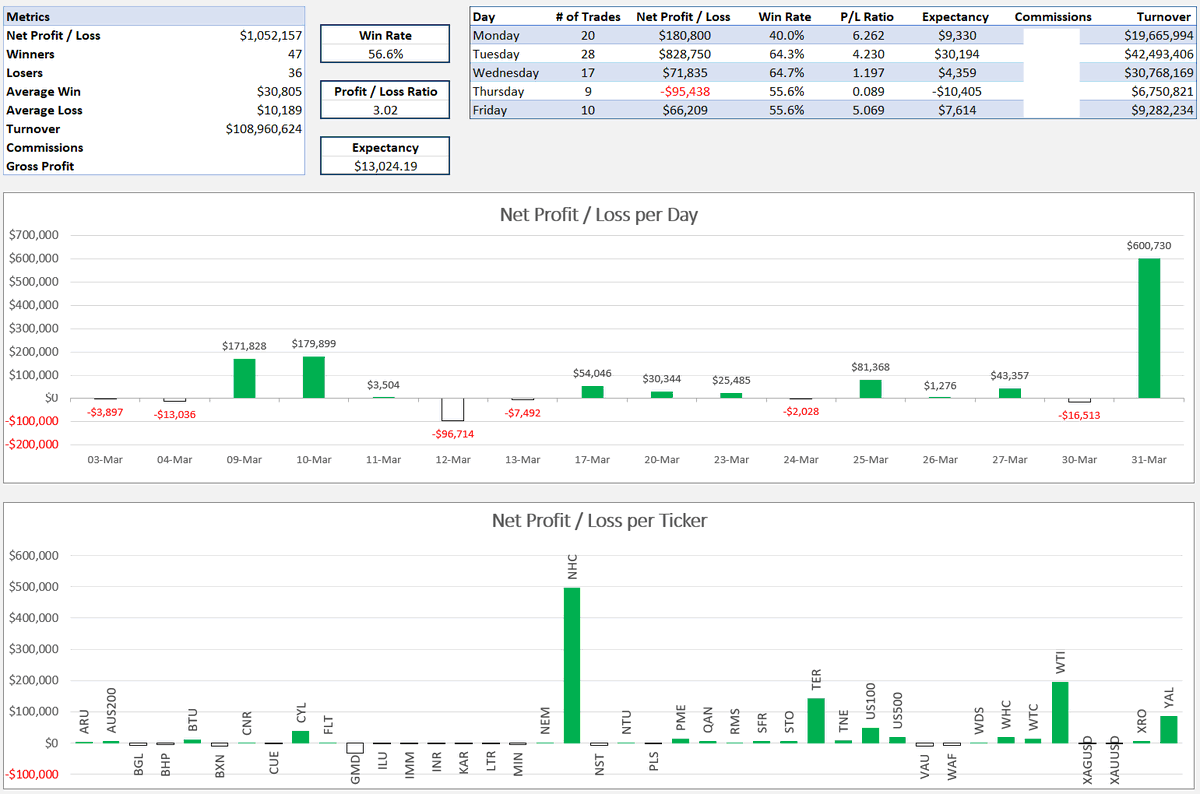
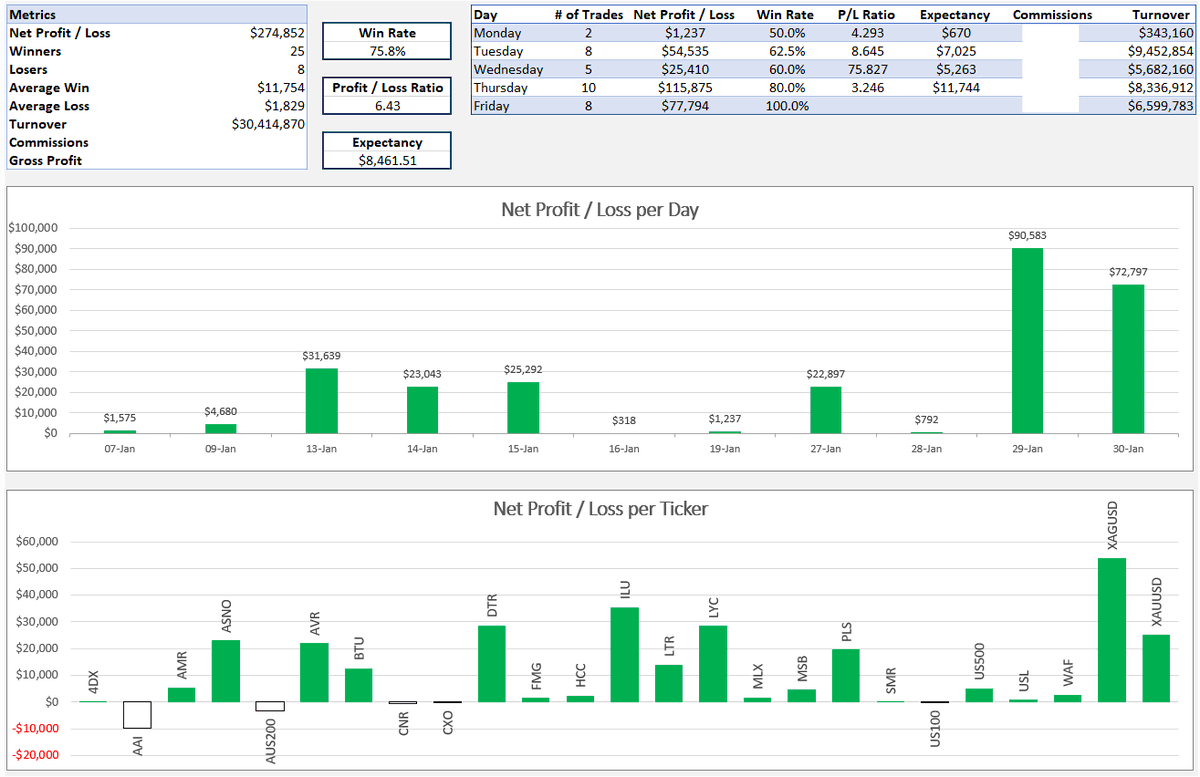
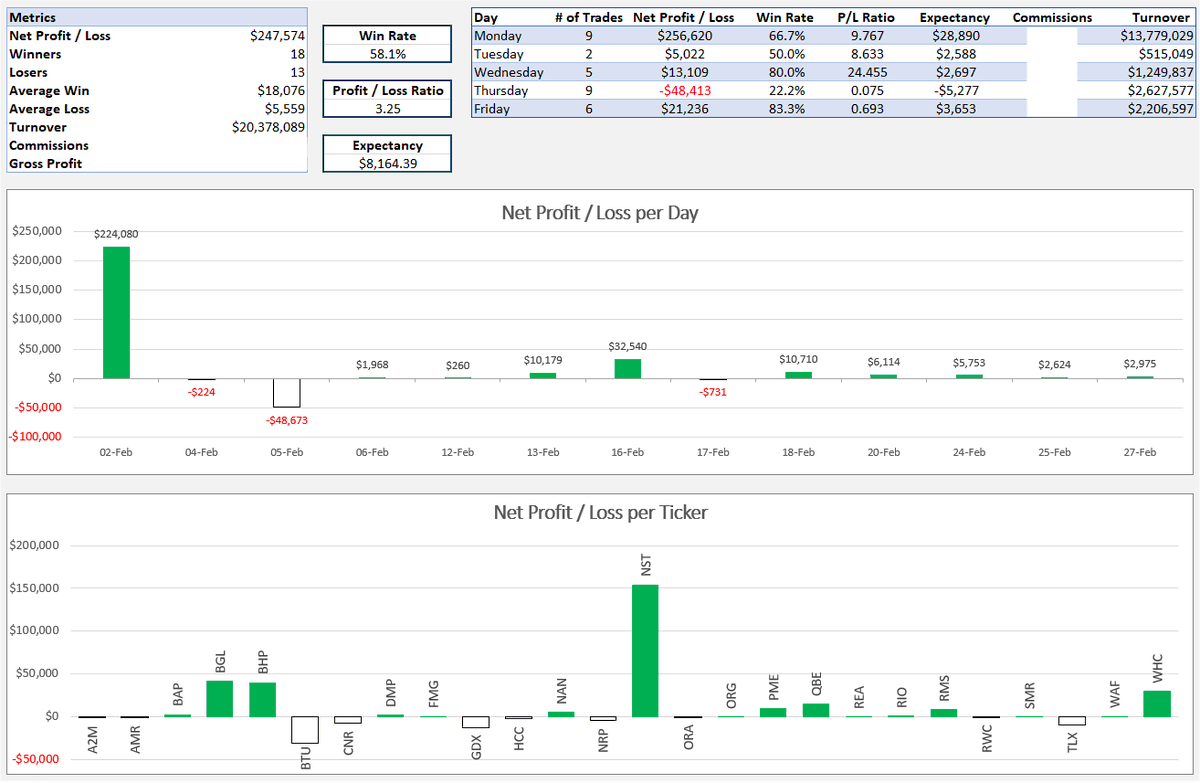
+$1.23m for 2025
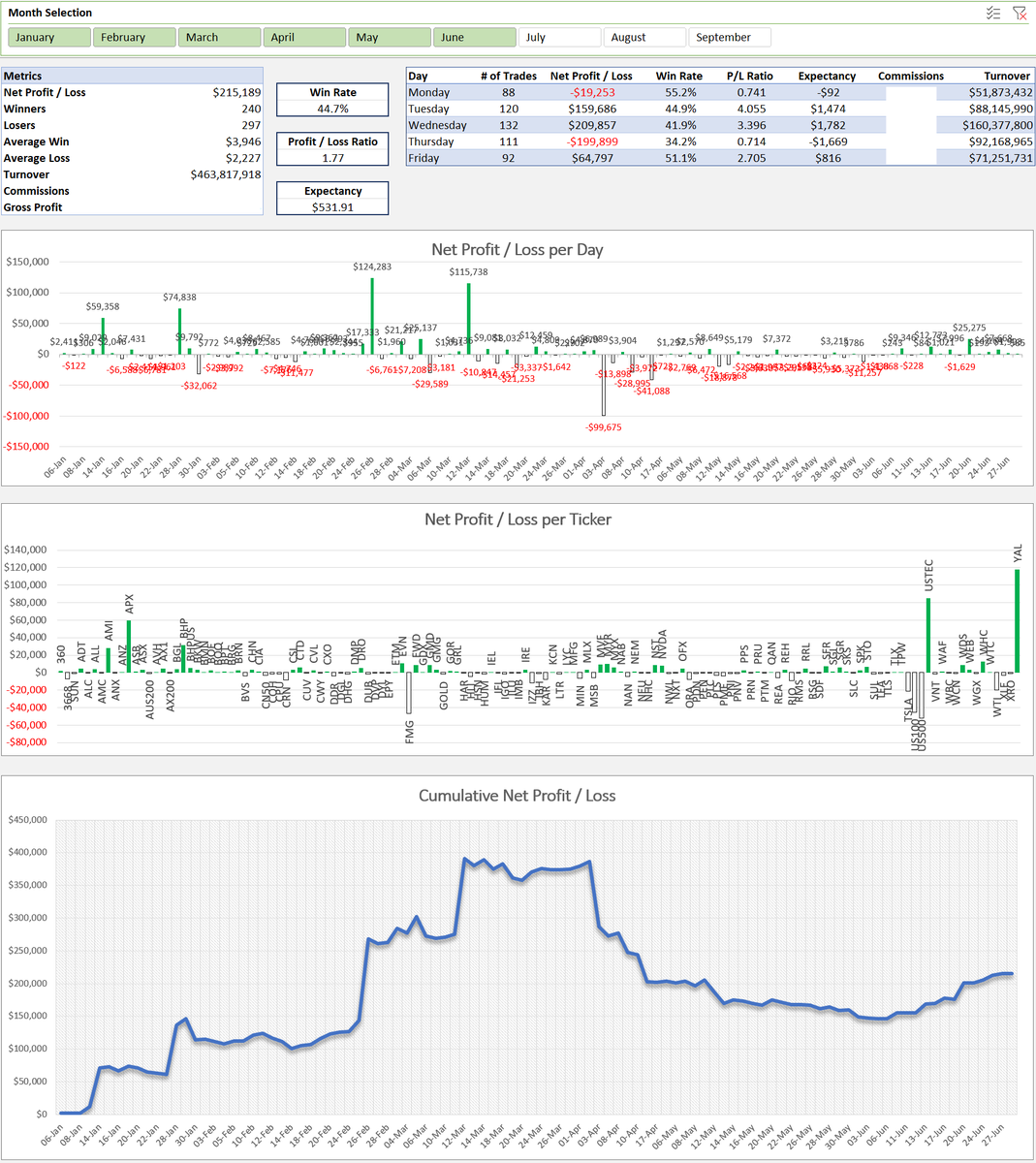
1H 2025 = $215k
2H 2025 = $1.02m
Another huge year for me, and my second consecutive 7 figure year. While I always had confidence I would become a consistently profitable trader, I never really imagined that I would be able to achieve something like this. Below I’ll provide additional context about my trading journey and how I made my money this year. Some of the following content was included in my end-of-year post last year, but since I deleted that post I thought it was worth repeating here.
Like many others, five years ago I saw Nick Fabrio‘s post showing that he’d made $1m of profit from intraday trading. After this, I discovered other Australian traders like Austin Mitchum, James Chen and Bryce Edwards. These traders proved, contrary to conventional wisdom, that it is possible to make a good living from short-term trading. This sparked my own trading journey, which I started by risking $1 per trade for many months. Since then, I’ve developed an edge in a few different setups and I’ve sized up significantly. This year, my turnover was over 50x higher than in my first year (and getting close to $1bn, which would have seemed absolutely crazy to me five years ago).
I’m definitely not the best trader out there; there are plenty of Australian traders with much more experience than me, some of whom presumably earn significantly more. However, most successful traders aren’t well known or don’t post their P&L, probably because humility is such an important character trait in becoming successful. The main reason I still post my P&L is to show that it is still possible to make money from short-term trading on the ASX. In a journey plagued with difficulty and self-doubt, I think there is value in knowing that the destination is actually achievable.
If you’re going to post P&L (particularly big positive numbers), I think transparency is important. It’s much easier to share wins than losses, which is why you see a lot more of the former. This presents a misleading picture of how easy it is to succeed. I once heard someone describe trading as ‘pulling money out of thin air’. This should be difficult, and it is. Successful traders are the tip of the iceberg. Even if you do achieve success, it’s inevitably a long runway, full of setbacks and emotional turmoil. However, if you love trading and you’re prepared to work hard, then it can be done. Throughout my trading journey I’ve shared both the highs and the lows, from my very first trade. I don’t think there is a more complete record of an ASX trader’s journey out there.
In the spirit of transparency, I would like to provide some additional context to my performance this year. Similar to last year, I made a significant amount of profit from swing trades, not intraday trades, often using significant amounts of capital (and bolstered by leverage). In theory, it would have been possible to make $1m purely from intraday trading on the ASX this year. However, it would have taken a truly elite performance. If you want to make bigger money on the ASX, a large part of that probably has to come from swing trades, because liquidity in the Australian market puts a cap on how much you can earn intraday. I note that my swing trades were typically measured in days/weeks, rather than months.
Second, I was fortunate to already have some savings built up before I started trading (and a spouse who still earns a good income). It’s this financial security that enabled me to survive the $80k drawdown early in my trading career, which would have crippled the vast majority of developing traders. It also enables me to endure significant drawdowns and overnight risk.
Third, the fact that I don’t need the money from trading to pay for living expenses gives me a psychological advantage which is difficult to overstate. It’s a huge part of the reason I was able to advance my sizing and profitability as quickly as I have. I think I still would have achieved success if I started with less capital, but it’s hard to say for sure and it definitely would have slowed down my growth rate.
Now for some comments on my trading performance this year:
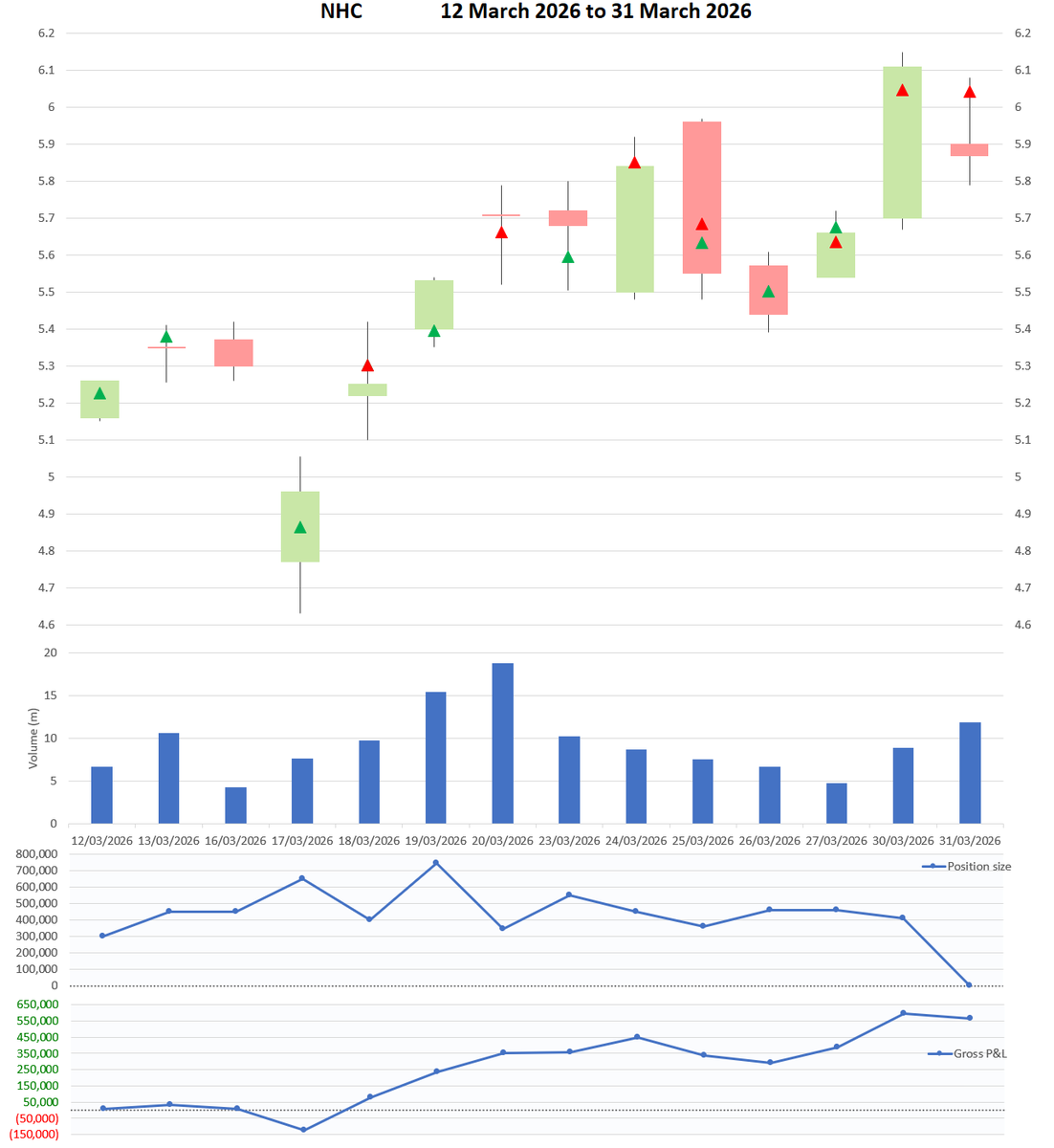
- I finished the year strong with a $437k winning trade in WAF (about $350k after hedging). This was a deep value play right up my alley and I sized it very aggressively.
- Overall, I’m not actually that happy with how I traded through the year. Compared to last year, I made about $100k additional net profit. However, I made 68% more trades and had 143% more turnover, so I was a lot less efficient. More importantly, my maximum drawdown was ~$250k, compared to ~$40k last year. I also had four drawdowns of $200k or more. Ultimately, this meant a lot more stress and volatility for relatively little gain.
- One of my goals for the year was to minimise big losses, and I completely failed at this. In total, I had 39 losses exceeding $10k for a total net loss of over $1m! Some of this was due to bigger sizing, but many losses were still too big, the biggest coming from DRO over the course of two days (almost $200k in total). There was undeniably a lot of avoidable P&L leakage from losses that were bigger than necessary.
- Sizing aggressively has always been one of my strengths. Sometimes, this results in outsized losses, but the flipside is that I also made a number of great winning trades. My biggest winning trades were as follows:
o $437k in WAF (swing trade held for about 30 days)
o $120k in YAL (swing trade held for about 20 days)
o $120k in APX (intraday)
o $90k in BOT (intraday)
o $76k in RUL (swing trade held for about 10 days).
- I made almost 70% of my P&L for the year from these top five trades. 100% of my P&L came from just my top 15 winning trades. Obviously, it isn’t realistic to assume I could just make big winners and nothing else, but it does show that a lot of the smaller trades are kind of meaningless for me.
- I strayed into index trading, which worked well initially but I abused it and ended up giving back all of the initial profits and more. This is a good tool to have in the toolbox, but there isn’t much edge there for me so it’s something I need to use sparingly.
- I failed to really take advantage of any major trades/themes, like rare earths, precious metals, lithium and DRO short. In the latter three trades/themes I had large positions established but didn’t manage to hold on for any meaningful gain (and in the case of DRO, I got smoked completely). In future, something I want to try is reducing my size and increasing my timeframe to reduce the variance of my P&L and my reliance on perfect timing.
Going forward, I’ve reached a point where I don’t need to keep pushing so hard and take so much risk, so I’d like to change how I trade to reduce stress and allow more time for other pursuits (eg golf, exercise, time with kids, projects around the home). I imagine this will mean less intraday trading, lower size and longer timeframes. The trade-off will probably be less P&L, but I’m okay with this.
Thanks to everyone who has followed me and provided encouragement or support over the past few years. If you have any questions please post them below or reach out to me privately.

English