
Tweet fixado
August
22 posts


@vertiasluxmea @xonkius @TheOrthoEnsign Yes his threads show exactly the position of Met. Theophan Prokopovich is not novel it is handed down by the holy Saints especially St Augustine. x.com/i/status/19829…
Orthodox Ensign ☦️🔄🧎@TheOrthoEnsign
Compiled quotes on the topic of Christ's righteousness or merits being imputed to, or appropriated by, or given as covering to, or possessed by, believers – a thread 🧵
English

English
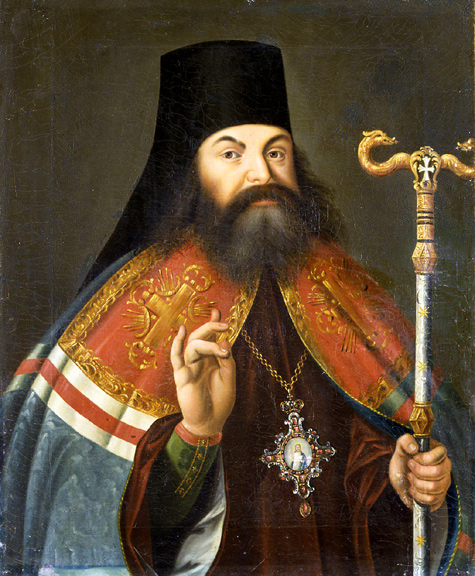
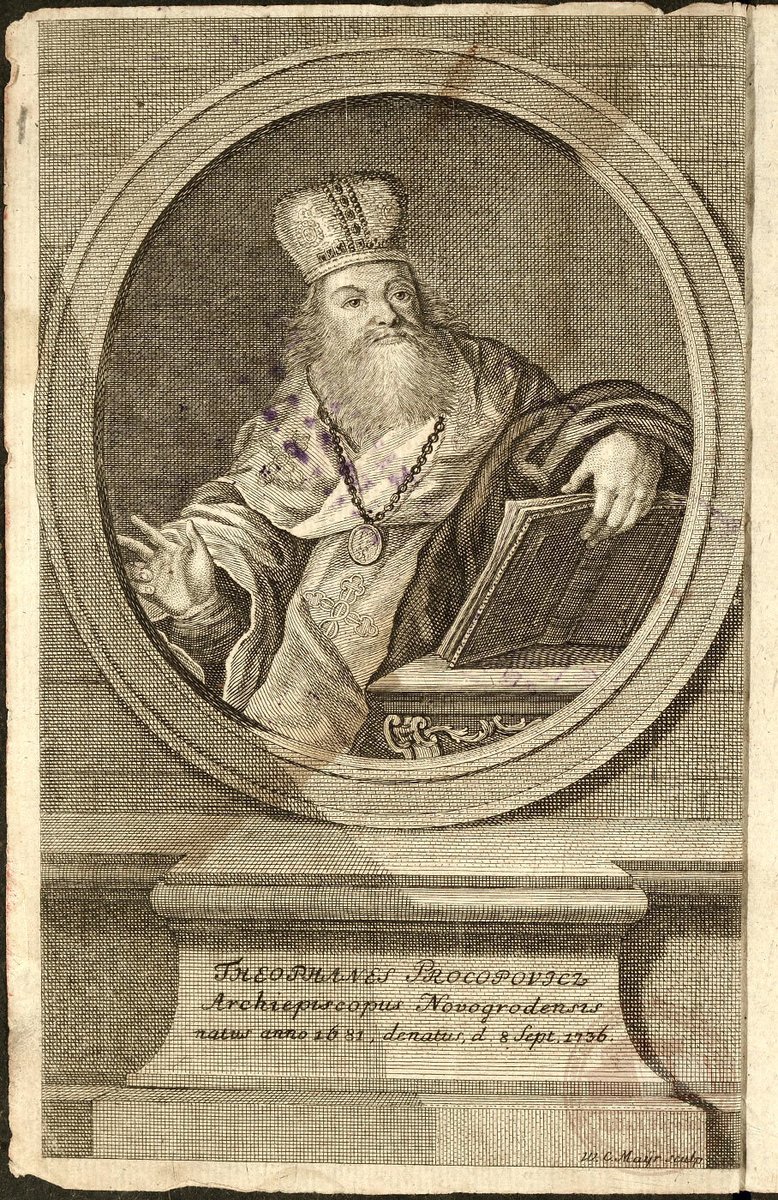
"Justification is an act of divine grace by which God freely — in relation to the human being — declares a sinner righteous: one who acknowledges his sins with true and sufficient sorrow and believes in Christ, on account of Christ's merit alone as apprehended by faith; declaring him righteous by not imputing — that is, by remitting — his sins and by truly imputing to him the righteousness of Christ. It is to be noted here that we take the term "justification" in its forensic sense — that is, as acquittal from the charge of a crime alleged against someone."—Theophan Prokopovich

English

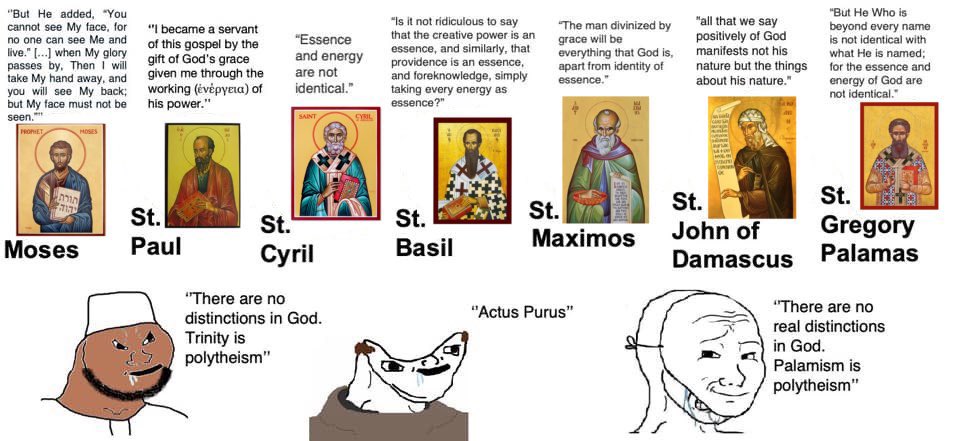
@AngloVarangian I also forgot to recap a little bit on distinctions.
Technically, when St. Gregory says that essence and energy are distinct, he doesn't mean a simply real distinction. What he means is either a formal-virtual or formal-actual. I think it's obv he meant the latter.
English
Being Catholic is a lot less stressful when you just obey the Catechism and trust that the church will never teach falsehood. People get so stressed out when Jesus literally promised the Catholic Church would never fail.

English
August retweetou


Orthodox do not believe the Eternal Holy Spirit wrote the entirety of scripture, as God Himself says.
English
August retweetou

"Q. How then could the eternal justice of God allow that Jesus should die a cruel death being wholly innocent?
A. He died for no sin of His own but for our sins. The eternal justice of God required such an innocent and priceless sacrifice for Adam's sin and ours."
~St. Nikolai

English
Theophan Prokopovich on Whether the tinder itself, or the original stain, is per se sin and merits the wrath of God:
"It should be noted first of all that the tinder of sin — that is, concupiscence — can be considered in three ways: first, as the concupiscible faculty, which is a natural power good per se; second, as an act of concupiscence that is good and ordered — such as the appetite for food in a hungry person; third, as evil concupiscence — and this is taken either for the very habit actually inhering in us, or for the first impulses and acts of it without consent, or for the very fruits produced after consent. Here therefore by the tinder we understand evil concupiscence taken in the first and second ways; for taken in the third way it is more a flame than a tinder. And it is asked of this tinder: is it per se sin? The Papists and Socinians deny it; we affirm it. Therefore let the following be stated.
THESIS V. THE TINDER OF SINS OR THE ORIGINAL STAIN IS PER SE A SIN IN THE TRUE SENSE OF THE WORD, AND MERITS THE WRATH OF GOD.
This is proved: first, from Rom. VII. 5. 7. 8. 9. and following, where concupiscence in the regenerate is fourteen times called sin — and properly and formally, not by metonymy; for it is called "evil" in verse 15, something to be hated, crucified, and mortified; second, from the fact that it truly conflicts with the law, and is therefore truly ἀνομία (anomia — lawlessness), as in Rom. VII. 7.: "I would not have known concupiscence if the law had not said: you shall not covet"; third, from the effects of concupiscence in the regenerate that belong exclusively to sin properly so called — such as: working evil, resisting the law of the mind, and holding us captive under the law of sin; fourth, from the fact that even the saints are obligated to pray daily "forgive us our debts," as said above; fifth and finally, the same is proved by the most open testimonies of antiquity. Ambrose, Libro contra Novatianos: "All men are born under sin, whose very birth is in vice — therefore the flesh of Paul was a body of death." Hilary, in Psal. CXVIII: "The law taught us that in this habitation of the earthly and mortal body we cannot be clean, unless we obtain cleansing through the offering of heavenly mercy." Augustine, Lib. VI. contra Iulianum cap. V.: "Who is so imprudent and shameless as, while confessing that sins are evil, to deny that evil concupiscence of sins is evil — even though the Spirit's lusting against it does not allow sins to be conceived and brought forth?"
But even Bellarmine himself with other Papists frequently admits that concupiscence is the law of the members resisting the law of the mind; is a vitiated power of the soul; is to be compared to mad dogs; is iniquity in the flesh materially and in the mind formally; is sin, vice; resists virtue; is hated by God; etc. How then is it denied that it is in itself and by its own nature sin? But the Papists object: first, Paul in Rom. VII. speaks not of himself as regenerate but as unregenerate as he formerly was. The Socinians also hold that under his own person the Apostle is speaking of an unregenerate man, because: first, he speaks in the past tense, not the present, as is plain from verses 4, 5, 6; second, because he speaks of a man in whom sin works every concupiscence, but the regenerate crucify sin with concupiscence, as in Gal. V. 23.; third, because in the man whom Paul describes, sin is said to live so strongly as to hand him over to death — but the regenerate is dead to sin, and sin does not reign in him; fourth, because to be carnal and sold under sin does not belong to the regenerate but to the unregenerate.
In reply: the Apostle absolutely treats in the prior verses up to verse 14 of an unregenerate man; yet it does not follow from this that nothing of what follows can be said of the regenerate. For he says that sin dwells even in himself as a regenerate man who does not will evil but desires to do good, as in Rom. VII. 18. — and therefore he calls himself carnal not simply and wholly but in a qualified sense and in part. For those who are simply carnal do not fight against the flesh; but Paul felt in himself the struggle of the flesh against the spirit. Likewise he says he is sold under sin not simply but in a qualified sense — on account of the feeling of and struggle with the indwelling sin — but not on account of its full dominion. Second, Bellarmine objects: concupiscence is called sin by Paul not properly but by metonymy — namely because it is a cause of sin if it is obeyed. In reply: the same can simultaneously be both a punishment and a cause of sin, and at the same time sin itself. For if concupiscence were only a punishment and not sin, Christ would have assumed it with human nature — since he assumed all our punishments including death itself."
English

Qué poca educación y qué poco respeto hay en nuestra sociedad.
Riéndose de nuestra fe (sí, siempre contra los mismo) y jugando con lo más sagrado e importante, cometiendo un sacrilegio gravísimo.
El que come al Señor indignamente come su propia condenación.

Español
"Some say there is a real distinction, inadequate, of the kind said to exist between a whole and its part, between greater and lesser: the whole contains the part, and the larger number contains the smaller; and a whole is not thereby distinguished from its part, nor a larger number from a smaller. Yet the whole and the larger number have something more besides the part or the smaller number, and are distinguished by this excess. Thus, they say, the person of the Father, for example, contains the nature, but also something more — namely, personality; or if you prefer, the divine nature contains the person, but also something more — namely, another person. But if this doctrine is to be understood through some analogy with human things, it is empty: for it says nothing other than that there is a distinction in the Deity, but does not explain what kind it is. If it is taken properly, it is impious: for it makes person a part of nature, or nature a part of person."—Theophan Prokopovich

English

TONS of new inquirers at church today. All of them came from watching apologetics.
Glory to God.
Today was a good day
English


English
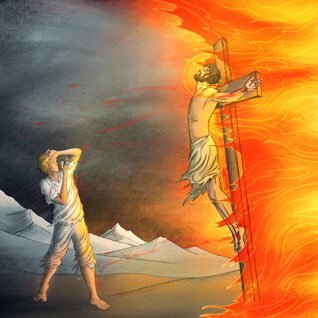
This FREE online conference is starting in a few hours. @EliAyal17454205 @Acts17David @tmcos_tony
Epic line up of topics. I'll be speaking at 5:40pm ET on "Eastern Orthodoxy and the Doctrine of Justification by Faith Alone"

English
Theophan Prokopovich on Gods absolute simplicity: That God is so simple as to lack substantial and integral parts, both homogeneous and heterogeneous, is proved.
First: from the fact that he is spirit, Joh. IV, 24. But a composition consisting of the enumerated parts can be appropriate only for bodies, not for spirits. For we call something a spirit because it lacks parts, by analogy with air; air, because it is a most light body that does not present itself to the eyes, and thus though it has parts, seems to have none, so we also borrow its name to express an immaterial, uncomposed, and simple thing.
Second: the same is shown from the infinity of God. For if God consisted of parts, the whole God would be greater than any of his individual parts, and therefore none of his parts would be infinite: for it would be less than the whole; but we have demonstrated above that an infinite thing less than another infinite is impossible. Consequently God himself would not be infinite: for what consists of finite things is not that infinite.
Third: from the perfection of God. If there were two parts in God, either one part would have all the perfections that the other has, or it would not. If the former: then the other part would be superfluous, or rather it would be not so much another part as another God. If the latter, that is, if this part had these perfections and that one had those, then neither would be most perfect, and therefore neither would the whole compound be most perfect: for what does not consist of most perfect parts is not most perfect or infinitely perfect.
Fourth: God is Jehovah, that is, being by excellence; therefore he is most simple and alien from all composition. Otherwise he would not be being but rather beings; nor could he be called being by excellence: because what is composed of parts does not have full and total being in any of its parts; and therefore it is composed, because the first part does not suffice for being of such a kind, but the other part is also required. Now it is more excellent being that does not need such composition, but is most simple through itself and sufficient for its own being.
Fifth: God is a being of himself, that is, from no one, both effectively and constitutively. But the parts from which a whole is composed are principles of the whole not indeed efficiently, but certainly constitutively.
Sixth: if God consisted of parts, he would certainly be composed. I ask: by whom would he be thus composed? By another? Then he would not be God, for he would be weaker and inferior to the one composing him. Or by himself? Then his parts would have the power of composing themselves, and would therefore each be omnipotent; thus they would be two gods rather than parts.
These are the reasons for the simplicity of God, all founded in Scripture, from which we know God to be most perfect. Let us conclude with an elegant saying of Tertullian, *Lib. VII, de Trinitate*: "He is himself all eye, because he sees all things all-together; all ear, because he hears all things all-together; and all hand, because he works all things all-together; all foot, because he is everywhere all-together. For he who is simple has no diversity in himself."

English

Orthodox saint says the Bishop of Rome is the head of all other bishops

English
"But now the clear words of Damascene, not being tolerable to the Latins, have been variously twisted and contorted by them. Some such as Bellarmine in de Christo, book 2, chapter 25, and Theophilus Rutka throughout his writings — would have it that Damascene's opinion was that..
English