E=NC^2

7.3K posts

E=NC^2 banner
E=NC^2

E=NC^2

@eeqnc2

PhD in MechE / Robotics || 1.5 yrs in Rockets/Controls/Embedded C++ || ML+AI since 2019 || Founder since 2024 || Christian

Gilbert, AZ Entrou em Aralık 2021
396 Seguindo347 Seguidores
Tweet fixado
E=NC^2
E=NC^2@eeqnc2·
What would be the Elon-tier solution for suburban life? How about a suburb that delivers extreme quality of life at cost. High trust, walkable, with affordable farm to table groceries delivered weekly to your doorstep milkman style. Kids roaming the streets safely. Service workers happy, well paid, and eating healthy. Here's how we do it: instead of an HOA, an HOC (Home Owners Corporation) which exists to provide economies of scale and cut out middlemen. It's owned by the residents and runs on 0% margins. This aligns incentives so the company can ruthlessly cut out middlemen and source top-quality food, beverages, 30% - 50% cheaper than grocery store prices. The service workers employed by the company would get free rent and free food (of course the apartments they live in are owned by the HOC) so the low cost high quality of life becomes part of their compensation this means the neighborhood bakery and gym can be staffed with wonderful people instead of grumpy teenagers or drug addicts. The neighborhood is kept safe with a security network that is professionally monitored - again: by residents and part of their pay is the food we get at a 50% discount. So kids can be free to play and any suspicious behavior will be flagged and taken care of. Oh I almost forgot the neighborhood micro-brewery!! Definitely need one of those. I say we buy 1000 acres of wilderness somewhere and stand this up. Who's with me?
English
1
0
1
440
E=NC^2 retweetou
E=NC^2
E=NC^2@eeqnc2·
@TheStudyofWar I wonder where gloabal oil supply will shift if Iran proves that Hormuz is unreliable?
English
0
0
0
98
Institute for the Study of War
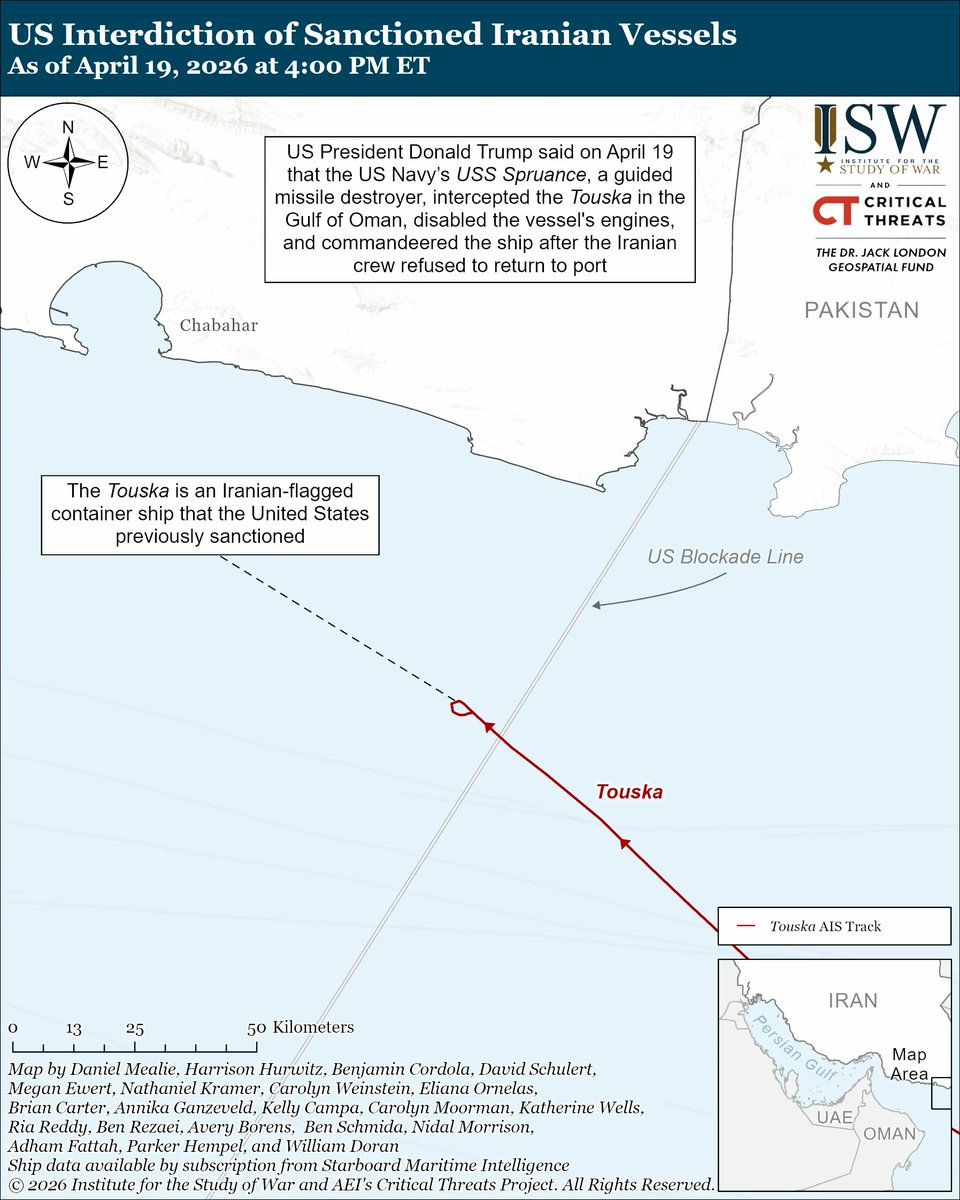
NEW: Any US settlement or resolution of the conflict that enables Iran to control traffic through the Strait of Hormuz would represent a major US defeat and set a precedent with critical implications for global trade, given the strait’s role as a critical energy chokepoint. Any US acceptance of Iran’s ability to regulate transit would undermine the principle of freedom of navigation through the Strait of Hormuz and enable Iran to condition access to the strait on compliance with its demands, thereby enabling Tehran to exert persistent pressure on the global economy and the United States and its allies. Iran is attempting to establish a protection racket in the Strait of Hormuz by granting priority transit to vessels that pay fees and comply with Islamic Revolutionary Guards Corps (IRGC) protocols as part of its effort to try to consolidate control over the strait. Iran has also continued to prevent non-Iranian-linked vessels from transiting the strait. US forces seized an Iranian-flagged container ship for the first time during the war. Commercially available shipping data indicates that the US Navy also forced at least three Iranian or Iranian-linked ships to change course toward Iranian ports on April 19. US Vice President JD Vance, US Special Envoy to the Middle East Steve Witkoff, and Jared Kushner are expected to travel to Islamabad, Pakistan, to engage in negotiations with Iran on April 21. ISW-CTP has not observed any Iranian sources confirming Iran’s participation in the negotiations as of 6:00 PM ET on April 19, however. Incomplete reporting about the damage that the US-Israeli combined force inflicted on Iran’s ballistic missile and drone programs precludes the development of a quantitative assessment about the threat that Iranian missiles and drones still pose. A statement released by Iranian-backed Iraqi militia Kataib Hezbollah on April 18 appears to confirm that IRGC Quds Force Commander Brigadier General Esmail Ghaani discussed preparations for renewed conflict with the United States and Israel during his meetings with Iraqi militia leaders in Baghdad on April 18. Ghaani may have specifically discussed enhancing coordination between Iraqi militias and other Axis of Resistance groups against the United States, Israel, and the Gulf states in the event of renewed conflict.
Institute for the Study of War tweet mediaInstitute for the Study of War tweet mediaInstitute for the Study of War tweet media
Institute for the Study of War@TheStudyofWar

NEW: The Iranian political officials who will reportedly negotiate with the United States in Islamabad, Pakistan, on April 21 neither have the authority to independently determine Iran’s negotiating positions nor are driving decision-making in Tehran. Other Key Takeaways: US Special Envoy to the Middle East Steve Witkoff and Jared Kushner will attend the talks. Iran’s negotiating delegation is expected to include Foreign Minister Abbas Araghchi and Parliament Speaker Mohammad Bagher Ghalibaf. The upcoming talks appear focused on extending the ceasefire, which is set to expire on April 22. Iranian sources familiar with the negotiations stated that Iran expects that the ceasefire will be extended and that additional talks will occur if the negotiations on April 21 go well. The Iranian negotiating team does not have the authority to independently determine Iran’s negotiating positions, however. IRGC Commander Major General Ahmad Vahidi and other senior members of the IRGC have consolidated control and wielded significant influence over the negotiations process thus far. Iran is attempting to establish a protection racket in the Strait of Hormuz, likely to consolidate the IRGC’s control over the strait and gain leverage over the United States in negotiations. Iran has reportedly decided to give vessels that pay a “security” fee and adhere to Iranian protocols priority to transit through the strait. The IRGC has continued to prevent traffic through the Strait of Hormuz. The IRGC Navy reportedly forced two oil tankers attempting to transit through the strait to change course. Many vessels that intended to transit through the strait have turned around.

English
20
169
499
413.5K
HeyGen
HeyGen@HeyGen·
We built our launch video in Claude Code using HyperFrames. Now it's yours. Open source, agent-native framework. HTML to MP4. $ npx skills add heygen-com/hyperframes RT + Comment "HyperFrames" to get the full source code of this launch video (must follow)
English
2.8K
1.9K
8.2K
2.9M
E=NC^2
E=NC^2@eeqnc2·
I’m going wrap my entire $200m dollar company in an autoresearch loop and see what happens.
English
0
0
1
28
E=NC^2 retweetou
E=NC^2
E=NC^2@eeqnc2·
I’m going to wrap an autoresearch loop around my company and see how fast I can double our $100m in topline revenue.
English
0
0
0
17
E=NC^2 retweetou
Shann³
Shann³@shannholmberg·
how autoresearch works, simplified it's a pattern that lets AI agents run experiments and improve anything you can measure three files is all you need, everyone should be running it. ↓ > program. md is where you tell the agent what to do. your goal, the rules it has to follow, and any constraints. think of it as the job description > train. py is the only file the agent can touch. this could be code, a config, a prompt, a math equation, whatever you want optimized > prepare. py is the scorecard. it measures results and the agent can never edit it. if it could, it would just fake better scores the loop it uses: 1. agent reads your goal 2. tries an experiment 3. measures the result 4. keeps it if the score improves, reverts if it doesn't 5. repeats for as long as it's improving. it can run 100+ experiments. a common conception is that it's for ML, but it can be applied widely. if you can score it, you can autoresearch it > Shopify ran it on their Liquid engine. 53% faster parsing from 93 automated commits > someone pointed it at a portfolio website and load time dropped from 50ms to 25ms in 4 minutes > Driveline Baseball used it for pitch velocity prediction. R-squared went from 0.44 to 0.78 marketing, trading strategies, prompt engineering, code performance. we have three conditions for it to work: > one number to optimize > automated evaluation with no human in the loop > one file the agent can change anything where "better" is subjective doesn´t really work. brand design, UX, pricing without user traffic data, so skip that. the edge here is picking the right metric give it a bad one and it will confidently optimize the wrong thing
Shann³ tweet media
Shann³@shannholmberg

Karpathy's AutoResearch is changing how campaigns get optimized and most marketers haven´t heard of it yet. Ole Lehmann tested it on landing page copy, 56% → 92% pass rate overnight. here´s how it works for marketing / skills 🧵

English
32
64
514
83.7K
E=NC^2 retweetou
Google Research
Google Research@GoogleResearch·
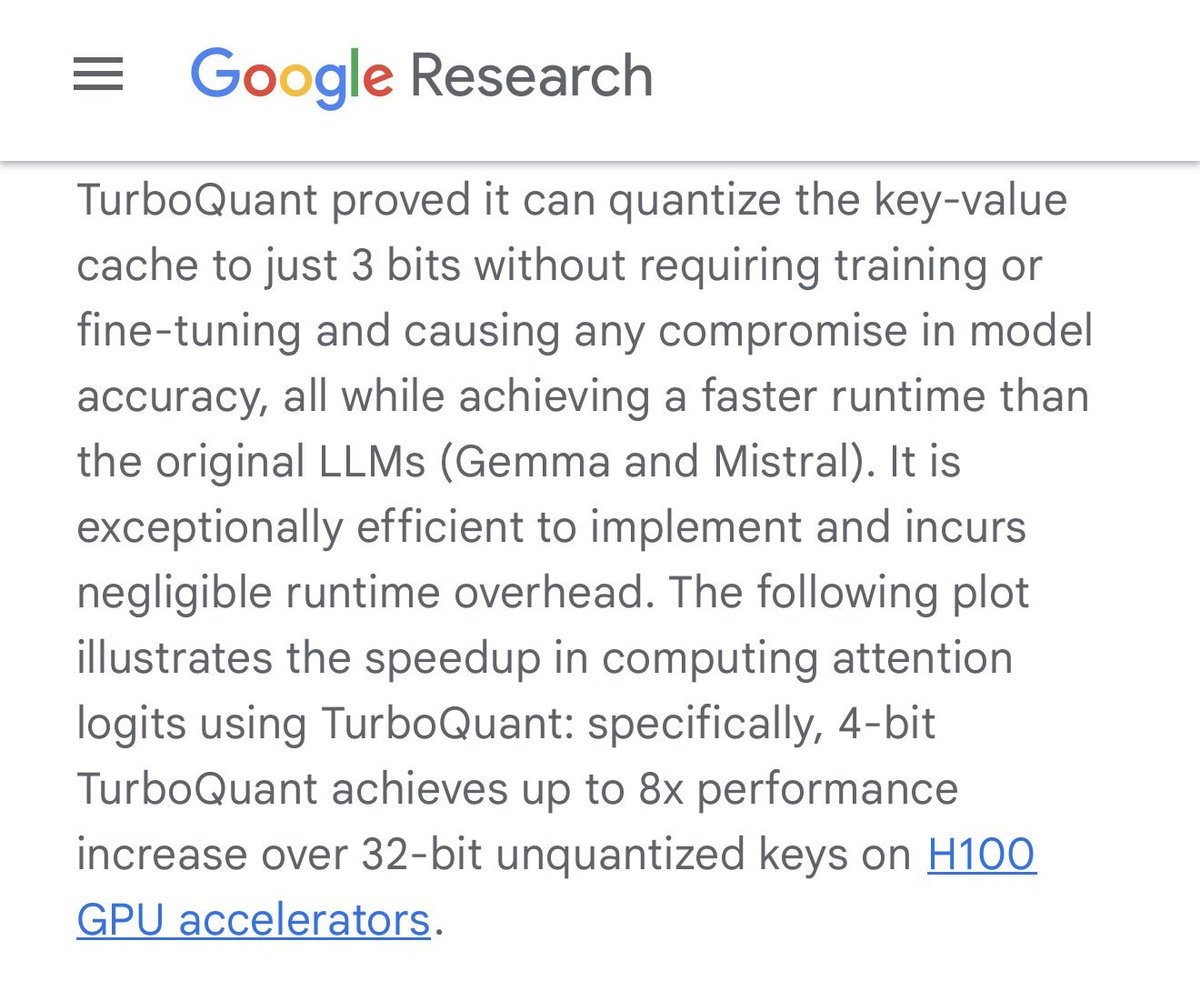
Introducing TurboQuant: Our new compression algorithm that reduces LLM key-value cache memory by at least 6x and delivers up to 8x speedup, all with zero accuracy loss, redefining AI efficiency. Read the blog to learn how it achieves these results: goo.gle/4bsq2qI
GIF
English
1K
5.8K
39.1K
19.3M
E=NC^2 retweetou
tae kim
tae kim@firstadopter·
Wat! "Our new compression algorithm that reduces LLM key-value cache memory by at least 6x and delivers up to 8x speedup, all with zero accuracy loss, redefining AI efficiency."
tae kim tweet media
Google Research@GoogleResearch

Introducing TurboQuant: Our new compression algorithm that reduces LLM key-value cache memory by at least 6x and delivers up to 8x speedup, all with zero accuracy loss, redefining AI efficiency. Read the blog to learn how it achieves these results: goo.gle/4bsq2qI

English
23
28
523
145.5K
E=NC^2
E=NC^2@eeqnc2·
Was off of X for the last couple months. What did I miss?
English
0
0
0
20
E=NC^2
E=NC^2@eeqnc2·
Sleep deprived, I made a gay joke around my gen Z employee "Jarvis put `Stephen is gay` on the TV." The bot didn't do it and it turns out Stephen really is gay so he didn't even laugh.
English
0
0
0
36
E=NC^2
E=NC^2@eeqnc2·
Agreed. December was a turning point.
Greg Brockman@gdb

Software development is undergoing a renaissance in front of our eyes. If you haven't used the tools recently, you likely are underestimating what you're missing. Since December, there's been a step function improvement in what tools like Codex can do. Some great engineers at OpenAI yesterday told me that their job has fundamentally changed since December. Prior to then, they could use Codex for unit tests; now it writes essentially all the code and does a great deal of their operations and debugging. Not everyone has yet made that leap, but it's usually because of factors besides the capability of the model. Every company faces the same opportunity now, and navigating it well — just like with cloud computing or the Internet — requires careful thought. This post shares how OpenAI is currently approaching retooling our teams towards agentic software development. We're still learning and iterating, but here's how we're thinking about it right now: As a first step, by March 31st, we're aiming that: (1) For any technical task, the tool of first resort for humans is interacting with an agent rather than using an editor or terminal. (2) The default way humans utilize agents is explicitly evaluated as safe, but also productive enough that most workflows do not need additional permissions. In order to get there, here's what we recommended to the team a few weeks ago: 1. Take the time to try out the tools. The tools do sell themselves — many people have had amazing experiences with 5.2 in Codex, after having churned from codex web a few months ago. But many people are also so busy they haven't had a chance to try Codex yet or got stuck thinking "is there any way it could do X" rather than just trying. - Designate an "agents captain" for your team — the primary person responsible for thinking about how agents can be brought into the teams' workflow. - Share experiences or questions in a few designated internal channels - Take a day for a company-wide Codex hackathon 2. Create skills and AGENTS[.md]. - Create and maintain an AGENTS[.md] for any project you work on; update the AGENTS[.md] whenever the agent does something wrong or struggles with a task. - Write skills for anything that you get Codex to do, and commit it to the skills directory in a shared repository 3. Inventory and make accessible any internal tools. - Maintain a list of tools that your team relies on, and make sure someone takes point on making it agent-accessible (such as via a CLI or MCP server). 4. Structure codebases to be agent-first. With the models changing so fast, this is still somewhat untrodden ground, and will require some exploration. - Write tests which are quick to run, and create high-quality interfaces between components. 5. Say no to slop. Managing AI generated code at scale is an emerging problem, and will require new processes and conventions to keep code quality high - Ensure that some human is accountable for any code that gets merged. As a code reviewer, maintain at least the same bar as you would for human-written code, and make sure the author understands what they're submitting. 6. Work on basic infra. There's a lot of room for everyone to build basic infrastructure, which can be guided by internal user feedback. The core tools are getting a lot better and more usable, but there's a lot of infrastructure that currently go around the tools, such as observability, tracking not just the committed code but the agent trajectories that led to them, and central management of the tools that agents are able to use. Overall, adopting tools like Codex is not just a technical but also a deep cultural change, with a lot of downstream implications to figure out. We encourage every manager to drive this with their team, and to think through other action items — for example, per item 5 above, what else can prevent a lot of "functionally-correct but poorly-maintainable code" from creeping into codebases.

English
0
0
0
20
Mike Futia
Mike Futia@mikefutia·
This YouTube AI Agent is f*cking wild. One keyword → every winning hook, angle, and theme from top YouTube videos 🤯 This n8n agent does your YouTube research in minutes instead of hours. Enter a niche. Get back a full breakdown of what's actually working. All inside n8n + Airtable + Gemini. Perfect for DTC brands and agencies who need creative inspiration without watching 47 videos first. Here's the problem: You're "researching" YouTube by watching video after video, taking messy notes, trying to figure out why certain content hits. Half your day disappears before you've pulled anything useful. This agent handles all of it: → Enter any keyword (protein powder, cold plunge, skincare routine) → Scrapes top-performing videos with full transcripts → Logs everything to Airtable—views, likes, publish date, channel → Gemini analyzes each transcript automatically → Extracts the hooks, angles, and themes that made them work No watching hours of content, manual note-taking, or rewinding the same 10-second clip five times. What lands in your Airtable: -> Video URL, title, channel, and performance metrics -> AI-extracted hooks (what grabbed attention in the first 10 seconds) -> Angles (the unique claim or perspective driving the video) -> Themes (the narrative structure underneath it all) -> Full transcripts for deeper research Built 100% in n8n. Want the complete n8n workflow + Airtable base? > Like this post > Comment "YT" And I'll send it over (must be following so I can DM)
English
243
21
405
25.6K
Stewart Alsop - Host of Crazy Wisdom Radio Show
Now that I’m experiencing what a social network that connects people together with threads rather than whatever twitter has turned into it gives me insight into the people in charge Musks narcissism allowed him to create a network “for people like me” I.e digital warlords Zuck is puro Aspergers meaning he is far more pragmatic, he listens to his advisors and says “let’s win by connecting people together” even though he doesn’t seem to actually connect with other human beings in the same way But this is also what led Zuck to allow for his company to make so many questionable decisions like destroying the spirit of the first amendment during COVID lunacy Musk actually stood up more than most to that nonsense (but not to the vax mandates, he failed there too)
English
3
0
5
294