
Esha Zaveri

1.1K posts

Esha Zaveri banner
Esha Zaveri

Esha Zaveri

@ezaveri

Senior Economist @WorldBank Ex @Stanford @penn_state—water, environment, agriculture, development—Student of music, nature & children's books. Views personal

Washington, DC Entrou em Nisan 2009
858 Seguindo818 Seguidores
Tweet fixado
Esha Zaveri retweetou
Ramachandra Guha
Ramachandra Guha@Ram_Guha·
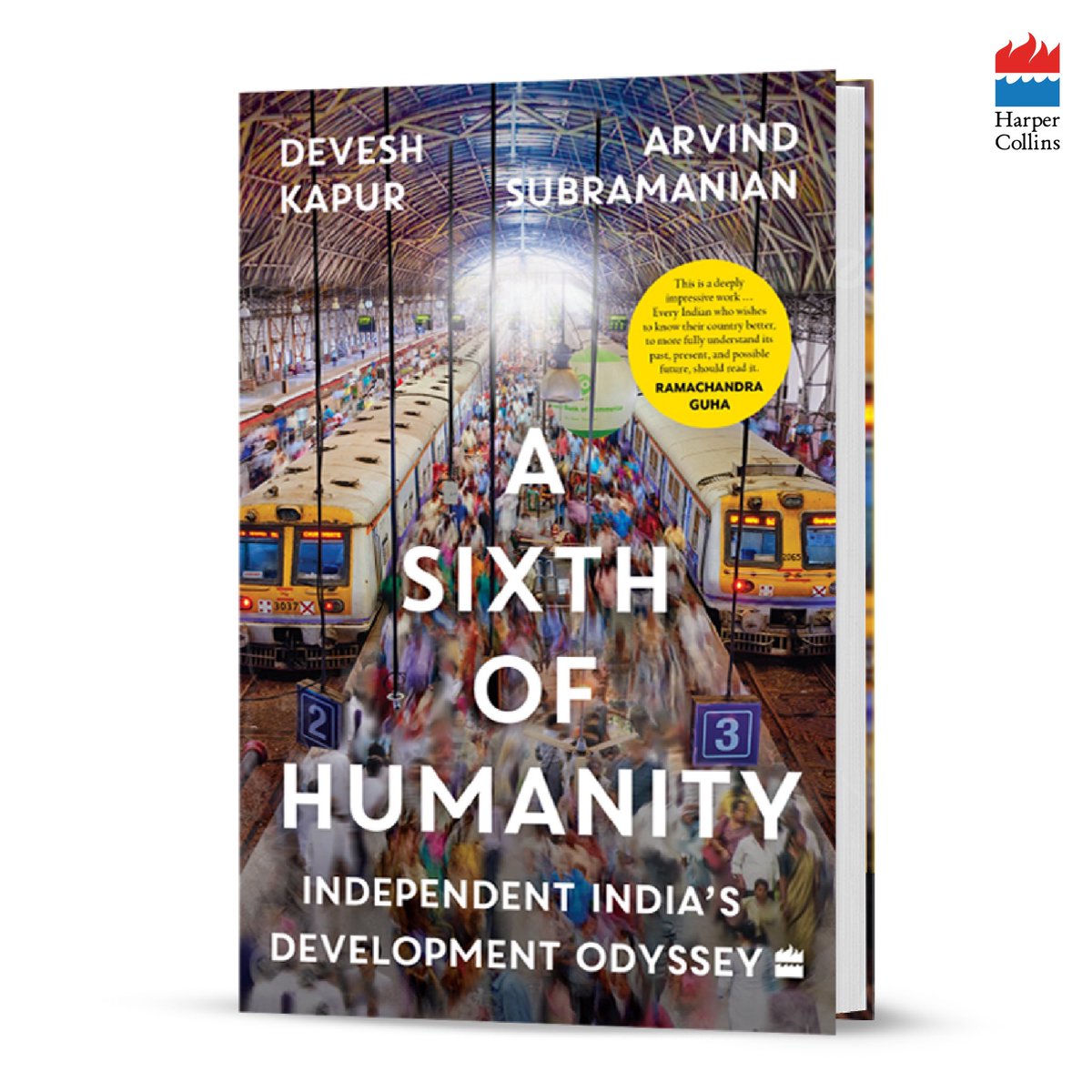
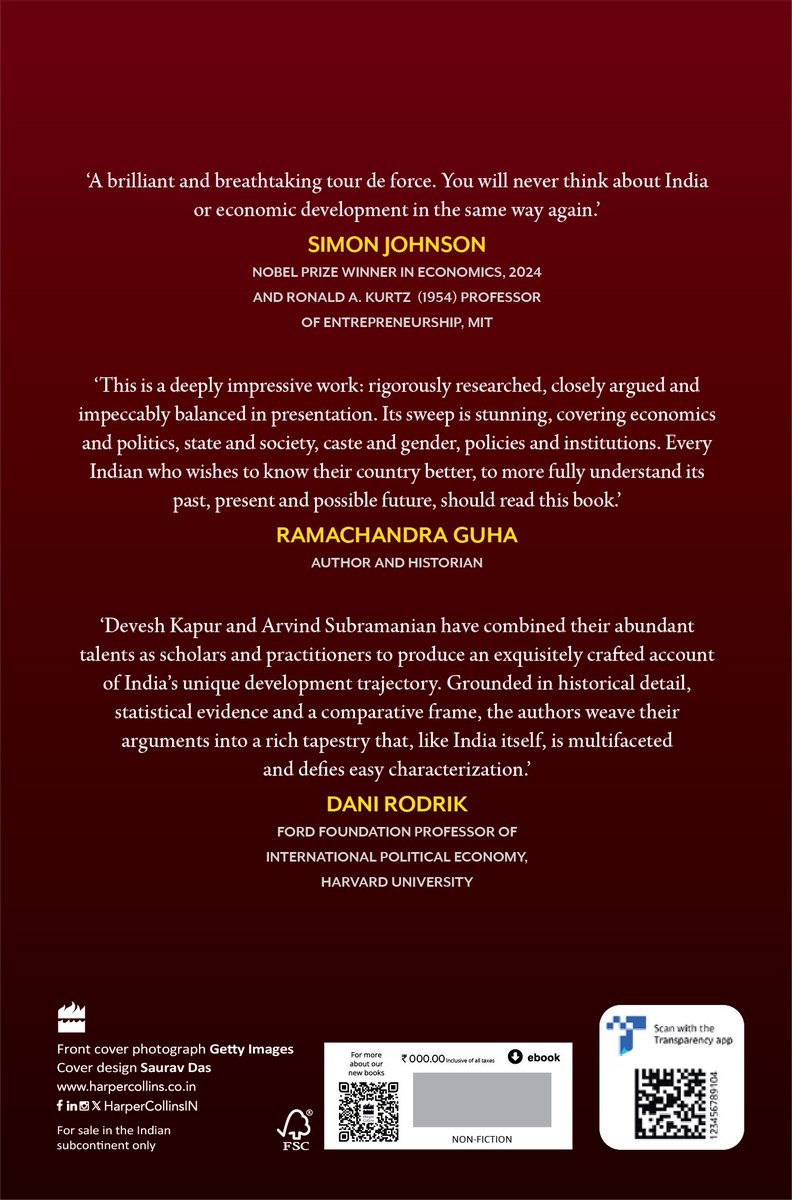
This just arrived. Professors Kapur and Subramanian have written a magnificent book, which is rigorously researched, elegantly presented, and impeccably balanced in its judgements. As I say in my endorsement, every Indian who wishes to know their country better should read it.
Ramachandra Guha tweet media
English
11
112
761
38.2K
Esha Zaveri retweetou
Luis Garicano 🇪🇺🇺🇦
I have a new paper with Luis Rayo on a key, simple question: will AI end careers as we know them? Link below. We all experience AIs usefulness every day: AI writing code, drafting legal memos, and analyzing spreadsheets. AI can already do many of the tasks that young people just ouf of university can do. This is fantastic for productivity, but it poses an existential threat to how we build careers. The traditional career path is essentially an apprenticeship. You start at the bottom, doing low-value, often menial tasks—the "grunt work." You accept lower pay because you are learning from experts. In effect, you are paying for your training with your time and effort. AI disrupts this bargain. If a machine can do the grunt work, the "currency" that juniors use to pay for their training disappears. If AI can do the junior work, why hire the juniors? And if no one hires them, how will they ever become seniors? This is what I have called the "AI-Becker problem" (after the economist Gary Becker, who analyzed the problem of general human capital acquisition). It’s a crucial question facing organizations today: Will the career pipeline survive the age of AI? In "Training in the Age of AI: A Theory of Apprenticeship Viability," Luis Rayo and I model this tension and find the tipping point. When AI enters an organization, it does two things simultaneously: It raises the Floor (Substitution): AI automates entry-level tasks. The "Floor" is the value the firm can get if they just use AI instead of hiring a novice. As AI improves, the floor rises. It raises the Top (Complementarity): AI can also boost the value of a fully trained expert. Think of an experienced architect using AI design tools to do better work faster. This is the "Top." The survival of the apprenticeship depends on a race between the Top and the Floor. As AI improves, both rise. But which one rises faster? We capture this race in a single statistic: the Expertise Leverage Ratio (R). It asks a simple question: How much more valuable is an AI-augmented expert compared to what AI can do alone at entry? R = (Value of Expert with AI) / (Value of AI alone at entry) Our main result is that there is precise threshold value of R (the mathematical constant "e" below which the apprenticeship collapses. Above, if AI alone is not good enough, or if AI increase the value of the expert enough, the career ladder continues. Why this specific threshold? It emerges from the delicate balance of the training relationship. In an optimal apprenticeship, the master "pays" the novice with knowledge, not cash (at least until they graduate). But the novice always has an outside option: they could quit and use the available AI themselves. To keep the novice from quitting, the master must transfer valuable knowledge just fast enough to make staying worthwhile at every moment. The master wants to slow down training to extract more work from the novice; the novice wants to speed it up. The constant e emerges mathematically as the tipping point that allows the master to optimally "stretch" the training duration. When the Gap is Large (R > e): If the gap between the Top (expert value) and the Floor (AI value) is large, the master has a lot of unique knowledge to "sell." They can stretch the training over an optimal, fixed duration. This gives the master enough time to recoup the costs of onboarding and mentoring. The pipeline is stable. When the Gap is Small (R
Luis Garicano 🇪🇺🇺🇦 tweet media
English
31
211
885
252.2K
Esha Zaveri retweetou
Garima
Garima@btwn_dimensions·
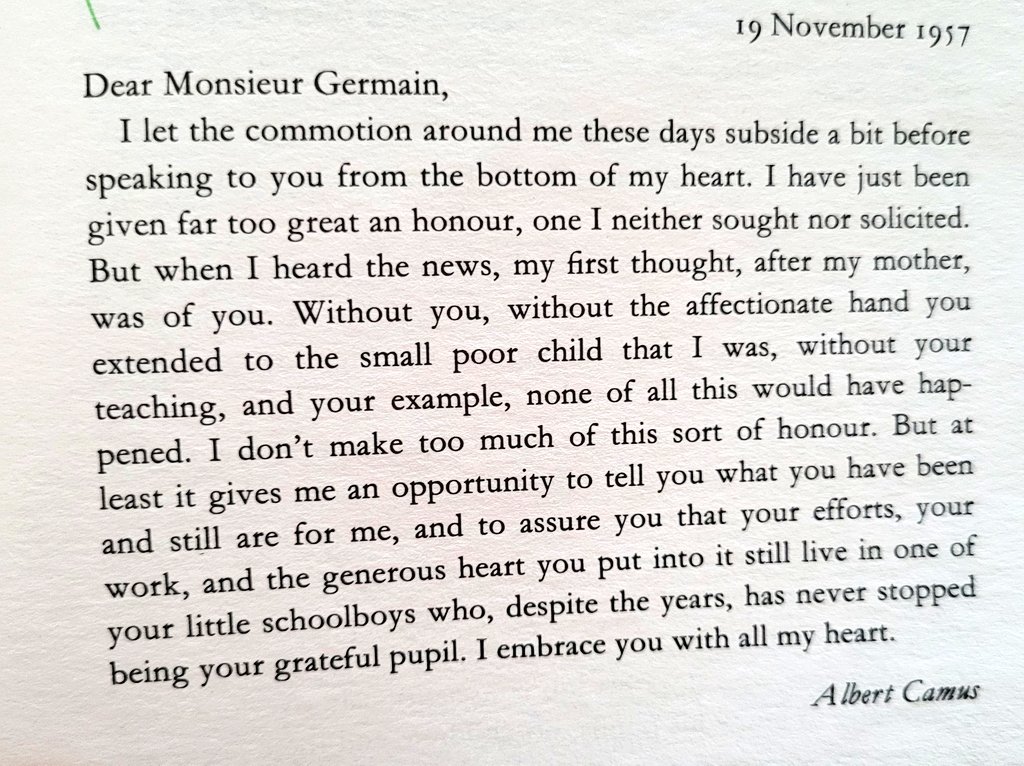
Camus' letter to his primary school teacher after he won the Nobel Prize for Literature.
Garima tweet media
English
9
288
1.6K
242.5K
Esha Zaveri retweetou
Maria Popova
Maria Popova@themarginalian·
Remembering the irreplaceable Jane Goodall with her abiding reflection on the measure of wisdom and the deepest wellspring of hope for our future: themarginalian.org/2021/12/26/jan…
English
1
31
121
8.5K
Esha Zaveri retweetou
Axel van Trotsenburg
Axel van Trotsenburg@Axel_vanT·
90% of people live with degraded land, unhealthy air, or water stress. In low-income countries, 8 in 10 face all three. Our new @WorldBank #RebootDevelopment report, launched today, shows we can grow economies & create jobs while protecting nature. 🌍 🔗 wrld.bg/QI5Q50WOPN9
Axel van Trotsenburg tweet media
English
3
18
32
8.4K
Esha Zaveri retweetou
Oxford Martin School
Oxford Martin School@oxmartinschool·
Can prosperity exist on a planet under strain? 🌍 The World Bank’s new flagship report shows how protecting nature is key to health, jobs & resilience. 📢 Launch event at @OxfordMartin School: 📆 Tues 2 Sept, 4–6pm 📍 In person, Oxford 🔗 Register: oxfordmartin.ox.ac.uk/events/the-eco…
Oxford Martin School tweet media
English
1
5
8
1.2K
Esha Zaveri retweetou
Milan Vaishnav
Milan Vaishnav@MilanV·
Having had the pleasure of reading drafts of this book by @arvindsubraman & Devesh Kapur, I can say—with no exaggeration—it’s one of the most —important books published on India—and development more generally—in recent memory. You can pre-order here: amazon.in/dp/9369891099?…
Milan Vaishnav tweet mediaMilan Vaishnav tweet media
English
3
27
137
10.8K
Esha Zaveri retweetou
Marshall Burke
Marshall Burke@MarshallBBurke·
Excited to announce a new funding opportunity for research on "what works" in climate adaptation. We are specifically looking for strong causal designs that tell us what interventions work (or don't) to reduce impacts of a changing climate. Link in next post. Plz share!
English
1
38
99
14.5K
Esha Zaveri retweetou
Derek Thompson
Derek Thompson@DKThomp·
Yes. Writing is not a second thing that happens after thinking. The act of writing is an act of thinking. Writing *is* thinking. Students, academics, and anyone else who outsources their writing to LLMs will find their screens full of words and their minds emptied of thought.
Derek Thompson tweet media
English
527
6.7K
30K
2.6M
Esha Zaveri
Esha Zaveri@ezaveri·
Never too late to read a magnificent article! Once one connects with a raga, its therav (or stillness) gently carries you back to where it first found you, regardless of how it’s rendered! Thanks for this gem @arvindsubraman
Arvind Subramanian@arvindsubraman

A personal musical journey provoked by the excellent Amazon Prime series Bandish Bandits, and in particular the Raga Marwa sung by the great Hindustani classical khayal singer Ustad Amir Khan in @scroll_in: scroll.in/article/108097…

English
0
0
0
223
Esha Zaveri retweetou
Avi Goldfarb
Avi Goldfarb@avicgoldfarb·
The Economics of Bicycles for the Mind. With @joshgans and @professor_ajay. A bicycle amplifies human locomotion. Computers and AI amplify human intelligence. We model such cognitive tools, showing when they affect productivity, inequality, & teams. nber.org/papers/w34034
English
2
12
43
3.5K
Esha Zaveri retweetou
AEA Journals
AEA Journals@AEAjournals·
Forthcoming in the JEL: "Difference-in-Differences Designs: A Practitioner’s Guide" by Andrew Baker, Brantly Callaway, Scott Cunningham, Andrew Goodman-Bacon, and Pedro H. C. Sant'Anna. aeaweb.org/articles?id=10…
English
3
200
671
52.7K
Esha Zaveri retweetou
Roland-Garros
Roland-Garros@rolandgarros·
This match is something else.
Roland-Garros tweet mediaRoland-Garros tweet media
English
111
977
7.5K
377.5K
Esha Zaveri retweetou
Michael Eddy
Michael Eddy@MichaelEddy·
Every year South Asia’s brick kilns spew as much CO₂ as the entire U.S. car fleet. They poison the air 2B people breathe—and kill over 50,000 annually A new study in Science supported by @stanfordimpact @open_phil & @JPAL shows how simple fixes can clean air & cut emissions🧵⬇️
Science Magazine@ScienceMagazine

Simple and inexpensive interventions aimed at making changes in how Bangladesh’s informal brink kilns operate could dramatically cut emissions and boost profits for producers, according to a new Science study. Learn more in this week's issue: scim.ag/4k9CsoV

English
6
44
101
27.1K