Bob Dewey

4.5K posts

Bob Dewey banner
Bob Dewey

Bob Dewey

@macroleverageTP

Most people think the future is collapsing. I study how progress actually happens.

Connecticut, USA Entrou em Mart 2009
945 Seguindo1.5K Seguidores
Tweet fixado
Bob Dewey
Bob Dewey@macroleverageTP·
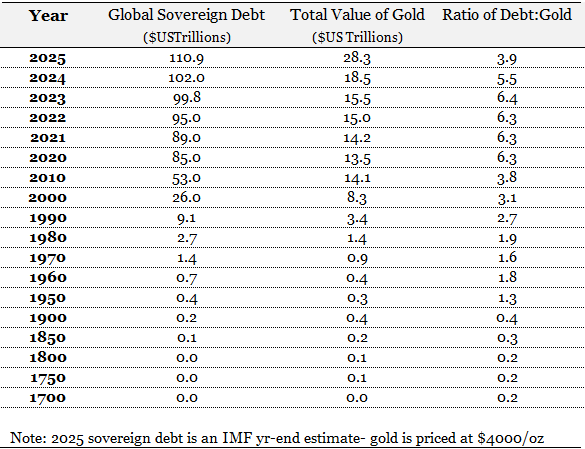
Gold is repricing trust. Below is the updated debt-to-gold ratio. For 100+ years it climbed almost in one direction as fiat replaced discipline. As @LynAldenContact has shown, gold couldn’t keep up with the telegraph — money had to move faster than metal. As @saifedean explains, WWI accelerated the break from sound money and ushered in the debt-laden fiat century. The ratio just turned — but not because debt fell.
Bob Dewey tweet media
English
3
0
9
526
Sam Callahan
Sam Callahan@samcallah·
“The ability to print money doesn’t apply here…You can’t print molecules.”
English
4
7
55
6K
Bob Dewey
Bob Dewey@macroleverageTP·
The complexities of crypto taxes are driving significant innovation in digital asset infrastructure. My new essay explores this hidden business. #CryptoTaxes
English
1
0
0
37
Nick Anthony
Nick Anthony@EconWithNick·
Everybody is saying it! It's time to stand up to the Bank Secrecy Act.
English
2
7
25
2.8K
Bob Dewey
Bob Dewey@macroleverageTP·
Such certainty… Centralization is not the same thing as security (against quantum attacks) and decentralization is not the same thing as insecurity. The probabilities of security are different. The legacy systems’ vulnerability is vastly greater due to its scale. And the honeypot from successful theft from legacy systems is vastly greater than theft from crypto wallets, especially because once detected, any crypto value would decline dramatically.
English
0
0
0
32
mert
mert@mert·
this is entirely incoherent btw bitcoin is uniquely vulnerable to quantum because i) it's pure root access to financial value, ii) decentralized other systems are comprised of several layers of different schemes and central monitoring and coordination such as rollbacks and almost none of them uniquely give you a single keypair to access all your money for bitcoin, even merely detecting the issue properly is incredibly difficult yet alone fixing it cleanly and timely it is dishonest to pretend that a decentralized system has the same challenges as the centralized one while larping about how decentralized is so much better because it's different
Michael Saylor@saylor

@chamath Your AI thesis assumes the digital world is quantum-resistant. If quantum breaks cryptography, it breaks AI, cloud infrastructure, banks, and the internet—not just Bitcoin. The entire stack upgrades together.

English
84
18
282
63.3K
Bob Dewey retweetou
matthew sigel, recovering CFA
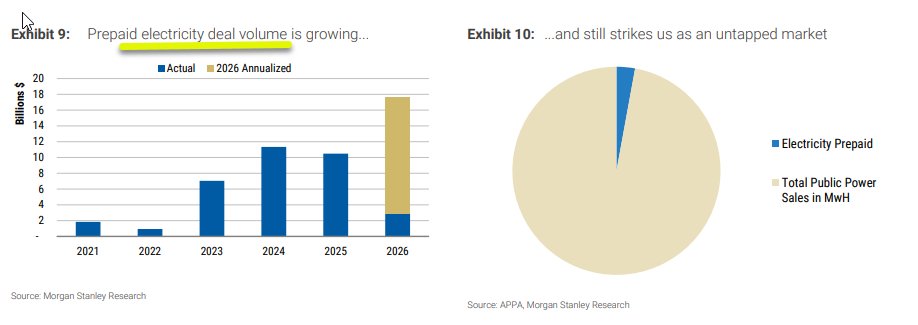
Why fund AI capex with expensive corporate debt when you can tap $4T of tax-exempt arbitrage to build the grid, slash prices, and ensure local control? Morgan Stanley, who pioneered the Bitcoin-to-data center conversion trade (likely after reading our research) is now signaling that the muni market is the next major funding vehicle for the AI race. They’re likely pitching this strategy to issuers right now to drive down infrastructure capital costs. >$100B Supply Wave: MS projects up to $100bn in incremental muni issuance to build the grid "backbone" AI requires. >15% Power Discount: Public power rates average 15% less than investor-owned utilities; could be a massive structural edge for high-load data centers. >The Prepay Arbitrage: Unlike taxable IPPs, public agencies can issue "Energy Prepay" bonds to lock in discounted power for decades; MS sees this market doubling to $200bn. >WACC Arbitrage: MS says 20GW of data center capacity will move onto municipal balance sheets to access the lowest cost of capital and mute retail power price hikes.
matthew sigel, recovering CFA tweet media
English
3
5
30
4K
Bob Dewey
Bob Dewey@macroleverageTP·
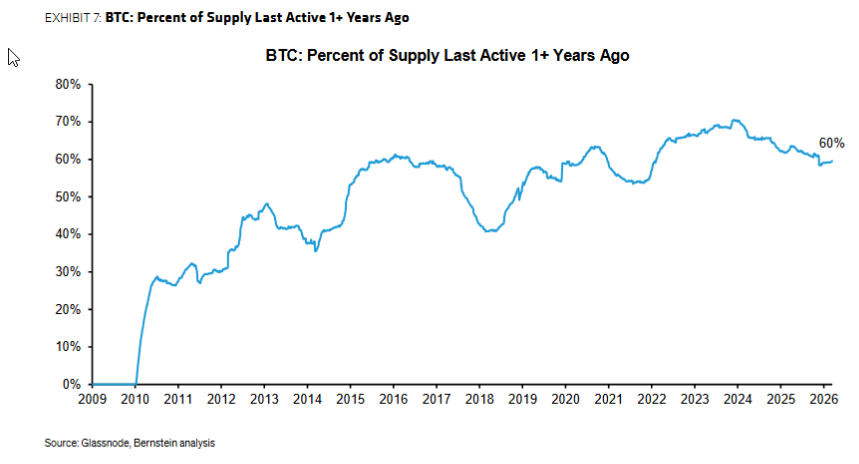
And high volumes (like most of the last 9 months) eventually lead to selling exhaustion. Since HODL rates have remained between 63% to 59%, the entirety of this selling volume is being churned through the remaining ~40% of supply held by <1yr traders. The 5 yr HODL rate is at 31.6%, only 0.2% off its high on Feb 28, 2024. The higher the average daily volume of Bitcoin, the faster that "available" selling supply runs out.
English
0
0
2
90
matthew sigel, recovering CFA
"Bitcoin retail holders have panic sold in recent months. However, long term holders remain resilient. Bitcoin holders inactive for more than 1 year stands at 60% of total supply. This ownership structure is unique to Bitcoin signifying long term ’believers’ who remain insensitive to Bitcoin volatility holding Bitcoin as a ’store of value’. This is despite Bitcoin’s significant underperformance vs. Gold last year. Almost ~14% of Bitcoin is held by ETFs, digital asset treasuries (incl. Strategy) and by governments. Bitcoin’s resilient capital base is growing." - Bernstein
matthew sigel, recovering CFA tweet media
English
21
36
311
15.6K
Bob Dewey retweetou
Michael Saylor
Michael Saylor@saylor·
@chamath If AI compresses terminal value and makes every moat temporary, capital will rotate to assets with no disruption risk. Bitcoin is Digital Capital - scarce, neutral, and impervious to AI disruption. $BTC should be the primary beneficiary of this shift.
English
277
794
8.4K
411.6K
Bob Dewey
Bob Dewey@macroleverageTP·
Only ~32,187 BTC have been mined so far in 2026. $MSTR alone has purchased 88,568 BTC. And this happened while its mNAV sat between 1.04 and 1.24 — the lowest buying power MicroStrategy has had in years. The market hasn’t fully processed this supply imbalance yet. Eventually price will have to move higher to unlock supply, and in the last 9 days it might be sniffing this out.
English
1
0
1
82
Bob Dewey retweetou
Jeff Booth ⚡️
Jeff Booth ⚡️@JeffBooth·
What are you building on? Foundations matter. When the groundwork is honest, everything above it flourishes. An honest protocol changes everything—like the TCP/IP of money: neutral, honest, permissionless. The truth is the strongest base. Choose wisely.
English
8
25
208
8.9K
Bob Dewey
Bob Dewey@macroleverageTP·
@leadlagreport That's the opportunity. Markets can't stay irrational over the long run.
English
1
0
2
48
Michael A. Gayed, CFA
Michael A. Gayed, CFA@leadlagreport·
Gold at $5,199. $BTC at $66K. One is pricing in monetary debasement. The other is pretending to be a safe haven while trading like a tech stock. Know the difference.
Michael A. Gayed, CFA tweet media
English
29
17
182
15.5K
Bob Dewey
Bob Dewey@macroleverageTP·
@jvisserlabs makes a point here that I think people still underestimate. AI doesn’t just increase productivity. It introduces competitors that work 168 hours a week. That changes the math of labor, competition, and eventually capitalism itself. Clip from our conversation ↓
English
0
0
0
40
Bob Dewey retweetou
Vivek Sen
Vivek Sen@Vivek4real_·
🇻🇪 VENEZUELA’S NEXT LEADER PROPOSED SOMETHING MASSIVE: SELL THEIR OIL FOR BITCOIN AND BUILD A GIANT BITCOIN RESERVE. THIS WILL MAKE THEM ONE OF THE RICHEST NATIONS ON EARTH. FIRST EL SALVADOR, NOW VENEZUELA BITCOIN ARMS RACE HAS BEGUN 🚀
English
216
624
4.4K
163.2K
Bob Dewey
Bob Dewey@macroleverageTP·
Fractional reserve banking works as long as depositors trust they can get their money back. In the U.S., that trust has held largely because the government steps in when too many depositors ask for their money at once. But every intervention expands the guarantee — and those guarantees eventually show up as dollar erosion. At what point do the guarantees themselves become the risk?
English
0
0
1
7
James
James@_jhunsaker·
@Pocket_Trades @scottmelker it's been discussed ad nauseum that those questions relate to fraud and other checks and are not some scheme to protect bank liquidity and yes the us dollar is essentially entries in a federal reserve computer and that's fine
English
2
0
2
66
The Wolf Of All Streets
The Wolf Of All Streets@scottmelker·
A man deposits $10,000 in a bank. The bank thanks him and records the deposit on its balance sheet. But not where you might expect. For the bank, that $10,000 is actually a liability – because technically it belongs to the customer and might have to be returned. So the bank does what banks do. It lends $9,000 of that money to someone buying a car. Now something interesting happens. The $9,000 loan appears on the bank’s books as an asset – because someone now owes the bank money. So the same $10,000 is doing two jobs at once. The depositor believes he has $10,000 safely in the bank. The borrower now has $9,000 to spend. That $9,000 gets deposited somewhere else. The next bank lends $8,100. That gets deposited again. Then $7,290 gets lent out. Soon the original $10,000 has quietly turned into tens of thousands of dollars of loans scattered across the economy. Everyone believes they have money. Depositors see balances in their accounts. Borrowers have the money they spent. Banks show healthy assets on their balance sheets because people owe them money. And here’s the best part. Banks charge interest on all those loans – maybe 7%. But the depositor who supplied the original money might earn only 0.5% on their savings account. So banks collect interest on money that mostly wasn’t theirs to begin with – and keep the difference. The system works beautifully. As long as nobody asks for the money back at the same time.
English
1.8K
8.2K
31.2K
1.7M
Bob Dewey retweetou
matthew sigel, recovering CFA
matthew sigel, recovering CFA@matthew_sigel·
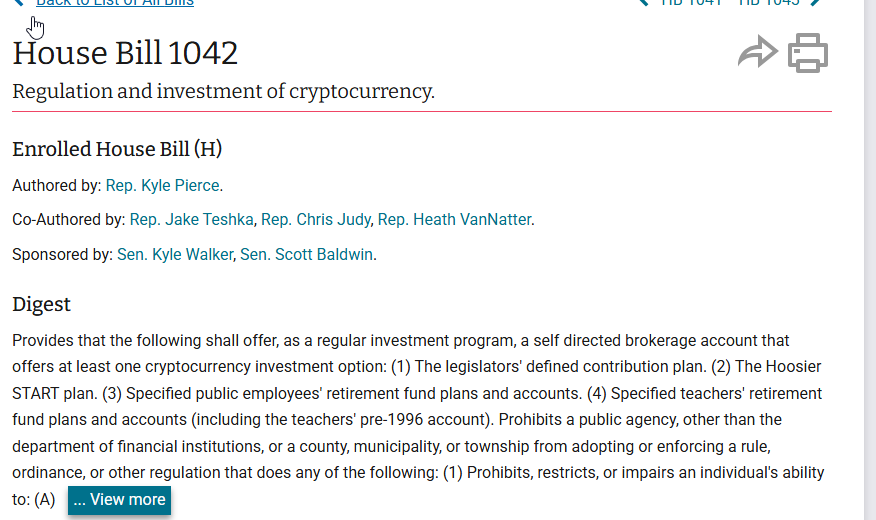
Indiana has become the first state in the US to legalize the inclusion of Bitcoin and other cryptocurrencies into state-managed retirement and savings plans. On March 3, Indiana Governor Mike Braun signed this into law under House Bill 1042, titled “Regulation and Investment of Cryptocurrency.” Henceforth, state-managed retirement and savings plans should provide at least one cryptocurrency as an investment option in a user’s self-directed brokerage account. This kind of account will allow users to operate nodes and engage in peer-to-peer transactions. Exchange-traded funds (ETFs) can be included in these plans, but not stablecoin-related funds due to the current lack of clarity regarding stablecoin yields. Pension providers now have until July 1, 2027, to have fully integrated digital asset provisions into their systems.
matthew sigel, recovering CFA tweet media
English
11
27
154
7.3K
Bob Dewey retweetou
Lyn Alden
Lyn Alden@LynAldenContact·
PSA: Just because Grok says something is real, doesn't mean it surely is. It often hallucinates just like any AI model. The more extreme a claim or video is, the more you should double-check it before sharing or believing.
English
177
96
1.9K
79.4K