

Ethics Gradient
15.8K posts
Ethics Gradient
@plate_class
As futile as this may be, no unsolicited DMs. Opposed to all the 3-letter global agencies. I go by 'J' - it's a lot easier than saying ethics gradient.
Entrou em Nisan 2025
1.2K Seguindo1.1K Seguidores

Guys be honest.
Do you find this attractive?
Me: 🤮
English
@nealasher This one really is gold.
Knocking Granny out with the lifesaver ring is brilliant.
And thank God the car didn't hit a pub.
English

That video is hilarious. Other videos from the same source don't quite hit the spot, sadly.
Andrew Bridgen@ABridgen
A great typically British take on the state of our roads. Very funny but sadly true. Where is all of the tax money going ? Not on repairing potholes that’s for sure. Please share
English
@marycatedelvey He's writing for Penthouse Forum for paedophiles.
English


@bulbasaur2713 @RusselNorman Probably drives around in a 50 yo 4WD that puffs out more smoke than Pinatubo.
English

@RusselNorman If you want to ride a bike everywhere go hard but shut the fuck up about it.
English

The NZ Govt just spent the last two years introducing policies to make NZ more dependent on fossil fuels, and proudly overturning policies that were reducing our dependence on fossil fuels. Now they have some Mickey Mouse national fuel plan. What a joke.
English
No they didn't you brain-dead cretin. They brought in policies to ensure energy independence and resilience whilst transitioning to a predominantly renewable energy base.
Which, incidentally, is something we could've done a few decades ago if you idiot greenies had allowed more hydro projects.
But no, because 'snails'.
English

@Evie_B2 Lol. I've got a friend who wears stilettos damn close to this.
English

Easy. You can't wear stockings with these types of stilettos. They slip off at the heel. You need a bare foot so the shoe adheres to the foot. Plus it's 2026.
Mambo Italiano@mamboitaliano__
Ladies, a genuine question out of pure curiosity: Why does First Lady Melania Trump never, ever wear stockings, on any occasion, in any weather, with any outfit? Really, never, never, never Does anyone know the reason? 🇺🇸👠
English
@OpinionistNZ They will wait on polling, but I reckon he'll probably go up. He won't go voluntarily.
English

I'm picking this guy will be goneburger within two weeks.
He is unfit to be a PM. That makes him unsuitable to be Labour leader. Bet the discussions are going on right now.
Hipkins and Ardern. Forced vaccines on NZ. Then hid behind lawyers when asked to appear in the Inquiry.

English
@SonofOmahu I wouldn't bother. Not sure why it had to be done and I never really got into the series of movies. Once the kids grew out of it, it was binned.
Other things to watch instead:
Send Help
How to Make a Killing
English

This is a hard choice.
Do I watch the new Harry Potter series, even though they've race-swapped Snape and made it look cheap and nasty?
Or boost its ratings just to piss off the trans community?

English
@4thOfJuly365 What I'd expect if I was getting my hair done in the salon by that dude.
English
@nealasher
This guy in NZ is very good at debunking the climate myths - perpetuated ad infinitum in NZ media.
x.com/investigatemag…
Ian Wishart@investigatemag
The Weekend Read - was this week's rainmaker a "climate change" event? As the cleanup from this week's unnamed ex tropical cyclone continues, the usual suspects wasted no time trying to capitalize on it. "Warmer climate to blame for heavier than normal rainfall - experts", read a headline in the Herald's live coverage feed yesterday. "Two (of) New Zealand’s experts have weighed in on the damaging weather - with one saying a warmer climate is responsible for heavier than normal rainfall. "Areas in Northland and Auckland have received more than a month's average rainfall in just 24 hours, according to MetService. "This kind of exceptional rainfall is exactly what is expected in a warmer climate,” said Victoria University of Wellington professor of climate science James Renwick. “Warmer air contains more moisture (water vapour) which is fuel for rainfall. So when there is a storm, rainfalls tend to be heavier in warmer conditions. Plus, a big storm like this acts like a bit of a vacuum cleaner, drawing in air over a wide radius, and wringing that air out as it rises. "As the climate continues to warm, we will see more of this kind of thing, and even heavier rainfalls in future.” "University of Auckland associate professor in river science Dr Jon Tunnicliffe said the shortened interval between storms is increasing the damage..." So there you have it: it's a record rainfall because of global warming (more intense), and we're getting less recovery time between storms (more frequent). Let's inject a little sanity back into the picture here. It's more frequent now, he says. Really? The Herald reported Kawakawa suffering its sixth flood in eight months in March 1935. "Creeks quickly overflowed the flats and flooded the roads, and communication was blocked both to the north and the south. The rain has now ceased, but the bowling green, the racecourse and adjacent flats are inundated to a depth of 3ft. to 4ft., and the water is still rising! This is the sixth flood during the last eight months." Which became a seventh flood by July 1935, cutting off road and rail links between Auckland and Whangarei. Further north, in a village 4ks south of Kaitaia, a rain gauge recorded an incredible five inches (127mm) in only 90 minutes, as reported by Kaitaia newspaper the Northland Age on July 26: "On Wednesday, particularly heavy rain fell in and around Kaitaia, and the rivers were all running bank high, and the lowly sections of land flooded. At Rangitihi, 5 inches of rain was recorded between 1.30 and 3 p.m. that afternoon. The culverts on the main street at Kaitaia were unable to carry the water, and the road and footpaths were flooded." By August 1935, one month later, Whangarei newspaper the Northern Advocate had crunched the numbers and counted 13 major floods in 18 months: "The weather is getting back to normal,” a Whangarei man remarked this morning, and although he meant to be sarcastic’, he was very nearly right. The wet weather that has been experienced this winter throughout the North has become almost a fixed state. Last night rain began to fall and this morning, with the holding up of traffic on some routes, it looked as if the thirteenth flood that has occurred in the North since February, 1934, was coming into being." While there's no question Northlanders mopping up from the third flood this year, 2026, have a right to be upset, it's not unprecedented in that region. So, no - extreme weather events are not more frequent than they were 90 years ago. Oh, but - interjects Renwick - the rainfall is exceptionally bigger now because we have a warmer climate. Really? Let's test that theory. This week's storm deliivered about 300mm across two days. In contrast, the December 1934 storm delivered 19 inches (498mm) to Kaikohe in 48 hours with a further 4.21 inches on the third day, for a total event of 605mm. The Mangakahia river rose 65ft (20m). There's photos of the bridge before and after the flood.
English

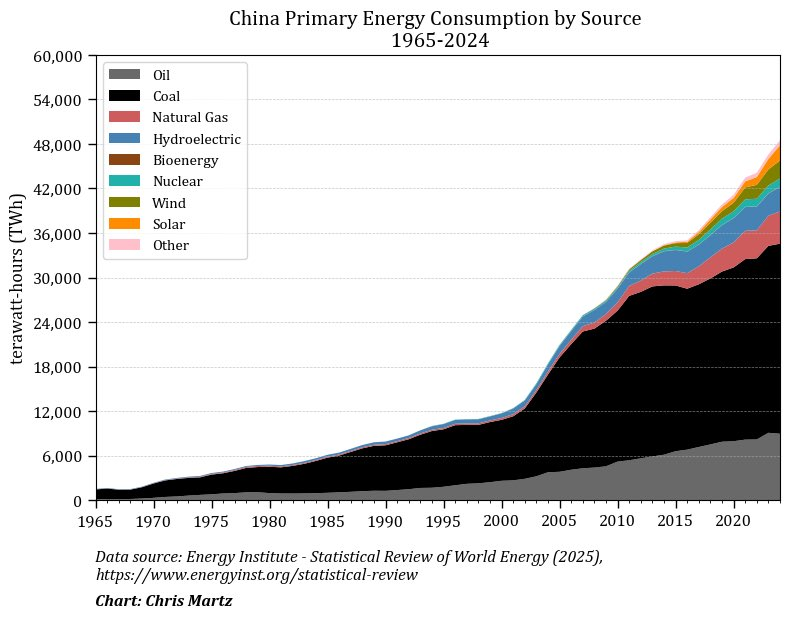
China isn't turning into a “green superpower.”
Any renewable energy systems they're installing only add to existing energy sources; they are not replacing fossil fuels at all.
China is increasing their use of ALL energy.
Matthew Stadlen@MatthewStadlen
@PeterMcCormack Have you not noticed that China is turning itself into a green superpower and that the future is green? Do you want us to be left behind as a fossil fuel dinosaur?
English
@MatthewStadlen @PeterMcCormack China is building more coal fired power stations per year than most countries have in total.
English

@PeterMcCormack Have you not noticed that China is turning itself into a green superpower and that the future is green? Do you want us to be left behind as a fossil fuel dinosaur?
English
Can we all now agree that greenifying British energy is unbelievably important for both the cost of living and national security?
English
@BrugesGroup Same issue here in NZ. Plus, diesel has now equalled the price of 91 octane petrol. This might not mean a lot to you guys, but diesel owners here have to buy Road User Charges on top of the price of diesel. Say, $76/1,000km - EV owners also pay this rate.
English

Fuel duty is 52.95p per litre. VAT is charged at 20% of the product price *and* the duty (so you’re taxed on your tax), while retailers make a razor thin profit.
And Ministers still have the absolute gall to make accusations of profiteering.
ft.com/content/732ceb…
English
@JSmith_Pula @saltyreigns It gives him a bit of rugged masculinity...
English

@saltyreigns He was alright looking back in the day but that beard 👀😅
English


This account is a lunatic.
Beware they keep posting false information.
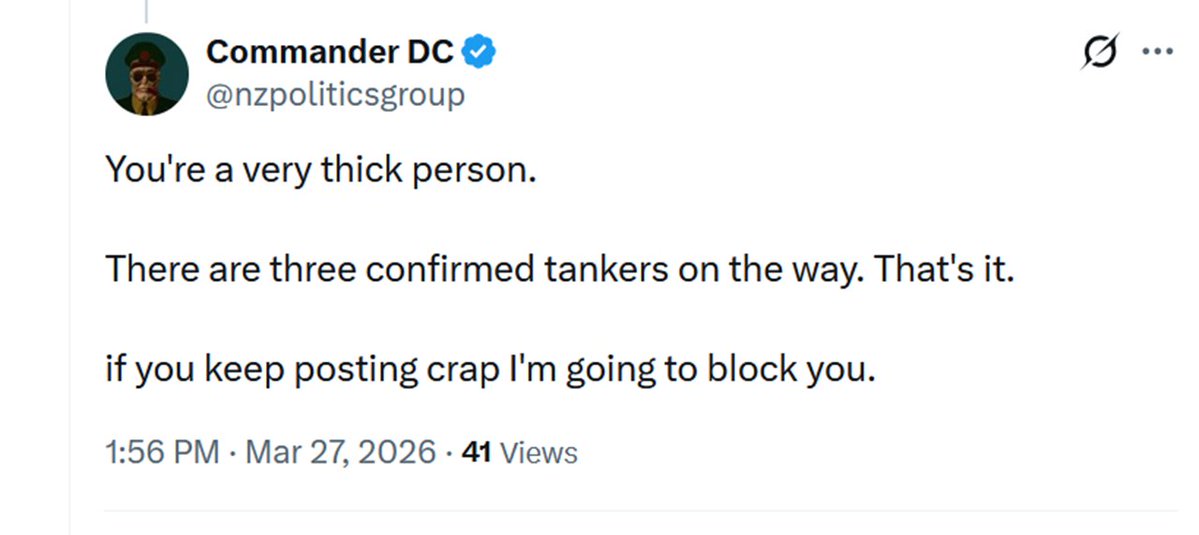
I posted the tanker schedule:
They replied with "there are only 3 confirmed tankers on the way".
When I moved to ask her to explain, I discovered I was blocked.
So beware, this account is false and is not interested in intelligent debate.


English
Raise your hand if you're a pureblood!
Lumen Rose@mamalechesocial
Since it’s officially spring, I have to ask: How are all the unvaccinated who were supposed to perish 5 winters ago? Check in.
English
@aniobrien She does carry a bit of baggage. Mind you, most of that affects the leftists who will never change their vote anyway.
English

Henry Cooke makes good points here. In my opinion, Nicola has proven she would make a better PM than Luxon over the past few weeks. I'm not saying Nats should roll him because that is messy, but Nicola has proven she is a good option.
thepost.co.nz/politics/36097…
English