In practice, there are an array of theos amongst takers and if the 'true' value is >61 you expect one may value it above 61.72 and take it. In turn makers are more likely to replace the empty layer with long orders than short orders at 61, so the market may eventually shift.
Maker rebates and taker fees create a strange dynamic where markets will tend towards stale prices.
Let's say a market is trading 60@61
The taker believes the value of the share is 61.5
But to take the share now costs ~61.72 so there's no way the taker is taking it.
Furthermore, the maker themselves may value the share at 61.1, but they effectively are selling for 61.18 after the rebate.
Even though everyone agrees the market should be 61@62, the market stays 60@61
4 hours playing slots & casino
lost 150k in 4 hours
what is life , what is money
I miss the days where having 2k to my name made me feel on top of the world
Gambling as a whole is so different when you have a few million
You can take bets at 1.25 odds , put $100,000 down and make $25,000 profit
Yet if you are broke , putting $50 on it and making $12.50 profit it’s like nothing
Get rich
Here is how @Polymarket is straight up lying and scamming you with the new fee system:
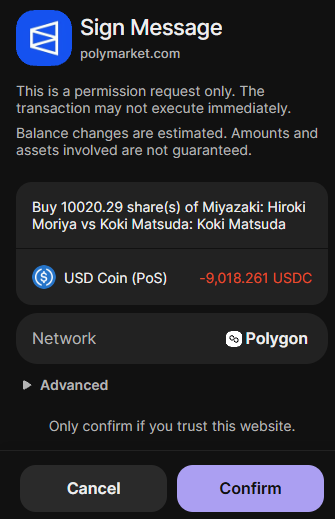
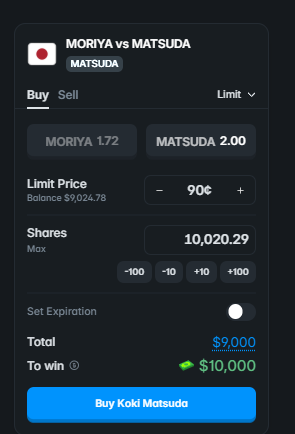
1. you preview the amount of shares you get and what price you pay. In this example 10k shares for 9k, in other words; risking 9k to win 1k.
2. you go on to confirm the transaction just to find out you're paying an extra fee which was originally not shown.
This is especially painful if your account is created via email, where there is no double confirm.
Thats why I reccomend you create your account with a wallet like phantom or metamask and use my ref link to thank me for saving you potentially thousants of dollars.
polymarket.com/?r=wixfall
I think I just noticed a really strange artefact in the @Polymarket fee structure, that can be abused to reduce fees incurred.
The formula for selling fees is listed as such:
fee = C × p × feeRate × (p × (1 - p))^exponent
Buying and selling shares both trigger fees at price p.
Buying a share for 25c is the equivalent of selling the complementary share for 75c. (In both cases the position changes 1 share in the same direction).
So for both transactions the fee calculation is nearly identical, except p is at the price of the sale. So in the case of a 25c share, selling the complement (75c) will incur a fee 3 times as large??? That's an enormous difference. It blows out to a factor of 99x at the wings.
So surely the play is to always either buy a share is its <50c or if its >50c you split a share and then sell the complement for <50c.
Am I missing something or is this how it would work?
@Polymarketgithub.com/Polymarket/ctf…
Theres some old polymarket docs suggesting fees would be on min(p, 1-p) but it seems they just haven't done that.
Maybe a move to claw extra fees from those who aren't paying attention?
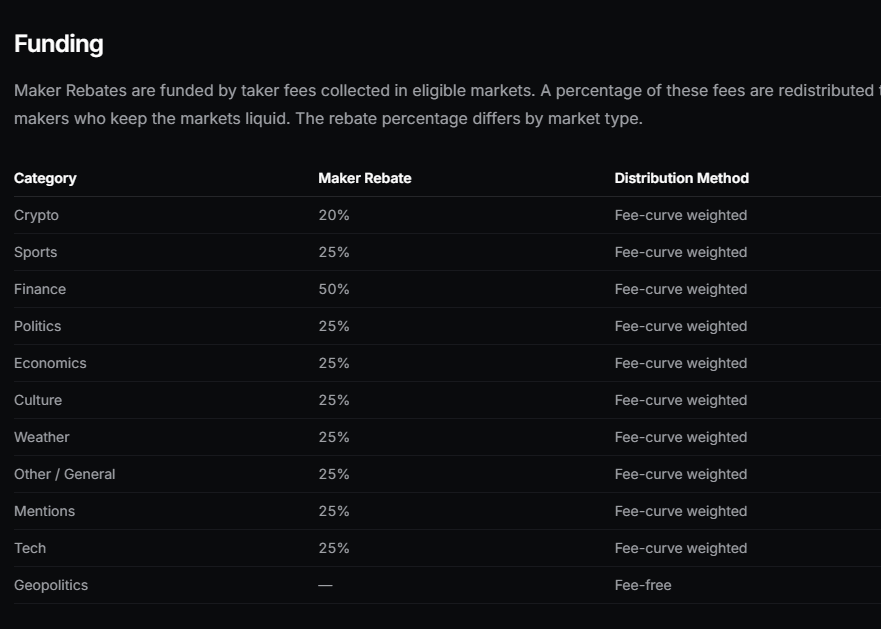
I've just realised that with fees, you're giving 75% of them in most markets to polymarket themselves XD. Kalshi 2.0
For anyone who doesn't understand you as maker are getting 25% of your fees collected. So say you're the only one market making a market (basically impossible) and only your orders are getting filled, and the total fees paid by takers are 100 usd, you would get 25 usd XD.
Where does the rest go?
Hmmmmmmmmmmmmmmmmmmmmmmmmmm
what X has turned into:
"
BREAKING: I BUILT A BOT THAT SEES THE FUTURE IN TENNIS
Polymarket updates in 15-20 seconds, my bot in 5!!!
5 SECONDS ADVANTAGE
My post is about to hit thousands of views yayyy
Then Mario Nawfal will just take my video, tag me, and get 10x more views yayyy
BOOKMARK THIS OR STAY BROKE FOREVER
"
DAMN