Aaryan

1.3K posts

Aaryan banner
Aaryan

Aaryan

@BscDetector

💭 Turning ideas into reality | 🚀 Exploring the intersection of tech, creativity, and life | ✨ Curiosity is my superpower Elite Goat @ Iotex

Присоединился Kasım 2021
691 Подписки161 Подписчики
Aaryan
Aaryan@BscDetector·
@lttlanna Yeah, need to get more attention towards it maybe some announcement would be helpful to spread awareness or cross asset collateral announcement which would make it unique and more eye catching.
English
0
0
1
39
Little Anna
Little Anna@lttlanna·
@BscDetector we need more traders to understand how beneficial it is to trade with XVS
English
2
0
5
327
Little Anna
Little Anna@lttlanna·
exchanges competed on fees for years. 0% maker. then negative maker. then 0% taker. the race to zero is over. it doesn't matter now. because the cost of trading was never just the fee. it was always fee + the cost of idle collateral. the industry spent a decade optimizing the first part and never touched the second. $100k sitting in your margin account earns $0. every day. every week. every month. while you trade on top of it. it can be "free" to trade. but it's expensive to hold margin. nobody in crypto talks about the second part. nobody really solved it either. until now. Expecting more
English
14
10
93
12.2K
Aaryan ретвитнул
Gladen
Gladen@lyubo_p·
State of liquidity and execution on @extendedapp v5 - TradFi Edition By popular demand, we're taking our liquidity analysis beyond crypto for the first time, this time covering TradFi markets: US equities (NVDA, MSTR, INTC, CRCL), precious metals (XAU, XAG), and the Nasdaq Index (NDX), across @extendedapp, @HyperliquidX (via @tradexyz), and @Lighter_xyz. Methodology 1. We measured slippage (buy/sell) on the above assets for $10k and $100k market orders across the three exchanges every 30 seconds from Mar 24, 07:11 UTC to Mar 31, 11:44 UTC (20,657 snapshots) 2. We ranked each exchange by market and clip size for both slippage and total cost of execution (slippage + exchange fee), where 1 = best and 3 = worst 3. Fees applied: Extended 2.5 bps, Hyperliquid base rate 4.5 bps, Lighter 0 bps 4. The dataset also includes charts showing how slippage evolved over the tracked period 5. NDX is listed as XYZ100 on Hyperliquid and QQQ on Lighter Results: Slippage - On equities and metals, Extended leads at $10k clip sizes, while Hyperliquid is better at $100k - On indices (NDX), Hyperliquid leads at both clip sizes Total cost of execution - where it gets interesting - Equities at $10k: Extended is the cheapest across all 4 - Equities at $100k: Hyperliquid leads across all 4 - Metals: Lighter's zero-fee model gives it the edge on both XAU and XAG at $10k, and on XAU at $100k - Indices (NDX): Hyperliquid leads at both clip sizes What this means 1. For equity trading at smaller sizes, Extended liquidity and fee structure make it the most efficient option overall 2. For larger orders, Hyperliquid has deeper liquidity and wins on total cost 3. Lighter's zero-fee model gives it a real edge in metals, though less so in equities It’s still early days for on-chain TradFi liquidity. There’s room for all exchanges to improve, and we'll keep tracking it. Full dataset: docs.google.com/spreadsheets/d…
English
10
14
71
12.4K
Aaryan
Aaryan@BscDetector·
@rf_extended Can sense something big coming in few weeks/months🙂‍↔️🚀 Expecting more........
English
0
0
4
198
rf.extended
rf.extended@rf_extended·
Perpetual futures will become a primary venue for price discovery in TradFi markets, but they will not replace dated futures and options. Today, price discovery happens across different instruments. Equities and FX primarily trade on spot markets, while commodities and energy rely on dated futures. USDC-settled perpetuals offer structural advantages that make them a strong alternative for trading and liquidity concentration: 1. They trade 24/7 2. They aggregate liquidity into a single order book and are structurally standardized 3. They enable higher capital efficiency through continuous margining Importantly, many of these advantages are structural. Traditional financial markets are not 24/7 not only due to historical inertia, but because risk management and settlement operate in discrete cycles. Margining is not continuous, and collateral transfers and custody updates occur in batches, requiring system-wide coordination. At the same time, traditional derivatives markets fragment liquidity. Dated futures split liquidity across expiries, while options spread it further across expiries and strikes. As a result, liquidity is distributed across many instruments. Perpetuals reverse this dynamic by consolidating liquidity into a single instrument per asset and providing a standardized structure across markets, with no rolling and simpler basis management. This makes them easier to hedge and trade. Perpetuals also allow for more capital-efficient use of margin through continuous risk management and liquidation mechanisms, although this comes with different risk trade-offs compared to the more conservative, discrete systems used in TradFi. Given these dynamics, USDC-settled perpetuals will become a primary venue for trading and price discovery in TradFi assets over time. However, several challenges remain: 1. Trust and inertia: Institutions will need time to build confidence in crypto-native infrastructure and adapt their internal processes and risk frameworks, for example moving from futures term structure to perp funding dynamics. 2. Index definition: Perpetual markets depend on a clear and reliable reference price. For TradFi assets, this requires consistent and widely accepted methodologies. This means spot-based references for equities and FX, and derived spot prices from futures for commodities and energy. In practice, areas like futures roll and non-trading hours are not yet fully standardised across the industry. We also recognise that the current approach used by Extended is not yet ideal, and we are actively working to improve the definition of a fair and robust reference price. Even if perps become dominant for trading, they will not replace dated futures and options, as these serve different purposes: 1. Dated futures provide time-specific hedging and a strong link to the real economy through physical delivery and convergence to spot at expiry. 2. Options provide convex payoffs and enable trading and hedging of volatility. In summary, perpetuals are structurally better suited for liquidity aggregation and continuous trading, and will play a leading role in price discovery. However, they will coexist with dated futures and options, which remain essential for time-specific hedging and non-linear risk management. Bridging perps and TradFi represents one of the largest and most durable opportunities in financial markets and is a core focus for Extended.
English
15
34
208
32.3K
Aaryan ретвитнул
Saram
Saram@Saram_ath·
One of the reasons traders choose Extended over other perp DEXs - and this isnt just us saying it, its something we hear directly from users - is that the team is genuinely responsive. And I think that says a lot. You can see it in how quickly tickets get handled, how active our team is on Discord, how feedback gets noticed, and even in how our CEO Ruslan replies to users’ suggestions himself. Its great to see that the community actually notices and appreciates that. It changes how people experience the platform, because it feels like there are real people behind it who care, listen, and want to keep improving. Even if we don’t reply to every single message publicly, that doesnt mean its ignored. A lot of what gets shared with us is seen, discussed internally, and helps shape how Extended evolves. Thats also why we genuinely enjoy meeting traders and community members face to face. From Singapore to Poland to Hong Kong - and through many 1:1 conversations along the way - spending time with people in person has always been important to us. A lot of the best conversations happen that way. So where should Extended go next?
Saram tweet media
English
18
3
83
3.6K
Aaryan
Aaryan@BscDetector·
@lttlanna That's great approach, This makes me more bullish on extended Expecting more🔥🫡
English
0
0
3
169
Little Anna
Little Anna@lttlanna·
why Extended won’t cut deals every week I get proposals for “special arrangements”. extra points pools, special trading budgets, requests to be placed in the highest league without trading. sometimes the numbers are big enough that saying no in the moment feels painful, especially when you’re responsible for growth and naturally think about how much faster things could move if you just agreed. but over time I've only become more convinced that saying no is the only correct decision. the first problem with deals like this is ethical. if a project publicly claims fairness while quietly making exceptions behind the scenes, it will eventually come out. it always does. when that happens, the reputational damage is much larger than whatever benefit the deal produced. the second problem is economic. most deals look attractive in isolation but stop making sense once you consider the system as a whole. take special points allocations. if you give someone an additional points pool, they are probably not the only one receiving it. a few more people get similar arrangements and suddenly no one is actually privileged - everyone just dilutes the overall distribution without even realizing it. or traders asking for budgets. when someone says: “give me $100k to trade or I won’t trade on your exchange.” my answer is usually simple: thank you for your time. a few days later I will probably see them trading on a competitor. that doesn’t make me sad that we lost them - it makes me sad that another exchange accepted the deal. traders who only show up because they are being paid to do so don’t care about your product, your token, or the long-term success of what you’re building. once the incentives disappear, they disappear too. another common request is to change the rules of the system. for example, people asking to be placed in the highest league to earn the extra APR without actually trading. besides being unfair, it breaks the economics. league rewards exist because active traders generate fees on the platform. if the people receiving that yield are not trading, there is no source of yield in the first place. the main cost of refusing deals is slower growth. it would definitely be easier to inflate metrics in the short term by making exceptions and distributing budgets. but if the goal is to build something that lasts, the rules have to be the same for everyone. Extended is not trying to grow as fast as possible. we are trying to build an exchange that traders continue using once incentives disappear, and that only happens if the system is fair and the economics actually make sense.
English
27
16
167
9.6K
Aaryan ретвитнул
lyonzzzz.extended
lyonzzzz.extended@_lyonzzzz·
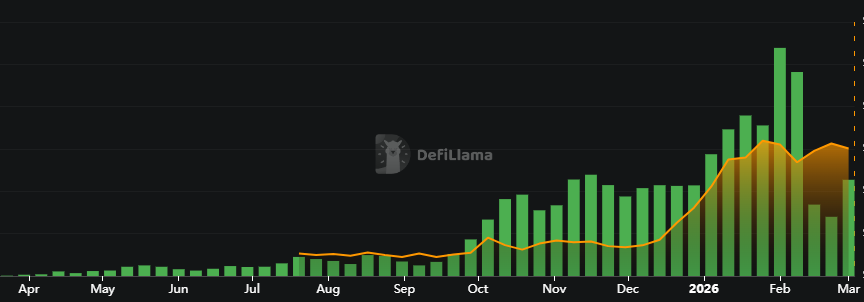
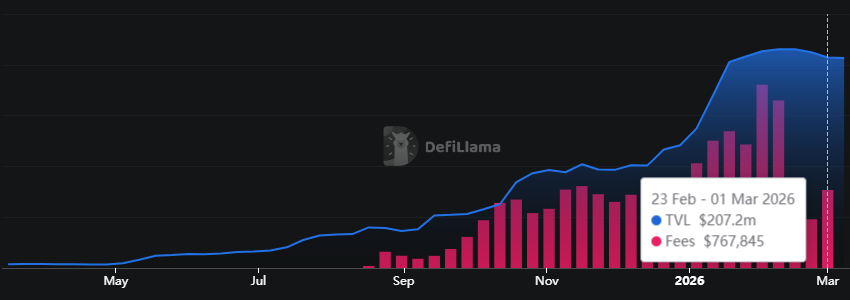
gExtended, WW3 but we still vibing. @extendedapp 2026 week 8 metrics: - weekly volume at $6.8b, up over 50% & volume across all DEXs picking up again. - OI still remaining near ATHs at $300m, barely moved despite extreme drop in volume. - TVL at $206, slowly dropping as yields have been considerably lower. - weekly fees with $0.75m, this going higher. - DAUs averaging around 4000 users, starting to pick up again. news: - cross-asset collateral being released sooon. - stocks & RWAs perps continue to be rolled out with $AAPL $INTC $PLTR $COIN $HOOD $GOOG $NVDA $AMD $TSLA $MSTR $AMZN $NATGAS $XPT
lyonzzzz.extended tweet medialyonzzzz.extended tweet media
English
7
3
24
1.4K
Aaryan ретвитнул
Extended
Extended@extendedapp·
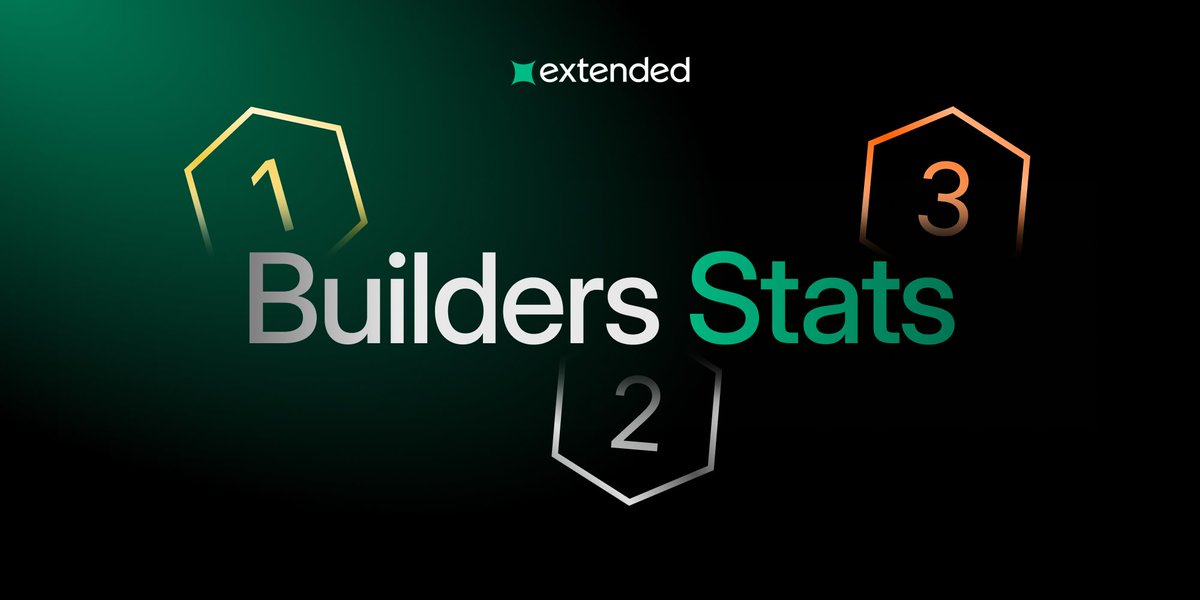
Extended Builders Stats are now live You can now track builders contributing to Extended growth on the dashboard: app.extended.exchange/builders To date, builders have generated over $2.5B in trading volume, with the top contributors by volume being @PlanemoTrading, @tread_fi, and @Flowbot_pro.
Extended tweet media
English
19
27
195
19.7K
Aaryan
Aaryan@BscDetector·
@onchainmonk Pacifica for sure and next ig it's extended
English
1
0
2
31
onchainmonk
onchainmonk@onchainmonk·
Legend Monk is ranked higher than Sar only on two perps platforms. Any guesses?
linenmito@linenmito

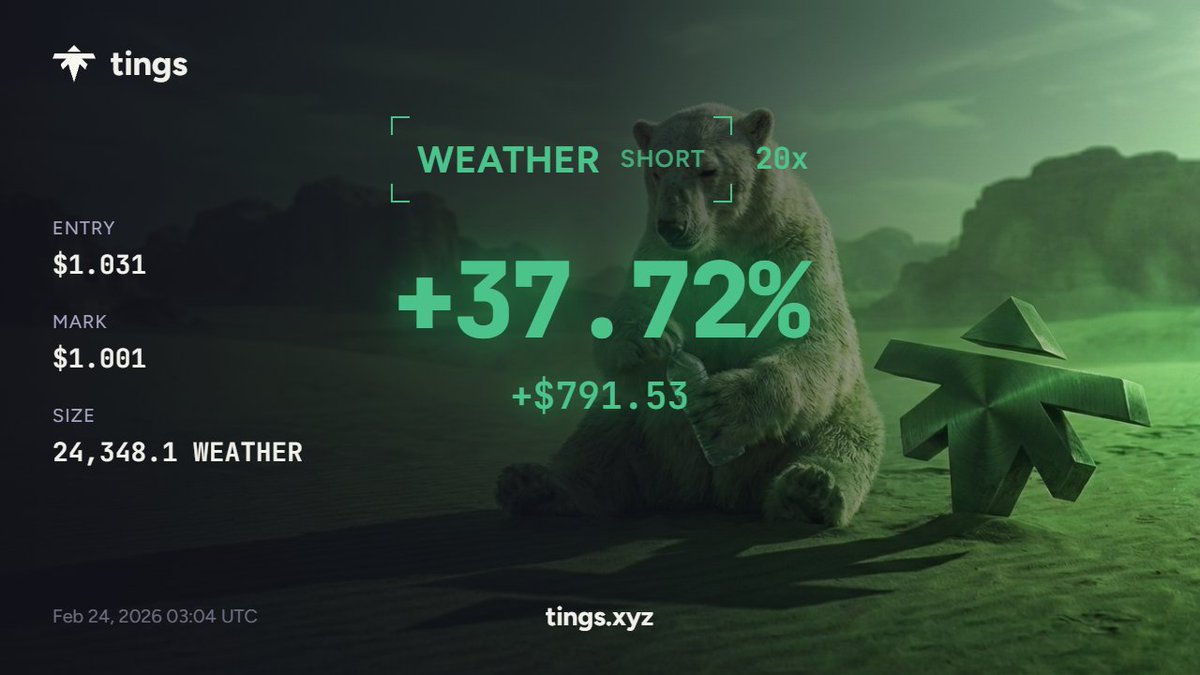
A lot of people ask which Perp DEXs I’m interacting with and where I actually rank. Here’s a transparent breakdown, categorized by effort level 👇 🔥 Top Effort Play (Serious Focus) 1. @variational_io , I Ranked #1 with 46K+ points. This is where most of my energy goes. ⚡ Medium Effort Plays (Exploring the Tech & Positioning Early) 2. @Backpack - 211K+ points in Season 4. Shoutout to @MadVincent666 3. @tread_fi - Ranked #19 with 9K+ points. 4. @pacifica_fi - 209K+ points. 5. @extendedapp - Ranked #85 with 63K+ points. 🧪 Early Positioning / Registered @01Exchange @nadoHQ @paradex Still monitoring these closely. 🎯 My Strategy Is Simple: I primarily trade $BTC, while rotating into key alts like $ETH, $SOL, $HYPE, and $LIT when the opportunity makes sense. Focused execution. Controlled aggression. Volume with intent. Which Perp DEX are you grinding right now and why? 👇
English
6
0
15
1.7K
Aaryan
Aaryan@BscDetector·
@HyperSwappy That's great🔥 Looking for more updates
English
0
0
0
16
Aaryan ретвитнул
Extended
Extended@extendedapp·
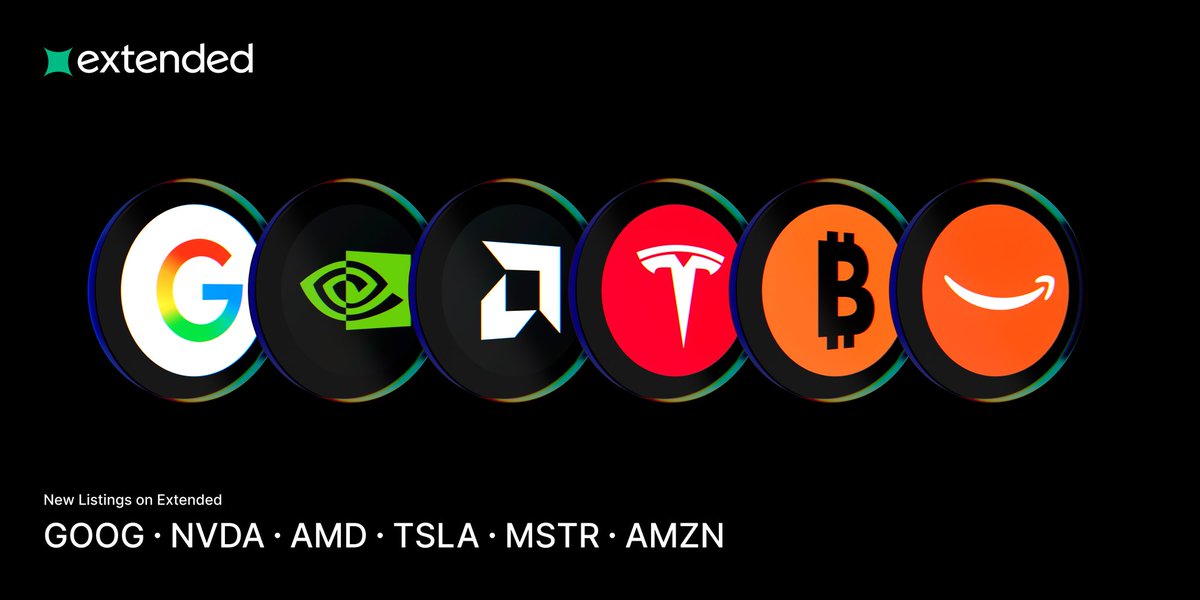
Extended was among the first perp DEXs to launch commodities and index perps in Spring 2025. The next step is equities. Extended is launching its first six equity perpetual pairs. Equity perps have not yet truly scaled onchain for one reason: liquidity. Extended is building to solve it - with further updates to follow.
Extended tweet media
English
56
67
371
39.5K
Andy
Andy@andyyy·
Who is the most underrated team in all of crypto???
English
217
11
205
40.6K
Aaryan ретвитнул
Extended
Extended@extendedapp·
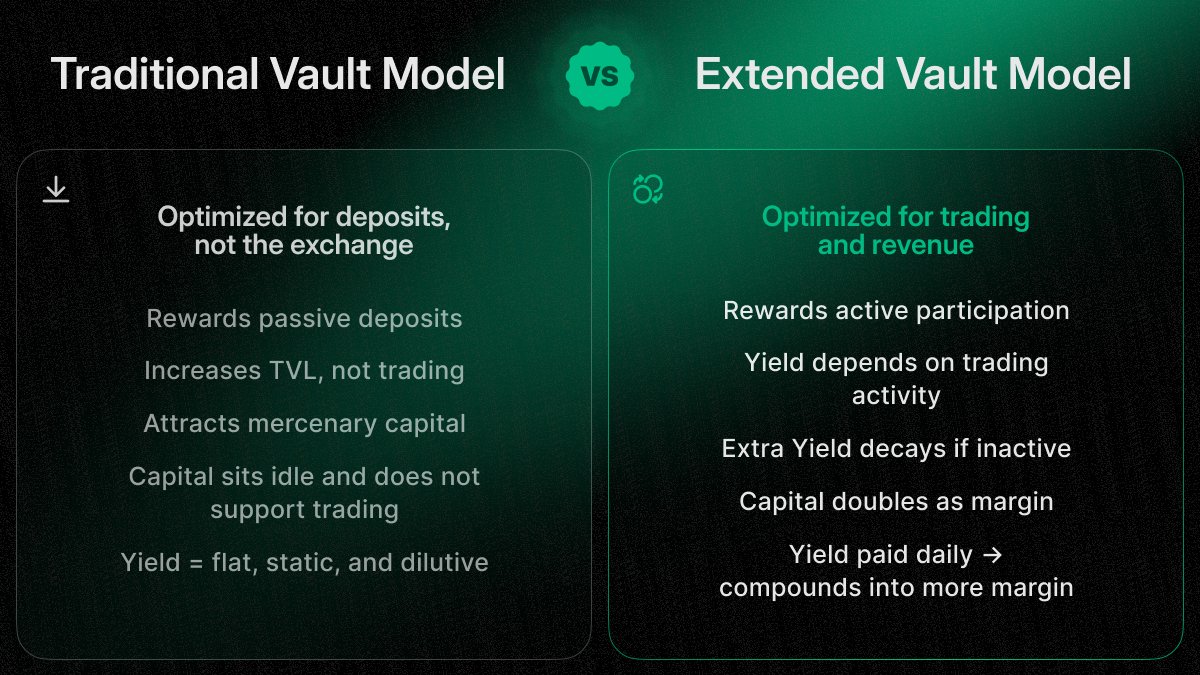
All-time PnL of the Extended Vault has crossed $3M, with >$1M earned in the last month, and a ~19% APR over the past week for active traders. Most vault models reward passive capital. This helps increase headline TVL, but it does not materially improve liquidity, volume, or execution quality on the exchange. From the perspective of an exchange, passive capital is not the scarce resource - active participation is. When a vault pays yield simply for deposits, it attracts mercenary liquidity. Capital arrives for the rate, not for the system. This is the natural outcome of treating vaults as passive rather than active components of an exchange. XVS takes a different approach. It does not reward presence. It rewards participation. Base yield is paid to all XVS holders, but meaningful yield is reserved for active traders through Extra Yield multipliers sourced from a share of net exchange fees. If a user stops trading, Extra Yield decays automatically as other users accumulate points and advance into higher leagues. No governance intervention or incentive rebalancing is required. The second difference is that XVS actively enables trading. XVS represents a claim on vault equity and contributes to user margin, meaning capital deposited into the vault can be used to open positions instead of sitting idle. Yield is paid daily, increasing user equity and available margin. For traders, this yield offsets a portion of trading fees and compounds into additional collateral that can be used to take on more positions. Over time, vaults that pay for deposits but do not support the exchange’s core function will struggle to compete with systems where vault capital is both productive and integrated into trading.
Extended tweet media
English
20
22
185
15.1K
Aaryan
Aaryan@BscDetector·
@ether_fi Same here, I love etherfi too
English
0
0
0
95
Aaryan
Aaryan@BscDetector·
@HyperSwappy Also, $Swap is roaring🔥 Terminal will make it more flying like Hype 🙂‍↔️
English
0
0
0
50
Swappy
Swappy@HyperSwappy·
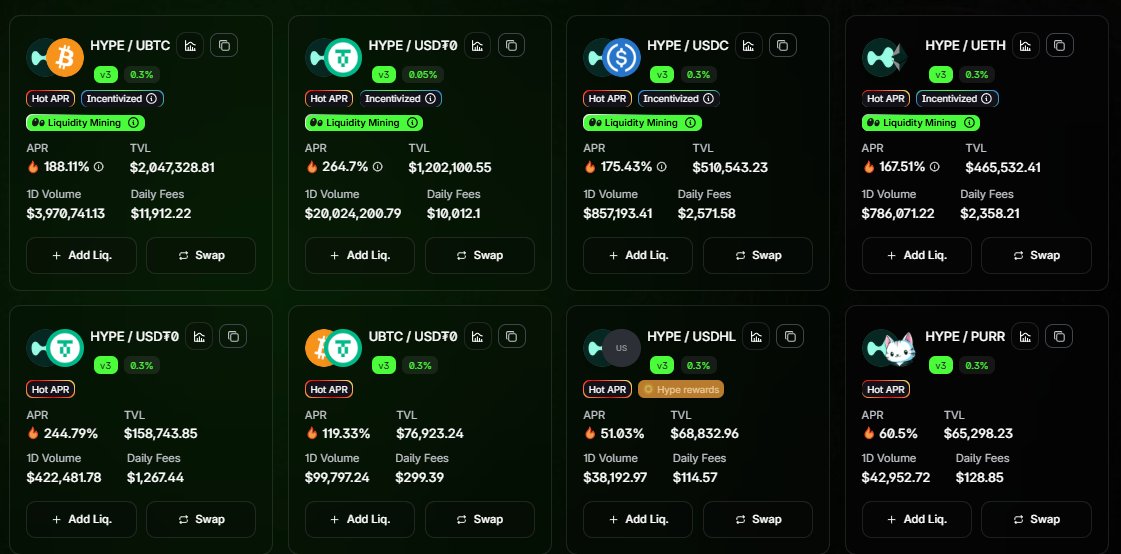
Gswap everyone 💚 $HYPE is pumping, on-chain volumes are roaring back, and APRs are going crazy. Our liquidity mining campaign is pushing yields even higher. What more could you ask for ? …maybe the terminal? 👀
Swappy tweet media
English
1
3
25
731