
Закреплённый твит
CrypticAvtar
2.1K posts


CrypticAvtar ретвитнул

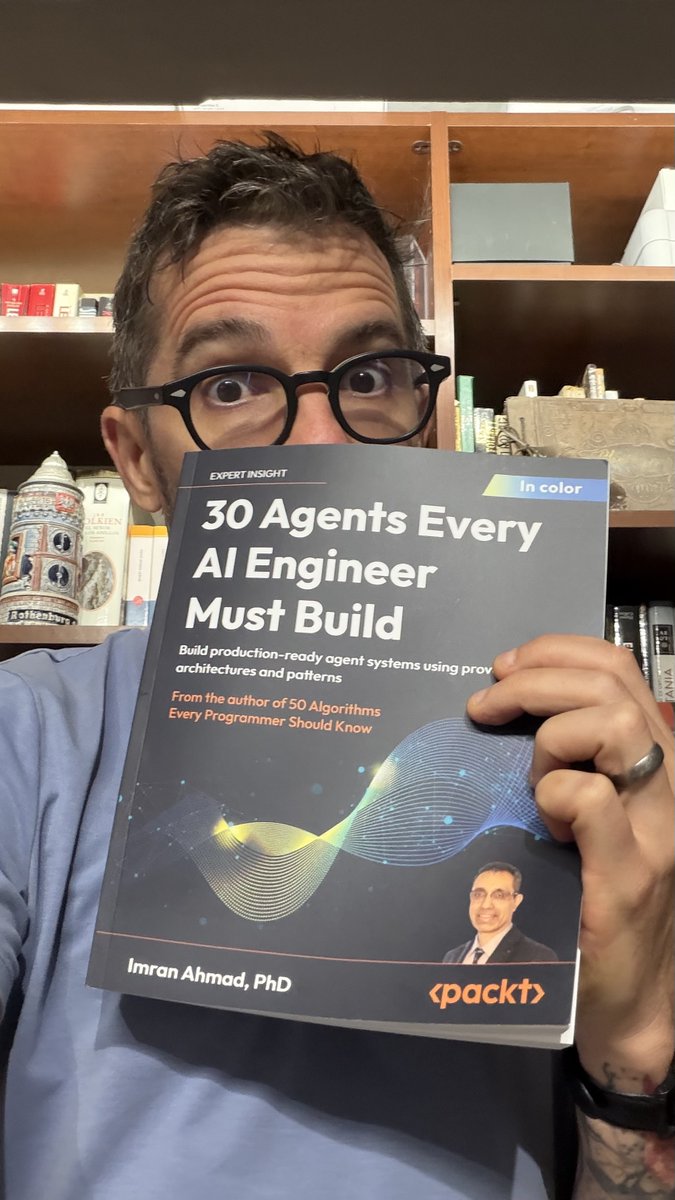
30 agents every AI Engineer must build.
This is the most comprehensive and practical book on AI Engineering that I've ever seen.
I can't think of a single use case that they didn't cover here:
1. The autonomous decision-making agent
2. The planning agent
3. The memory-augmented agent
4. The knowledge retrieval agent
5. The document intelligence agent
6. The scientific research agent
7. The tool-using agent
8. The agentic workflow system
9. The data analysis agent
10. The verification and validation agent
11. The general problem solver agent
12. The code generation agent
13. The security-hardened agent
14. The self-improving agent
15. The conversational agent
16. The content creation agent
17. The recommendation agent
18. The vision language agent
19. The audio processing agent
20. The physical world sensing agent
21. The ethical reasoning agent
22. The explainable agent
23. The healthcare intelligence agent
24. The scientific discovery agent
25. The financial advisory agent
26. The legal intelligence agent
27. The education intelligence agent
28. The collective intelligence agent
29. The embodied intelligence agent
30. The domain-transforming integration agent
I also read 50 Algorithms Every Programmer Should Know by Imran. Same vibe.
Here is the Amazon link: amzn.to/4t5ystE
English
CrypticAvtar ретвитнул

At 26, she was diagnosed with advanced rectal cancer. Four months later, there was no detectable evidence of the disease.
Mrinali Dhembla had begun experiencing clear warning signs: rectal bleeding and persistent constipation. These symptoms led to more in-depth testing and a definitive diagnosis — stage 3 rectal cancer, with the disease already starting to spread beyond its original site.
An underlying genetic condition was also present: Lynch syndrome, which increases the risk of developing several types of cancer.
The standard approach in such cases typically involves surgery and chemotherapy. However, her medical team chose a different path.
And from that point, everything changed.
She was started on an immunotherapy regimen using two drugs: nivolumab and ipilimumab. The goal was to stimulate the immune system, encouraging it to recognize and attack cancer cells.
The treatment lasted four months.
By the end of that period, follow-up scans showed an unexpected outcome: no detectable tumor remained. Blood tests for circulating tumor DNA also came back negative.
The patient was declared to have no evidence of disease.
This case has drawn attention for the potential of immunotherapy in similar situations, particularly in patients with specific genetic profiles.

English
CrypticAvtar ретвитнул

CrypticAvtar ретвитнул

ANDREJ KARPATHY COULD HAVE CHARGED $500 FOR THIS WALKTHROUGH.
He put it on YouTube.
Every way he personally uses LLMs in his own life. Thinking models. Deep research. File uploads. Python interpreter. Claude Artifacts.
Not theory. Not benchmarks.
The actual daily workflow of the person who built Tesla Autopilot and co-founded OpenAI.
2 hours walking through his personal LLM workflow.
The gap between people who watch this week and those who save it for later is not 2 hours.
It is everything those 2 hours quietly change about how you work for the rest of your career.
English
CrypticAvtar ретвитнул

The hottest job for the next five years is going to be the agent operator.
They don't need to be an engineer. They can walk into marketing, legal, or life sciences research and actually make agents work for that function.
Required skills:
> MCPs
> CLIs
> Writing skills (the file kind)
> agents.md fluency
> Business acumen
None of this is in any CS curriculum today.
Soon, enterprises will be pressured to redesign their workflows for agents, not for people. And when that happens, agent operators will be in massive demand.
English
CrypticAvtar ретвитнул

wake up because this is the GREATEST time in history to start a company with TRILLIONS of dollars up for grabs over the next 10 years
1. consumer mobile is INTERESTING again for the first time since like 2017. apps can actually do things now.
do things. real things. book the flight, draft the contract, follow up with the lead, negotiate the rate, do things. we went from "tap to view" to "tap to deploy." the entire interaction model of software just flipped & most people haven't even registered it yet. OH, and the cost to create these apps is 1/100th of 2017.
2. HARDWARE is back on the table because you can shove Gemma 4 or DeepSeek onto a device that costs less than dinner & it runs locally with zero cloud costs. a year ago that sentence would have sounded insane. you can ship a physical product with a real brain in it now. the last time hardware was this accessible was the early smartphone era & that created a trillion dollar app economy from scratch.
3. literally EVERY category is open to be rebuilt AI-first. the incumbents know it & they're paralyzed. they can't move fast because moving fast because incumbents move slower than you (usually). that paralysis is your opportunity. build the app. build the SaaS. build the AI agent
4. distribution is FREE. you can go from zero audience to 10,000 people who trust you in 90 days on X or YT or IG your first 100 customers are sitting in your replies right now. the old playbook of "raise money, hire sales team, buy ads" is being lapped by a solo founder with a twitter account & a working demo. Oh, and you can use AI to automate a lot of it (ideas, research, AI avatars etc)
5. Idk about you but it feels like companies are doing LAYOFFS like it's the great depression and it's only getting started. No job is secure. So, building a side project that could turn into the main project is more important than ever.
6. the ENTIRE economy is being repriced in real time. the surface area for new companies has never been wider. the tools to build are free. the models are open source. the incumbents are running committees about their "AI strategy" while you could have already shipped.
and somehow the predominant response from most people is to watch youtube videos about it & go back to their 9-5.
not saying this is easy
not saying everyone will win
but im saying right now is a time worth trying
YOU ARE LIVING through a mass reshuffling of who owns what & who builds what. the last time this happened was the internet itself. before that, electricity.
this almost never happens.
& you're sitting there doing nothing about it?
wake up.
English
CrypticAvtar ретвитнул
There’s $1T up for grabs for agent-first startups and this window is WIDE open. Probably 10,000+ niches.
How it plays out:
1. Every SaaS company follows salesforce and goes headless within 18 months
2. a new category of "agent-native" startups emerges that treat salesforce, HubSpot, workday etc as dumb backends. the startup IS the agent. the SaaS is just the database.
3. the entire consulting/services industry around enterprise SaaS gets compressed into software. the agent replaces the implementation team.
4. outcome-based pricing becomes default. nobody pays per seat when the "seat" is an agent making 10,000 API calls a minute. you pay when revenue hits your account.
5. the winning founders are ex-operators who understand a vertical workflow cold. the code is the easy part. knowing that a property manager spends 14 hours a week on lease renewals? that's the insight worth $100M.
6. distribution becomes the moat. when anyone can wire agents to APIs, the company with the audience and the brand wins. media + agents is the new SaaS. There’s a rush to incubate live/short form shows.
7. Silicon Valley goes all influencer. Roy lee gets this. Pat Walls gets this. Sam Parr gets this.
8. the first $1B agent-native company in each vertical will look nothing like the SaaS it replaced. smaller team, higher margins, no implementation cost, no churn from bad UX because there is no UX.
the fastest path to wealth right now: find an industry that still runs on dashboards, phone calls, and spreadsheets. build the agent-native version. charge per outcome. own the workflow end-to-end.
someone reading this right now is going to build a $100M company off this exact shift. tell me about it on the @startupideaspod when you do. Im rooting for you.
Less reading, less bookmarking, more building.
the last wave rewarded people who built pretty interfaces on top of ugly data.
I think this wave rewards people who build smart agents on top of exposed APIs.
Or who just build the APIs themselves
Here we go
Marc Benioff@Benioff
Welcome Salesforce Headless 360: No Browser Required! Our API is the UI. Entire Salesforce & Agentforce & Slack platforms are now exposed as APIs, MCP, & CLI. All AI agents can access data, workflows, and tasks directly in Slack, Voice, or anywhere else with Salesforce Headless 360. Faster builds, agentic everything. 🚀 #Salesforce #Agentforce #AI venturebeat.com/ai/salesforce-…
English

Remember when folks told us we could do any job "for pennies"?
And remember when I told you those folks couldn't do grade school level math?
When you see someone say we'll be doing a 60K job for 600 bucks just know those folks are getting on their own supply and should lay off the crack pipe.
The subsidy era is over. Check your API bill.
Hedgie@HedgieMarkets
🦔Goldman Sachs reports that companies are blowing past their AI inference budgets by orders of magnitude, with inference costs in engineering now approaching 10% of total headcount costs and potentially reaching parity with salaries within several quarters. KPMG surveyed 2,100 senior leaders and found US companies plan to spend an average of $178 million on AI over the next 12 months, with Asia-Pacific firms budgeting $245 million and EMEA $157 million. The two reports together show companies are spending more than planned and intend to spend even more. My Take Inference costs approaching headcount parity is an extraordinary number that most finance teams did not model when they approved their AI strategies twelve months ago. The compute crunch, electrical component shortages, and GPU spot prices up 48% in two months are all flowing into corporate operating costs faster than anyone budgeted for, and Goldman's trajectory suggests it accelerates from here. What I find hard to reconcile is that $178 million average sitting alongside enterprise data showing eight in ten workers are either avoiding AI tools or not using them at all. Companies are committing to nine-figure inference budgets while their own employees aren't using what's already been deployed. I've watched this dynamic build all year and my honest read is that a significant portion of this spending is driven by competitive fear rather than demonstrated returns. Nobody wants to be the company that didn't invest in AI when everyone else did. That's how bubbles get funded, and at some point boards are going to demand a number that justifies it. Hedgie🤗
English
CrypticAvtar ретвитнул

Off topic but consulting firms will be a glorious example of jevons paradox.
As AI makes things cheaper + faster to build…more companies try to adopt it (and struggle/fail).
Twitter fingers claim consulting is toast, but the amount of companies needing ongoing support to implement AI is practically endless with how fast things move + change.
Nobody really has a choice either...companies need to adopt AI for survival. First-movers will need to constantly adapt to stay ahead of competition too.
I see 3 waves:
> "where do we even start with ai?"
> "can you actually implement this?"
> "can you maintain + evolve it?"
specialized skill + ai fluency + speed of adaptation = new consulting moat
English
CrypticAvtar ретвитнул

I'm genuinely, and with conviction, believe this is true.
I just can't comprehend what should be happening in a person's head who doesn't see this as an obvious outcome of how LLMs work.
Sure, in some utopian AGI world that won't be true. But how are you reading all the research on using LLMs at scale and not seeing that LLMs need frameworks?
Ryan Carniato@RyanCarniato
I've seen talk of AI removing the need for frameworks. As an author using AI to assist writing, it feels we aren't there. Trying to debug/fix framework code without introducing regressions is non-trivial. To think app code isn't going to be missing edge cases is fanciful.
English
CrypticAvtar ретвитнул
In the next 10 years we will have what used to be programming jobs split clearly into 3 roles:
- highly specialized manual coders who output 10x better quality code than any model
- "normal" developers who are augmenting themselves with AI to do most of day to day software development (normal best practices apply, 99% of code is reviewed and understood by human)
- and "slop wranglers" who are building everything with AI and using AI to keep slop spinning with AI review, AI monitoring, AI project management and AI ideation
Jamon@jamonholmgren
In the next several years: Lots of slop shipped, huge issues with key software, feeling out of control, exciting, fun, scary, wild, stupid, hard. More agentic software dev adoption across more industries as business owners see opportunity. Devs who don’t have good boundaries will become overworked, burned out. Devs with good boundaries might be looking for new jobs as their nominal productivity doesn’t keep pace with the slop slingers. Huge security breaches exposed due to much worse quality and much better automated threats. Many of these breaches never discovered. Building software will become much more bottlenecked in other areas: product design, marketing, UI/UX, user adoption, etc. Large layoffs and reshuffling, but plenty of opportunities popping up all over. Small dev teams with a few devs and a big agent and CI budget will become more of a norm. It’ll feel more like startup times. New ways of working that are more sustainable will be developed. Better expectations around what makes a good software developer are established. Lots of disruption in nearly every industry as new players come online with competing software, much smaller and scrappier. Legal fights all over. Shifting landscape, hard to plan ahead so nobody bothers, it’s easier to just iterate as challenges pop up. Anthropic eventually learns how to be professionals. Their creativity and innovation pace slows, but they don’t constantly shoot themselves in the foot, and manage to stay relevant as a result. Google eventually releases a decent coding model that is a fraction of the cost of the others, and it takes over a good chunk of the market. Many still hate it. OpenAI becomes the market leader among devs again by default as Anthropic stumbles, and immediately people realize why they left for Claude in the first place. But they don’t go back. A slow difficult grind toward regaining software quality as business owners realize it can’t continue like that. Really hard core automated validations (specifications, tests, and more) will become everyone’s focus, because it allows for much higher quality agentic code. A sizable chunk will be agentic teams that use all good models as checks and balances for each other. Ping-ponging implementation plans back and forth between different models until all angles are considered is considered a best practice. AI and CI spend stays very high, despite lower token costs. Exploratory implementations will be normal: it’s just as easy to implement as it is to plan, so might as well have a dozen implementations of every idea to test and evaluate for inclusion. Even game devs and system devs will succumb eventually to agentic coding, except in small pockets around certain influential recalcitrant streamers. However, these streamers will help hold the quality line across the industry through sheer force of will. A slow return to software quality as a result of all this. More situations where you truly do not need to read the code; there are enough checks and balances that the average human review is less useful than the existing validations. More seamless, well-integrated agent + validation solutions to various types of software and platforms. In-house at first, and then available as dev products or open source. Self-healing software becomes fairly normal — where bugs are reported, reproduced, fixed, and eventually deployed. Eventually the average software quality will exceed 2021 levels by a large factor. 100X more software will exist in nearly all facets of life. Advancements in robotics makes us all forget about how crazy AI software is. I’ll still be working on helicopter games and driving my tractor. My grandchildren count will increase. All this before GTA 7.
English
CrypticAvtar ретвитнул

In 20 years...
- $50k in savings will be worth $41k
- $50k in gold will be worth $74k
- $50k in ETFs will be worth $193k
Here's how ETF investing can make YOU a millionaire:
This isn't some secret new strategy...
- You don't need a finance degree
- You don't need a financial advisor
- You don't need to understand the stock market
My wife and I built a 7-figure portfolio with the same boring strategy I'm about to show you 👉🏻
Step 1: Open a Brokerage
ETFs let you buy hundreds of stocks for one price...
But you need to open a brokerage first:
-> Vanguard (lowest fees)
-> Fidelity (best all rounder)
-> Schwab (great research tools)
All three are completely free.
Step 2: Pick 1-5 ETFs
Here's a list of our favorite ETFs & 10 year avg returns👇🏻
- $VTI: Total US market (~10% avg)
- $VWO: Emerging markets (5-6% avg)
- $VXUS: International stocks (~6% avg)
- $VUG: Growth stocks (~12% avg)
- $VT: Total world market (~8-9% avg)
Pro tip: Take a "Risk Tolerance Quiz" before you choose.
Step 3: Automate Contributions
Set up an automatic transfer on every payday.
Even $200/mo works.
This is called "dollar cost averaging"...
And it removes the #1 reason people fail at investing:
Themselves 🤣
Step 4: Turn On DRIP
DRIP = "Dividend Reinvestment Plan"
Every time your ETFs pay dividends...
DRIP automatically reinvests them into more shares.
Step 5: Don't Touch It
This is where most people screw up.
Markets crash? Stay invested.
Markets boom? Stay invested.
We go to war? Stay invested.
Missing the 10 best trading days over 20 years cuts your returns in HALF...
But staying invested keeps you protected.
Here's where it gets crazy...
If you invest $1,000/mo at avg returns, you'll have:
$190,640 in 10 years
$647,998 in 20 years
$1,751,015 in 30 years
All it takes is consistency & time 🙏🏻
Hope this helps!
Share this with your spouse if you're ready to get your money right...
And follow me for more 🤝🏻
English
CrypticAvtar ретвитнул
ETFs made my wife and I millionaires in 7 years.
But there's over ~10,000 to choose from.
Here are 10 ETFs that can make you a millionaire in 2026:
Total US Stock Market: $VTI
This is my bread and butter.
It tracks the ENTIRE US stock market...
So you get a piece of every pie 😉
Best Year: +30.9% (2013)
Worst Year: -38.4% (2008)
10 Year Average: ~14%
Total International: $VXUS
This tracks everything that $VTI doesn't.
If you want global diversification without picking countries...
This is your best bet.
Best Year: +32.4% (2025)
Worst Year: -16.1% (2022)
10 Year Average: ~10%
Nasdaq 100: $QQQM
This tracks the top 100 (non financial) US companies.
It's heavily weighted toward tech, AI, and innovation...
So it's high risk, high reward.
Best Year: +56.4% (2023)
Worst Year: -32.6% (2022)
10 Year Average: ~20%
S&P 500: $VOO
This is Wall Street's "gold standard."
It tracks the 500 largest US companies...
And 92% of fund managers can't beat it 🤷♂️
Best Year: +32.4% (2013)
Worst Year: -18.2% (2022)
10 Year Average: ~15%
Small Cap Value: $VBR
These are smaller US companies trading at discount valuations.
They're more volatile than large caps...
But they have a great track record.
Best Year: +36.6% (2013)
Worst Year: -32.2% (2008)
10 Year Average: ~10%
Growth Stocks: $VUG
These are the fastest growing (large cap) companies in the US...
And they're perfect for aggressive investors.
Best Year: +46.8% (2023)
Worst Year: -33.2% (2022)
10 Year Average: ~17%
Real Estate: $VNQ
This is a dividend heavy fund that tracks REITs.
(Real Estate Investment Trusts)
It's like being a landlord without the tenants 🤣
Best Year: +40.5% (2021)
Worst Year: -37% (2008)
10 Year Average: ~6%
Tech Stocks: $VGT
This tracks software, hardware, & any tech you can think of.
It's the highest returning ETF on this list...
But if a -40% year would make you sell, skip it.
Best Year: +61.9% (2009)
Worst Year: -42.8% (2008)
10 Year Average: ~22%
High Yield Dividend: $VYM
This is the "passive income" ETF.
It targets stocks with the highest dividends...
So you get paid while your portfolio grows 😏
Best Year: +30.1% (2013)
Worst Year: -31.9% (2008)
10 Year Average: ~12%
Total World Market: $VT
This lets you buy the entire world.
It's split 60/40 US / International...
With 9,000+ total stocks 🤯
Best Year: +32.7% (2009)
Worst Year: -33.1% (2008)
10 Year Average: ~13%
If you want help getting started...
Hit the link in my bio 🎯
English
CrypticAvtar ретвитнул

CrypticAvtar ретвитнул

CrypticAvtar ретвитнул

Anthropic’s agents won’t kill SaaS. But something else will.
The “SaaSpocalypse” narrative is everywhere right now. When Anthropic dropped Claude Cowork plugins in Feb, $285 billion+ evaporated from software valuations in 48 hours.
I’ll be the first to admit: I have skin in the game. As an early-stage AI investor and founder of Freshworks, my perspective is naturally colored by that journey. But looking past the hype, here is my honest take on where we are actually headed.
1. Will “Vibe Coding” Kill SaaS?
There’s a popular idea that because anyone can now “vibe code” an app in minutes with Claude Code, the value of SaaS drops to zero.
First, vibe coding is not a SaaS death sentence.
Yes, you can now describe your requirements in plain English and Claude/Cursor spits out a working app in minutes. I’ve seen solo founders replace $300/mo tools overnight. Cool.
But that’s a weekend prototype — not a system that survives 10k concurrent users, SOC2 audits, 17 legacy integrations, and the 3 a.m. pager storm.
But the most important point is you are vibe-coding yesterday’s legacy systems based on structured forms. The right approach should be to start reimagining what software should feel like when AI is the operating system.
2. Agents vs. Systems of Record
The “Claude agents will kill SaaS” argument misses a fundamental architectural reality.
If an agent sits on top of HubSpot, Salesforce, or Freshworks to deliver intelligence, how exactly does that kill the underlying platform?
These applications are the System of Record. They are the crucial data input layer. To be effective, agents need:
• Structured data from CRMs and ERPs
• Unstructured data from emails, Zoom summaries, and call recordings
The agent is the brain. The SaaS platform is the memory and the nervous system. One cannot function effectively without the other. (Aaron Levie nailed it recently: agents will be SaaS’s biggest users.)
There is another theory that you don’t need the underlying system of record anymore. Just connect the zoom meetings, emails and call transcripts and AI can figure out everything by itself - thats a very flawed assumption and we will do a separate post on why and how that will fail
3. So, Who Will Kill SaaS?
SaaS isn’t going to be killed by a specific LLM release. It will be disrupted by whoever reimagines the solution from the ground up.
Adding an AI layer on top of legacy architecture is a stop-gap—a “wrapper” strategy.
The real killer will be either:
• An incumbent brave enough to disrupt its own legacy architecture, or
• An AI-native startup that builds a system where AI isn’t an “add-on,” but the core foundation of the logic.
The Path Forward
We are moving from a world of “software you use” to “software that does.” The transition won’t be overnight, but the blueprint is changing fast.
In my next post, I’ll outline exactly what a reimagined system of enterprise software—built from day one for the AI era—actually looks like.
English
CrypticAvtar ретвитнул

One of the best software engineers I worked with was on the job market: and their job search was completely different than almost all job searches:
This engineer did not fire off a single job application or reply to any LinkedIn InMail or other message. Yet he secured three offers, thanks to former colleagues he worked with jumping to refer him with the warmest referrals possible.
I posted about this person five months ago, and on LinkedIn, a dev asked if it would be possible to interview this engineer (thank you!)
I asked, and he said yes, but with one condition: to keep his identity anonymous (he is not seeking employment, nor does he want fame or attention.)
The interview is out in today's @Pragmatic_Eng. Here it is: newsletter.pragmaticengineer.com/p/how-to-be-a-…
Oh, and this is this engineer's actual, public GitHub profile. Don't judge a book by its cover!

English