January 2026 payments are available in your Wallet for all 2025 NFT Holders.
English
DefiBullWorld
742 posts
@DefiBullWorld
Welcome to DEFI BULL WORLD. We are developing our 2026 program, and we hope to go live in April 2026. Class of 2025 payouts have started on the 28th of January.


FlareDrops are nearing the end. If you still want your FLR to work for you after the airdrop phase, the path is simple: • pick a DeFi strategy that fits your risk • remember that many routes on Flare are incentivised with rFLR (per FIP.09) • check the DeFi tab on @flaremetrics to see where rFLR rewards are currently flowing Airdrops ending ≠ yield ending. It just means the focus shifts to how you use FLR on-chain

PSA: DeFi without decentralized data isn’t DeFi at all. If your “DeFi” stack relies on centralized data, you’re still in TradFi with extra steps.
Just published an essay about some ideas for insurance for AI agents: @jrodthoughts/insurable-agents-designing-for-auditability-not-vibes-4f59388bd7ce" target="_blank" rel="nofollow noopener">medium.com/@jrodthoughts/…
. This is an area I started paying more attention as we started building @Firelightfi Here are some key points: Insurance for AI Agents: The missing layer between “it works in the demo” and “it runs the business.” We are graduating from the era of Chatbots to the era of Agents. This shift changes everything about risk. When a chatbot hallucinates, it’s embarrassing. When an agent hallucinates, it’s a liability. Agents don’t just talk; they act. They browse, negotiate, move money, and deploy code. The failure mode is no longer "wrong answer"—it is "financial and operational exposure." Enterprises won't deploy autonomous agents at scale until they can answer one question: "If it breaks, who pays?" This makes insurance the most critical unlock for the agent economy. But you can't insure a black box. Traditional software is deterministic; agents are stochastic. To make them insurable, we need to stop treating insurance as a financial after-thought and start treating it as an architectural constraint. What "Insurable Architecture" looks like: You cannot underwrite vibes. You must underwrite boundaries. An insurable agent requires a "Safety Sandwich" architecture: The Operational Plane: The agent doing the work (LLM + Tools). The Assurance Plane: A completely separate monitoring layer. Policy Engines: Hard constraints (e.g., "Cannot spend >$500 without human approval"). Circuit Breakers: Automated kill-switches that stop the agent if behavior drifts. Immutable Logs: A "black box" recorder for claims attribution. The Bottom Line: Insurance isn't just about paying claims; it’s about deployment. It converts messy technical uncertainty into a contract that procurement and legal teams can actually sign. If you want to build agents that run the world’s boring, expensive machinery, stop optimizing just for capability. Start optimizing for insurability. The next big wedge in AI isn't just a better model—it's the infrastructure that makes models safe enough to sign checks.
I do appreciate the reporter's candor in the comments to the online version of the story: "there is no indication that president or the White House pressured the S.E.C. to go easy on specific crypto firms, and we did not find evidence that the firms had tried to influence the cases against them through donations or business ties to the Trump family." It shows the headline and the overall narrative to be even more twisted.
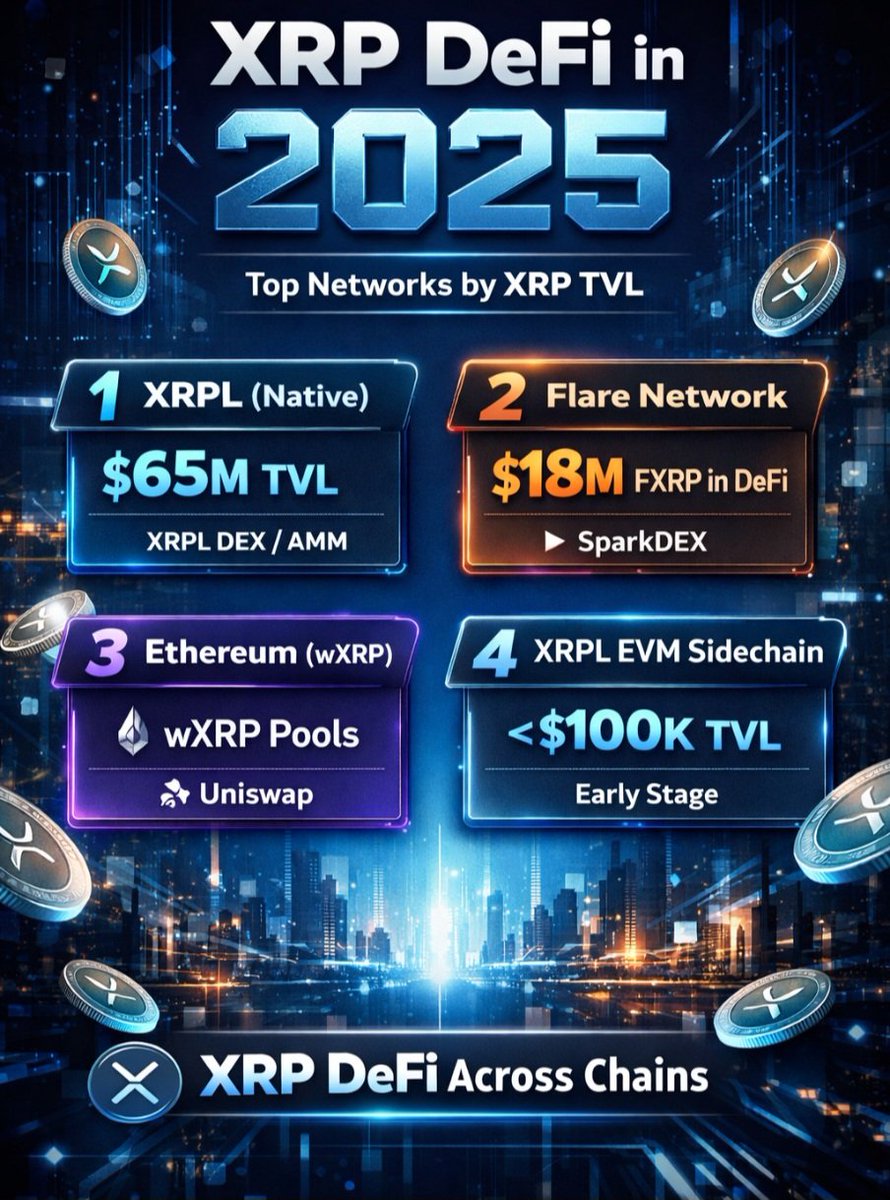
One thing I’m still trying to fully understand is the separation of concerns in the final architecture. As FXRP, stXRP and Firelight mature, would it be fair to say that: 1/ execution can happen across multiple chains, 2/ while risk parameters, coverage logic and protocol safety remain anchored to Flare? In other words, Flare acting as the coordination + risk layer rather than the execution venue itself. Fucking huge ! 🚀 #Web3 #Crypto #RWAs
🗳️ Add stXRP as a custom price feed on Flare As XRPFi grows on @FlareNetworks, stXRP is becoming one of the ecosystem’s valuable assets to unlock its full DeFi potential - collateral, lending/ borrowing, liquidations, yield strategies, and deeper DEX integration - the network needs a reliable, onchain USD price feed for stXRP. With FIP.13 enabling Custom Feeds on Flare Time Series Oracle (FTSO), the Flare Foundation is proposing to add an stXRP/ USD Custom Feed. Here’s what that means: 1️⃣ What is being proposed? A new stXRP/ USD price feed, built using the Custom Feed framework introduced in FIP.13. 2️⃣ What are Custom Feeds and how are they different? Custom Feeds compute price directly from on-chain logic, not from data provider submissions or CEX markets. They are ideal for LSTs, LRTs, and wrapped or derivative tokens - assets whose value is defined on-chain rather than traded on exchanges. 3️⃣ Why is this needed? • Supports more efficient and reliable use of @Firelightfi's stXRP in DeFi, paving the way for additional yield and collateral strategies on Flare. • Safer, oracle-backed liquidation mechanisms • Better integration across XRPFi and Flare-native DeFi • More composability for advanced strategies • Mirrors how @SceptreLS's sFLR benefits the FLR DeFi ecosystem. 4️⃣ How will the feed stay accurate & secure? Accuracy depends on: • The audited, transparent staking contract logic • The standardized Custom Feed contract interface defined by FIP.13. • The price is defined by deterministic onchain math, making it verifiable and tamper-resistant. 🗳️ The Infrastructure Provider Management Group (MG) will now review and vote on the proposal at: portal.flare.network/managementProp… If the vote reaches quorum, the stXRP/USD pair will be added to the FTSO on Flare.




Stake on Firelight to turn idle $XRP into on-chain DeFi coverage, bringing claim-paying abilities to DeFi. Stakers earn for underwriting DeFi cover, and staked capital attracts protocols seeking coverage, generating higher revenues and incentivizing additional stakers.