More in our CEO @aprilloong 's interview with @SamoraKariuki , check the video:
youtube.com/watch?v=7epiMV…

YouTube
English
Waka
69 posts

@HelloWaka_
Hello it's Waka 😊 Building in public the trade settlement platform for Africa trade. Follow to stay in touch! 🔔

Fast growth of direct port-to-port routes between China and Africa, after the introduction by China of total zero-tariff for African imports. The increase in air links between the 2 is led by African carriers while the new maritime surge is led by Chinese shipping companies. africa.businessinsider.com/local/markets/…
Stablecoins are moving from idea to infrastructure—powering real settlement. Visa has hit a $7B annualized run rate, + 50% QoQ. We have expanded our global stablecoin settlement program to @Arc, @Base, @CantonNetwork, @0xPolygon and @Tempo, bringing us to nine chains. Stablecoins are multi‑chain. Settlement has to be seamless across it.
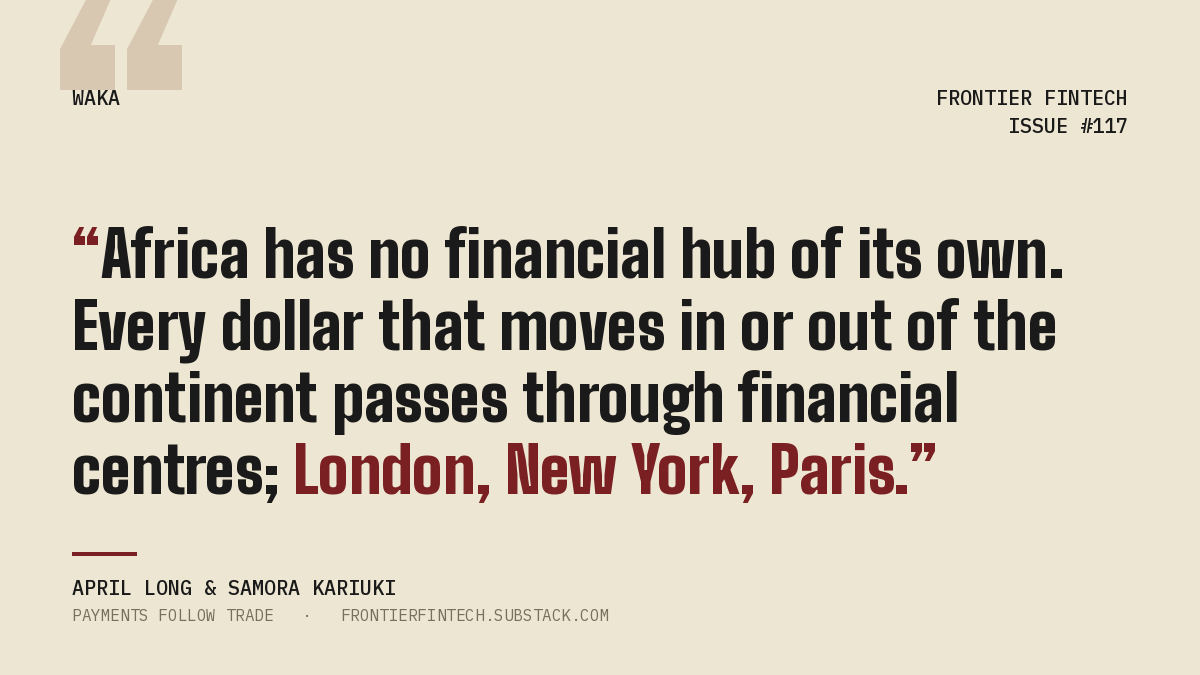
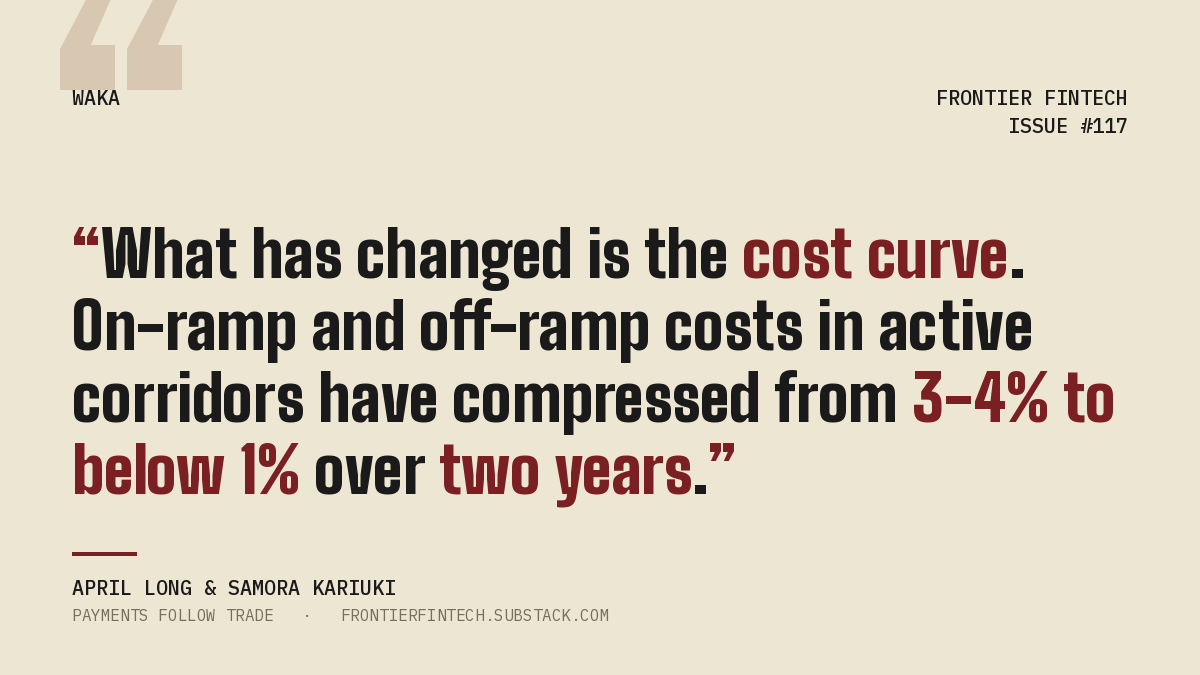
Every year, African businesses move billions of dollars to pay their Asian supply chain partners. Electronics, machinery, solar panels, construction equipment. They pay slowly, expensively, and through infrastructure designed for entirely different corridors. The correspondent banking system was built to serve trade flows that ran west. Africa's trade increasingly runs east. In 2024, Africa ran a $62 billion trade deficit with China while running surpluses with Europe and the United States. The dollars earned in London and Brussels must eventually reach Shenzhen and Guangzhou. The infrastructure connecting those two realities was never designed for the job. Stablecoins are changing part of this picture; less as a new currency, more as a mechanism for making existing dollar liquidity move at the speed trade actually requires. But the rail is only one layer. Settling into China carries compliance requirements that have no equivalent in Western payment systems. The data that travels with the payment is what makes the payment legitimate. Our latest piece on Frontier Fintech examines what it takes to build infrastructure that fits this reality and profiles Waka, the company April Long built after a decade managing the Africa-Asia corridor from inside Standard Chartered Kenya. Link in Comments. Subscribe to Frontier Fintech.
VIRTUAL ASSETS Kenya moves closer to regulating virtual assets as public participation on the Draft Virtual Asset Service Providers (VASP) Regulations, 2026 concludes. The Regulations operationalize the Virtual Asset Service Providers Act, 2025, providing a clear legal framework for licensing, regulating, and supervising virtual asset businesses in and from Kenya. Virtual assets such as cryptocurrencies, tokenized assets, and stablecoins are reshaping global finance. Kenya is positioning itself to harness innovation while safeguarding financial stability, protecting consumers, and managing emerging risks. Public value: The framework establishes a fair, transparent, and competitive market,supporting innovation, strengthening investor confidence, and unlocking new economic opportunities. Strong safeguards introduced include: • Fit & proper ownership requirements • Adequate capital thresholds • Strong governance frameworks • Robust risk management and AML/CFT compliance Consumer protection remains central: • Clear risk disclosures • Transparent pricing structures • Effective complaints handling mechanisms • Strict segregation and protection of customer assets Market integrity measures include: • Fair and orderly trading rules • Due diligence before listing virtual assets • Continuous monitoring of markets • Zero tolerance for manipulation, insider trading, and false trading Enhanced oversight and resilience measures include: • Continuous reporting and disclosures • Onsite and offsite supervision • Strong cybersecurity and incident reporting frameworks • Mandatory audits, insurance, and prudential requirements A whole of government approach anchors implementation, bringing together The National Treasury, Central Bank of Kenya (@CBKKenya), and Capital Markets Authority (@CMAKenya) for coordinated oversight. Kenya is building a trusted framework that balances innovation with financial stability. Next step: review and consolidation of stakeholder submissions ahead of finalization of the Regulations. Stakeholders are encouraged to follow updates as Kenya advances this regulatory framework.
Every year, African businesses move billions of dollars to pay their Asian supply chain partners. Electronics, machinery, solar panels, construction equipment. They pay slowly, expensively, and through infrastructure designed for entirely different corridors. The correspondent banking system was built to serve trade flows that ran west. Africa's trade increasingly runs east. In 2024, Africa ran a $62 billion trade deficit with China while running surpluses with Europe and the United States. The dollars earned in London and Brussels must eventually reach Shenzhen and Guangzhou. The infrastructure connecting those two realities was never designed for the job. Stablecoins are changing part of this picture; less as a new currency, more as a mechanism for making existing dollar liquidity move at the speed trade actually requires. But the rail is only one layer. Settling into China carries compliance requirements that have no equivalent in Western payment systems. The data that travels with the payment is what makes the payment legitimate. Our latest piece on Frontier Fintech examines what it takes to build infrastructure that fits this reality and profiles Waka, the company April Long built after a decade managing the Africa-Asia corridor from inside Standard Chartered Kenya. Link in Comments. Subscribe to Frontier Fintech.