Longevity Journal Club

6 posts

Longevity Journal Club

Longevity Journal Club

@LongevityJC

Physician (@ShawnXMa) interested in longevity For those looking to go beyond article abstracts and the podcaster/influencer "X paper shows..." one-liners

Присоединился Ekim 2022
7 Подписки14 Подписчики
Longevity Journal Club
Longevity Journal Club@LongevityJC·
LINK pubmed.ncbi.nlm.nih.gov/40395689/ GLOSSARY Creatine monohydrate (CrM) = most widely studied and bioavailable form of creatine, a naturally occurring compound that helps cells regenerate ATP Total creatine (tCr) = combined pool of free creatine and phosphocreatine in the brain Magnetic resonance spectroscopy (MRS / MRSI) = imaging technique measuring chemical concentrations in living tissue Cohen's d_z = measure of effect size for paired (within-subject) comparisons. Values of 0.2, 0.5, and 0.8 conventionally considered small, medium, and large effects, respectively. Paired t-test = statistical test comparing two measurements taken from the same individual (e.g., baseline vs. 8 weeks). Practice effect = improvement on a test simply from having taken it before, not from any true cognitive change Placebo effect = improvement attributable to the participant's expectation of benefit, heightened attention from study staff, and the psychological impact of participating in a trial APOE ε4 = genetic variant of the apolipoprotein E gene that is the strongest genetic risk factor for late-onset Alzheimer's disease. Carriers (one or two copies) have 3–15× increased risk Plasma p-tau217 = blood biomarker of tau pathology (a hallmark of AD). Levels ≥0.4 pg/mL suggest the presence of brain amyloid pathology. MMSE (Mini-Mental State Examination) = 30-point screening test for cognitive impairment in clinical practice and AD trials, the most common clinical dementia score NIH Toolbox Cognition Battery = standardized set of cognitive tests covering multiple domains (attention, memory, processing speed, language). Mean population score = 100; standard deviation = 15. CDR-SB = Clinical Dementia Rating-Sum of Boxes – validated rating scale commonly used in clinical trials to quantify the symptom severity of AD and other dementias
English
0
0
0
3
Longevity Journal Club
Longevity Journal Club@LongevityJC·
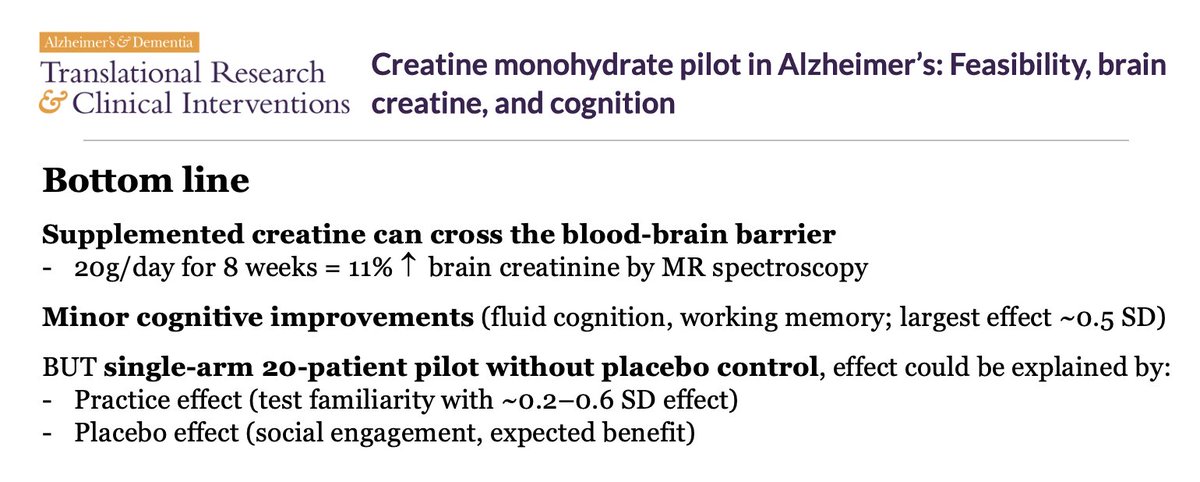
BOTTOM LINE - Supplemented creatine at 20 g/day for 8 weeks can cross the blood-brain barrier - 11% increase in brain creatine by MR spectroscopy - Minor cognitive improvements in some categories (fluid cognition, working memory; largest effect ~0.5 SD) - BUT single-arm 20-patient pilot trial without placebo controls - effects could be explained by: - Practice effects (improvement due to test familiarity rather than true cognitive improvement, estimated 0.2-0.6 SD improvement) - Placebo response (increased social engagement and expected effect) CLINICAL QUESTION Is 8 weeks of high-dose creatine supplementation (20 g/day) feasible in patients with Alzheimer's disease (AD), and is it associated with changes in brain creatine levels and cognitive performance? DESIGN Study type: Single-arm pilot trial; cannot establish causation for cognitive outcomes given no control group Population: 20 patients with AD, ages 60–90 Exposure: 20 g/day CrM powder (Life Extension Inc., donated) split into two 10 g doses, for 8 weeks. Weekly calls from a research dietitian. Outcome measurement: - Feasibility (primary): Self-reported compliance (≥80% = compliant), serum creatine at baseline, 4 weeks, and 8 weeks - Brain creatine: Magnetic resonance spectroscopic imaging (MRSI) – validated measure of total brain creatine (tCr), measured at baseline and 8 weeks - Cognition: NIH Toolbox Cognition Battery and MMSE at baseline and 8 weeks - Statistical methods: Paired t-tests for pre-post comparisons; Cohen's d_z for effect sizes - Baseline characteristics (mean ± SD): - Age: 73.1 ± 6.3 years - MMSE: 21.6 ± 4.4 (mild-moderate dementia range) - APOE ε4 carriers: 65% - Plasma p-tau217: 1.1 ± 0.5 pg/mL; 90% amyloid-positive (≥0.4 pg/mL) RESULTS Follow-up: None lost to follow-up; 19/20 met ≥80% self-reported compliance Serum creatine: Massive increase from baseline 0.6 ± 0.4 to 15.0 ± 13.6 mg/dL at 8 weeks (p < .001) Brain tCr (primary biomarker outcome): - Baseline: 330.5 ± 36.8 IU → 8 weeks: 366.9 ± 57.5 - Mean increase: 36.4 IU (11%), p < .001, Cohen's d_z = 1.01 (large effect) Cognition (secondary outcomes): Total Cognition Composite: 75.3 → 78.6, +3.3 points, p = .02, d_z = 0.58 Fluid Cognition Composite: 59.1 → 63.5, +4.4 points, p = .004, d_z = 0.74 List Sorting Working Memory: 66.2 → 74.2, +8.0 points, p = .001, d_z = 0.87 Oral Reading Recognition: 98.0 → 103.0, +5.0 points, p < .001, d_z = 1.03 Flanker Inhibitory Control: 68.1 → 73.0, +4.9 points, p = .05, d_z = 0.33 MMSE: 21.6 → 21.0, −0.6 points, p = .33 (no change) No change in crystallized cognition, picture vocabulary, picture sequence memory, or pattern comparison Correlations: Change in serum Cr and change in brain tCr: r = 0.49, p = .004 (positive correlation, supporting biological plausibility) Change in brain tCr and change in oral reading recognition: r = 0.60 (p = .005); crystallized cognition: r = 0.48 (p = .03) Brain tCr change not correlated with change in fluid cognition, working memory, or any other cognitive test — notable because fluid cognition and working memory were the tests showing the most improvement Safety: 13 mild adverse events (cramping/muscle pain, diarrhea, constipation, nausea, facial flushing, sleep disturbance) - Serum creatinine increased slightly (0.94 → 1.25 mg/dL, p = .001) — expected and not clinically concerning STRENGTHS - Appropriate primary objective: Feasibility answered - 20 g/day CrM tolerable and achievable in AD patients - Objective biomarker confirmation: Brain tCr by MRS - Biological confirmation of compliance: Serum creatine levels - Well-characterized AD population: 90% amyloid-positive by p-tau217 assay, 65% APOE ε4 carriers, mean MMSE 21.6 — genuine AD population - Zero attrition over 8 weeks - Registered trial (ClinicalTrials.gov NCT05383833), reducing risk of selective outcome reporting. LIMITATIONS No control group — Without placebo control, cognitive changes are uninterpretable. Multiple phenomena can produce the apparent improvement: - Practice effects: The authors note practice effects "modest in the NIH Toolbox," but even modest practice effects in a 20-person study with no correction for multiple testing can produce spurious significance - Placebo response (well-documented placebo response in dementia trials): Social stimulation alone can improve cognitive performance in AD (weekly calls with dietitian, attention from study staff). AD patients who receive more structured attention and engagement perform better on cognitive tests, entirely independent of any biological effect of creatine. - Regression to the mean: Participants were enrolled during a period when they met clinical criteria — cognitive performance may naturally fluctuate around the mean. - Multiple comparisons without correction: The study tested ~10 cognitive outcomes with no Bonferroni or false discovery rate correction. At α = 0.05, one would expect approximately 0.5 false positives by chance across 10 tests. Finding 4–5 "significant" results without correction inflates the apparent signal. - Surrogate endpoints treated as clinically relevant: NIH Toolbox are psychometric scores, not clinical outcomes - 3.3-point change in total cognition composite score has unclear clinical significance. MMSE (more widely used) did not change. - Selective correlation pattern undermines the proposed mechanism: If CrM improves cognition through increased brain creatine, one would expect brain tCr change to correlate with the cognitive domains that improved most. Instead, brain tCr change did not correlate with fluid cognition (p = .89) or working memory (p = .23) — the domains showing the largest apparent improvements. This dissociation weakens the mechanistic plausibility. DISCUSSION Objection 1: "The brain creatine increase is real and objective — doesn't this support the cognitive findings?" The MRS data are compelling and represent the study's most important contribution. However, demonstrating that a supplement reaches the brain is a necessary but not sufficient condition for cognitive efficacy. Many interventions alter brain chemistry without producing clinical benefit. More critically, the correlation between brain tCr change and the specific cognitive improvements was weak or absent for the most AD-relevant domains (fluid cognition, working memory), which undermines the "more brain creatine → better cognition" narrative. Objection 2: "Creatine has a strong safety profile and is inexpensive — isn't there enough evidence to recommend it even as a 'why not try it' approach?" The safety profile is reassuring (only mild adverse events, and creatine is well-studied in other populations). One thing to consider: the history of creatine in other neurodegenerative diseases (see Broader Literature Context) provides a cautionary tale about extrapolating from promising pilot data. BROADER LITERATURE CONTEXT - Creatine and cognition in healthy/aging adults: A 2024 systematic review and meta-analysis of 16 RCTs (492 participants) found a modest overall positive effect of CrM on cognition, but with substantial heterogeneity across studies and high risk of bias in many included trials. A 2026 systematic review of creatine and cognition in older adults found 5 of 6 studies reported positive associations, but most were cross-sectional with poor methodological quality. - Creatine in other neurodegenerative diseases: - Parkinson's disease: A large Phase III RCT (NET-PD LS-1, n >1,700) testing 10 g/day creatine for up to 5 years was terminated early for futility - Huntington's disease: The CREST-E Phase III trial (n = 553, doses up to 40 g/day) halted for futility - ALS: Multiple RCTs showed no clinical benefit - Key gap: No placebo-controlled trial of CrM has been conducted in AD patients. The current study fills the feasibility gap but leaves the efficacy question open. - Most important next study (author recommendation): Randomized, double-blind, placebo-controlled trial of CrM in AD with the ADAS-Cog as the primary cognitive outcome (the standard in AD drug trials), adequate sample size, longer duration, and hard clinical co-endpoints (functional assessments, CDR-SB) CONCLUSION - The 11% increase in brain total creatine (d_z = 1.01) is a robust proof-of-concept that oral CrM reaches the brain in AD. - The cognitive improvements cannot be attributed to CrM due to the absence of a placebo control group and no correction for multiple comparisons. - If creatine does prove beneficial in AD, the public health implications could be substantial given its low cost and favorable safety profile. But that requires rigorous evidence that this study, by design, cannot provide.
English
1
0
0
3
Longevity Journal Club
Longevity Journal Club@LongevityJC·
Creatine Monohydrate Pilot in Alzheimer's: Feasibility, Brain Creatine, and Cognition This 2025 paper has been cited by many in the longevity space (@foundmyfitness, etc.) as a reason to increase creatinine to 20g/day for cognition. But what does the paper really suggest?
Longevity Journal Club tweet media
English
1
0
0
3
Longevity Journal Club
Longevity Journal Club@LongevityJC·
Glossary: SD = standard deviation CV = cardiovascular CHD = coronary heart disease SCD = sudden cardiac death HTN = hypertension SBP = systolic blood pressure T2DM = type 2 diabetes mellitus BMI = body mass index LDL-c = cholesterol carried by low-density lipoprotein SES = socioeconomic status HR = hazard ratio Compares the chance of an event happening in a group (A) compared to a reference group (B) over time. HR of the reference group is defined as 1. If HR of group A is 1, there is an equal chance of the event compared to the reference group. If HR of group A is <1 (eg. 0.7), the event is less likely to occur in group A compared to reference group B (in fact, a 30% risk reduction). If HR of group A is >1 (eg. 1.3), the event is more likely to occur in group A compared to reference group B (a 30% risk increase) Bradford Hill Criteria = 9 principles that can be useful in epidemiology to establish a causal relationship between a presumed cause and an observed effect
English
0
0
0
104
Longevity Journal Club
Longevity Journal Club@LongevityJC·
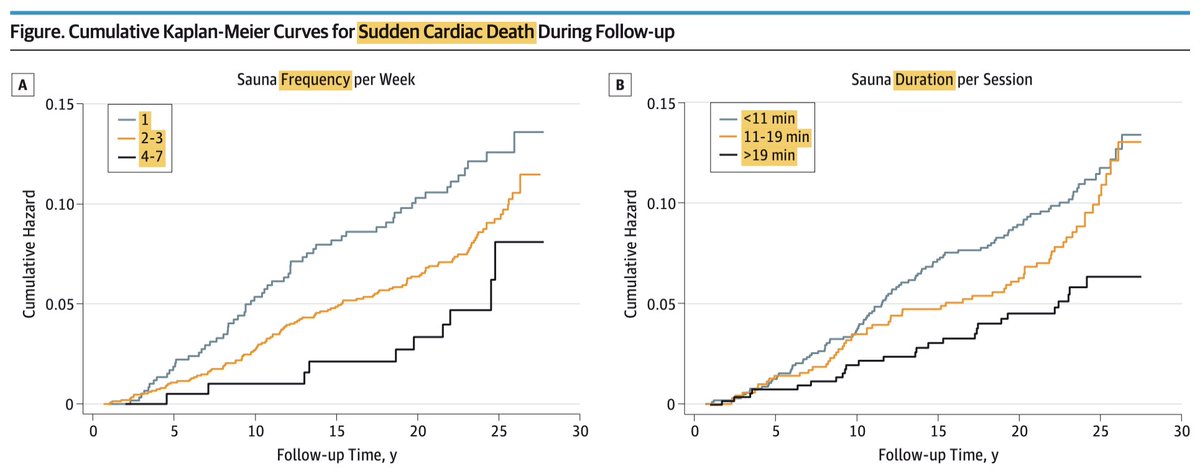
JAMA IM 2015: Association Between Sauna Bathing and Fatal Cardiovascular (CV) and All-Cause Mortality Events BOTTOM LINE - Strong dose-dependent association of dry sauna and lower CV + all-cause mortality - For optimal benefit, suggest sauna 4+/week for 19+ min at >171F Details CLINICAL QUESTION: Is frequency and duration of sauna associated with risk of sudden cardiac death (SCD), fatal coronary heart disease (CHD), fatal cardiovascular disease (CVD), and all-cause mortality? DESIGN: - Prospective, cohort (observational) study, population-based sample of 2315 men (42-60 yo) from Eastern Finland - 3434 invited → 2682 participated (78%) → 2315 sauna data available (68%) - Grouped by frequency (1, 2-3, 4-7 per week) and session duration (<11, 11-19, >19 min) - Baseline characteristics measured once at beginning of the study: -- Labs/vitals -- Chronic diseases assessed by internist -- Cardiorespiratory fitness measured by VO2 max cycle testing -- Physical activity by 12 month questionnaire - Self-reported sauna data by typical week; temperature measured by participant at head level - Outcomes/deaths by interview, hospital records, death certificates by 2 reviewers (blind to sauna data) Baseline, avg (sd): - Age 53 (5.1) - BMI 27 (3.5) - LDL-c 156 (39) - SBP 134 (16) - VO2 max 30 (8.0) mL/kg/min - Physical activity 372 (357) kcal/day - 30% smokers - 24% CHD - 34% HTN (21% on anti-HTN meds) - 5% T2DM Sauna: - 2.1 (1.1) sessions per week - 14.2 (7.5) min per session - 174 (17) degrees F RESULTS: - Avg follow-up time 19 years (no loss to follow-up) - Avg sauna session duration did NOT differ significantly by frequency - Avg temp of 4-7/week 171F vs. 1/week group 176F (p<0.001) Hazard ratios adjusted for age, BMI, SBP, LDL-c, smoking, alcohol, T2DM, CRF, physical activity, SES Subgroup analysis: Avg characteristics of 4-7/week group compared to 1/week: - 2 years younger - Slightly higher VO2 max - Slightly higher BMI - More HTN, T2DM - Less smokers - NO physical activity data provided More benefit in terms of CV mortality in less healthy population, aka patients with: - T2DM - Oldest third - Bottom third of VO2 max - BMI >25 - Trending toward benefit in middle/top third of VO2 max, not statistically significant (not powered for this analysis) - More benefit for non-smokers, likely due to overwhelming negative impact of smoking on CV health STRENGTHS: - Relatively generalizable sample - population-based group, no formal exclusion criteria -- Middle-aged -- Slightly overweight on average by BMI -- No exclusion based on co-morbidities -- VO2 max similar (30 vs. 33 for males 50-59 by FRIEND database - FRIEND excluded CAD/CHF likely explains slightly higher VO2 max) - Large sample size (2315) - Long follow-up duration (~19 years) - Use of 1 sauna session/week as control group, rather than no sauna -- Controls some confounding (all can tolerate sauna, all have access/time for at least some sauna) LIMITATIONS: - Homogenous population (male, not ethnically diverse) - Observational study, likely residual confounding - Regression dilution bias: one-time sauna reporting (sauna habits could change over long the follow-up period) - Duration should have been compared between frequency groups, or compared total weekly sauna time -- Once-a-week, 20 min session (20 min weekly total) is in >19 min group, but daily 10 min session (70 min weekly total) is in <11 min group → likely explains weaker associations with sauna duration - Biggest critique: Did not break out physical activity in the subgroup analysis of frequency groups -- Large variance in activity among participants (avg 372, st dev 357), can imagine a strong correlation with frequency of sauna -- Although HR was adjusted for physical activity, likely still residual confounding related to exercise OTHER DISCUSSION: - 4-7/week group was slightly healthier than 1/week group at study enrollment (age 52 vs. 54, VO2 max 32 vs. 29, less T2DM, less HTN) - However, may be in part due to existing sauna habit prior to study enrollment - Authors attempted to adjust for these with adjusted HR which included age, smoking, HTN, T2DM, cardiorespiratory fitness Potential rebuttal: “Those who can tolerate more frequent sauna are healthier” - Avg temp of 1/week is higher than 4-7/week - Higher temp is more taxing, 1/week can regularly tolerate this higher physiological stress Potential rebuttal: “one-time sauna reporting is too limiting” - Agree, more sampling of sauna data would be useful (though practically difficult) - Per article: “Practically, Finnish people are accustomed to have a sauna bath regularly at least once per week.” - Assuming this is directionally true, the biggest possible regression would be in the 4-7/week group, which would decrease the effect size, not increase it Applicable Bradford Hill criteria: - Strength (effect size) - Biological gradient (dose-response) In the context of other literature (to be covered): - Consistency (reproducibility) - Temporality - Plausibility - Coherence - Experiment CONCLUSION: - In this population of middle-aged men, there is a large beneficial association of sauna with CV death (adjusted HR 0.6) and all-cause mortality (adjusted HR 0.5) for 4-7 sauna sessions/week compared to 1 sauna session/week, in a dose-dependent relationship across frequency and duration - Stated magnitude of effect probably overestimated due to residual confounding even after adjusting hazard ratio, most likely due to correlation of sauna frequency with physical activity - Trending toward a causal relationship given most Bradford Hill criteria met for this study in the context of the broader literature - Subgroup analysis shows increased magnitude of benefit for more unhealthy population, but trending toward benefit in healthier populations as well (not sufficiently powered for this analysis) - This study suggests that sauna 4+ sessions/week for 19+ min/session at a temperature >171F (avg temp of 4-7/week group) may be optimal for mortality benefit Link: jamanetwork.com/journals/jamai…
Longevity Journal Club tweet mediaLongevity Journal Club tweet media
English
1
1
3
241