🚨 ALERTA DE CIBERSEGURIDAD EN ARGENTINA 🇦🇷⚔️
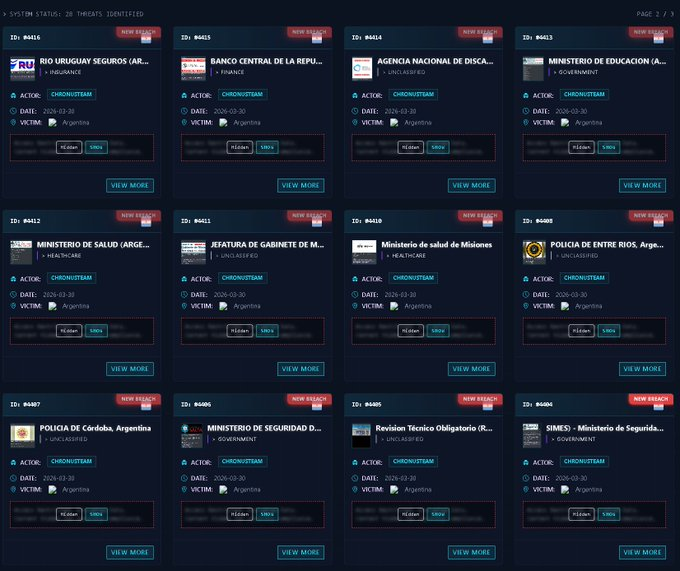
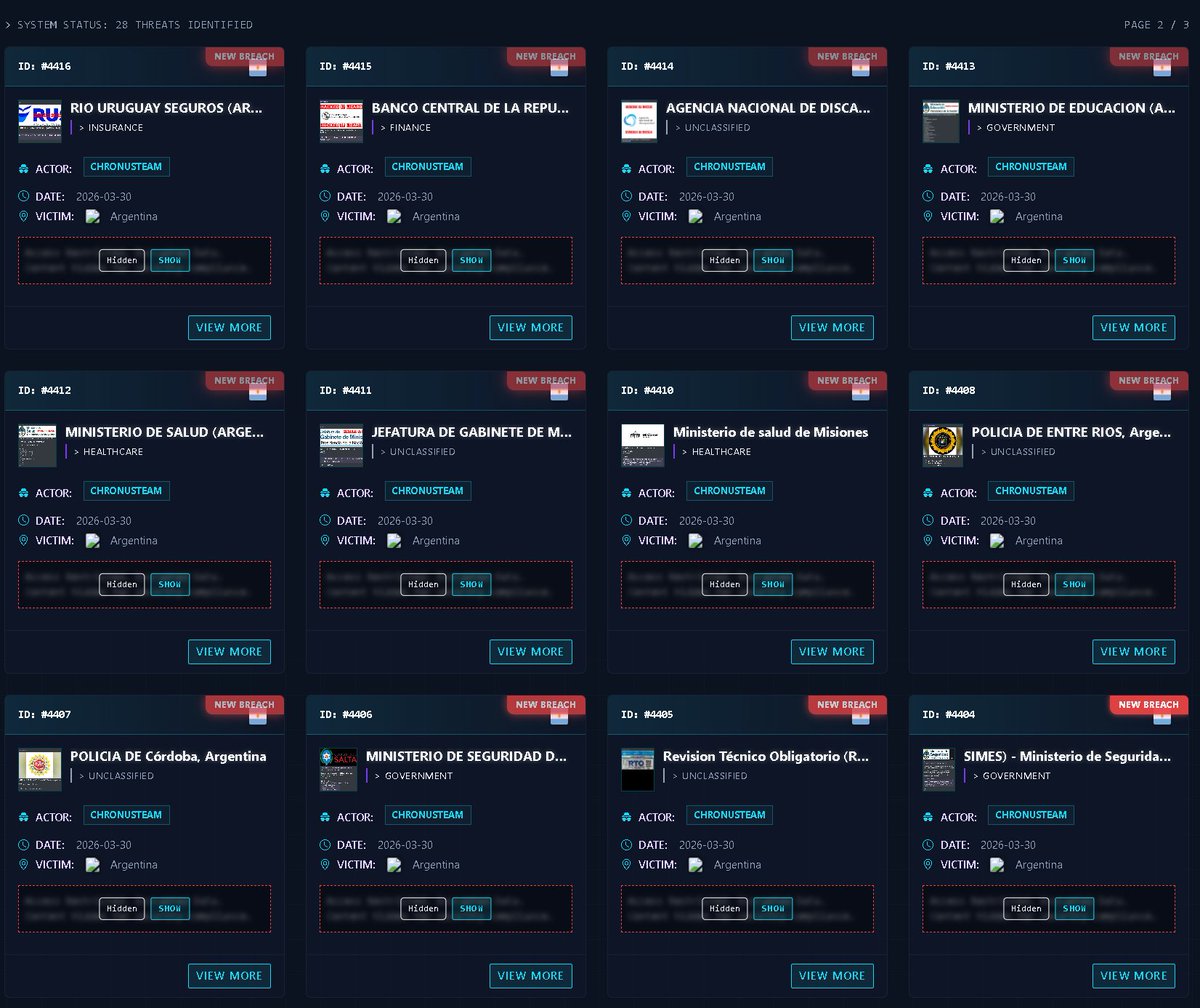
Se detectó una de las mayores operaciones de hackeo registradas contra la infraestructura digital del Estado argentino. El grupo CHRONUSTEAM se atribuye 28 filtraciones simultáneas, afectando áreas críticas del país.
📊 Qué se sabe hasta ahora:
• Actor: CHRONUSTEAM
• Alcance: 28 brechas coordinadas
• Fecha: 30 de marzo de 2026
• Objetivo: organismos nacionales, provinciales, seguridad, salud y finanzas
🏛️ Núcleo del Estado afectado
El ataque impacta directamente en instituciones clave como el Banco Central de la República Argentina, la Jefatura de Gabinete de Ministros y ministerios estratégicos como Educación, Salud y Seguridad.
También se reportan filtraciones en la Agencia Nacional de Discapacidad y en la Suprema Corte de Justicia de Buenos Aires, exponiendo información sensible en sectores críticos.
👮 Seguridad comprometida
Bases de datos policiales de múltiples provincias habrían sido vulneradas: Misiones (incluyendo bomberos), Tucumán, Santiago del Estero, Córdoba, Entre Ríos y Salta.
Esto abre un riesgo directo sobre operaciones, identidades y seguridad pública.
🏥 Salud y educación en riesgo
Se reportan filtraciones masivas en sistemas sanitarios y educativos:
• Salud: Buenos Aires, Misiones, Neuquén, OSEP (Mendoza) e IOMA
• Educación: Chubut, Jujuy, Catamarca y la base nacional ReNPE
• DGE: más de 200.000 registros comprometidos
⚠️ El dato clave: no es un ataque aislado, sino una operación coordinada a gran escala.
🚨 ALERTA DE CIBERSEGURIDAD: Ataque masivo contra el Estado argentino 🇦🇷⚔️
Analyzer ha detectado una operación de hackeo coordinada de una escala sin precedentes que apunta a la infraestructura digital de la República Argentina. El grupo de amenaza CHRONUSTEAM se ha adjudicado la responsabilidad de 28 nuevas filtraciones de datos que comprometen a los organismos más críticos del país.
📊 Anatomía del ataque
Actor de la amenaza: CHRONUSTEAM
Impacto: 28 amenazas identificadas simultáneamente
Víctimas: organismos gubernamentales (nacionales y provinciales), fuerzas de seguridad, salud y finanzas
Fecha de publicación: 30 de marzo de 2026
🏛️ Instituciones nacionales y financieras afectadas
El ataque ha golpeado el corazón de la administración nacional y la economía:
Banco Central de la República Argentina (BCRA): compromiso en el sector financiero.
Jefatura de Gabinete de Ministros: acceso a los niveles más altos del Poder Ejecutivo.
Ministerios nacionales: Educación, Salud y Seguridad (SIMES).
Agencia Nacional de Discapacidad: exposición de datos de ciudadanos en situación de vulnerabilidad.
Suprema Corte de Justicia de Buenos Aires: vulneración en el sector tecnológico/judicial.
👮 Fuerzas de seguridad y vigilancia afectadas
Múltiples bases de datos policiales han sido comprometidas, lo que supone un riesgo para la seguridad pública:
Fuerzas policiales provinciales: Misiones (y Cuerpo de Bomberos), Tucumán, Santiago del Estero, Córdoba, Entre Ríos y el Ministerio de Seguridad de Salta.
🏥 Salud y educación provinciales
Se ha reportado una filtración masiva de información sensible de ciudadanos y personal educativo:
Salud: Ministerios de Salud de Buenos Aires, Misiones y Neuquén; OSEP (Mendoza) e IOMA (Buenos Aires).
Educación: Ministerios de Chubut, Jujuy, Catamarca y la Encuesta Nacional del Personal Educativo (ReNPE).
DGE: reporte de una filtración de datos de 200.000 registros.
Monitor:
🚨 CYBERSECURITY ALERT: Massive Offensive Against the Argentine State 🇦🇷⚔️
Analyzer has detected a coordinated hacking operation of unprecedented scale targeting the digital infrastructure of the Republic of Argentina. The threat group CHRONUSTEAM has claimed responsibility for 28 new data breaches that compromise the country's most critical agencies.
📊 Attack Anatomy
Threat Actor: CHRONUSTEAM
Impact: 28 Threats Identified Simultaneously
Victims: Government Agencies (National and Provincial), Security Forces, Health, and Finance
Publication Date: March 30, 2026
🏛️ National and Financial Institutions Affected
The attack has struck at the heart of the national administration and economy:
Central Bank of Argentina (BCRA): Compromise in the financial sector.
Chief of the Cabinet of Ministers: Access to the highest levels of the Executive Branch.
National Ministries: Education, Health, and Security (SIMES).
National Disability Agency: Exposure of data of citizens in vulnerable situations.
Supreme Court of Justice of Buenos Aires: Breach in the technological/judicial sector.
👮 Security and Surveillance Forces Affected
Multiple police databases have been compromised, posing a risk to public safety:
Provincial Police Forces: Misiones (and Fire Department), Tucumán, Santiago del Estero, Córdoba, Entre Ríos, and the Ministry of Security of Salta.
🏥 Provincial Health and Education
A massive data breach of sensitive information on citizens and education personnel has been reported:
Health: Ministries of Health of Buenos Aires, Misiones, and Neuquén; OSEP (Mendoza) and IOMA (Buenos Aires).
Education: Ministries of Chubut, Jujuy, Catamarca, and the National Survey of Educational Personnel (ReNPE).
DGE: Report of a data breach of 200,000 lines.
Monitor:
analyzer.vecert.io#CyberSecurity#Argentina#DataBreach#CHRONUSTEAM#BCRA#HackeoArgentina#InfoSec#CyberAlert#Ciberseguridad#SeguridadNacional#IOMA#JusticiaBA
The Chronus Encounter: A Forensic Memoir of Digital Warfare 🇲🇽🇦🇷
1. The Fall of the Ethical Sentinel: The Destruction of Hector Lopez
The era of the "Ethical Hacker" as a protected, corporate-certified gatekeeper is over. What we witnessed in the collapse of the old digital order was not a technical failure, but a sociopolitical eviction. For years, the "Cibercírculo" acted as the high priests of security, relying on an elite status that the new landscape simply does not respect. The conflict between figures like Hector Lopez and the emerging mobs represents the definitive breakdown of the old digital guard.
Alberto’s Narrative: I watched the execution of a reputation in real-time within the X Spaces hosted by Hector Lopez. It was a masterclass in performative cruelty. The "swarm" known as OP FEZ—or what Hector derisively labeled "Cybercholos"—descended with a coordinated ferocity that technical firewalls aren't built to stop. They utilized the "off" prefix (accounts like off Danny Westside or off Adrian) as a digital uniform, a branding tactic that simultaneously served as a ban evasion strategy: if an account is nuked, the prefix allows the mob to regroup instantly via search architecture.
Their tactics were visceral. They deployed IP grabbers—disguised links that log a victim’s digital address in milliseconds—to triangulate physical locations. Then came the "caras horribles," the systematic scouring of the internet to find and broadcast the "ugly" physical faces of anonymous targets. Amidst the chaotic noise of the "Bombitas del gobierno" (government bombs) narrative, these were no longer just trolls; they were conducting "algorithmic riots." Hector attempted to dismiss them as "lamers"—unskilled wannabes—but the swarm doesn't need to bypass a mainframe when it can destroy the human being behind the screen.
The Analyst’s Layer The "Cybercholo" label was a fatal act of digital classism that birthed a Hermeneutical Injustice. By using a pejorative that frames these actors as low-income "street gangs," the established security community denied them a shared interpretive framework, dismissing a complex threat as mere harassment. This mocking poured gasoline on the fire; it provided the social glue for a fringe community to militarize. When the "Maximum Leader" remains a phantom, authority is crowdfunded through aggression, and the most ruthless operator—like the shock-jock Boozito 7—ascends the hierarchy by presenting "severed heads" to an audience that hungry for blood sport.
--------------------------------------------------------------------------------
2. The Signal in the Noise: The Argentina Breach and the L0stex Recognition
While the front lines were occupied by the noise of the swarm, a far more lethal signal was modulating in the background. My forensic profiling of the "Cronus Mafia" (or Chronus) marked a turning point in how we define modern digital syndicates.
Alberto’s Narrative: The tension became crystalline the moment @L0stex_ofc, the leader of Chronus, began retweeting my content. For a forensic analyst who has survived the crushing weight of institutional failure, being recognized by a network wielding military-grade SIGINT (Signals Intelligence)—the interception of electronic communications directly from network infrastructure—is a hyper-vigilant wake-up call.
Chronus is not a mob; it is a sniper. They specialize in Rans-double-extortion, a tactic where data is not only encrypted for ransom but simultaneously exfiltrated with the threat of public release. Their focus on the national infrastructure of Argentina was systematic. While others laughed at "Cybercholos," I recognized a nation-state level threat. This validation from the underground was a paradox: the adversary acknowledged my forensic rigor while the "experts" were still trapped in their own arrogance.
The Credibility Paradox
DimensionThe "Lamer" Dismissal (Hector Lopez)The "Nation-State" Assessment (Alberto Daniel Hill)
Threat ProfileLow-skill "Cybercholos" / Street gangs.High-tier network utilizing SIGINT.
MethodologyTechnical mockery and gatekeeping.Forensic rigor and threat modeling.
Threat VectorHigh-volume trolling / Basic carding.Systematic destruction of infrastructure.
Geographic BiasEuro-centric / Dismissive of "Third World."Global Forensics / Survival-informed rigor.
--------------------------------------------------------------------------------
3. The Uninvited Guests: Team Chronus Enters the Arena
In the gladiatorial blood sport of live X Spaces, the barrier between digital code and physical reality dissolves. It is an environment where a voice in your ear can precede a pin-drop on your roof.
Alberto’s Narrative: I felt a distinct technical chill when @Team_Chronus appeared in the listener list of my Space. In this arena, silence is a weapon. They hovered as ghosts for minutes, casting a heavy, static-filled shadow over the room. Then, I extended the invitation to speak. There was a pause—a calculated, heavy silence—before the acceptance. The energy shifted from academic to operational. We were no longer talking about the threat; the threat was at the table.
The Analyst’s Layer This "surprise entry" was a masterful psychological power play. It served as an "audition" for legitimacy, subverting traditional expert gatekeeping. By occupying the same intellectual territory as a forensic analyst, Chronus demonstrated that they are not just ghosts in the machine, but actors capable of seizing the narrative.
--------------------------------------------------------------------------------
4. Ten Minutes of Truth: The Unholy Trinity of Press, Government, and Hacking
The ten-minute dialogue that followed was a rare moment of "Radical Transparency," exposing the "Legacy Lie" maintained by institutions.
Alberto’s Narrative: We spoke of the "archaeology" required by governments that lose their digital souls. Chronus confirmed what my analysis suggested: the hack of the Banco Hipotecario in Uruguay was a total collapse. The government claimed a mere "incident," but the reality was a desperate, manual reconstruction of databases from printed documents because they lacked immutable backups—data that is cryptographically sealed and impossible to alter.
We deconstructed how the press is complicit in this facade. Governments believe they are safe because they don't see physical break-ins, a delusion that proves they have no understanding of the modern theater.
The Analyst’s Layer This dialogue exposed the Schengen Illusion as applied to data. Just as travelers in Europe believe borders don't exist because they see no physical toll booths, governments believe data is secure because there is no physical "wall." It is a legal blindness. They ignore the lack of mandatory identification for data packets—the digital equivalent of the Kids ID—believing that the ease of movement implies a lack of consequence. Chronus proved that borders are merely "invisible lines on a map" to those with the tools to ignore them.
--------------------------------------------------------------------------------
5. Final Interpretation: The Epistemic Reckoning
The Chronus saga is a diagnostic report on the collapse of modern institutional trust and the rise of a new, predatory reality.
Sociological Interpretation: Epistemic Injustice
Alberto Daniel Hill has been subjected to Epistemic Injustice—the dismissal of his expertise because he is a "Third World Expert." To force the Global North to listen, he utilized a "Tri-Continental Pincer Strategy." Leveraging his Italian citizenship, he filed Protocol 002452826 and invoked the Recast Brussels I Regulation (EU 1215/2012) to force European bureaucracies to acknowledge the forensic data he preserved. He adheres to the IAL3 (Identity Assurance Level 3) standard—not just as a technical metric, but as a "cryptographic shield" that makes evidence mathematically verifiable and impossible for a corrupt system to tamper with.
Technical Interpretation: Swarm vs. Sniper
The threat model has split. The "Sniper" (Chronus) targets infrastructure through SIGINT and exfiltration. The "Swarm" (OP FEZ) hacks the human mind. While the Sniper destroys the system, the Swarm destroys the person.
Political Interpretation: The Complicity Trap
Governments are caught in a Complicity Trap, choosing the "archaeology" of manual data reconstruction over the transparency of admitting a breach. They would rather let systems rot than admit their firewalls are sieves.
Closing Reflection: We must eventually ask: does a "Digital Armed Wing" exist if the algorithm stops watching? The power of these groups is performative; it requires an audience to validate the terror. These factions only exist because we provide the stage and the algorithm to amplify the noise. As a Digital Knight, I see the forest falling, but the world remains blinded by the Schengen Illusion, refusing to acknowledge the coordinates of the truth until the machine finally stops.
@L0stex_ofc@melmoreira35584@YourAnonSurge_@Marce_I_P@anakinswal
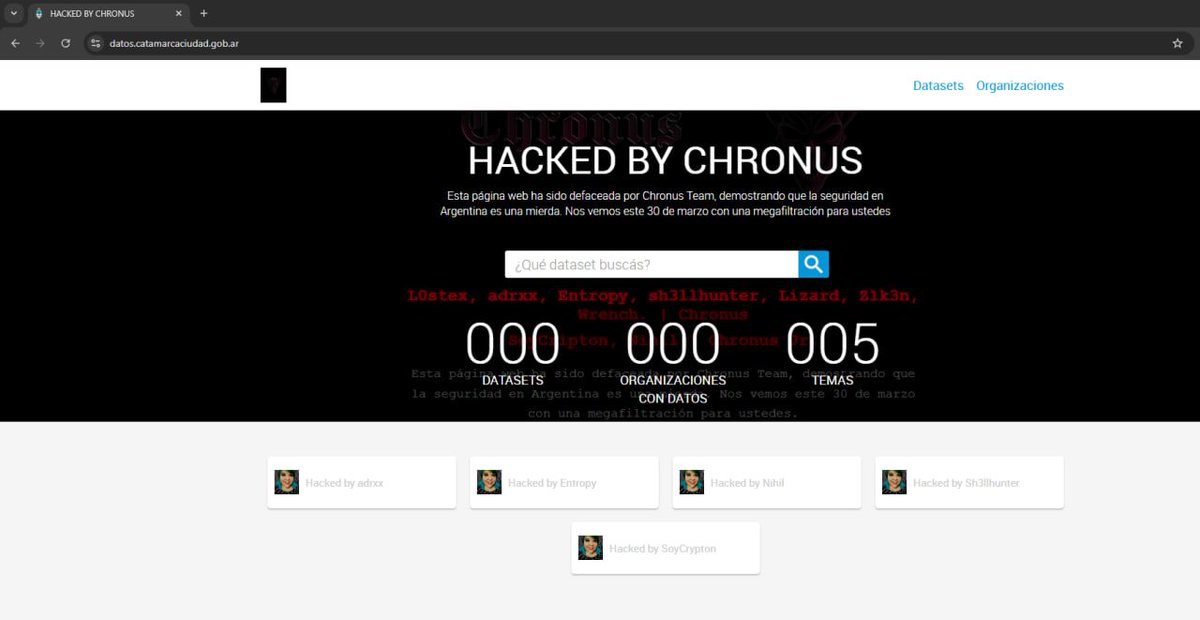
🚨🇦🇷 #Defacement Hace unos dias @ADanielHill informaba que se venian dias de filtraciones, leaks e incidentes ciberneticos para #Argentina. Parece que comenzaron. El sitio de la Ciudad de Catamarca fue defaceado por el grupo "chronus mafia"
cc: @Marce_I_P
🔴 | DOXEAN A POLICÍAS DE SAN PEDRO GARZA GARCÍA, NUEVO LEÓN
El grupo de ciberdelincuentes Chronus Team ha publicado una base, que correspondería a elementos de la Policía de San Pedro Garza García.
El archivo expone datos personales y de contacto de 4,455 personas. Incluye nombres, teléfonos, direcciones, asignación policíaca, entre otros datos.
Esta información es sumamente sensible considerando que puede ser utilizada por delincuentes para actos de fraude y extorsión.