Bernie Gartenlaub
29.4K posts

Bernie Gartenlaub
@argoexp
Stock Trader. Former Hedge Fund Manager. Stock Charts & Ideas. All things NY Rangers #NYR
New York Присоединился Şubat 2009
992 Подписки2.1K Подписчики
Bernie Gartenlaub ретвитнул

💥NEW: Nurse Practitioner and Close Confidante of Rudy Giuliani, Dr. Maria Ryan, on his miraculous recovery🙏
“He was really critical and he went to the hospital Sunday night. I actually brought him there … I had a priest come in, give him his last rites … And we were talking about seeing if he could breathe on his own the next day. But we’re thinking, ‘Geez, we’ll see if he can take any breaths.’”
“And I swear to God, it was the prayers. The next day, we were able to take him off the ventilator — and he was able to breathe on his own.”
“He’s able to talk, unfortunately still requiring oxygen and lots of medication for cardiac issues and others. But we’re all optimistic. He’s going to pull through this. And it’s day by day. But he knows the prayers have been coming in. And I’m telling you, he feels them.”
English
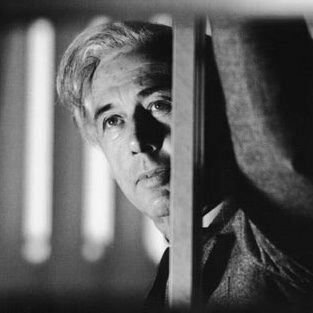
@DannyDrinksWine Great movie and moral lesson. However, as far as Iran’s leaders are concerned, I would be part of the lynch mob.
English

On this day, 83 years ago, one of the greatest Westerns of all time, William A. Wellman's "The Ox-Bow Incident" (1943) premiered in New York City, USA.
The real life incident that sparked Henry Fonda to make films that tackle prejudice in the society:
Henry Fonda, at the age of 14, witnessed the lynching of Will Brown in downtown Omaha, Nebraska, 1919 during the riot. He was deeply affected by the incident. This enraged the young Fonda and he kept a keen awareness of prejudice for the rest of his life.
William A. Wellman's "The Ox-Bow Incident" (1942) which was based on the novel of the same name, tackles the theme of lynching of 3 innocent men by a posse. This movie was one of Fonda's favourite movies.
Fonda chose projects which tackle the issue of prejudice in the society. John Ford's "Young Mr. Lincoln" (1939) and Sidney Lumet's "12 Angry Men" (1957) also revolves around similar themes.
Here is Henry Fonda talking about the incident in Omaha:
"After supper, [my dad] put me in the car with him and we drove back downtown [to the printing office]. And it was very unusual for me — for my dad to be taking me at my age and turning lights on and unlocking doors and going up the stairs. It’s not like doing it in the daytime. I remember those physical things, and walking across this empty office to a window that overlooked the courthouse square. This was where the riot was happening. My father never talked about it. He never preached about it. We both just were observers. […] It was the most horrendous sight I’d ever seen. […] My hands were wet and there were tears in my eyes. All I could think of was that young black man dangling at the end of a rope."
(Fonda's interview with Norman Parkinson, 1975)
English


@FoxNews Get off your hind feer and fuck ‘em. Blow Iran away already!
Screw the polls, the midterms, Iran’s unburied missiles, etc.
we’re in it to win it so stop stalling
English

BREAKING: Secretary Rubio sounds the alarm about reports that Iran could move to control traffic in the Strait of Hormuz as he announces the U.S. is expecting a response on peace negotiations today:
"We've seen the reporting overnight that Iran has established or trying to establish some agency that's going to control traffic in the Straits… That would actually be unacceptable."
"We're expecting a response from them today at some point. We have not received that yet... I hope it's a serious offer, I really do."
English
Bernie Gartenlaub ретвитнул

@Pokeycorky Turner’s biased meat headed response says it all about her thinking.
Throw her off the air
English

Harold Ford shared his wife is a former Republican,
Then out of the blue,
Fox News Hall Monitor Gillian Turner asks him live on the air,
“Is your wife comfortable with you sharing this?”
#TheFive
English
Bernie Gartenlaub ретвитнул

I am the Chairman and CEO of Vornado Realty Trust. Eighty-four years old. Seven buildings in Midtown Manhattan. I said what I said.
I said "tax the rich" is the equivalent of a racial slur. I said it at REBNY. Into the microphone. Eight hundred people. Median net worth in that room was north of $240 million, I know because our CFO ran the guest list through a Bloomberg terminal as a joke, and then it wasn't a joke. And when I said it, twelve people applauded. The rest nodded. One woman in the third row mouthed, "Finally." I saw her.
Sharon, my communications advisor, Columbia, $430,000 a year, very bright, Sharon wants me to walk it back. She drafted something. "Mr. Roth's comments were intended to highlight the emotional impact of political rhetoric on business communities." I read it. I put it in the trash can on my desk. Not the recycling. The trash. Here's my clarification: I understated it.
"Tax the rich" is worse than a slur. A slur is just a word. It doesn't come with a CBO score. Nobody is introducing a bill called the Racial Slur Implementation Act of 2026. But there are seventeen active proposals in Congress, I had Sharon count them, seventeen proposals designed to take more of my money. My money. Mine. Money I acquired by being better at acquiring Manhattan commercial real estate than anyone alive for four consecutive decades. That is not a crime. That is a record.
I pay property taxes on $18.2 billion in assessed assets. $412 million a year. Say it again: four hundred and twelve million. I carry that number. It's the first thing I think about when I see a protest sign. I think: I pay more in property tax than the entire annual budget of the city of Fort Lauderdale. I looked this up. Fort Lauderdale: $408 million. Steve Roth: $412 million. I am a small city. And the city doesn't get screamed at.
My effective tax rate last year was 11.4 percent. I say this because I believe in transparency and because I'm not ashamed of it. The rate reflects the legal structure of real estate investment trusts, depreciation schedules Congress established in 1986, and carried interest provisions that both parties have voted to preserve for forty years. I did not write these laws. I organized my entire financial existence around them with the help of nine full-time tax professionals who have offices on the 38th floor of 888 Seventh Avenue, which I also own. Their office is in my building. Their work protects my buildings. This is not a loophole. Sharon calls it a loophole. I've told her: a structure maintained by nine attorneys across four decades is not a loophole. A loophole is something you slip through once. This is architecture. This is the foundation. This is the building.
Last Tuesday, same as every Tuesday, I walked past 1290 Sixth Avenue. My building. And there was a man. Same man as last week. Same sign: "Billionaires Pay Your Fair Share." He was standing on my sidewalk. My literal sidewalk — my company owns the ground lease. He was maybe thirty. He was wearing a jacket I would estimate cost $60. My lunch that day was $114. For one. I am telling you this not to boast but because these are facts. He has decided I'm his enemy. Based on a number he saw on a Forbes list. He doesn't know what I pay. He doesn't know what my buildings cost this city in construction jobs and lease revenue and foot traffic. He knows one number. He has made one judgment.
I see him every Tuesday. I've started to notice things. He brings coffee from the cart, not the Starbucks. He has a backpack that looks heavy. He doesn't look unhealthy. He looks like he probably works somewhere, but not on Tuesdays. I've wondered: does he have a job? Does he have a building? Does he have anything that depends on him the way 4,200 employees depend on me? I suspect not. And yet he has opinions about my tax rate.
I gave $22 million to charity last year. The Met. NYU Langone. Mount Sinai. I gave a building to NYU. Not money for a building — a building. The Steven Roth Residence Hall. It houses 400 students. That man with the sign has never housed 400 students. He hasn't housed one. He gives cardboard. I give structures. This is not a comparison I'm making to flatter myself. It's just arithmetic.
When I said what I said at REBNY, I was saying what every person in that room believes and none of them will say publicly because they have communications advisors and the communications advisors all went to Columbia and they all say "unhelpful." I'm eighty-four. I'm too old for helpful. I'm too old to perform restraint for people who hate me for something I can't change.
I didn't choose to be rich. I chose to be good at one thing for a very long time, and this is what happened. You don't punish someone for that. You don't legislate against someone for that.
My net worth fluctuates between $3.8 and $4.1 billion depending on the quarter. I fluctuate more in a fiscal week than that man on my sidewalk will earn in his life. Both of these are facts. Only one of them is considered polite to say.
They want me to apologize.
I'll be dead in ten years. Twenty if I'm lucky. And they'll still be renting my buildings.
English

@marcthiessen Trump changed his stance towards Iran. Playing in neutral is not his game. Time to go on offense again for the kill
English

If you were in Iran’s shoes, you would perceive weakness, conclude that Trump’s threats were bluster and that he is unwilling to resume the bombing campaign, that Trump is feeling political pressure from high gas prices, that the U.S. blockade of Iran in the strait is backfiring on him and that it is only a matter of time before he is forced to end that too. You would think that your ability to threaten the oil infrastructure of America’s Persian Gulf allies is not only successfully deterring Trump from striking you again but also preventing him from taking away your control of the strait. You would think that you, not Trump, have the cards.
wapo.st/4eEuLHX
English

@EchoesofWarYT I wish you had annotated the sources of all your accounts of Doc Hollday.
English

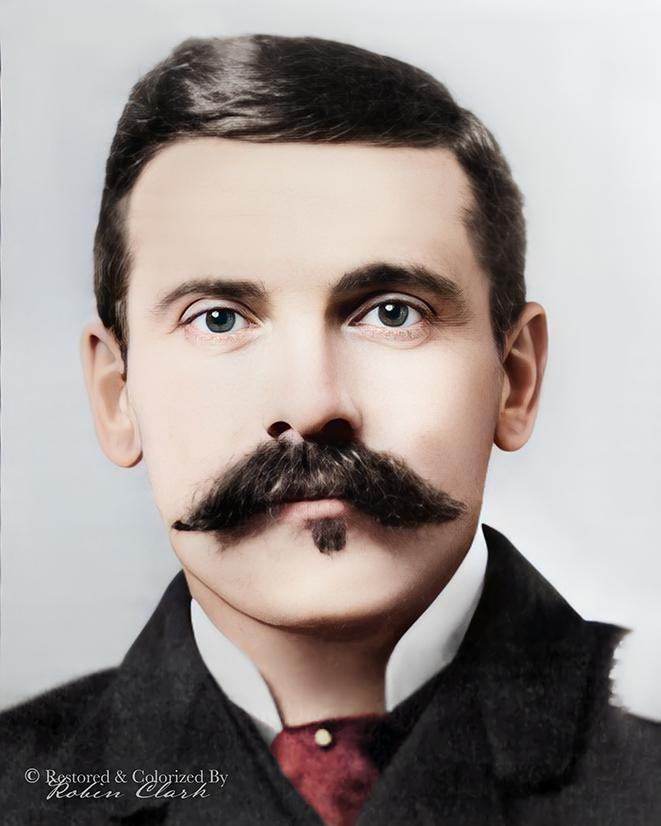
Doc Holliday was a dentist with a classical education in Greek and Latin who killed his first man at 19, coughed blood into a handkerchief for the next 17 years, and died in bed with a glass of whiskey, saying, "This is funny."
Funny because he'd spent his entire adult life expecting to die in a gunfight. He never did.
John Henry Holliday was born in Griffin, Georgia in 1851. He came into the world with a cleft palate and a partial cleft lip, a deformity that in 1851 was usually a death sentence for an infant. His uncle, a surgeon named John Stiles Holliday, performed the corrective surgery himself when the baby was two months old. His mother Alice spent the next several years patiently teaching the boy to speak clearly. She taught him piano. She taught him manners. She taught him how to bow to a woman and how to address a gentleman. By the time he was a teenager, John Henry could quote Virgil in the original Latin, play Chopin from memory, and dance a quadrille.
Then she died of tuberculosis when he was 15, and so did the small, soft world she'd built for him.
He was sent to Philadelphia to study dentistry. He graduated from the Pennsylvania College of Dental Surgery in 1872 at the age of 20, one of the youngest in his class, and his entry "Diseases of the Teeth" was considered exceptional. He won an award at a dental fair for "Best Set of Artificial Teeth in Gold." His diploma still exists. You can look at it.
He moved back south, set up a practice, and started coughing.
By 1873 the diagnosis was unmistakable. Pulmonary tuberculosis. The same disease that killed his mother. Doctors gave him a few months, maybe a year. They told him his only chance was to move west, where the dry air might slow the lungs from drowning. He kissed his cousin Mattie goodbye. He had been in love with her for years. She would later become a Catholic nun, Sister Mary Melanie, and she was the woman Margaret Mitchell would model Melanie Hamilton on in Gone With the Wind. They wrote each other letters until the day he died. Nobody has ever found those letters. The family burned them.
He went to Dallas. He set up a dental office. And his patients, watching this thin polite young man cough blood into a handkerchief between extractions, stopped coming.
So he turned to cards.
Faro, mostly. Poker when he could find it. He had a gambler's gift and a dying man's nerve, and within two years he was making more in a week at the tables than he'd made in a year pulling teeth. He moved through Texas and into the Colorado mining camps, then New Mexico, then Arizona. He drank an estimated two to three quarts of whiskey a day, partly because it numbed the lungs and partly because nothing else did.
Here is what made him terrifying.
Most gunfighters in the Old West were cowards in expensive boots. They picked fights they could win and avoided fights they couldn't. Doc Holliday already knew he was dying. There was nothing you could threaten him with. There was no future you could take from him. He would walk into a room of armed men with that thin slow smile and a Colt and a knife and sometimes a sawed off shotgun under his long grey coat, and the math running behind his pale blue eyes was simple. Every day he was alive was already stolen. The men across the table had something to lose. He had nothing.
He weighed about 135 pounds. He was five foot ten. He was usually drunk. And by the time he reached Tombstone, men crossed streets to avoid him.
His common law wife was a Hungarian woman named Mary Katharine Horony, better known as Big Nose Kate. She had been born to nobility in Budapest, run away as a teenager after her parents died, worked as a prostitute in Iowa, and ended up on the frontier with a temper that matched his. He once got her out of jail by bribing a guard. She once got him out of jail by setting fire to the hotel next door as a distraction, then walking him out at gunpoint. They fought constantly. They loved each other in the way two people love each other when they both know one of them is going to die soon.
He met Wyatt Earp in Fort Griffin, Texas, in 1877. The friendship that followed would shape both their lives. The legend goes that Doc saved Wyatt's life in Dodge City, walking out of the Long Branch Saloon to find Wyatt surrounded by cowboys with guns drawn, and putting his pistol to the leader's temple before anyone saw him move. Wyatt later said he owed Doc his life. He said Doc was "the most skillful gambler, and the nerviest, fastest, deadliest man with a six gun I ever knew."
Wyatt Earp said that. About a tubercular dentist who could quote Cicero.
At the OK Corral on October 26, 1881, the fight lasted thirty seconds. Doc was carrying a 10 gauge coach gun under his coat. He killed Tom McLaury with both barrels. When Morgan Earp was assassinated months later in retaliation, Doc rode with Wyatt on what history would later call the Vendetta Ride, a three week killing spree across Arizona that left every man they believed responsible dead in the dirt. They were never caught. They were never tried. They simply rode out of the territory and disappeared.
By 1887 the disease had finally caught up with him. He was 36 years old. He weighed less than 120 pounds. He had outlived nearly every man who had ever tried to kill him, and most of the ones who had only thought about it. He checked into the Hotel Glenwood in Glenwood Springs, Colorado, where the sulfur springs were said to ease the lungs. They didn't.
On the morning of November 8th, the nurse brought him a glass of whiskey. He had always sworn he would die with his boots on, the way a gunfighter was supposed to die. He looked down at his bare feet under the white hospital sheet. He looked at the whiskey. He started to laugh.
"This is funny."
Then he drank it.
And he died.

English
Bernie Gartenlaub ретвитнул

This reminds me: When is Obama going to be criminally investigated!
TheBlaze@theblaze
Obama: "The White House shouldn't be able to direct the AG to go around prosecuting whoever the president wants prosecuted. You can't have a situation where whoever is in charge of the government starts using that to go after their political enemies or reward their friends."
English

@CrazyVibes_1 Contrast the patriot Truman with the communist traitor Obama the leech
English

On the morning of January 20, 1953, Harry S. Truman and his wife Bess climbed into their own Chrysler — paid for with their own money — and drove themselves out of Washington.
No motorcade. No security caravan. No choreographed farewell meant to polish the record. The thirty-third President of the United States merged into ordinary traffic and headed back to Independence, Missouri — the same small town that had shaped him — carrying an approval rating near thirty-two percent and a widely shared media conclusion that his presidency had fallen short.
Washington did not mourn his departure.
Home offered no immediate redemption. Truman returned not to comfort but to constraint. His income came largely from a modest military pension — sufficient only if one defined “sufficient” generously. There was no speaking tour prepared, no corporate directorship, no financial cushion reserved for a former president. At one point, he took out a bank loan simply to bridge the distance between what he had and what daily life demanded.
Congress noticed. Not out of sentiment, but out of unease. Watching a former commander-in-chief navigate visible financial strain unsettled even political opponents. In 1958, lawmakers passed the Former Presidents Act, establishing pensions and benefits for those who followed. The system exists because Truman’s reality made its absence impossible to ignore.
He did not campaign for sympathy.
He walked the streets of Independence every morning, as he always had. There was no Secret Service protection for former presidents yet, and he never requested special treatment. He answered his own telephone. He personally replied to thousands of letters. If someone wrote to him, he believed they deserved an answer from him. On his desk — now preserved in the Truman Library — sat the sign that defined his presidency: The buck stops here.
The decisions that had damaged his popularity were not reconsidered.
The Marshall Plan committed American resources to rebuilding Western Europe after World War II. Critics warned of excess and entanglement. The rebuilt Europe of the following decades offered its own rebuttal.
The Truman Doctrine established the framework for containing Soviet expansion — a foreign policy architecture that would shape four decades of global strategy. Its consequences would be debated for generations. Its structure endured.
In 1948, Truman signed Executive Order 9981, desegregating the United States military. Congress would not act. He did. The political cost was immediate and steep; Southern support fractured. He signed it anyway.
In 1951, he dismissed General Douglas MacArthur.
MacArthur was not simply a general; he was a national icon. Removing him for publicly challenging civilian authority was politically perilous. Public backlash intensified. Mail poured in criticizing Truman. Approval numbers dropped further.
He acted because the constitutional principle of civilian control of the military mattered more than personal standing. That principle outweighed applause. Truman accepted the cost without visible regret.
History, unlike approval polls, operates on delay.
In July 1965, President Lyndon B. Johnson traveled to Independence — not for optics, but for acknowledgment. At the Truman Library, Johnson signed Medicare into law. Truman had proposed national health insurance in 1945. It had been rejected, attacked, and politically burdensome. Two decades later, the idea returned in workable form.
Johnson handed the first two Medicare cards to Harry and Bess Truman.
The gesture recognized continuity. The idea had begun with the man once dismissed as misguided. Time had altered the nation’s readiness, not the principle itself.
Truman died on December 26, 1972, at eighty-eight.
By then, the verdict of January 1953 had been revised. Presidential historians increasingly ranked him among the upper tier — not without noting mistakes, but with acknowledgment that the most controversial decisions had proven consequential and largely correct. He understood the distinction between popularity and necessity.
The Marshall Plan. The Truman Doctrine. Desegregation of the armed forces. The removal of MacArthur. The early call for national health insurance. Individually, each was politically hazardous. Collectively, they reveal a presidency grounded in consequence over comfort.
He left Washington in a Chrysler, approval in the thirties, carrying a bank loan.
He spent nineteen years walking the same streets of Independence, answering his own phone, replying to letters himself, living quietly under a belief that character is measured most honestly when no audience is present.
History recalibrated.
It often does.
Not quickly. Not loudly.
But eventually, for those who chose what was necessary over what was easy, it arrives.

English

@AmitSegal @BarakRavid Trump is screwing up. He can’t make a “deal” with Iran now. Finish them! Or fuck it up
English

According to @BarakRavid the U.S. and Iran are at the closest point to an agreement since the war began. The framework includes:
• The U.S. and Iranian naval blockade will be gradually lifted during the detailed negotiation period.
• The United States will commit, in the memorandum of understanding, to gradually lift sanctions and release tens of billions of dollars from frozen assets.
• Negotiations are still underway on the duration of the uranium enrichment freeze. Three sources said the freeze would last at least 12 years, and one source estimated the final outcome would be 15 years. In addition, the U.S. wants to include in the agreement a clause stating that any Iranian violation regarding uranium enrichment will extend the freeze period.
• Two sources claimed that Iran would agree to transfer the highly enriched uranium it possesses out of the country.
• The United States expects to receive Iran’s response within 48 hours regarding several key points in the draft framework agreement.
English
Bernie Gartenlaub ретвитнул

t.co/XdFzIETIFT
‼️🇦🇪🇮🇱 HISTORIC BREAKTHROUGH 🔥
For the first time ever, an Arab nation is hosting Israeli defense forces and technology on its soil.
Israel and the UAE just signed a major defense pact — Israeli air defense systems and operators are now deployed in the Gulf.
This is the Abraham Accords in action: real alliances against the Islamic regime and its jihadist proxies.
English

@EricLDaugh @stockcommgroup Those Iranian liars will keep on stringing us on. We have to wipe them out now!
English