Bruno ༽

1.5K posts

Bruno ༽ banner
Bruno ༽

Bruno ༽

@criptopraleigos

Присоединился Ağustos 2009
266 Подписки105 Подписчики
Bruno ༽
Bruno ༽@criptopraleigos·
@gdomemes27 @crenangs VOCE ESTÁ COBERTO DE RAZAO. ATE PRESIDENTE DE ORGANIZADA EU JA FUI NO RJ. PAREI COM ESSA IDIOTICE EM 2005 GRAÇAS A DEUS. JA PASSOU DA HORA DE PROIRBIREM AS ORGANIZADAS DE VEZ NO BRASIL.
Português
0
0
1
481
Bruno ༽
Bruno ༽@criptopraleigos·
@vivoxvivendo Eu pertenci a organizadas até meados de 2005. Inclusive fui presidente de torcida no RJ. Posso afirmar que as organizadas deveriam ser banidas e serem tratadas como facções criminosas. Sim, existem pessoas de bem, mas até no crime também existem.
Bruno ༽ tweet media
Português
0
0
0
607
Bruno ༽
Bruno ༽@criptopraleigos·
@ConfissoesXiX Foi preciso o melhor amigo morrer para ele perceber o que a noiva dele realmente é? Não houve nada de valioso perdido, mas ele precisa aprender a ter mais discernimento nas escolhas que faz. Não é sempre que um amigo vai perder a vida para salvar a dele.
Bruno ༽ tweet media
Português
2
1
75
11K
Bruno ༽ ретвитнул
Shai (Deshe) Wyborski
Shai (Deshe) Wyborski@DesheShai·
Before I respond, an announcement: I came to a decision in my heart that this will be the last time I spend half an afternoon on generic FUD, including any followups by Justin. If a post makes a new cricism, I will gladly address it, but let the current post be my swan song when it comes to responding to bad post that just reiterate previously made claims. Regarding the post, it is essentially 75% opinions (despite OP's gratuitous use of the word "objective" many times, each and every one of them disingenuous) presented as facts, and 25% wrong factual claims. Since it is a waste of time to discuss opinions with someone who doesn't know the facts, I will focus on the latter. The tl;dr is that: a. Justin has a very strong bias against proof-of-work, but he has never justified it. I have rebuked all his previous arguments for PoS and against PoW in the past, but he never acknowledged my points. PoW vs. PoS is not an argument that can be settled by math alone, because it is highly affected by economic externalities that no one can predict. My perspective on PoW vs. PoS and why I think any efforts to decentralized PoS are futile is detailed here: #google_vignette" target="_blank" rel="nofollow noopener">kasmedia.com/article/unders… I don't see any reason for any further comments on all "PoS is factually better" statements, as they are objectively based on nothing. b. The rest is just ignorance about L2s. It seems that Justin once learned about a the drawbacks of a specific design for L2s, and is since under the impression that all possible designs share the same afflictions. However, all crucial faults he points out are simply untrue for our design. If Justin had bothered to read the relevant discussions (e.g. in the research forum: research.kas.pa), he might have found that out before making his blusterous post. But I guess this is above the capacity of the self-proclaimed "professional crypto researcher". c. To elaborate on b. a bit more, the core of Justin's objections are to non-based rollups. The problem with such rollups is exactly that they don't have a good separation of work between the L1 and the L2, and particularly grant the L2 permissions they arguably should not have (and provides no incentives for the L2 to benefit the security budget of the L1). That's one of the main reasons the chosen path is the based path, because it essentially resolves all of these issues. Justin never bothered to make the distinction, because he never bothered with reading the design and understand its motivations. It's pretty striking to see how many of the "problems" he points out are design motivation that our directly addressed in the relevant (publicly available) discussions. And with that I give you my last masterpiece: 88 things that are wrong in Justin's tirade: 1. "KAS has no smart contracts [...] Making it uncompetitive, regardless of scalability" Regarding SC, this is a lie of omission. Yeah, there are no SCs deployed yet, but there is intense work in bringing them to Kaspa. Ignoring that effort altogether is unreasonable, especially when most of the post is a (bad) criticism of that very effort. 2. "KAS has no [...] PoS! Making it uncompetitive, regardless of scalability" See a. above [Moving on into the linked thread where he "explains" why L2's are "terrible" (x.com/Justin_Bons/st…)] 3. "Arbitrum, Optimism, Base, Blast, Mantle, Starknet & ZkSync all have admin keys! This means they can steal all users' funds right now" That's an overt oversimplification. Take Arbitrum for an example. Now, I don't like Arbitrum's trust model at all, I think it lends to much power to permissioned entities. But I would never go as far as saying there's a single entity that can steal all your money on a whim. Arbitrum has a permissioned list of committee members appointed by the DAO. They also have a sequencer that is controlled by the Arbitrum foundation. If there are n committee members, stealing user's funds will require the collusion of n-1 committee members and the sequencer. Now, I don't think this is a good trust model, but it definitely doesn't mean your money is up for easy grabs. Similar statements can be made to all of the above (except Blast, for which this statement is actually accurate). The trust model introduces centralized entities that I do not like, but it's a huge stretch to go from there to "there's a person that can just decide one day to steal your money effortlessly with impunity". 4. "A centralized sequencer cannot steal user funds, but it can censor & front-run, which is unacceptable" Again, a statement that is true for some designs but not in general and not for Kaspa. I'd say that this concern is the true reason to go with based rollups. In a based rollup the L1 is the sequencer. This means that users interact with the L2 by posting data to the L1 (which is accumulated into the L2's blob). Yes, the L2 data is opaque to the L1, which doesn't know (or care) whether the (valid) L1 txn contains valid or invalid instructions for the L2 (that's exactly the line separating sequencing from processing). The proof output by the prover proves, among the rest, that the entire blob has been fully and correctly processed. The bottom line: the only way to censor/frontrun on a based L2 is to censor/frontrun on the L1. 5. "L2 SCs require admin keys for upgrades, even if through a DAO [...] This is why L2 sequencers & admin keys end up facing the same challenges as L1s but without an L1s security & scale!" The first part is essentially correct, but again, does not imply the second part because the sequencing is on the L1. 6. "Even after "decentralizing," L2s only get a fraction of L1 security, as it relies on a separate consensus layer: Ironically, the only way to remove centralized sequencers & admin keys is by adding a consensus mechanism!" Or, y'know, by doing the sequencing on the L1. A model called based rollups. This idea is not new to Kaspa and was actually proposed for Ethereum by Justin Drake almost two years ago (ethresear.ch/t/based-rollup…). That is more than a year before Justin wrote his "why L2s suck" tirade, which means he hasn't done a lick of dd. My guess is that he reviewed the state-of-the-art of Ethereum somewhere around 2017-2018 and since then he just assumes things remained the same way. He shares this affliction with many "researchers" that are investors and not actual developers/scientists. (This reminds me that just the other day I had an argument with another "investor/researcher" who insisted that the best solution for post-quantum UTXOs is Lamport signatures. I tried to explain that Lamport sigs are huge and only provide one-time security, and that there are much better post-qc schemes than Lamport signatures. He replied with "well, it's your word against Vitalik's" and posted a talk Vitalik gave in 2015, before stuff like Dilithium or Falcon even existed.) 6. "L2s will always have a lower validator set (security) compared to L1" Except if they are based whereby the validators are those of the L1. See how much I'm repeating myself? Because, again, it is impossible to have an argument of opinions with someone who doesn't know the facts. If Justin spent on dd, like, half the time he spends on writing and picking fights, then this entire unfortunate exchange could be avoided. He also knows that I am a nice person (when not provoked) and my DM is always opened. Why not just ask me before jumping to conclusion? 7. "There is no way around this problem for L2 decentralization. They have to become "blockchains" in their own right!" Except, again, there is and they don't. Again, see Justin Drake's post: ethresear.ch/t/based-rollup… And our's: research.kas.pa 8. "At the end of the day, L2s are competing with each other & the L1 itself" The fact that L2s compete with each other is good. The facts that they compete with the L1 itself is wrong. Why? Repeat after me kids: based rollups are sequences by the base layer. 9. "Representing various power blocks who do not always get along This dynamic is good in most cases, but for blockchain scaling; it only guarantees massive fragmentation!" Unless, and hear me out here, the sequencing is done on the L1. 10. "Thinking everyone will use the same seamless interoperability protocol While custodians pack up shop in favor of superior technology... Is a fantasy & does not represent how free markets actually work!" So it's oh so very nice that L1 sequencing can enforce that all L2 use the same canonical bridge. See here: research.kas.pa/t/l1-l2-canoni… 11. "In that environment, a seamless & interoperable UX would also put too many at risk For example; a decentralized L2 should not be seamlessly interoperable with a centralized L2!" "Seamless interoperablity" doesn't mean interoperability can be made without the user's knowledge or consent. That's just an absurd claim. That it seamless means that interoperability between L2s can't be read off the L1, not that it allows L2 operators to arbitrarily move funds to other L2s via bridges without telling anyone! 12. "Demanding far more steps & understanding from the user is what ruins UX! This is what makes L2 UX unsolvable!" Quite the opposite. In either case, the user must be informed of what they are getting themselves into. The meaning of seamlessness is that once the user gave their consent (typically by an L2 txn signed by their key), the L2 can "take it from there" and no user involvement is required further, making the UX better! 18. "These different rule sets are what break composability" Huh? Say what? Come again? If all chains had the same rule sets you wouldn't need interoperability. The entire point of interoperability is to be able to move your coin across different services. It creates coupling between different L2s and defragments the liquidity. Were you licking toads before writing this post? 19. "As you are now either an Arbitrum, Optimism, or ETH user, they are competing!" OK, so that's a fault with Arbitrum and Optimism, not with L2s as a concept. 20. "That is why seamless interoperability between all L1s & L2s is impossible " This is a not even wrong type of statement. A word salad, if you will. The entire notion of "seamless interoperability between all L1s and L2s" is ill-defined. There are so many different ways to interpret this statement, and each will admit a different level of veracity against the following statements. 21. "The difference with L1 scaling is that it does not arbitrarily limit how much will fit within a single composable state As that is anti-competitive!" Excuse me, what? Not only is that not necessarily true, but there is one relatively known counter-example. Ever heard of a small, niche coin called Solana? Well, in Solana, the amount of execution per transaction is capped by a global constant, exactly like you said an L1 wouldn't. 22. "As the user now needs to know what L2 their friend is on & how to bridge between [...] Compare this to simply using a scalable L1!" Yeah, well, even in the L1 world the user faces many options and needs to be careful. That's just a reality of life, people should be careful with their money. There is no substance to the claim that L2s somehow exacerbate that reality. 23. "Whether parallelization, enshrined roll-ups, or execution sharding Using ETH would just be using ETH without requiring a user to think about extra steps" If we put aside service disruption for a second, and assume both networks scale properly, do you really think using ETH as an L1 has better UX than using a token of Solana? Really really? 24. "This inevitably ends up in most users choosing custodians, who can simplify the process for them. This is also what happened to BTC's Lighting Network" No no no no no! The reason LN encourages custodians has nothing to do with interoperability. It is because if users want to have their own peer they must be constantly online, which is unreasonable. 25. "ETH core has finally acknowledged the problem of fragmentation with "L2 scaling"! Proposing "shared sequencing" as a solution It will not work, as it relies on L2s agreeing to use the same sequencer. It goes against human nature to cede power & profit to a shared sequencer." Oh, so now you finally acknowledge the existence of other designs, but utterly fail to understand how they work. Based rollups provide many guarantees that non-based rollups cannot. You listed some of them yourself: better UX, better security guarantees, L1-grade censorship resistance. In Kaspa, this also comes with MEV resistance, secure oracles, and so on. Better services attract more users, making them earn more money and provide a better ecosystem (that reduces development costs), incentivizing using them. On top of that, the only way running your own sequencer is more profitable than using L1 sequencing is if you intend malfeasance. If your sequencer was just supposed to follow the protocol then why should you care? This makes network that insist on running their own sequencer on a non-based L2 even more suspicious, which should deter people from using them. You cryptobros like to talk a lot about "free markets" but you couldn't recognize a laissez faire market if it slaps you across the face! 26. "The ability to censor, monitor & privately order TXs still has sufficient value, real or perceived" The ability to monitor txns exists in all non-privacy coins. The ability to privately order txns exists in all coins (and why is it even a drawback? If I want to pay a miner directly instead of going through the mempool it is my prerogative). And the ability to censorship? Arguably not as valuable as the ability to honestly proclaim "censorship on my L2 is impossible". 27. "That many L2s will choose not to surrender that power to a shared sequencer, making it unsolvable!" Unsolveable... you keep using this word... 28. "That is why L2s will not want to be fully interoperable with their competitors As they are building their own "shared sequencers" that compete with each other Putting us back to square one!" Sequencing has little (not nothing, but little) to do with interoperability. An L2 isn't forced to be interoperable with another L2 just because they both use the same L1 for sequencing. This is not a counterargument to L1 sequencing. 28. "Driven by the thought that if everyone used the same L2 (their L2), it would solve the UX problems!" Again, astonishing lack of understanding of what Eth actually propose, which is L1 sequencing. Justin read the word "shared sequencing", and now assumes this means some global L2 sequencer is created that all other L2s are expected to use. That's not the design at all. What do you think the word "enshrine" even means?!? The whole point of L1 sequencing is that it is enforceable by the L1. 29. "The idea is also ironic; if it was possible for a single L2 ecosystem to scale for global demand Then it implies we could have done it on an L1 instead!" Wth man? That's not true in the slightest. The separation between L1 and L2 has so much more substance than just "L1 can run several L2s", and there are many examples where a single tech is divided into several layers, and encapsulate the "L2" data even though they are running both the L1 and L2. Hadera is an example. 30. "That is also where the conflict of interest lies As these two outcomes are diametrically opposed to each other, if the ETH community would rally around this idea, hard By refusing to use non-enshrined sequencers Then I admit there is a possibility of this working out" Yeah but what if, and be with me here, we are not talking about Eth but about other techs who have enshrined the use of L1 sequencing to all rollups from the get go as a prerequisite? Ever considered this design, Justin? 31. "This would be a case where a small community pivots against incentives in favor of ideology" No, that would be a case of users preferring the technology that can offer better service, leaving the non-enshrined counterpart with an only temporary advantage of having more adoption and a more developed ecosystem (and the latter isn't even the case for open-source projects because they could be ported to an enshrined L2. Heck, they could even port it to a different chain, given that there's sufficient infrastructure. See @Igra_Labs which are about to release an execution layer for generic EVM over Kaspa). 32. "Even if ETH succeeds in making a shared sequencer a shelling point for L2s, which I am doubtful off It still does not solve the problem of there being varied trust trade-offs between L2s" Why is that a "problem"? Different techs give different trade-offs, that's why there's justification for their existence. 33. "While L2s earn far more by supporting a narrative that restricts L1 capacity, in favor of exclusively scaling through L2s" The capacity of L1s is already restricted by hardware. If your network can saturate this bound (like Kaspa can), then this point becomes moot. If you don't offer on-chain execution (which I still maintain is a terrible idea to begin with), then the L2s have sufficient value proposition in terms of advanced functionality. 34. "Only a fraction of fees are paid back to ETH, severely weakening the overall economic design Compared to L1 scaling, "L2 scaling" economics are weak!" Hmm, if there was only a design where the activity of the L2 naturally requires using the L1 and paying fees therein. I dunno, maybe if the sequencing was somehow on the L1 🤔🤔🤔 35. "This is comparable to what happened in BTC with SegWit, as it gave an arbitrary discount to its L2; Lightning Network" This is not what SegWit did. SegWit was a necessary reaction to the observation that one can slightly modify ECDSA signatures without changing their validity, causing a problem of malleability: two transactions that are functionally identical, but have different IDs. The solution, segregate the witness (in this case, the signature) to a non-hashed field. Transaction malleability is a delicate phenomenon that usually doesn't have pragmatic consequences, but it does contradict the design of LN. So in order to make LN possible, the SegWit fix (which was necessary anyway) was expedited. There is nothing wrong with core designer expediting features that are important for ecosystem initiatives. For example, the functionality of txn payloads was expedited into the Crescendo hard-fork, because it streamlined the design of KRC20 indexers. It doesn't mean the KRC2 network was given "an arbitrary discount", or that this feature isn't for the benefit of the ecosystem in general. That's a very cynical, misleading way to describe what happened. 36. "Whereas L1 scaling aims to collect fees from a large amount of TXs; paying a low fee" The offending word here is "whereas", the comparison was against ETH&BTC but it is strongly insinuated that the objection is against all "non-L1 scaling" in general. But again, for the thousandth time, L1 sequencing means users post L1 txns to use the L2. The dichotomy between "L1 scaling" and "most txns happen on the L2" is false. 37. "The L1 scaling approach is superior as low fees provide utility for users, while high fees destroy utility!" Reality paints a different picture tho. The high fees on the L1 are utility costs for the entire L2s, which aggregate the small fees paid by the users over the L2. I don't think this is a very strong point, and I hate it when people use it as an argument against L1-scaling (my opinion is obviously that you want to combine L1 scaling with based rollups, because then your L1 could do much more sequencing), but it is still technically correct and counterfactual to Justin's argument. 38. "The bottom line is that a modular chain like ETH has no capacity Forcing usage to move to L2s which take the lion's share of fees Comparing this to a monolithic chain; which keeps all of the fees for itself" See point 36. 39. "Because a zkEVM obsoletes all contemporary L2s!" zkEVM is not a scaling solution, it is an enhancement of ZK rollups, providing them with a canonical way to produce ZK proofs for EVM executions. This will indeed scale Eth tremendously, in the amount of L1s it can carry lol. It will allow existing EVMs to delegate the small part of execution the have to do on-chain to themselves, providing proofs instead, thus decreasing the amount of L1 txns they have to perform. For example, Arbitrum resolves conflicts by on-chain arbitration that requires a logarithimic amount of txns. With zkEVM, they could replace the entire thing with a single proof. It is amazing that after ignoring/sidelining actual approach to the problems that concern you, the only "solution" that satisfies you is not a solution at all. 40."am not against the zkEVM; it definitely has some compelling attributes It is essentially a form of sharding, as multiple enshrined roll-ups can shard the state into multiple EVMs Which can be seamlessly interoperable with each other, as it is all part of the L1 now" Really Justin? All of it? What about the provers? You know, the guys responsible for actually generating those "magic proofs"? They are the ones who do all the hard work, but what should they? How are they compensated? I'll let you stew on that for a while instead of just telling you the answer. 41. "It does come with the trade-off of potentially losing historical state, though that also makes it more private" OMG it doesn't! Anyone can eavesdrop and keep store of the entire history. Just because it isn't stored by default doesn't mean that you can count on it for privacy. 42. "Implementing a basic form of sharding in the meantime would make a massive difference & stop L2 entrenchment!" How? How would a "basic form of sharding" counteract L2s? How do you maintain all the shards, and keep consistency across shard? 43. "Core devs could easily raise the limit within a month Instead, they removed "increase L1 gas limit" from the roadmap [...] A false abdication of responsibility as they conveniently shift the blame to the validators" I'm not going to dive into the internal politics of Eth and their choice not to increase gas limits. I don't know much about it (though Justin's descriptions come off as kinda conspiratorial imho). But I can state a simple, technical fact: gas limits the amount of execution each transaction could require the validators to perform, so increasing the gas limit will require stronger validators, harming centralization. I don't know if that's the motivation, I don't know what kind of increase we're talking about and what kind of impact it is going to have, and I don't particularly care. All I know is that arguing that appealing to the validators sake is completely without merit is dead wrong. 44. "As this requires a majority of validators to continuously vote on higher limits" There is a very simple reason why such a decision should be taken with extreme care (not to mention that it requires implementing on-chain governance on Eth, which is far from trivial). There's this convergent dynamic: gas limit increased, weaker validators drop off, stronger validators have more voting dominance, gas limit increases, etc. etc.. The rich-get-richer dynamics of PoS are problematic enough without giving the richest validators an on-chain tool to increase the cost of being a validator. 45. "BTC is even worse, where the blocksize limit is determined by the "reference client"" What what what? Being determined by the reference client is the best possible scenario. It means that users get a free choice in what they consider the "true" protocol. This is a farcry from networks that rely on centralized services, prohibiting easily creating forks and competing references.
Justin Bons@Justin_Bons

1/15) Kaspa is a primitive dinosaur chain 🦖 So far behind that, it lacks all the critical features of a modern chain KAS has no smart contracts or PoS! Making it uncompetitive, regardless of scalability KAS promises the moon, yet objectively, it fails in every single way: 🧵


English
113
234
843
80K
Bruno ༽
Bruno ༽@criptopraleigos·
@pumpolinsky I want to win 2000 kaspas. If I don't win, I'll do this.
English
0
0
0
8
Bruno ༽ ретвитнул
Pumpolinsky
Pumpolinsky@pumpolinsky·
🔥 I'm doing a #Kaspa Giveaway!! 💚Giving back to the community ✨To participate, 👉Like the post, Follow me, Comment and Repost! 🎉February 15th i will reveal the winner of 2000 Kaspa!
GIF
English
626
490
861
42.7K
Bruno ༽
Bruno ༽@criptopraleigos·
@MadureiraEC_BR Isso só reflete o que este clube se tornou. A gigante e amorosas torcida do Vasco só existe pelo passado. Se dependesse do presente e futuro, seria deprimente.
Português
1
0
3
2K
Madureira EC
Madureira EC@MadureiraEC_BR·
NOTA DE REPÚDIO O Madureira Esporte Clube vem, por meio desta nota, manifestar sua perplexidade diante da atitude do Vasco da Gama, que impediu que a delegação do Madureira viajasse junto com a sua no mesmo voo contratado para os dois clubes para Manaus.
Madureira EC tweet media
Português
1K
1.4K
28.8K
1.6M
Bruno ༽ ретвитнул
DikkeDrerrie
DikkeDrerrie@Balastingdienst·
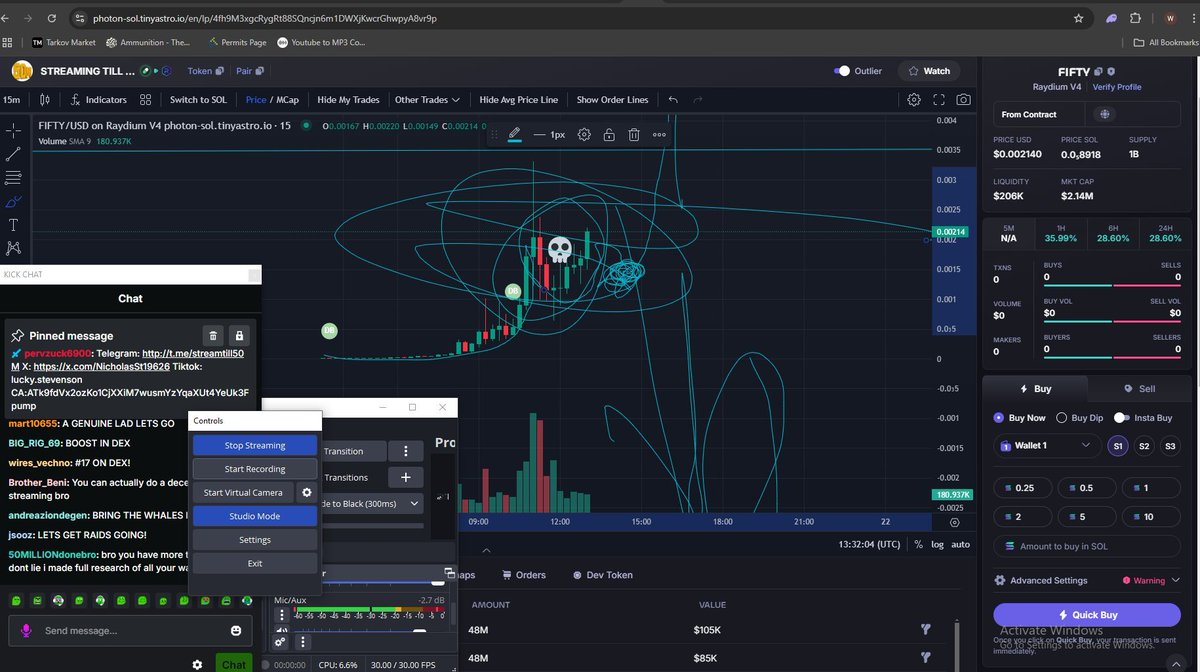
This guy reading chart like a god, he too dumb to rug us, supporting till the 50m marketcap! $FIFTY
DikkeDrerrie tweet media
English
13
37
156
7.3K
Bruno ༽
Bruno ༽@criptopraleigos·
@osguridascripto Eu poderia concordar com cada palavra que escreveu, mas daí seriam dois animais.
Bruno ༽ tweet media
Português
0
0
3
216
O Guri Digital
O Guri Digital@osguridascripto·
Vendi todas as altcoins só Mative 80% de BTC, Mercado virou de tendência, é baixa por pelo menos 4 meses 😂😂😂😂😂
O Guri Digital tweet media
Português
87
31
821
39.9K
pepe
pepe@pepe·
he who controls the memes controls the universe
pepe tweet media
English
639
1.1K
7K
407.4K
Binance
Binance@binance·
How long do you have to stare before the moon gives you answers?
Binance tweet media
English
1.2K
562
2.7K
379.3K
Bruno ༽ ретвитнул
pepe
pepe@pepe·
we the pepe
GIF
English
316
754
4.2K
207.5K
Bruno ༽
Bruno ༽@criptopraleigos·
@Binance_intern The movie would be called: "Kaspa: The Evolution". $KAS
Bruno ༽ tweet media
English
0
0
0
56
Binance Intern
Binance Intern@Binance_intern·
Your favorite token just released a movie. What’s the title?
English
1.3K
94
1.2K
203.1K
Bruno ༽ ретвитнул
KASPA Enthusiast 𐤊
KASPA Enthusiast 𐤊@KASPAEnthusiast·
#Kaspa is back at 15 cents 🔥 $KAS chart looks bullish 🚀
KASPA Enthusiast 𐤊 tweet media
English
22
96
611
12K
Bruno ༽
Bruno ༽@criptopraleigos·
@binance Já está na hora
Bruno ༽ tweet media
Português
0
0
0
11
Binance
Binance@binance·
When your clock reflects your 24/7 grind.
Binance tweet media
English
723
336
2.1K
263.7K