Max Simchowitz

109 posts

Max Simchowitz

Max Simchowitz

@max_simchowitz

Assistant Professor @mldcmu. Formerly: Postdoc @MITEECS, PhD @Berkeley_EECS, Math Undergrad @Princeton. New to Twitter. https://t.co/67bMOAyqK6

Присоединился Mayıs 2024
144 Подписки1.8K Подписчики
Закреплённый твит
Max Simchowitz
Max Simchowitz@max_simchowitz·
⏰⏰(another) science of robot learning paper. Why does action chunking work so well in robotic manipulation? Probably lots of reasons. but here’s one you may not have thought of: control stability. After months of polishing and 5 revisions, check out“ Action Chunking and Exploratory Data Collection Yield Exponential Benefits for Imitation Learning”. The title says it all. Lead by the eloquent @ThomasTCKZhang , illustrated by the talented @dpfroms , supported by @ChaoyiPan of MIP fame (simchowitzlabpublic.github.io/much-ado-about…) fame, and in collaboration with the one and only @NikolaiMatni .
Thomas Zhang@ThomasTCKZhang

🤖🤖Very excited to finally share our new work “Action Chunking and Exploratory Data Collection Yield Exponential Improvements in Behavior Cloning for Continuous Control” Everyone in robotics does action-chunking, but why does it actually work?🤔🤔And, what can theory tell us about the properties of data we should be collecting for robotic behavior cloning? 🧵1/N

English

2
16
163
19K
Max Simchowitz ретвитнул
Aran Nayebi
Aran Nayebi@aran_nayebi·
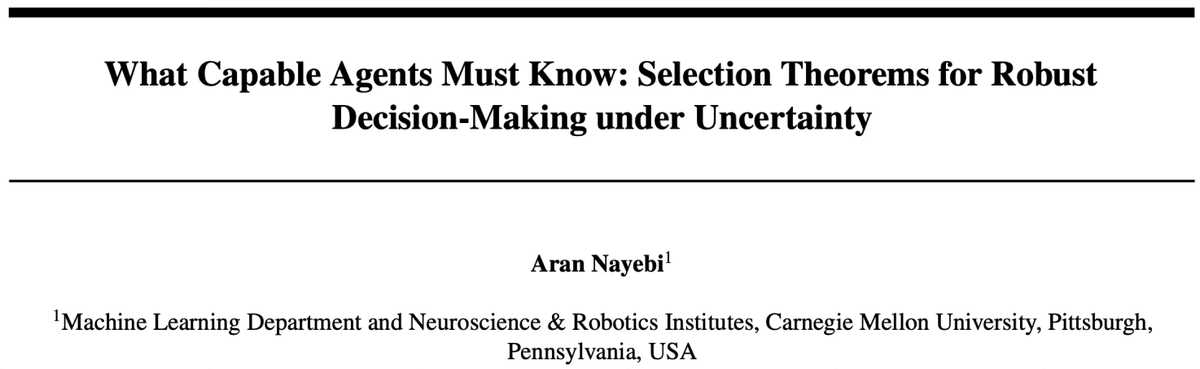
1/ As AI agents become increasingly capable, what must *inevitably* emerge inside them? We prove selection theorems: strong task performance forces world models, belief-like memory and—under task mixtures—persistent variables resembling core primitives associated with emotion.
Aran Nayebi tweet media
English
3
36
189
24.9K
Max Simchowitz ретвитнул
Aviral Kumar
Aviral Kumar@aviral_kumar2·
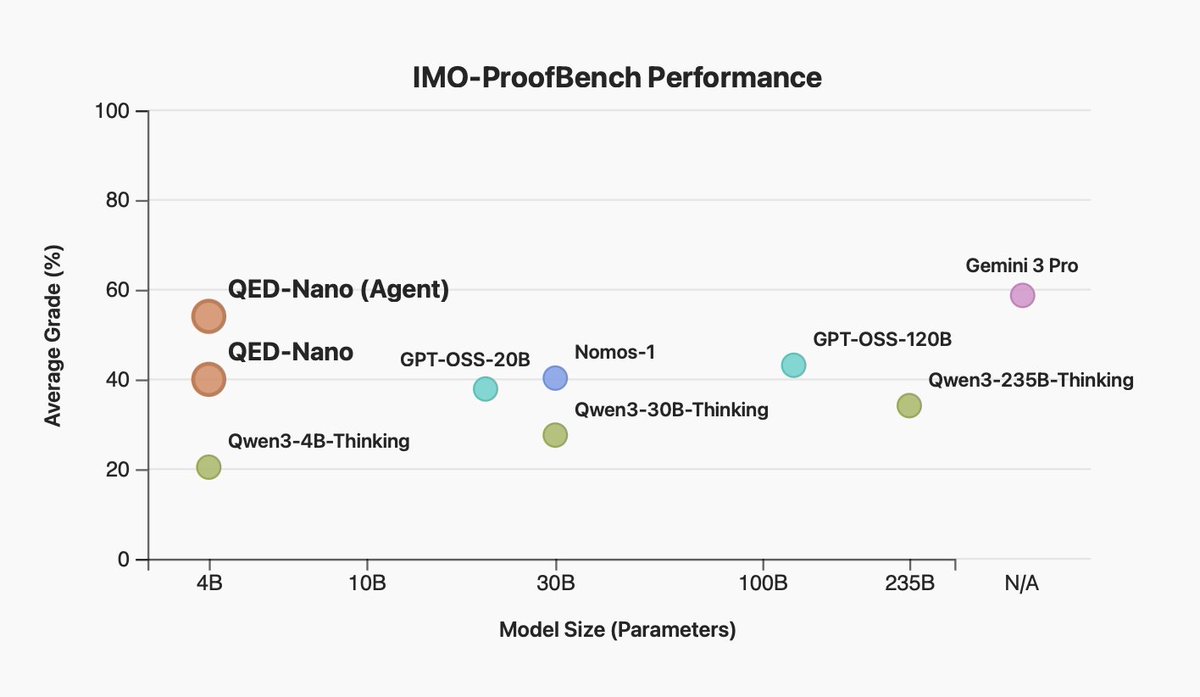
Can just a 4B model solve IMO-level proof problems at the level of much stronger LLMs like Gemini 3 Pro? Yes, if you can train the LLM to scale test-time compute well! We're very excited to release our 4B model "QED-Nano", built via an awesome open collab! Details below🧵⬇️
Aviral Kumar tweet media
English
8
27
168
21.5K
Max Simchowitz ретвитнул
Boyuan Chen
Boyuan Chen@BoyuanChen0·
Introducing Large Video Planner (LVP-14B) — a robot foundation model that actually generalizes. LVP is built on video gen, not VLA. As my final work at @MIT, LVP has all its eval tasks proposed by third parties as a maximum stress test, but it excels!🤗 boyuan.space/large-video-pl…
English
21
96
577
94.1K
Max Simchowitz ретвитнул
Yutong (Kelly) He
Yutong (Kelly) He@electronickale·
I’ve always seen twitter bros be like “keep building keep shipping” when using ai agents for coding, but now that I’ve tried it for real, it feels less like grinding and more adjacent to eating popcorn while bed rotting and watching heated rivalry (I’m not complaining)
English
1
1
38
5.1K
Max Simchowitz ретвитнул
Francesco Bertolotti
Francesco Bertolotti@f14bertolotti·
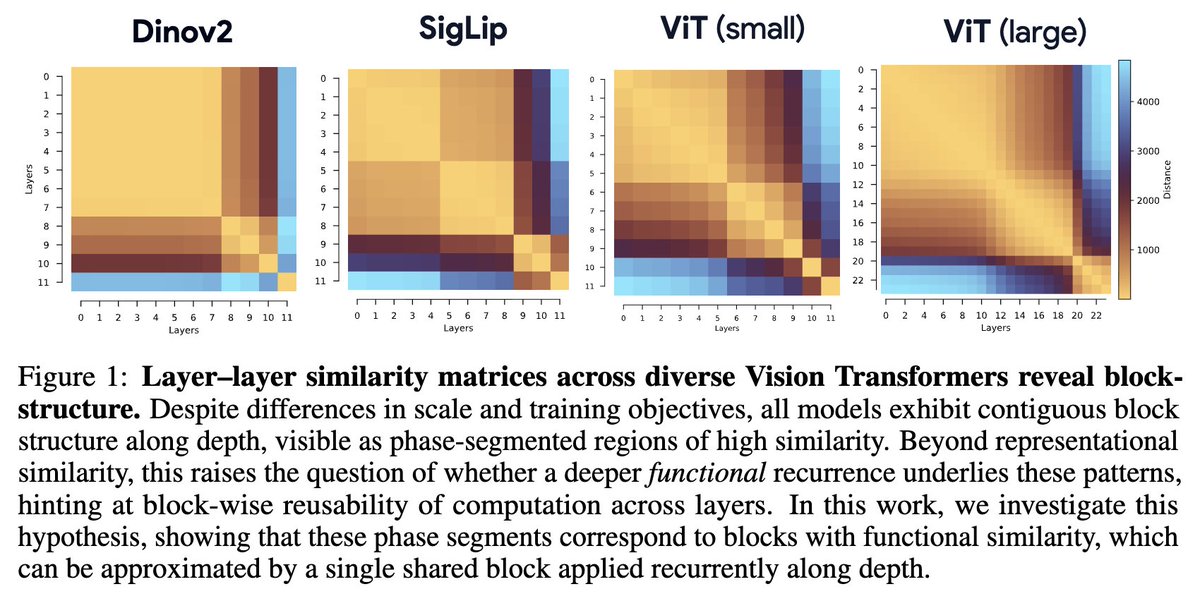
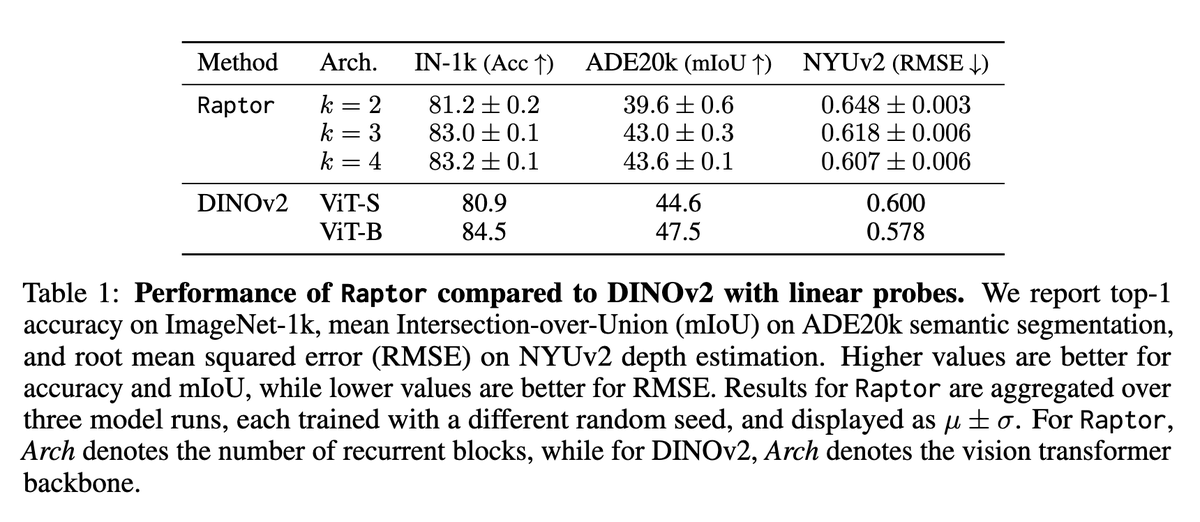
The authors ask whether an N-layer ViT can be rewritten using just K<<N layers by recurring on them. Remarkably, they match DINOv2 performance with only 2-3 layers. The paper also offers rich dynamical-systems analysis. Very cool work! 🔗arxiv.org/abs/2512.19941
Francesco Bertolotti tweet mediaFrancesco Bertolotti tweet mediaFrancesco Bertolotti tweet mediaFrancesco Bertolotti tweet media
English
8
66
654
42.7K
Max Simchowitz
Max Simchowitz@max_simchowitz·
Standard training of generative policies is surprisingly bad at learning multi-modal strategies from training data. So what can we do to pre-train for diverse solutions and effective post-training? Check out @ajwagenmaker 's new paper for an answer :)
Andrew Wagenmaker@ajwagenmaker

How should we pretrain a policy from demonstrations to ensure it is an effective initialization for RL finetuning, while preserving the performance of the pretrained policy itself? We propose Posterior Behavioral Cloning (PostBC)! (1/11)

English
1
5
64
11.8K
Max Simchowitz
Max Simchowitz@max_simchowitz·
My friends @elvisnava and @mimicrobotics (makers of awesome robot hands 🧤) just put out a video-first VLA. 📹📹 Motivation: A bitter-lesson alternative to retargeting, and a path to cross-embodiment. Key Idea: Nvidia Cosmos backbone with T5 text encoder, and but pre-train from RGB rather than low-dim actions. Low-Dim actions only needed for a lightweight flow-decoder for task-specific fine-tuning. Benefits: Opens to the door for human data collect with off-the-shelf cloth gloves (and maybe soon, YouTube!), leverages internet scale video, embodiment agnostic. Excited to see where you go next!
Elvis Nava@elvisnavah

Today @mimicrobotics and friends are excited to share mimic-video, a new class of Video-Action Model that elevates video model backbones as first class citizens for robot learning!

English
4
13
114
8.9K
Max Simchowitz ретвитнул
Jonathan Fine
Jonathan Fine@jonathanbfine·
the mistake so many people make is seeing university professors as intellectuals when they’re actually employees at a combination hedge fund and healthcare conglomerate that operates a small luxury resort/sports franchise where student-customers occasionally take classes
English
246
2.8K
25.5K
575.7K
Sander Dieleman
Sander Dieleman@sedielem·
Overgeneralisation is probably the main reason why we're still so reliant on it. I think we are also intentionally collapsing the distribution towards its more canonical examples (guidance is just one way to do that, various forms of post-training are also used for this). The data distribution used in pre-training is usually too broad compared to what we want the model to produce. People don't tend to show direct comparisons anymore these days, but most models are pretty bad without guidance (see x.com/sedielem/statu…). I like the toy experiments in the autoguidance paper: arxiv.org/abs/2406.02507
Sander Dieleman tweet media
English
2
7
106
5K
Max Simchowitz
Max Simchowitz@max_simchowitz·
What is the best current explanation for why CFG is needed for conditional generation? Is it just that are unguided models “undersharpened”/ over smoothed bc of NN inductive bias ?
English
3
5
73
11.7K
Vlad Feinberg
Vlad Feinberg@FeinbergVlad·
Flash 3.0 is out! Culmination of years of high-conviction infra & science investment (we knew it'd be this good a priori). I truly believe no other place trains these models the way we do. I'm lucky to get to work so intimately with the team that made this happen. We aren't slowing down.
Google DeepMind@GoogleDeepMind

3 Flash delivers frontier performance on benchmarks like GPQA Diamond - evaluating PhD-level reasoning – and Humanity’s Last Exam – testing broad expert knowledge. It’s state-of-the-art on MMMU Pro, with a score comparable to 3 Pro - easily analyzing inputs across videos and images, not just text. And it handles complex tasks significantly faster than 2.5 Pro at a lower cost, using fewer tokens - or units of information - to save time.

English
13
24
298
65.8K
Max Simchowitz
Max Simchowitz@max_simchowitz·
⏰⏰(another) science of robot learning paper. Why does action chunking work so well in robotic manipulation? Probably lots of reasons. but here’s one you may not have thought of: control stability. After months of polishing and 5 revisions, check out“ Action Chunking and Exploratory Data Collection Yield Exponential Benefits for Imitation Learning”. The title says it all. Lead by the eloquent @ThomasTCKZhang , illustrated by the talented @dpfroms , supported by @ChaoyiPan of MIP fame (simchowitzlabpublic.github.io/much-ado-about…) fame, and in collaboration with the one and only @NikolaiMatni .
Thomas Zhang@ThomasTCKZhang

🤖🤖Very excited to finally share our new work “Action Chunking and Exploratory Data Collection Yield Exponential Improvements in Behavior Cloning for Continuous Control” Everyone in robotics does action-chunking, but why does it actually work?🤔🤔And, what can theory tell us about the properties of data we should be collecting for robotic behavior cloning? 🧵1/N

English
2
16
163
19K
Amir-massoud Farahmand
Amir-massoud Farahmand@SoloGen·
What are you favourite Imitation Learning and Inverse Reinforcement Learning papers? What are the essential papers? It doesn't matter much whether they are new or old, but I prefer a conceptually elegant and mathematically solid work.
English
6
2
29
5.9K
Max Simchowitz
Max Simchowitz@max_simchowitz·
👋👋New Generative Modeling Paper from @electronickale and @KeelyAi04: Evaluating sample likelihoods is a fundamental primitive in flow-based generative modeling . Now we can compute them faster. Much faster. Like 10-100x faster. ✈️✈️ Check out our new work on fast likelihood distillation, F2D2, lead by Kelly and Xinyue, together with @_albertgu , @rsalakhu, @zicokolter, and @nmboffi . And stay tuned for more in this direction in the next few months 😉 (And: @KeelyAi04 's applying to grad school and she is aawesome)
Yutong (Kelly) He@electronickale

Diffusion/Flow-based models can sample in 1-2 steps now 👍 But likelihood? Still requires 100-1000 NFEs (even for these fast models) 😭 We fix this! Introducing F2D2: simultaneous fast sampling AND fast likelihood via joint flow map distillation. arxiv.org/abs/2512.02636 1/🧵

English
2
18
100
11.4K
Yutong (Kelly) He
Yutong (Kelly) He@electronickale·
Diffusion/Flow-based models can sample in 1-2 steps now 👍 But likelihood? Still requires 100-1000 NFEs (even for these fast models) 😭 We fix this! Introducing F2D2: simultaneous fast sampling AND fast likelihood via joint flow map distillation. arxiv.org/abs/2512.02636 1/🧵
Yutong (Kelly) He tweet media
English
9
72
429
118.8K
Max Simchowitz
Max Simchowitz@max_simchowitz·
second, the entire point is that we don't need anything like SGLD. This is why score matching is the wrong formalism. because in two steps, what we do looks nothing like any form of mixing. the fact that we don't need to mix emphasizes that distribution fitting is not needed.
English
1
0
0
108
Philip Bachman
Philip Bachman@philip_bachman·
@max_simchowitz For proper samples, you could run some SGLD iterations through the second denoising stage with appropriately scaled noise. Though, mixing time may be bad. Drastically increasing the "scale resolution" was a (the?) big win for DDPMs et al vs similar, earlier DAE-based efforts.
English
2
0
1
121
Max Simchowitz
Max Simchowitz@max_simchowitz·
⏰⏰ New Science of Robot Learning Paper: "Much Ado About Noising." TL;DR we answer why generative models, like flow and diffusion models, actually work for robotic control tasks🤖🤖 (hint: its not multimodality). This leads to a new minimal iterative policy (MIP) that matches flow models with much faster inference🚄🚄 Check out @ChaoyiPan 's thread and paper to find out more. Amazing work by @ChaoyiPan, together with @GuanyaShi , @nmboffi , @guannanqu. Come find us at NeurIPS to chat more!
Chaoyi Pan@ChaoyiPan

Generative models (diffusion/flow) are taking over robotics 🤖. But do we really need to model the full action distribution to control a robot? We suspected the success of Generative Control Policies (GCPs) might be "Much Ado About Noising." We rigorously tested the myths. 🧵👇

English
4
26
200
19.5K