

Rabha
771 posts
Rabha
@rabhamotion
Helping finance creators increase retention through visual storytelling
Присоединился Ocak 2025
93 Подписки26 Подписчики

@rabhamotion I would probably do that about 5 years ago, but currently I don't drink alcohol at all. Sobriety improves performance dramatically ;)
English
@DB_Visuals_ @MarioJoos yes intro should directly communicate what you'll get in this video
English

@MarioJoos I usually just do the hook instead of intro
English

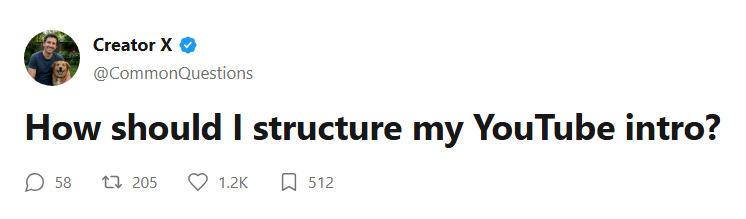
When you’re creating an intro on YouTube, you want to make sure that the viewer gets what THEY want out of an intro. Here are the 4 most important elements of an intro:
1. Tone
As much as I’d like to start with some of the other points, the most important part of an intro is the type of tone it sets for the entire video. Tone is the overall style, the overall way in which we deliver our content. Is the video highly edited? Is the goal exciting enough for the viewer? Is it scripted or unscripted, and is that something the viewer wants?
Tone tells the viewer if this video is intended for them or not. Ever watch a Minecraft video that feels too “childish” but still got millions of views? It’s because you weren’t the intended audience in the first place.
So, as viewers, we tend to look for any information about the tone of the video.
But how do you set the tone?
I’d break it down into two big focus points:
How to set the tone for the way the content will be delivered.
How to set the tone for what content will be delivered.
The first one is easy. Just edit your intro in a manner that matches the overall feel of the video. Then the viewer can use this to understand if the video is for them or not.
The second one is harder, but still pretty straightforward. What better way to set the tone for the content than teaser clips?
2. Confirmation
Now, we’re getting into the technical parts of an intro.
When a viewer clicks on a video, they come in with a certain level of confidence that they’ll be interested in it because they clicked on the title. However, that confidence may not stay.
That click didn’t just get them into the video. In a way, it took them from selection to decision.
What do I mean?
Well, when they were browsing for their next video to watch, they were trying to choose a video that matched their interests. However, once they click on the video, they’re no longer trying to choose it. Instead, they’re asking themselves: Is this video relevant to me, and will I stay engaged?
The best way to establish this relevance is by confirming the initial expectation they had before clicking.
And what better way to do this than to simply restate the title?
3. Essential Context Only
One of the biggest mistakes creators make in their intros is overloading the viewer with too much information about the video. Your job isn’t to give away the entire video. Your job is to give away just enough information for the viewer to understand the first segment.
You see, viewers don’t like being overfed information. It’s not the content they signed up for. However, it is important to make sure they don’t get confused. That’s why we typically try to keep context to a minimum.
So what context should we give?
This depends from viewer to viewer, but we notice that structural context is highly desired. Structural context is where we give the viewer some sense of how the video will flow. Maybe we talk about the structure of the segments, maybe we highlight an intended strategy, or maybe it’s a rule that instantly comes into play when the video starts.
If you’re ever wondering whether the context you’re giving is essential, ask yourself: Is there any way I can give this information later and not have the viewer become confused?
4. Goal
Wait, wait. Let me ask you a question.
Why do you think we set the goal in our intro?
Most of the time, when I ask this question, a person answers: to give the viewer something to look forward to.
That’s correct, but it doesn’t paint a complete picture.
The secondary reason, and maybe the most important reason, why people like to understand the goal of the video early is because it gives them a way to judge each scene or segment based on how much it progresses toward that goal. If the scene progresses meaningfully toward that goal, we’re good. If not, we tend to have a weaker moment.
So, where does that leave us?
If you’re writing an intro, make sure you’re not just thinking about creating an initial moment. Think about the needs of the viewer, what is actually important, and then how you can get into the content as fast as possible.
English

Want better edits?
Stop asking:
"How can I make this look cooler?"
Start asking:
"How can I make this easier to watch?"
English
Don’t Listen To Generic Advice
English


Raw footage looked boring 🥱
Final cut hits different 🔥
What’s one thing you always remove or simplify in your 3D animations or UI motion graphics? 🤔
DM me if you want this level for your Videos 📩
English



Vitalii made $3M last month, him and his cofounder changed the way I build my team culture
Vitalii Dodonov@vitaliidodonov
I made $3.36M in May 2026. 🏦 Stan Store - $3.12M 💼 Stanley LinkedIn - $134K 🤳 Stanley Instagram - $122K In the last 5 years, I've made $600M+ for my customers. And got 11.5K followers on X. All I'm trying to say is: If you don't have a following here, it doesn't matter.
English

Real estate editing style created for my client.
In this niche, text is one of the most important elements, as it helps communicate the value clearly and keeps the audience engaged.
English


Cooked a little too hard on this one 😭
It's doing numbers on YouTube right now 📈
Worth checking out if you're into cold email and lead generation👀
Instantly.ai@InstantlyAI
Turns out you can build a full lead gen pipeline with Claude in a few minutes. @brandon_ai did it, recorded it, and now you can replicate it.
English


Video editors, how much are you charging per video edit right now?
A: $0-$100
B: $100-$500
C: $500-$1000
D: Above $1000
English