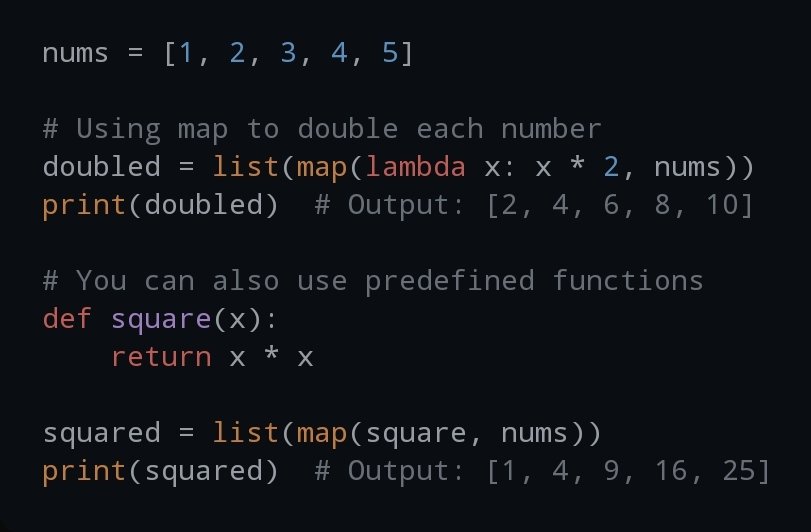
Python’s map() applies a function to every item in an iterable. It’s clean, efficient, and saves you from writing repetitive loops! #Python#MapFunction
Day 38/100
Today, I explored the map() function in Python. It allows you to apply a function to every item in an iterable (like a list) in a clean and efficient way.
#Python#MapFunction#100DaysOfCode#learntocode
#Python:
The built-in method 'map()' applies a given function to each item in an iterable and returns a new iterable. It takes two arguments: the function and the iterable.
Example:
print(map(lambda num: num**2, (1, 2, 3, 4, 5)))
Output: [1, 4, 9, 16, 25]
#Python#MapFunction
#Python: Use of `map()` to apply the `abs()` function to each element of a list.
```python
print(list(map(abs, [-4, -3, -1, 0, 2, 3, 4]))) #[4, 3, 1, 0, 2, 3, 4]
```
#Python#MapFunction
The map function is a JavaScript function really useful for handling arrays.
The map function accepts a function that can accept another function and so on.
#mapfunction#javascript#reactjs
youtube.com/playlist?list=…
Chcesz poznać i zrozumieć funkcję zip w języku Swift? Sprawdź naszą playlistę na YouTube! Przedstawiamy tam, jak działa funkcja zip oraz jak jest ona generalizacją funkcji map. #Swift#Zip#MapFunction
Want to save time and streamline your data processing in #GoogleSheets?
Introducing the #MAPfunction! 💥 This powerful tool allows you to apply a formula to a range of cells, making data manipulation and analysis on P&L and BS a breeze.
👉Try it out: liveflow.io/product-guides…
Javascript Tip 💡
How to use the map function in Javascript 👇
map() creates a new array from calling a function for every array element.
#javascript#mapfunction#javascripttip