

Filling a raised bed with bought compost alone costs more than it needs to. The lasagna method — layering free or near-free organic materials from the bottom up — produces growing medium that improves year on year and costs a fraction of a filled bag approach.
Build it from the base upward:
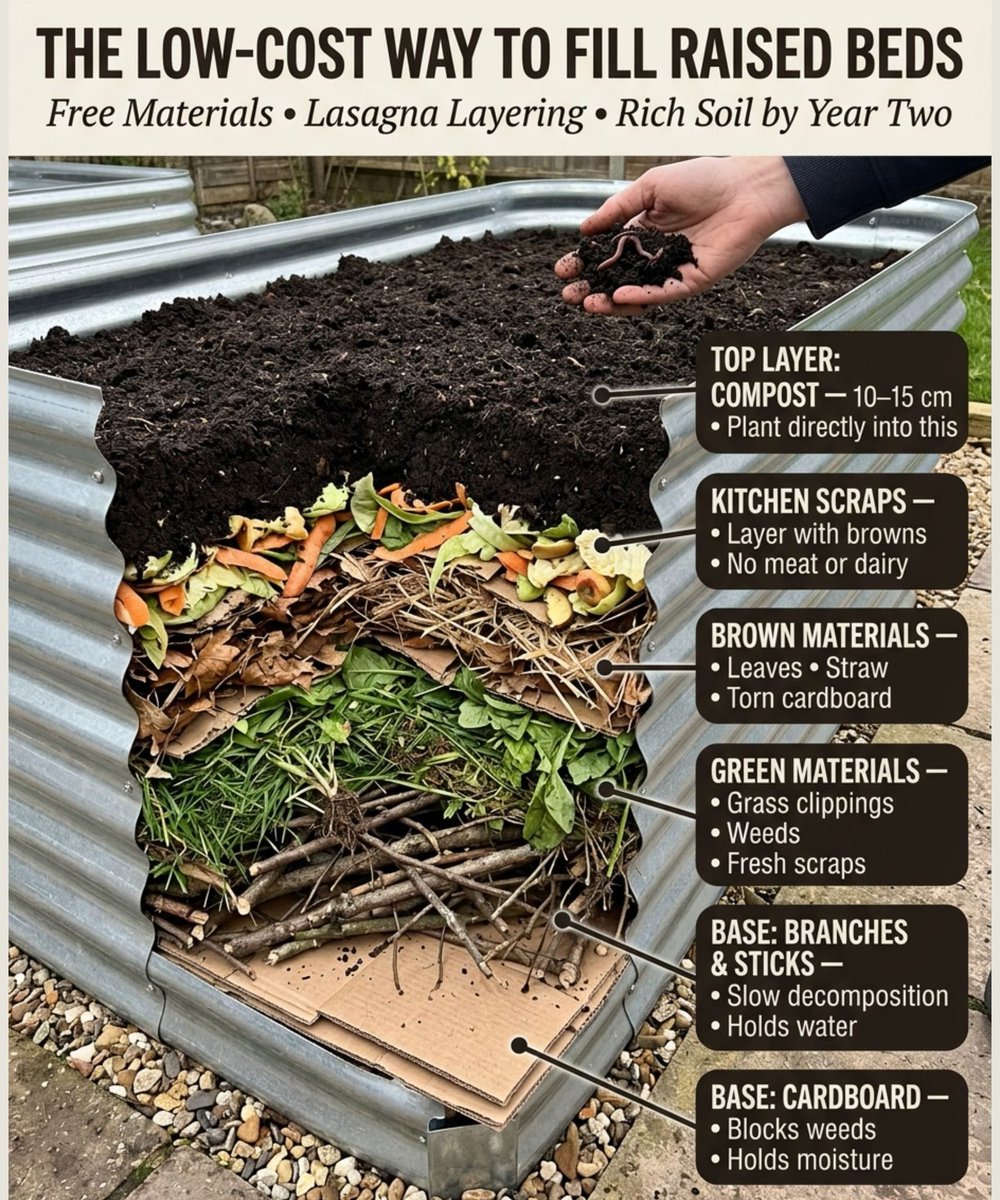
Cardboard: lay a double layer of flattened cardboard directly on the ground at the base — this suppresses any weeds below and holds moisture. Remove all tape and staples.
Branches and sticks: a 10 to 15 cm layer of rough woody material — prunings, small logs, broken branches. As this wood rots slowly it acts as a water reservoir and feeds the soil life from below. This is the hugelkultur principle applied to a raised bed.
Green materials: a layer of grass clippings, pulled weeds (without seed heads), and fresh vegetable scraps from the kitchen.
Brown materials: a roughly equal layer of dead leaves, straw, torn cardboard, or dried plant stems. The ratio to aim for is two parts brown to one part green by volume.
Kitchen scraps: vegetable peelings, coffee grounds, eggshells, and fruit scraps layered between browns. No meat, fish, cooked food, or dairy.
Top layer — compost: finish with 10 to 15 cm of good compost — either home-made or bought. This is the layer you plant directly into. Everything below is decomposing slowly and feeding the roots as the season progresses.
By year two the whole bed settles and transforms into rich, crumbly, worm-filled growing medium with no further inputs needed beyond a top-dressing of compost each autumn.
#RaisedBedGardening #AllotmentLife #NoDigGarden #KitchenGarden
English