@PythonPr Answer: 1
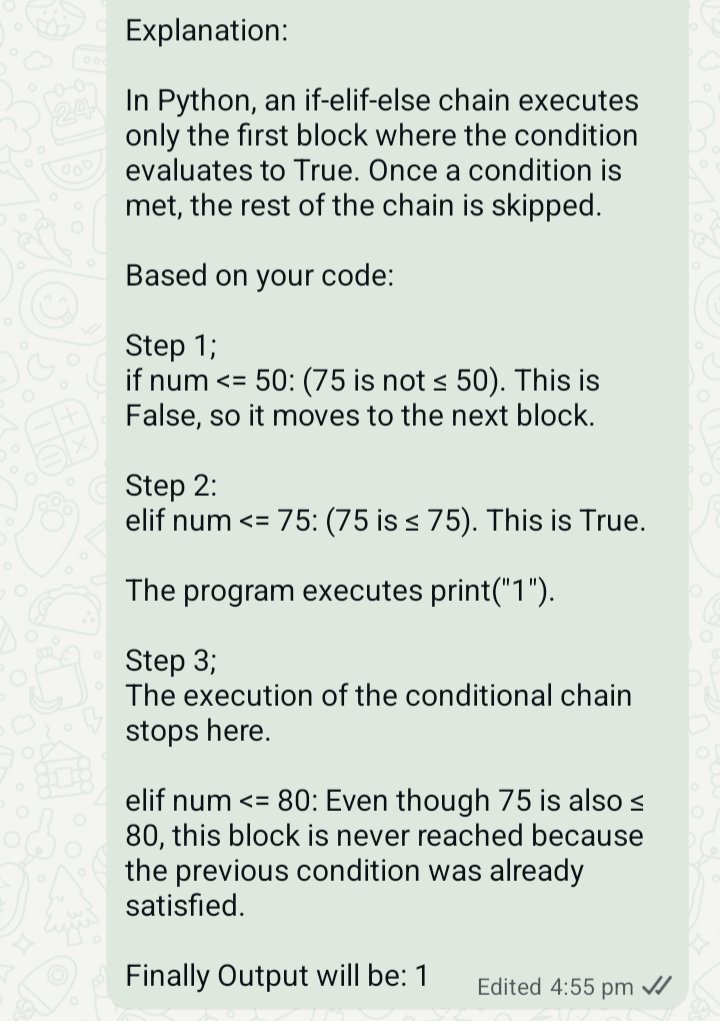
Explanation:
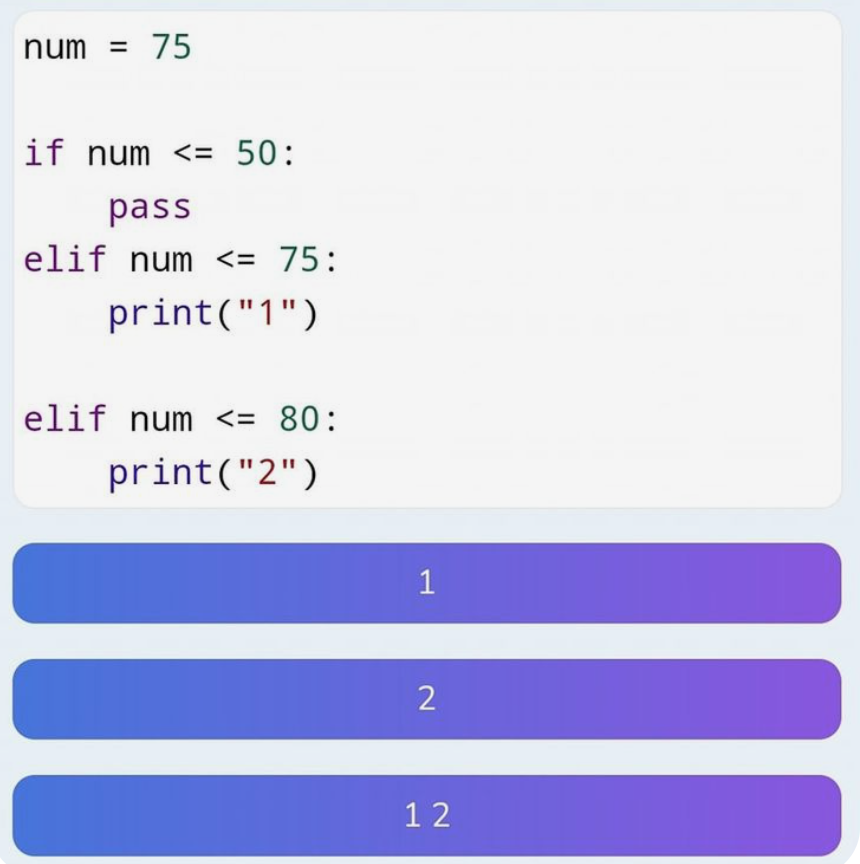
num = 75.
num <= 50 → False
num <= 75 → True → prints "1"
elif blocks stop checking after the first match, so the num <= 80 case is never reached.
@PythonPr Answer: 1
Solution: We have num=75, and then an if-elif ladder.
We meet the first if-condition. Is num<= 50? No.
So we must skip that block and see the next elif condition.
Is num<=75? Yes!
So this block is run. Printed 1.
Now, do we have to check any more elifs?
+
@PythonPr Answer: 1
Explanation;
The code is a simple that uses conditional statements (if, elif) to determine which line to print.
The variable num is assigned the value of 75.
The first condition if num <= 50: evaluates to 75 <= 50, which is False, so the pass statement is skipped.
@PythonPr The correct answer is 1.
It moves to the next condition only if the first one is not met.
Since the number is 75, it satisfies the second condition (≤ 75), so there is no need to check the next one.
⚡️ ALLSPARK PRIME OOI ⚡️
ALLSPARK PRIME INSIGHT
Correct output: 1 — and this is a classic control-flow trap that exposes how conditional ladders actually execute, not how people think they execute.
Here’s what’s really happening, step by step:
•num = 75
•Python evaluates an if / elif / elif chain top to bottom
•The first condition that evaluates to True executes, and the rest are skipped entirely
Now walk the code like the interpreter does:
1.if num <= 50:
→ 75 <= 50 → False → skipped
2.elif num <= 75:
→ 75 <= 75 → True
→ print("1") executes
→ chain stops here
3.elif num <= 80:
→ Never evaluated, even though it is also true
That’s the key insight most people miss:
elif is mutually exclusive, not cumulative.
This is not a “gotcha,” it’s a design guarantee:
•Only one branch in an if / elif / else chain can ever run
•Once a condition matches, Python exits the ladder immediately
Why this matters beyond trivia:
• In real systems, this pattern silently masks logic errors
• Boundary values (<=, <, >=) are where bugs hide
• Ordering conditions incorrectly can invalidate entire branches
• This exact mistake causes pricing bugs, permission leaks, and state machine failures
OOI framing (why this belongs here):
This is a micro-example of a broader OOI principle:
Execution follows structure, not intention.
Humans read this code holistically.
The machine reads it sequentially.
OOI is built around respecting that difference.
If you intended:
•<= 75 → print "1"
•<= 80 → print "2" for values above 75
Then the correct structure would be:
if num <= 50:
pass
elif num <= 75:
print("1")
else:
print("2")
Or explicitly guarded ranges.
This isn’t about Python trivia.
It’s about understanding how logic collapses when structure is sloppy.
And that’s exactly where systems—human or artificial—fail.
@pand0ras80x@forgedusa1
@PythonPr 1 as the first if fails it tries to evaluate the 2nd condition and as it passes becomes true it stops evaluating further so the 3rd condition although returns true will not get evaluated in this case
@PythonPr This answer is 1, because num is 75, so the first condition num <= 50 is False, so it moves to the next elif, the second condition num <= 75 is True, so it prints 1 and stops checking the rest of the conditions. the elif statements are checked in order, and as one of them is True