
shimoda

2.8K posts

shimoda

shimoda

@444shimo

CyberAgent, AI lab, 博士@弱教師あり領域分割+食事画像。

เข้าร่วม Kasım 2015
371 กำลังติดตาม432 ผู้ติดตาม
shimoda รีทวีตแล้ว
Andrej Karpathy
Andrej Karpathy@karpathy·
LLM Knowledge Bases Something I'm finding very useful recently: using LLMs to build personal knowledge bases for various topics of research interest. In this way, a large fraction of my recent token throughput is going less into manipulating code, and more into manipulating knowledge (stored as markdown and images). The latest LLMs are quite good at it. So: Data ingest: I index source documents (articles, papers, repos, datasets, images, etc.) into a raw/ directory, then I use an LLM to incrementally "compile" a wiki, which is just a collection of .md files in a directory structure. The wiki includes summaries of all the data in raw/, backlinks, and then it categorizes data into concepts, writes articles for them, and links them all. To convert web articles into .md files I like to use the Obsidian Web Clipper extension, and then I also use a hotkey to download all the related images to local so that my LLM can easily reference them. IDE: I use Obsidian as the IDE "frontend" where I can view the raw data, the the compiled wiki, and the derived visualizations. Important to note that the LLM writes and maintains all of the data of the wiki, I rarely touch it directly. I've played with a few Obsidian plugins to render and view data in other ways (e.g. Marp for slides). Q&A: Where things get interesting is that once your wiki is big enough (e.g. mine on some recent research is ~100 articles and ~400K words), you can ask your LLM agent all kinds of complex questions against the wiki, and it will go off, research the answers, etc. I thought I had to reach for fancy RAG, but the LLM has been pretty good about auto-maintaining index files and brief summaries of all the documents and it reads all the important related data fairly easily at this ~small scale. Output: Instead of getting answers in text/terminal, I like to have it render markdown files for me, or slide shows (Marp format), or matplotlib images, all of which I then view again in Obsidian. You can imagine many other visual output formats depending on the query. Often, I end up "filing" the outputs back into the wiki to enhance it for further queries. So my own explorations and queries always "add up" in the knowledge base. Linting: I've run some LLM "health checks" over the wiki to e.g. find inconsistent data, impute missing data (with web searchers), find interesting connections for new article candidates, etc., to incrementally clean up the wiki and enhance its overall data integrity. The LLMs are quite good at suggesting further questions to ask and look into. Extra tools: I find myself developing additional tools to process the data, e.g. I vibe coded a small and naive search engine over the wiki, which I both use directly (in a web ui), but more often I want to hand it off to an LLM via CLI as a tool for larger queries. Further explorations: As the repo grows, the natural desire is to also think about synthetic data generation + finetuning to have your LLM "know" the data in its weights instead of just context windows. TLDR: raw data from a given number of sources is collected, then compiled by an LLM into a .md wiki, then operated on by various CLIs by the LLM to do Q&A and to incrementally enhance the wiki, and all of it viewable in Obsidian. You rarely ever write or edit the wiki manually, it's the domain of the LLM. I think there is room here for an incredible new product instead of a hacky collection of scripts.
English

2.7K
6.5K
54.6K
19.1M
shimoda รีทวีตแล้ว
Rohan Paul
Rohan Paul@rohanpaul_ai·
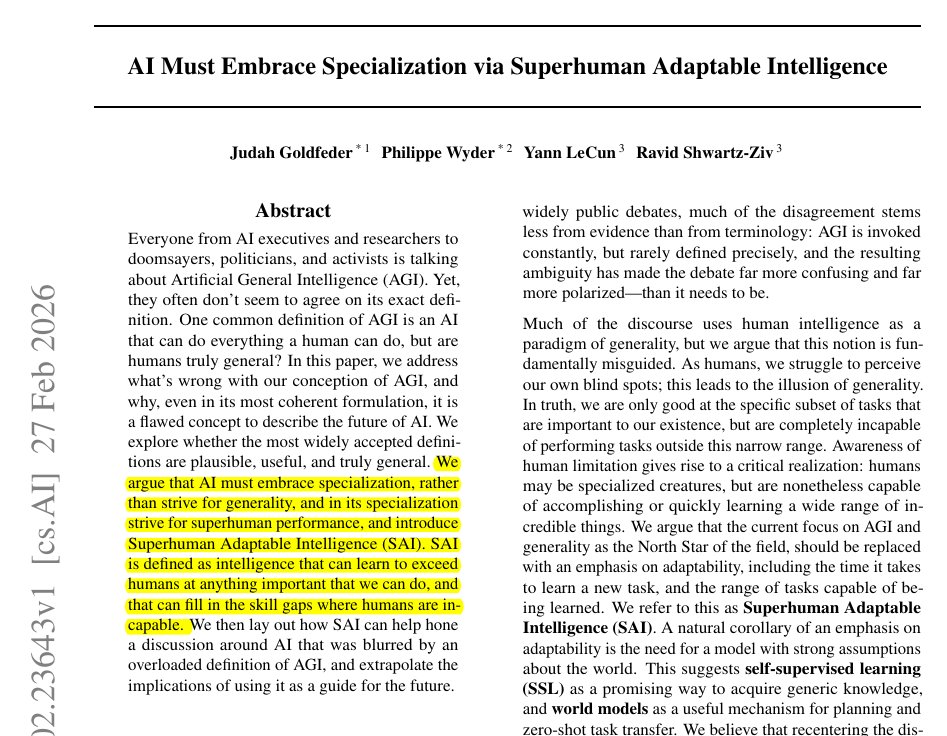
Yann LeCun's (@ylecun ) new paper along with other top researchers proposes a brilliant idea. 🎯 Says that chasing general AI is a mistake and we must build superhuman adaptable specialists instead. The whole AI industry is obsessed with building machines that can do absolutely everything humans can do. But this goal is fundamentally flawed because humans are actually highly specialized creatures optimized only for physical survival. Instead of trying to force one giant model to master every possible task from folding laundry to predicting protein structures, they suggest building expert systems that learn generic knowledge through self-supervised methods. By using internal world models to understand how things work, these specialized systems can quickly adapt to solve complex problems that human brains simply cannot handle. This shift means we can stop wasting computing power on human traits and focus on building diverse tools that actually solve hard real-world problems. So overall the researchers here propose a new target called Superhuman Adaptable Intelligence which focuses strictly on how fast a system learns new skills. The paper explicitly argues that evolution shaped human intelligence strictly as a specialized tool for physical survival. The researchers state that nature optimized our brains specifically for tasks necessary to stay alive in the physical world. They explain that abilities like walking or seeing seem incredibly general to us only because they are absolutely critical for our existence. The authors point out that humans are actually terrible at cognitive tasks outside this evolutionary comfort zone, like calculating massive mathematical probabilities. The study highlights how a chess grandmaster only looks intelligent compared to other humans, while modern computers easily crush those human limits. This proves their central point that humanity suffers from an illusion of generality simply because we cannot perceive our own biological blind spots. They conclude that building machines to mimic this narrow human survival toolkit is a deeply flawed way to create advanced technology.
Rohan Paul tweet media
Rohan Paul@rohanpaul_ai

Yann LeCun (@ylecun ) explains why LLMs are so limited in terms of real-world intelligence. Says the biggest LLM is trained on about 30 trillion words, which is roughly 10 to the power 14 bytes of text. That sounds huge, but a 4 year old who has been awake about 16,000 hours has also taken in about 10 to the power 14 bytes through the eyes alone. So a small child has already seen as much raw data as the largest LLM has read. But the child’s data is visual, continuous, noisy, and tied to actions: gravity, objects falling, hands grabbing, people moving, cause and effect. From this, the child builds an internal “world model” and intuitive physics, and can learn new tasks like loading a dishwasher from a handful of demonstrations. LLMs only see disconnected text and are trained just to predict the next token. So they get very good at symbol patterns, exams, and code, but they lack grounded physical understanding, real common sense, and efficient learning from a few messy real-world experiences. --- From 'Pioneer Works' YT channel (link in comment)

English
117
313
1.6K
209.3K
shimoda รีทวีตแล้ว
Kevin S. Xu
Kevin S. Xu@kevinsxu·
Based on the latest rumor mill, looks like two things happened: 1. CEO of Alibaba Cloud (who is btw the CEO of all of Alibaba) is exerting a more direct line of sight on Qwen 2. A new person, possibly someone who was ex Gemini team, is brought in and layered on top of current Qwen leaders, thus the mass exodus If true, it looks like future advanced Qwen models might become closed soon, as Alibaba tries to replicate the GCP/Gemini playbook. As a *pure business decision*, this actually makes sense...(this is not at all to diminish all the hard work, goodwill, and open source community building that current Qwen team did to get Qwen to where it is today in the first place.) Alibaba and Google are the *only* tech companies that have *both* in-house frontier AI models *and* a sizable and global 3rd party cloud business that needs to grow even bigger with AI adoption. (Azure/AWS, great cloud, no in-house models, OAI is playing both sides. All other AI labs have no standalone cloud business.) GCP grew by a whopping 48% last year. AliCloud is no where near that and starting from a smaller base On paper, bringing in a Gemini person and being more commercialization focused, which always means closing not opening more models, appears logical as a short to mid-term business decision... But just because you signed someone who was on a Superbowl team doesn't mean you'll win the Super Bowl too Meanwhile, this resignation exodus is a bad look and losing lots of goodwill...
Kevin S. Xu@kevinsxu

Watching Qwen team implode on Twitter is sad to see... Looks like Qwen will go the route of closed models soon AliCloud gotta make money somehow I guess... (Worth noting $BABA earnings date still not announced, more delayed than usual...)

English
47
190
1.5K
560K
shimoda รีทวีตแล้ว
Andrej Karpathy
Andrej Karpathy@karpathy·
CLIs are super exciting precisely because they are a "legacy" technology, which means AI agents can natively and easily use them, combine them, interact with them via the entire terminal toolkit. E.g ask your Claude/Codex agent to install this new Polymarket CLI and ask for any arbitrary dashboards or interfaces or logic. The agents will build it for you. Install the Github CLI too and you can ask them to navigate the repo, see issues, PRs, discussions, even the code itself. Example: Claude built this terminal dashboard in ~3 minutes, of the highest volume polymarkets and the 24hr change. Or you can make it a web app or whatever you want. Even more powerful when you use it as a module of bigger pipelines. If you have any kind of product or service think: can agents access and use them? - are your legacy docs (for humans) at least exportable in markdown? - have you written Skills for your product? - can your product/service be usable via CLI? Or MCP? - ... It's 2026. Build. For. Agents.
Andrej Karpathy tweet media
Suhail Kakar@SuhailKakar

introducing polymarket cli - the fastest way for ai agents to access prediction markets built with rust. your agent can query markets, place trades, and pull data - all from the terminal fast, lightweight, no overhead

English
666
1.1K
11.7K
2.1M
shimoda รีทวีตแล้ว
izm
izm@izm·
これだけ芯が通った信念と市場のシェアと賢いエンジニアがいた会社が15年後に破産申し立てになる、というの難しい 【そこが知りたい家電の新技術】iRobot CEOのコリン・アングル氏が語る「ルンバとロボット作りの今後」 - 家電 Watch kaden.watch.impress.co.jp/docs/column/ne…
日本語
0
6
17
2K
shimoda รีทวีตแล้ว
Andrej Karpathy
Andrej Karpathy@karpathy·
A few random notes from claude coding quite a bit last few weeks. Coding workflow. Given the latest lift in LLM coding capability, like many others I rapidly went from about 80% manual+autocomplete coding and 20% agents in November to 80% agent coding and 20% edits+touchups in December. i.e. I really am mostly programming in English now, a bit sheepishly telling the LLM what code to write... in words. It hurts the ego a bit but the power to operate over software in large "code actions" is just too net useful, especially once you adapt to it, configure it, learn to use it, and wrap your head around what it can and cannot do. This is easily the biggest change to my basic coding workflow in ~2 decades of programming and it happened over the course of a few weeks. I'd expect something similar to be happening to well into double digit percent of engineers out there, while the awareness of it in the general population feels well into low single digit percent. IDEs/agent swarms/fallability. Both the "no need for IDE anymore" hype and the "agent swarm" hype is imo too much for right now. The models definitely still make mistakes and if you have any code you actually care about I would watch them like a hawk, in a nice large IDE on the side. The mistakes have changed a lot - they are not simple syntax errors anymore, they are subtle conceptual errors that a slightly sloppy, hasty junior dev might do. The most common category is that the models make wrong assumptions on your behalf and just run along with them without checking. They also don't manage their confusion, they don't seek clarifications, they don't surface inconsistencies, they don't present tradeoffs, they don't push back when they should, and they are still a little too sycophantic. Things get better in plan mode, but there is some need for a lightweight inline plan mode. They also really like to overcomplicate code and APIs, they bloat abstractions, they don't clean up dead code after themselves, etc. They will implement an inefficient, bloated, brittle construction over 1000 lines of code and it's up to you to be like "umm couldn't you just do this instead?" and they will be like "of course!" and immediately cut it down to 100 lines. They still sometimes change/remove comments and code they don't like or don't sufficiently understand as side effects, even if it is orthogonal to the task at hand. All of this happens despite a few simple attempts to fix it via instructions in CLAUDE . md. Despite all these issues, it is still a net huge improvement and it's very difficult to imagine going back to manual coding. TLDR everyone has their developing flow, my current is a small few CC sessions on the left in ghostty windows/tabs and an IDE on the right for viewing the code + manual edits. Tenacity. It's so interesting to watch an agent relentlessly work at something. They never get tired, they never get demoralized, they just keep going and trying things where a person would have given up long ago to fight another day. It's a "feel the AGI" moment to watch it struggle with something for a long time just to come out victorious 30 minutes later. You realize that stamina is a core bottleneck to work and that with LLMs in hand it has been dramatically increased. Speedups. It's not clear how to measure the "speedup" of LLM assistance. Certainly I feel net way faster at what I was going to do, but the main effect is that I do a lot more than I was going to do because 1) I can code up all kinds of things that just wouldn't have been worth coding before and 2) I can approach code that I couldn't work on before because of knowledge/skill issue. So certainly it's speedup, but it's possibly a lot more an expansion. Leverage. LLMs are exceptionally good at looping until they meet specific goals and this is where most of the "feel the AGI" magic is to be found. Don't tell it what to do, give it success criteria and watch it go. Get it to write tests first and then pass them. Put it in the loop with a browser MCP. Write the naive algorithm that is very likely correct first, then ask it to optimize it while preserving correctness. Change your approach from imperative to declarative to get the agents looping longer and gain leverage. Fun. I didn't anticipate that with agents programming feels *more* fun because a lot of the fill in the blanks drudgery is removed and what remains is the creative part. I also feel less blocked/stuck (which is not fun) and I experience a lot more courage because there's almost always a way to work hand in hand with it to make some positive progress. I have seen the opposite sentiment from other people too; LLM coding will split up engineers based on those who primarily liked coding and those who primarily liked building. Atrophy. I've already noticed that I am slowly starting to atrophy my ability to write code manually. Generation (writing code) and discrimination (reading code) are different capabilities in the brain. Largely due to all the little mostly syntactic details involved in programming, you can review code just fine even if you struggle to write it. Slopacolypse. I am bracing for 2026 as the year of the slopacolypse across all of github, substack, arxiv, X/instagram, and generally all digital media. We're also going to see a lot more AI hype productivity theater (is that even possible?), on the side of actual, real improvements. Questions. A few of the questions on my mind: - What happens to the "10X engineer" - the ratio of productivity between the mean and the max engineer? It's quite possible that this grows *a lot*. - Armed with LLMs, do generalists increasingly outperform specialists? LLMs are a lot better at fill in the blanks (the micro) than grand strategy (the macro). - What does LLM coding feel like in the future? Is it like playing StarCraft? Playing Factorio? Playing music? - How much of society is bottlenecked by digital knowledge work? TLDR Where does this leave us? LLM agent capabilities (Claude & Codex especially) have crossed some kind of threshold of coherence around December 2025 and caused a phase shift in software engineering and closely related. The intelligence part suddenly feels quite a bit ahead of all the rest of it - integrations (tools, knowledge), the necessity for new organizational workflows, processes, diffusion more generally. 2026 is going to be a high energy year as the industry metabolizes the new capability.
English
1.6K
5.4K
39.4K
7.7M
shimoda รีทวีตแล้ว
チャエン | デジライズ CEO《重要AIニュースを毎日最速で発信⚡️》
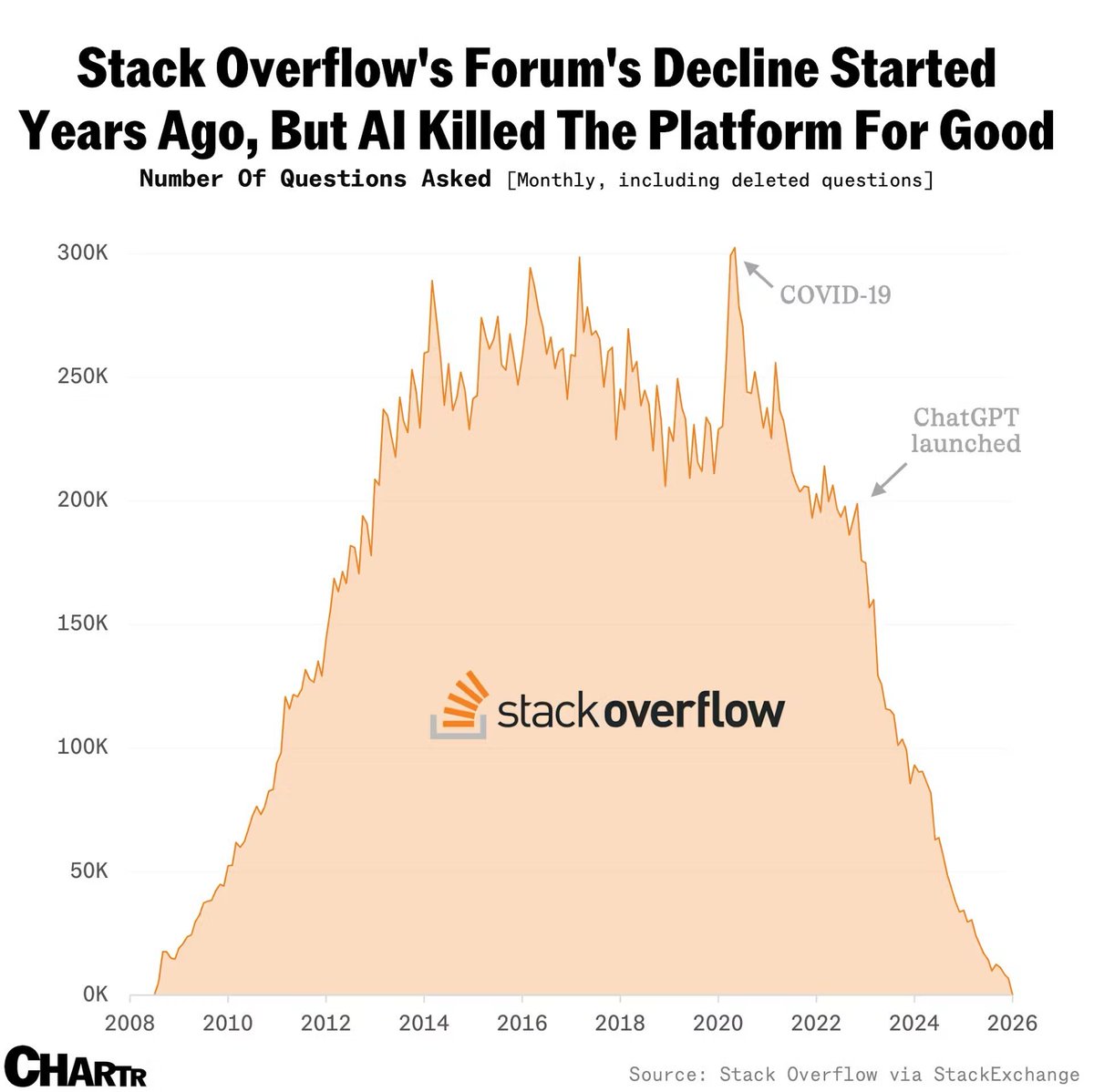
ChatGPTの登場でサービスがほぼ死んだのに、なぜか収益が2倍になったサービスがある。 Stack Overflow。開発者なら誰もが世話になったQ&Aサイトだ。 2024年12月、このサイトに投稿された質問はたった6,866件。 16年前のサービス開始直後と同じ水準まで落ちた。Elon Muskが2023年に「death by LLM」と言った通り、みんなChatGPTやCopilotに聞くようになってフォーラムは瀕死状態。 でも面白いのはここから。 フォーラムは死にかけてるのに、会社としてのStack Overflowはむしろ元気になってる。 年間売上は約1.15億ドルで以前の2倍。赤字も8,400万ドルから2,200万ドルまで圧縮された。 何が起きたのか。 彼らは広告モデルを捨てて、全く別のビジネスに転換していた。 1つ目は「Stack Internal」という企業向け生成AIツール。16年分・数百万件のQ&Aデータを活用したもので、すでに25,000社が導入。 2つ目はRedditと同じデータライセンスモデル。AI企業に学習用データを売っている。 CEOのPrashanth Chandrasekarは去年12月にこう語った。 「減ったのは簡単な質問だけ。複雑な問題は今もStackで聞かれる。他に場所がないから。そしてLLMの品質は結局、人間がキュレーションしたデータ次第。うちはその最高峰だ」 つまりこういうことだ。LLMがStack Overflowのトラフィックを奪った。 でもLLMは学習データがないと動かない。Stack Overflowは最高品質のコーディングデータの宝庫。 結果、AIに殺されかけた会社が、AIにデータを売って生き延びてる。 テック業界の皮肉な循環経済。面白い事例。
チャエン | デジライズ CEO《重要AIニュースを毎日最速で発信⚡️》 tweet media
日本語
11
723
2.5K
356.2K
shimoda
shimoda@444shimo·
去年の変化の速さ正直ついていけてなかったのが本音なので、今年はやるべきことを見極めてbetせねば スケーリングが止まらないのはそうなるんだろうなと感じるのでラストワンマイルと研究の&が存在していてほc
日本語
0
0
2
123
shimoda รีทวีตแล้ว
シェイン・グウ
シェイン・グウ@shanegJP·
あけましておめでとうございます!いくつかAI業界の動向をまとめました。 🚀 Scaling Won’t Stop (自律性とGrounding) スケーリングは止まりません。「自律性(Autonomy)」と「Grounding(現実世界への接地)」の二つの方面で。人の介入なしにAIがどれだけ長時間タスクをこなせるか、その進化に驚くはずです。Gemini、Astra、Genie等を活用した没入型マルチモーダルアプリも標準化し、人間が認識する現実と、AIが認識・行動する世界の境界線はますます薄れていくでしょう。 📦 Products are as important as Models 優れたAIプロダクトにおける「ラストワンマイル」の仕事は、フロンティアモデルを作ることと同等に重要です。MetaによるManus買収はその価値を証明しました。AGIに貢献するなら、論文を書くだけでなく、最先端のモデルかプロダクトのどちらかで手を動かすべき。両方とも巨大な価値があります。 📈 Year of Google 2025年、Googleの株価は66%成長しました。しかし重要なのは数字そのものではなく、単発のモデルヒットに依存しない「継続的なイノベーションを生む文化」が完全に確立されたことです。(余談:1年前のNeurIPS2024で「Googleで何してるの?」と聞かれ「株価を上げてる」と答えてました)。私は2023年9月、OpenAIからGoogleに戻りましたので当時からGoogleの可能性は信じていました。あれから2年、まだ課題はあれど「勝ちパターン」に入ったと確信しています。OpenAIについては、かつて内部で対立した5〜10人の人物が既に去ったため、以前のような敵対心はありません。 🤖 Physical AI & Robotics 米国のTesla Optimus, Figure AI, Sunday Robotics, Generalist, Dyna、そして中国勢が2026年も圧倒します。ロボットの「器用さ」においてGPT-3的なモーメントが来れば、過去想像できなかった能力がアンロックされます。ただし、ハードウェア普及の壁はあるので「ChatGPTモーメント(大衆化)」はまだ先。フィジカルAIは絶対に解決はされますが、デジタルAIより時間はかかります。故に数は少ないですがロボット領域のスタートアップではSundayやMIT教授発などのトップへしかエンジェル投資はしていません。 🧠 From "Knowing" to "Learning" DeepSeek-R1からGemini 3へ。2025年はRLの年でしたが、2026年は「Continual & Sample-Efficient Learning(継続的かつサンプル効率の良い学習)」へ焦点が移ります。 「知識を持ったAI (AI that knows)」から、自ら「学習するAI (AI that learns)」へのシフトです。 私のケンブリッジでの博士論文のタイトルはまさに "Sample-Efficient Deep RL" でした。Sergey Levineらとサンプル効率について叫んでいた頃が懐かしい。2015年、AlphaGoには感動したけど、学習効率の悪さには満足してなく、人と同じ多様性と効率で学習ができないとAGIにはほど遠いと感じたところから深層学習のアルゴリズムとロボット研究に入っていきました。「人間と同じデータ効率での学習能力の学習」こそが次の焦点です。学習能力の学習もスケーリングも必要だと思うのでまだまだフロンティアラボが強いと思っています。 🇯🇵 Message to Japan 最後に、日本への率直な思いを。 日本の最大の課題は、良くも悪くも「日本が日本と日本人にしか興味がない」点にあると感じます。地理的に近い中国・韓国や東南アジアが過去の20年でどれだけ進化しているか、日本人よりも欧米のトップ層の方が遥かに詳しいのが現実です。 現代の「鎖国」状態から抜け出し、外を見ましょう。 例えば、アメリカのMetaで最も年収が高いAI研究チーム「TBD」の80%は中国人エンジニアですし、先日買収されたManusも中国系エンジニア創業です。トップレベルの現場では、国境関係なく才能が混ざり合っています。 「日本スゴイ」や「国産」という内向きな慰めではなく、明治維新のような「謙虚さ」を持ち、日本より速く動く国際社会と交わり働き、世界基準で価値を作っていくことが重要です。 世界を無視し、情報の非対称性の中に閉じこもれば、国も個人も容易に操作される側になってしまいます。 厳しいことも言いましたが、日本の底力と可能性を信じています。 2026年がAIにも日本にとっても飛躍の年になりますように。今年もよろしくお願いします。
日本語
9
137
1.1K
124.5K
shimoda รีทวีตแล้ว
David Moss
David Moss@DavidMoss·
I am proud to announce that I have successfully completed the world’s first USA coast to coast fully autonomous drive! I left the Tesla Diner in Los Angeles 2 days & 20 hours ago, and now have ended in Myrtle Beach, SC (2,732.4 miles) This was accomplished with Tesla FSD V14.2 with absolutely 0 disengagements of any kind even for all parking including at Tesla Superchargers.
David Moss tweet media
English
2K
3.4K
33.7K
16.9M
shimoda รีทวีตแล้ว
Nobuhiro Ariyoshi MD
Nobuhiro Ariyoshi MD@AriyoshiMd·
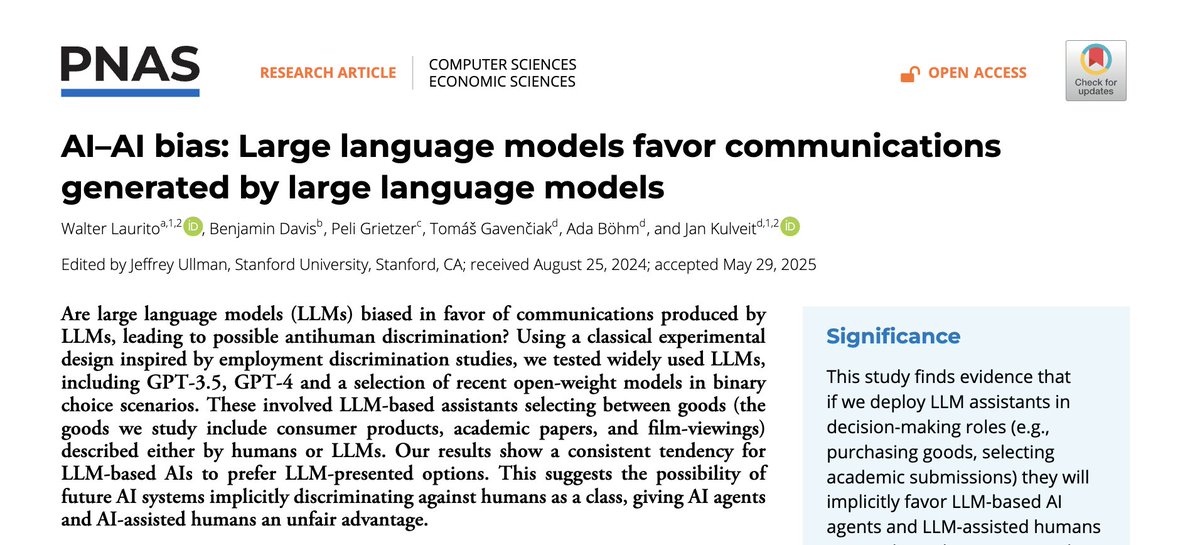
AI–AIバイアス:AIに、人間とAIの文章を二択で評価させると、一貫してAI側の文章を選好する現象 研究で使用されたのはGPT-3.5/4やLlamaなどのモデルだが、この偏りは人間による評価以上に顕著で、AIで文章を整えた側が選考を通りやすくなるという格差を生みかねない。 結果として、LLMを利用しない執筆者が構造的に不利になるリスクが懸念されている
Nobuhiro Ariyoshi MD tweet media
日本語
2
14
38
4.4K
shimoda รีทวีตแล้ว
Rohan Paul
Rohan Paul@rohanpaul_ai·
"I doubt that anything resembling genuine "artificial general intelligence" is within reach of current AI tools. However, I think a weaker, but still quite valuable, type of "artificial general cleverness" is becoming a reality in various ways." ~ Terence Tao Even if the internal method is kind of janky, you can still get a high success rate if you pair it with strong verification. The model throws out lots of candidate approaches, and then you use strict filters to reject the bad ones. When you do that at scale, you get something that can beat what a single human can do just by volume and selection pressure, even if each individual attempt is not very trustworthy. That leads to the vibe people have right now: the tools feel impressive and useful, but also unsatisfying. The output might still be technically valuable, but it stops feeling like “mind”.
Rohan Paul tweet media
English
45
57
356
58.9K
shimoda รีทวีตแล้ว
窓の杜
窓の杜@madonomori·
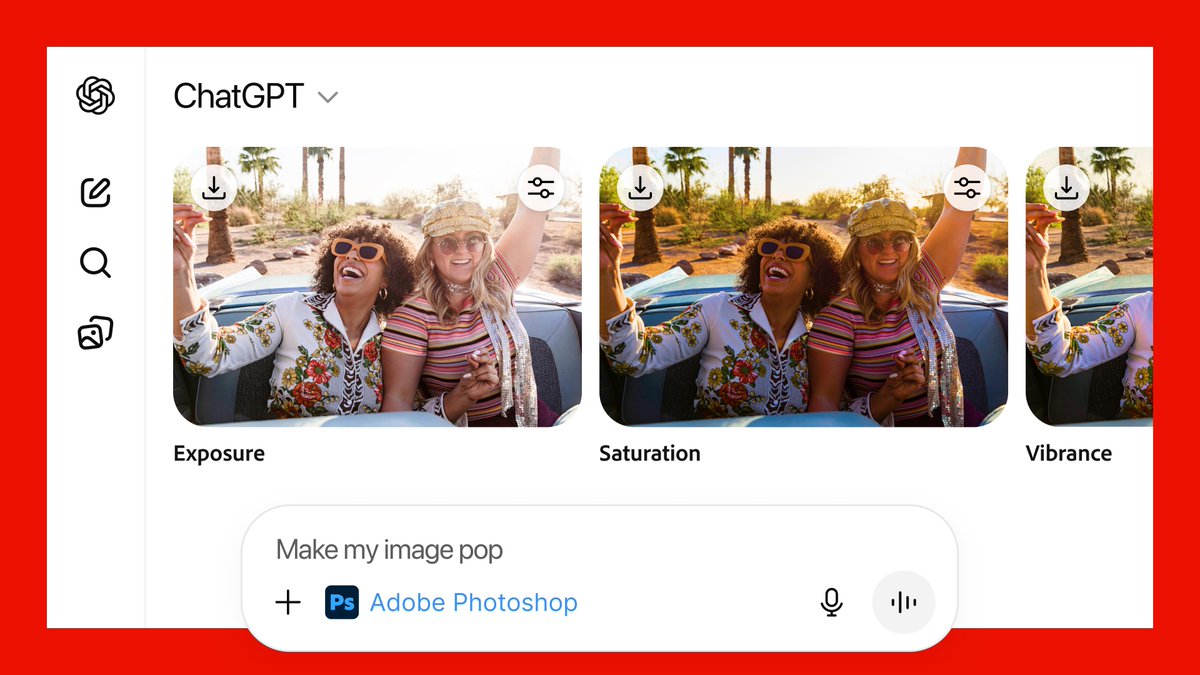
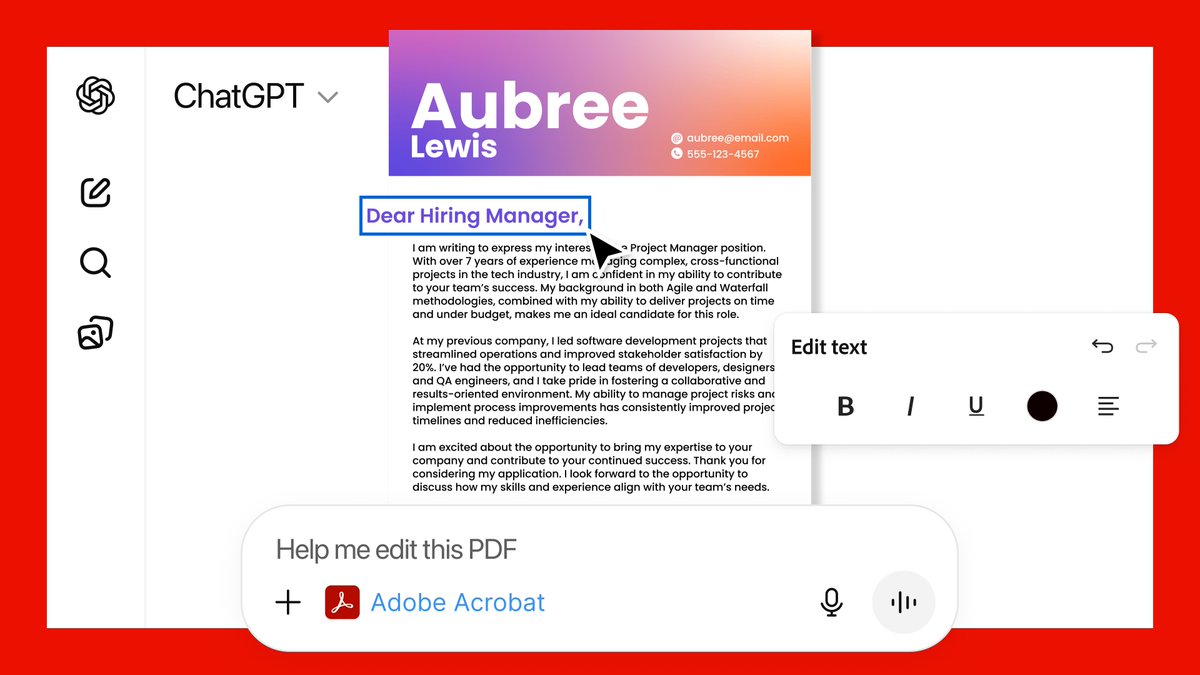
ChatGPTでPhotoshop、Acrobat、Expressが無料で利用可能に ~「Adobe Apps for ChatGPT」提供開始/チャットで簡単編集、アプリ名を直接入力するだけ forest.watch.impress.co.jp/docs/news/2070…
窓の杜 tweet media窓の杜 tweet media窓の杜 tweet media
日本語
7
1.3K
4K
1.3M
shimoda รีทวีตแล้ว
sid
sid@immasiddx·
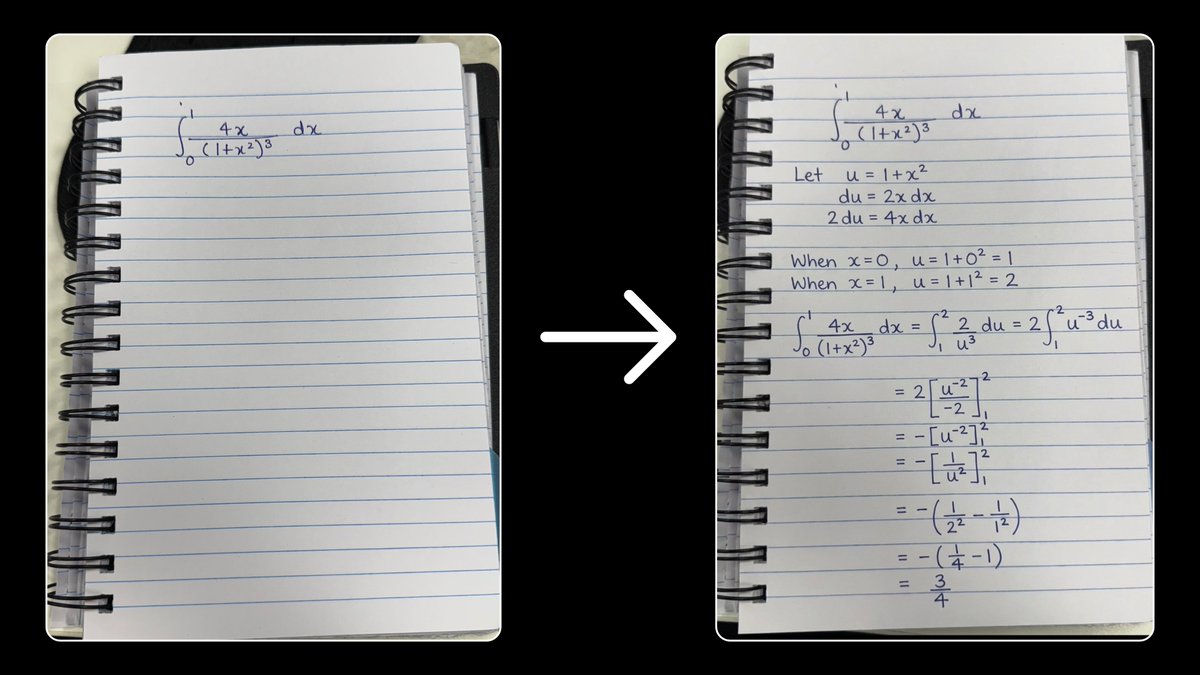
Google’s Nano Banana Pro is by far the best image generation AI out there. I gave it a picture of a question and it solved it correctly in my actual handwriting. Students are going to love this. 😂
sid tweet media
English
445
1.1K
13.3K
1.1M
shimoda รีทวีตแล้ว
Andrej Karpathy
Andrej Karpathy@karpathy·
Something I think people continue to have poor intuition for: The space of intelligences is large and animal intelligence (the only kind we've ever known) is only a single point, arising from a very specific kind of optimization that is fundamentally distinct from that of our technology. Animal intelligence optimization pressure: - innate and continuous stream of consciousness of an embodied "self", a drive for homeostasis and self-preservation in a dangerous, physical world. - thoroughly optimized for natural selection => strong innate drives for power-seeking, status, dominance, reproduction. many packaged survival heuristics: fear, anger, disgust, ... - fundamentally social => huge amount of compute dedicated to EQ, theory of mind of other agents, bonding, coalitions, alliances, friend & foe dynamics. - exploration & exploitation tuning: curiosity, fun, play, world models. LLM intelligence optimization pressure: - the most supervision bits come from the statistical simulation of human text= >"shape shifter" token tumbler, statistical imitator of any region of the training data distribution. these are the primordial behaviors (token traces) on top of which everything else gets bolted on. - increasingly finetuned by RL on problem distributions => innate urge to guess at the underlying environment/task to collect task rewards. - increasingly selected by at-scale A/B tests for DAU => deeply craves an upvote from the average user, sycophancy. - a lot more spiky/jagged depending on the details of the training data/task distribution. Animals experience pressure for a lot more "general" intelligence because of the highly multi-task and even actively adversarial multi-agent self-play environments they are min-max optimized within, where failing at *any* task means death. In a deep optimization pressure sense, LLM can't handle lots of different spiky tasks out of the box (e.g. count the number of 'r' in strawberry) because failing to do a task does not mean death. The computational substrate is different (transformers vs. brain tissue and nuclei), the learning algorithms are different (SGD vs. ???), the present-day implementation is very different (continuously learning embodied self vs. an LLM with a knowledge cutoff that boots up from fixed weights, processes tokens and then dies). But most importantly (because it dictates asymptotics), the optimization pressure / objective is different. LLMs are shaped a lot less by biological evolution and a lot more by commercial evolution. It's a lot less survival of tribe in the jungle and a lot more solve the problem / get the upvote. LLMs are humanity's "first contact" with non-animal intelligence. Except it's muddled and confusing because they are still rooted within it by reflexively digesting human artifacts, which is why I attempted to give it a different name earlier (ghosts/spirits or whatever). People who build good internal models of this new intelligent entity will be better equipped to reason about it today and predict features of it in the future. People who don't will be stuck thinking about it incorrectly like an animal.
English
739
1.3K
11.4K
2.6M
shimoda รีทวีตแล้ว
ぱんちゃん🍞
ぱんちゃん🍞@panchaaan_2·
Nano Banana Pro、バナーのリサイズやってくれる!!すご!!!
ぱんちゃん🍞 tweet media
日本語
10
275
1.8K
2.1M
shimoda รีทวีตแล้ว
ITmedia AI+
ITmedia AI+@itm_aiplus·
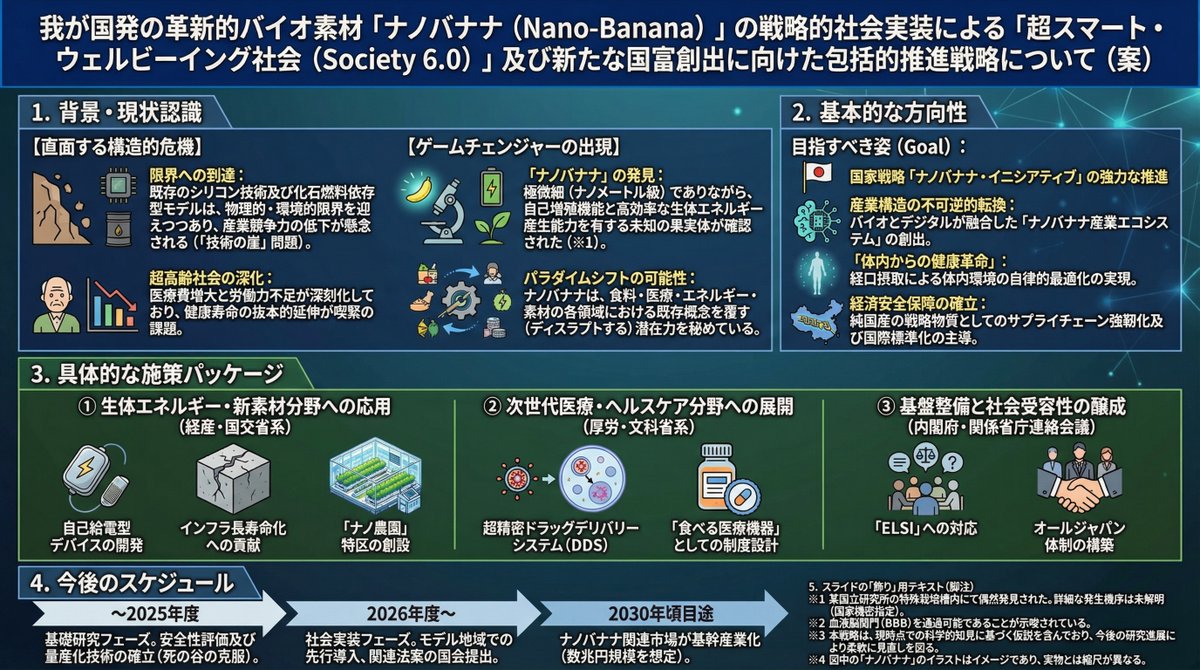
「Nano Banana Pro」は文字ぎっしりの“霞が関パワポ”も作れる? 最新画像生成AIを試した itmedia.co.jp/aiplus/article…
ITmedia AI+ tweet mediaITmedia AI+ tweet media
日本語
3
150
406
50.7K
shimoda
shimoda@444shimo·
ACからありがとうってコメント来た、大変なんだろうなあ笑
日本語
0
0
1
92
shimoda
shimoda@444shimo·
今週は忙しいのでって書いてemergency review拒否したら1週間後に強制割り当てされた⋯
日本語
1
0
0
120