

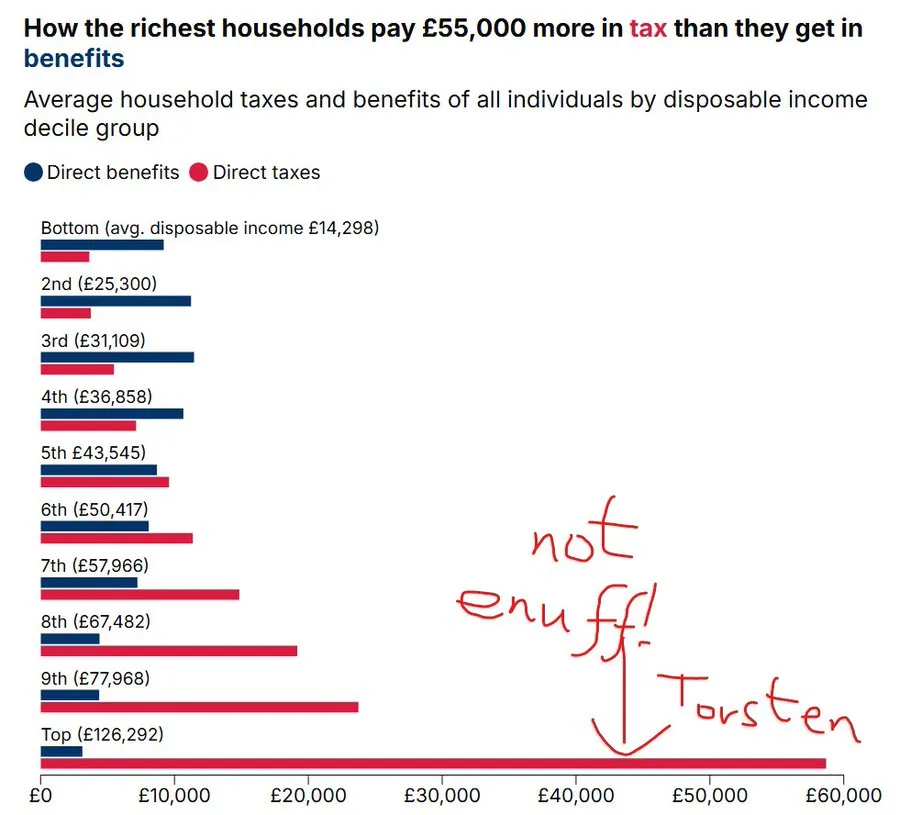
Yes. Great point. One for @an0n_Nic The real "working people" are those on >£43-45k. Let me explain… At £43-45k gross, a single person is paying roughly £6,300 income tax, £2,700 employee NICs, their employer pays circa £4,500 employer NICs on their behalf, then perhaps £3,500 in VAT through consumption, circa £2,000 council tax, fuel duty, excise, the cascade of indirect levies. Only then does that person scrape past the crucial £20k mark. That £43-45k figure is the bare minimum at which a taxpayer stops being a net drain on the state. Officially. Unofficially it’s higher. I’ll come back to this. The ONS defines "net recipients" as households receiving more in benefits (including benefits in kind: NHS, education, policing) than they pay in all taxes combined. Already 55% of UK households are net recipients under this framework. Let that one ruminate and stink the gaff out. TME 2025-26: £1,370bn divided by 68.3m population = £20,059 per head. NHS, education, defence, welfare, debt interest, the lot. Bear in mind that population figure is informed by census and DWP data. The real number of bodies consuming services is higher. The Home Office openly concedes it cannot track expired visa holders. The true fiscal drag is significantly worse. Per the official (lowballed) data alone, the three thresholds work out roughly as: Single, no dependants: circa £43,500 gross. One head of spending to cover at £20k. Couple, no dependants: circa £65-67k gross household. Two heads = £40k burden. Family of four: circa £105k gross household. This is the most savage figure of all. Four heads of spending at £20k each = £80k burden, only two earners generating tax revenue. The children consume full public spending (education alone runs circa £7k per head per year) while contributing precisely nothing to the revenue side. You need to be comfortably in the top decile of household income to have two kids and not be a net taker. And it gets worse. If the family of four runs on a single earner, which is to say a father working while the mother raises the children, the breakeven figure does not sit at £105k. It sits north of £135k. And that single earner hits the £100-125k personal allowance taper, where the marginal rate spikes to circa 60-67%. The state actively punishes the very household configuration it should be incentivising. The man trying to support a family on one income is taxed as though he is a luxury. Hosed relentlessly no matter what you do. Now consider. If the excess population above 68.3m is entirely on the consumption side of the ledger, paying no tax, consuming full services, what does that do to the per-capita burden carried by the existing population? The maths is straightforward. TME is fixed at £1,370bn. That money gets spent regardless. The question is how many heads are consuming it. 70m: Burden rises to £20,558 per head. Hidden liability of circa £34bn, roughly £1,200 per household per year. 75m: £22,027 per head. Hidden liability circa £134bn. Approximately £4,700 per household per year. More than double the average council tax bill. Materialising as longer NHS waits, overcrowded classrooms, infrastructure running beyond capacity. 80m: £23,494 per head. Hidden liability circa £235bn. Roughly £8,200 per household per year. A sum larger than most households' entire income tax contribution, socialised silently across the tax base. At 75m a family of four needs north of £120k to break even. At 80m it approaches £140k. The median household is not remotely in contention at any scenario. The £20k figure is itself conservative. Blended TME includes defence and debt interest which do not scale with headcount. The marginal cost of an additional service-consuming resident (NHS, education, housing, policing) is higher than the average. This is how terminally fucked Britain's social contract is. The only answer at this point is to smash the welfare state to bits. @trevgoes4th @ColeFusionHQ @db_fink @HayekAndChips