Ron Hogsett

45 posts

Ron Hogsett banner
Ron Hogsett

Ron Hogsett

@AlphaInMadrid

Managing Director at Forms Academy & Forms Madrid. LSE graduate. Dedicated to redefining youth football development worldwide.

Madrid, Spain เข้าร่วม Kasım 2024
25 กำลังติดตาม160 ผู้ติดตาม
Ron Hogsett
Ron Hogsett@AlphaInMadrid·
Our FORMAX 5x5 model is built on the reality that development is non-linear. We can't assess players on physical output alone—we must evaluate perceptual awareness, cognitive processing speed, and motor schema robustness. #FootballScience #TalentID
English
0
0
0
23
Ron Hogsett
Ron Hogsett@AlphaInMadrid·
US youth soccer fails to produce elite technicians by prioritizing tactics over ball mastery. Myelination science tells us the motor skill window closes rapidly after age 11. We're wasting critical developmental years on team shape. #USMNT #YouthSoccer
English
3
0
4
1K
Ron Hogsett
Ron Hogsett@AlphaInMadrid·
Cognitive-motor integration defines the elite player. You can't teach anticipation to a player still thinking about ball control. Automatize technique first—perceptual awareness follows. #FormsAcademy #SkillAcquisition
English
0
0
0
98
Ron Hogsett
Ron Hogsett@AlphaInMadrid·
We mistake early physical maturation for technical potential in youth soccer. True development requires repetition density during neuroplastic windows. Without thousands of varied touches weekly, elite neural pathways simply won't form. #PlayerDevelopment #Neuroscience
English
1
1
9
963
Ron Hogsett
Ron Hogsett@AlphaInMadrid·
The foundation of elite football is not tactical understanding—it is motor schema formation. Prioritizing dribbling mastery ages 4–11 literally wires the brain for technical acquisition. Technique must precede tactics. #YouthFootball #MotorLearning
English
0
0
10
476
Ron Hogsett รีทวีตแล้ว
NobletStrength
NobletStrength@NobletStrength·
@AlphaInMadrid So even arguably nonfunctional moves like around the worlds actively improving your technical ability because it's sending the same signals to your brain to increase coordination in your legs and feet. This benefits you specific skills in game indirectly.
English
0
1
1
106
Ron Hogsett
Ron Hogsett@AlphaInMadrid·
A little context on why I’m obsessed with crafting and developing functionally technical, adaptable, and portable players. When I say portable, I mean players who can walk into any environment and function for any coach, in any country, within any system. They don’t need to be re-taught how to play. They don’t shrink or panic when the structure changes. They don’t depend on a specific role to survive. Most coaches I’ve met over the years have moments that force them to confront their own thinking. I wanted to share one that reframed mine. The video is my oldest son at 7 years old. About a year before that he asked me to teach him the rainbow flick. I told him no as I didn’t think it had any real application. I thought I was being practical. Fast forward to the Manchester City Cup in San Diego, his first 7v7 tournament. I’m coaching on the sideline and from kick-off he does this. That moment bothered me in the best way. He exposed a blind spot in my framework. What fascinated me wasn’t whether the rainbow solved some immediate problem. It was the thought process: why that skill, why then? He thought he could, so he did. Thought through to execution in real time. How do we improve that connection? If I could be that wrong about something so simple (7 year old curiosity), what else was I filtering out without realizing it? What parts of his growth was I suppressing because they didn’t fit my definition of “useful?” Once you understand how neural networks form, how repetition and exploration physically wire the brain, you realize every constraint you impose has real consequences. Every “no” shapes the architecture. That rainbow wasn’t about a trick. It was about whether I was limiting the expansion of his technical vocabulary before it even had a chance to form. This changed how I evaluated everything. And I’m thankful it didn’t stop there. There were other moments, with Hudson, with Hollis, and with the other players I’ve been lucky enough to train. Those moments matter because they’re not about my kids. They’re proof of concept. They are the closest thing I have to a controlled environment. I control the inputs, the repetition density, the progression, the constraints. So when something translates under pressure, in unfamiliar environments, against different opposition, that’s real information. That’s why, from time to time, I’ll share clips of my boys. Not to showcase them, but to demonstrate the progression from proof of concept to proof of work. To show what happens when coordination depth, bilateral fluency, repetition density, and technical range are prioritized before you layer on structure. My mission is to craft and develop functionally technical, adaptable, and portable players. I’m obsessed with technical development. A lot of what I discuss and do is testing the theory in real time and doing my best to grow every day.
English
2
0
11
2.1K
Ron Hogsett
Ron Hogsett@AlphaInMadrid·
@NobletStrength @alike_no @KingKnightEd @NobletStrength appreciate that. Fair point and I can agree with you on that. I am still fairly new to putting all of this out on X and explaining it publicly so feedback like yours really helps. Thanks again for the honest take.
English
1
0
1
93
NobletStrength
NobletStrength@NobletStrength·
@AlphaInMadrid @alike_no @KingKnightEd I think I agree with you, but I also think you could reach your audiences much better by just stating it in layman's terms. Practice fundamental technique and progress the technique with more difficulty and complexity over time.
English
1
0
1
845
Ron Hogsett
Ron Hogsett@AlphaInMadrid·
I recent had someone recently asked about our methodology and how we teach players to dribble, how we help them to develop their technique and touch. I’ll get that question quite often and I believe the reason is because there are so many ways to see football and the developmental process. We train dribbling and touch by developing the neural mechanics behind them. Most coaches train dribbling as a foot skill; we train it as a sensory-motor circuit. Every drill is designed to increase proprioceptive sensitivity, the brain’s awareness of where the ball, body, and space are at all times. Once that feedback loop is refined, the player’s control looks effortless.
English
2
0
4
1.9K
Ron Hogsett
Ron Hogsett@AlphaInMadrid·
@alike_no Not exactly. The inside outside rhythm is just the early scaffolding. What is actually being trained is the continuous recalibration the nervous system has to do on every touch because the two balls have completely different mass, rebound, size, feel, spin, etc. The foot sequence is not a fixed prescribed rhythm the brain is recalling, it’s adapting in real time. That is the interaction layer that builds the stable control we see transfer to the game. Appreciate the thoughtful exchange.
English
0
0
0
48
Michael O'Neill
Michael O'Neill@alike_no·
@AlphaInMadrid @KingKnightEd So stripping all that back, are you saying that the answer to the question is this... The ball size is the variable thing and that's what brings the neurological benefits so we keep the foot pattern constant with a prescribed rhythm ?
English
2
0
0
569
Ron Hogsett
Ron Hogsett@AlphaInMadrid·
Fair point. Exact percentages are unknowable in the real world. What matters more is the order we build things. We develop stable coordination and precise micro contacts first. Only then do we add variability and pressure. If we get that sequence wrong, we end up with inconsistent touches under pressure instead of real adaptability. That is why we use the two different balls the way we do. We see that transfer consistently with the players who come through the program. On a separate not, I really appreciate how you highlight the damage early positional teaching does to off-ball movement. Spot on. Kids end up stuck in zones instead of solving space intelligently. Appreciate the thoughtful exchange.
English
0
0
0
34
NobletStrength
NobletStrength@NobletStrength·
Or plausibly both matter and the exact percentage of which matter and which one is superior is impossible to directly determine even if we lived in a perfect world where we could always train optimally and not based on the constraints of reality.
Ron Hogsett@AlphaInMadrid

Dribbling mastery emerges not from volume alone, but from the intelligent orchestration of constraints that refine coordination architecture. Constraint-based neuromotor enrichment aligns with a developmental model that prioritizes movement intelligence over mechanical repetition

English
1
0
1
182
Ron Hogsett
Ron Hogsett@AlphaInMadrid·
@alike_no Michael, appreciate the close look and the direct question. What you see is a structured inside outside rhythm with a ball swap. That structure is intentional scaffolding. What is actually being trained is continuous recalibration across two objects with very different mass, size, rebound, and timing characteristics. Every interaction with the ball is a neural event. Every touch requires micro adjustments in force, ankle orientation, and proprioceptive feedback. The visible sequence is predictable but the sensorimotor load is not. Those two things do not contradict. There is a key distinction between rehearsing decisions and stabilizing motor primitives. This exercise does not prescribe these actions as game solutions. Rather, the intention is to refine the micro contacts that later allow solutions to assemble in real time without recall. Think of it like a pianist. Scales build precise finger control and timing, but the concert is not playing scales. It draws from that refined vocabulary to create something adaptive in the moment. Elite skill acquisition progresses from coordination stability to repetition density to variability to pressure and perception layering. Without that stable base, adding variability too soon just creates messy, inconsistent touches instead of real progress. This is early stage precision work. As complexity and decision demand increase, the same mechanics scale into the adaptive creative control you see at the highest levels. @KingKnightEd thank you again for the clean neuroscience framing and for stepping in. Much appreciated. Happy to break this down even further for anyone who wants. Just ask.
English
2
0
4
683
Michael O'Neill
Michael O'Neill@alike_no·
@AlphaInMadrid @KingKnightEd What I hear is: 'Our focus is on interactions rather than memorized patterns' While what I see is: A memorized pattern of outside-inside-outside-inside, swap balls. How do those two things not contradict each other?
English
1
0
0
1.2K
Ron Hogsett
Ron Hogsett@AlphaInMadrid·
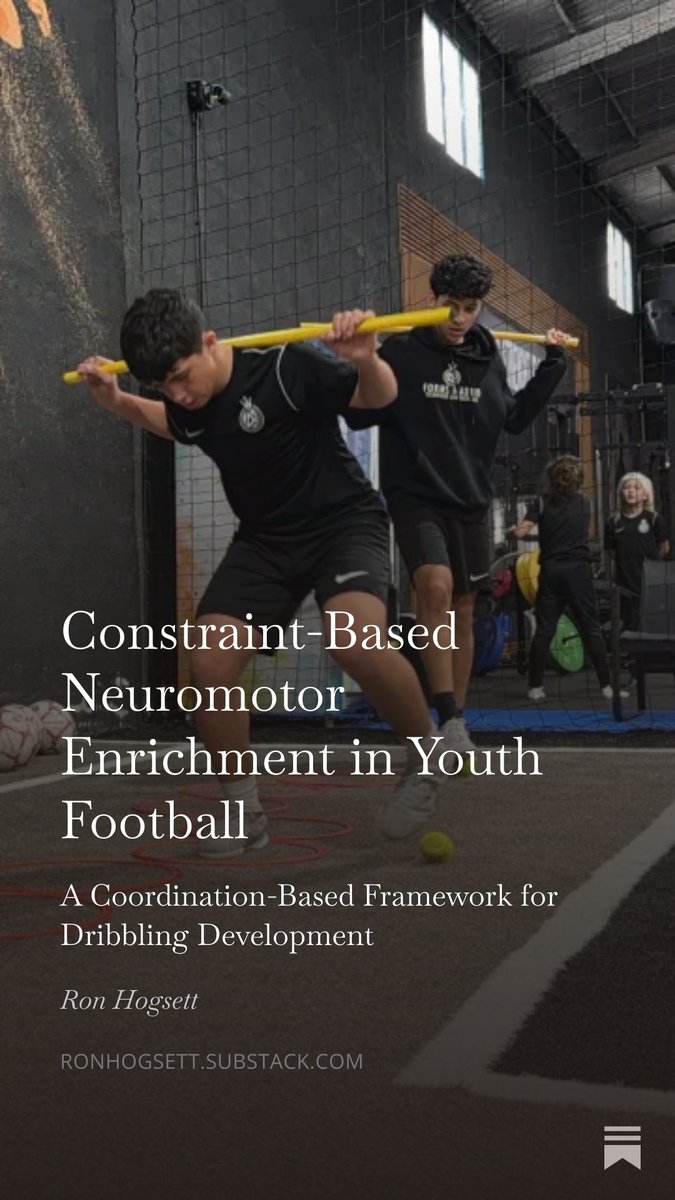
Dribbling mastery emerges not from volume alone, but from the intelligent orchestration of constraints that refine coordination architecture. Constraint-based neuromotor enrichment aligns with a developmental model that prioritizes movement intelligence over mechanical repetition
English
1
2
6
1.3K
Ron Hogsett
Ron Hogsett@AlphaInMadrid·
The Developmental Burden: Training That Forces Evolution As Managing Director of Forms Academy, I am absolutely convinced of one non-negotiable truth: children will never rise above the ceiling they believe exists for themselves. Those beliefs are shaped almost entirely by the environment the adults around them create. When the surrounding system signals low expectations, low demands, or low stress, the child internalizes a ceiling that reflects that environment. Biologically, human systems self-stabilize around familiar loads unless those loads are progressively and intelligently increased. Real growth only occurs when the level of resistance is repeatedly forced upward. [more here] open.substack.com/pub/ronhogsett…
English
0
0
4
358
Ron Hogsett
Ron Hogsett@AlphaInMadrid·
Paddy, this was incredibly generous to read. Thank you. Your journey is exactly what a lot of us have lived through, seeing what’s possible for young players, then running into systems that don’t want anything to change. It’s the reason Forms exists and the reason we obsess over the technical details every single day. We’re nowhere near finished, but knowing our work helped spark something in you means a lot. And I’m genuinely looking forward to your book. The sport needs more coaches willing to dig deeper into how players actually learn. Appreciate you for putting this out there.
English
0
0
2
1.2K
King Knight Education
King Knight Education@KingKnightEd·
Around Covid I did a course with FC Barcelona which focused on the acquisition of technical skills from the cognitive neuroscience perspective. It was eye opening and game changing. I have spent a few years after that trying to collect my thoughts in one place and roll out a program across club level but the challenge was hard, almost impossible. Fighting club politics and non-bought-in coaches, I just had to leave it. A few years later I played against a team (in Ohio) from Texas who were down there trying to qualify for the Super Copa, if I remember rightly. Not that it is important, but we beat them that day. Just. And I mean by the skin of our teeth. They were then, and to this day still are, the most technically dominant team of young players (maybe 11/12 at the time) that I have ever seen. Not just technically smooth, but technically powerful. Technically dominant. That reignited my passion. They could do things other kids seemingly couldn’t. But they were the same kinds of kid, so why couldn’t our kids do what they were doing? The course I did in Barcelona, coupled with witnessing first hand what was possible with these young players, re inspired me to put my notes and thoughts down into a book on how to help players achieve dominance over, not just the ball, but their body, their balance etc. And that book will be out around Christmas. But the point of this post was to try and inspire other coaches who may have come up against resistance when trying to change the paradigm to ‘don’t stop believing’. On that note, and we have no affiliation with them, I would like to invite coaches to head over to Instagram and check out Forms Academy out of Texas. And to follow their director Ron Hogsett @AlphaInMadrid to really open their minds and see what is possible. This guy, and this organization know what’s up. If you do one thing today to improve yourself as a coach, follow these guys to see what is possible.
King Knight Education tweet media
English
3
6
19
2.9K
King Knight Education
King Knight Education@KingKnightEd·
Ron, we understand your methods are proprietary, but would would you be able to give an example of a principle of that? For example, do you ever teach a particular 'move' or do you just teach control of the ball holistically, and then expect players to use whatever is the appropriate solution in the given moment? Are you able to walk us through one example from start to finish? We are huge fans of your work and results.
English
2
0
2
960