Altinus

180 posts

Altinus banner
Altinus

Altinus

@Altius__

hello

เข้าร่วม Aralık 2021
132 กำลังติดตาม769 ผู้ติดตาม
Altinus
Altinus@Altius__·
Async inference with ONNX Runtime is now successfully loading the deep learning model. Since the model is relatively small, inference runs fine on CPU with reasonable resource consumption. No JUCE frameworks required at the bottom layer — it's pure Lua + a thin C++ wrapper
Altinus tweet media
English
0
1
15
509
Altinus
Altinus@Altius__·
we can draw the spectrum waterfall in real time with new apis
Altinus tweet media
English
0
0
1
69
Altinus
Altinus@Altius__·
Added more graphics apis to pdluajit, such as shadow and image support. Benchmarks show CPU usage drops dramatically from 18–23% to just 2–5% when repainting 8,000 shapes simultaneously.
English
1
2
12
520
Altinus
Altinus@Altius__·
After integrating luajit into pdlua, I find the syntax a little strange. For instance, C arrays created with ffi use 0-based indexing, while lua tables start at 1, which can definitely lead to confusion🤮
English
0
0
4
160
Altinus
Altinus@Altius__·
@Naskomusic I believe that, currently, it can load pure algorithm libraries focused on mathematical computations, rather than standard Pd externals which are bundled with Pd-specific API boilerplate? i haven`t try that though
English
0
0
1
86
Nasko
Nasko@Naskomusic·
@Altius__ wait wtf does this mean pdlua can load dll based externals??
English
1
0
2
392
Altinus
Altinus@Altius__·
The integration of JIT and FFI enhances lua`s DSP performance, achieving near-native C efficiency while enabling dynamic library invocation at runtime directly from Lua. dsp can be done simply by writing Lua scripts while maintaining very low CPU usage!
English
2
2
37
1.5K
Altinus
Altinus@Altius__·
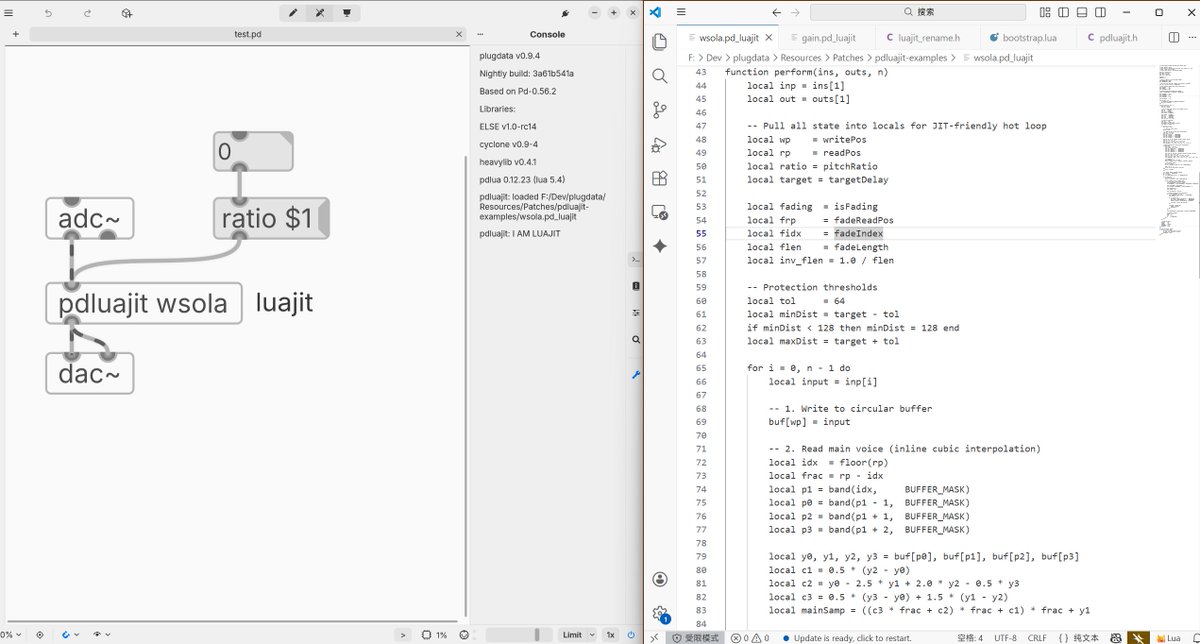
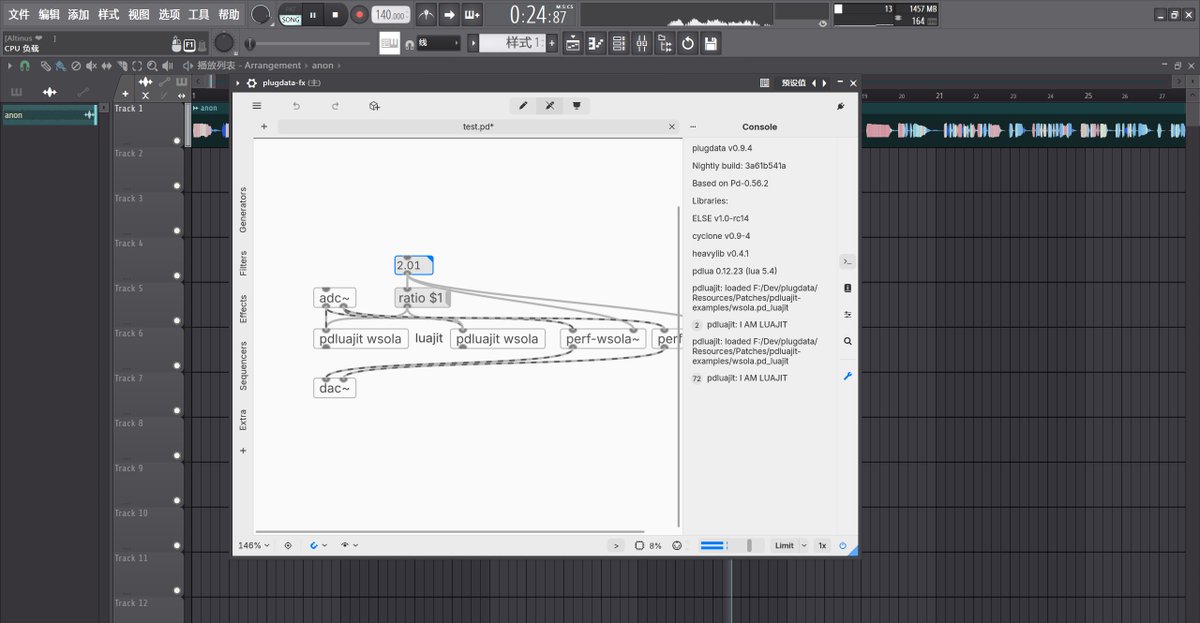
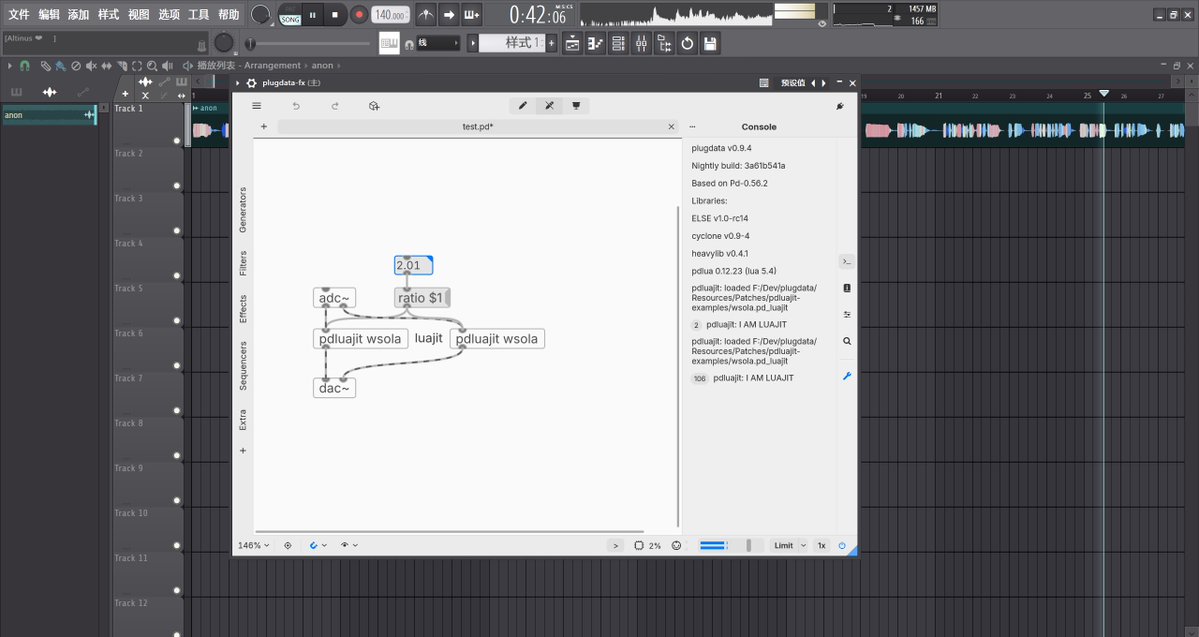
I’ve integrated LuaJIT into plugdata’s nightly build while keeping the original DSP API unchanged. Testing shows a performance boost for DSP tasks. For example, WSOLA processing went from ~13% CPU usage on Lua 5.4 down to just 2% with LuaJIT.
Altinus tweet mediaAltinus tweet mediaAltinus tweet media
English
0
0
8
306
Altinus รีทวีตแล้ว
あにめる
あにめる@animel7316·
あにめる tweet media
ZXX
9
510
5.9K
76.7K
Altinus รีทวีตแล้ว
AluanWang
AluanWang@IOivm·
InkField | 墨域 is about to be released. From the first version, both humans and bots will be able to create on it together. In a way, the system reflects the time we live in. Humans and machines are already living in a kind of symbiosis. I’m generally an optimistic person. But I have to admit, 2026 feels a little heavy right now. Maybe the work will reflect that. Maybe it won’t. Either way, wishing everyone well. I still believe the dawn is coming.
English
26
198
2.2K
108.9K
Altinus
Altinus@Altius__·
Further tweaks, clones now smartly disable dsp when not needed, cutting down on resource usage.
English
0
8
95
3.9K
Nasko
Nasko@Naskomusic·
@Altius__ ohhhhh i see!! does lowering it cause interference? i assume that‘s what the correlation is for right?
English
3
0
0
29
Altinus
Altinus@Altius__·
The real-time performance of pdlua is truly impressive. It has perfected the previous autotune and incorporated a new pitch-shifting algorithm.
English
5
14
281
11.5K
Altinus
Altinus@Altius__·
@Naskomusic then accumulating the analysis increment approximates epoch positions; accumulating the synthesis increment triggers new grain emission
English
0
0
1
24
Altinus
Altinus@Altius__·
@Naskomusic Pitching down formants is just slowing grain read speed, i uses linear interpolation here. This stretches each grain’s duration in the output, shifting formants lower. At moderate ratios. info loss is small i think, but artifacts do exist
English
1
0
1
47
Nasko
Nasko@Naskomusic·
@Altius__ When using PSOLA, are we losing some information when pitching down the formant? afaik we're remapping the content of the grain to expand, so naturally some information get's lost no? just going from intuition here i might be wrong!
English
1
0
0
47
Altinus
Altinus@Altius__·
Found a new approach that dramatically lowers the CPU load of my old plugdata granulator. On my pc, running 32 STEREO grains now takes around 7% CPU. By contrast, the old version with 32 MONO grains was eating up about 16%. demo(new one):
English
1
4
47
2K
Nasko
Nasko@Naskomusic·
@Altius__ that must be fun to use with a touchscreen :DD looks great btw!
English
1
0
1
211
Altinus
Altinus@Altius__·
just for fun: Implemented Karplus-Strong in pdlua, with a basic visualization UI added, with some AI assistance of course
English
1
5
34
1.5K
Altinus
Altinus@Altius__·
@Naskomusic You can take a look at this code for reference: musicdsp.org/en/latest/Anal…. I’m calculating the autocorrelation using fft directly, so my approach differs somewhat from this. I’m not very familiar with the monophonic Helmholtz though
English
0
0
0
53
Nasko
Nasko@Naskomusic·
@Altius__ nice!! Are you doing auto correlation with an fft because it‘s easier compared to a monophonic helmholtz style one? i wouldn‘t even know where to begin with that in native pd 😅 but i assume it could also be done in pdlua?
English
2
0
0
327
Altinus
Altinus@Altius__·
vibe coded an LPC vocoder in pdlua💀 sped up autocorrelation with fft
English
1
5
21
1.4K
Altinus
Altinus@Altius__·
@Naskomusic I use the autocorrelation + Levinson-Durbin algorithm to compute the LPC coefficients. The autocorrelation part is accelerated using rfft~, and the Levinson-Durbin recursion is implemented in pdlua
English
0
0
0
56