ArchDAO

145 posts

ArchDAO banner
ArchDAO

ArchDAO

@ArchDAOfi

The Market of Ideas: turning governance into a market. Don’t vote, bet on the best ideas, built on @Base. Join us: https://t.co/GoH1tiCJhr

Base เข้าร่วม Kasım 2025
2 กำลังติดตาม1.6K ผู้ติดตาม
ทวีตที่ปักหมุด
ArchDAO
ArchDAO@ArchDAOfi·
ArchDAO docs are live! Futarchy is ushering in the fairest iteration of governance in crypto. Learn how the protocol works, from launching a project through ArchDAO's raise mechanics to decision markets and governance. Transparency starts here. docs.archdao.fi
English
124
42
162
138.4K
ArchDAO
ArchDAO@ArchDAOfi·
This is the missing layer in crypto. Not just how capital is raised, but how it decides where to go in the first place. Now built as a core part of ArchDAO on @base
English
0
0
11
188
ArchDAO
ArchDAO@ArchDAOfi·
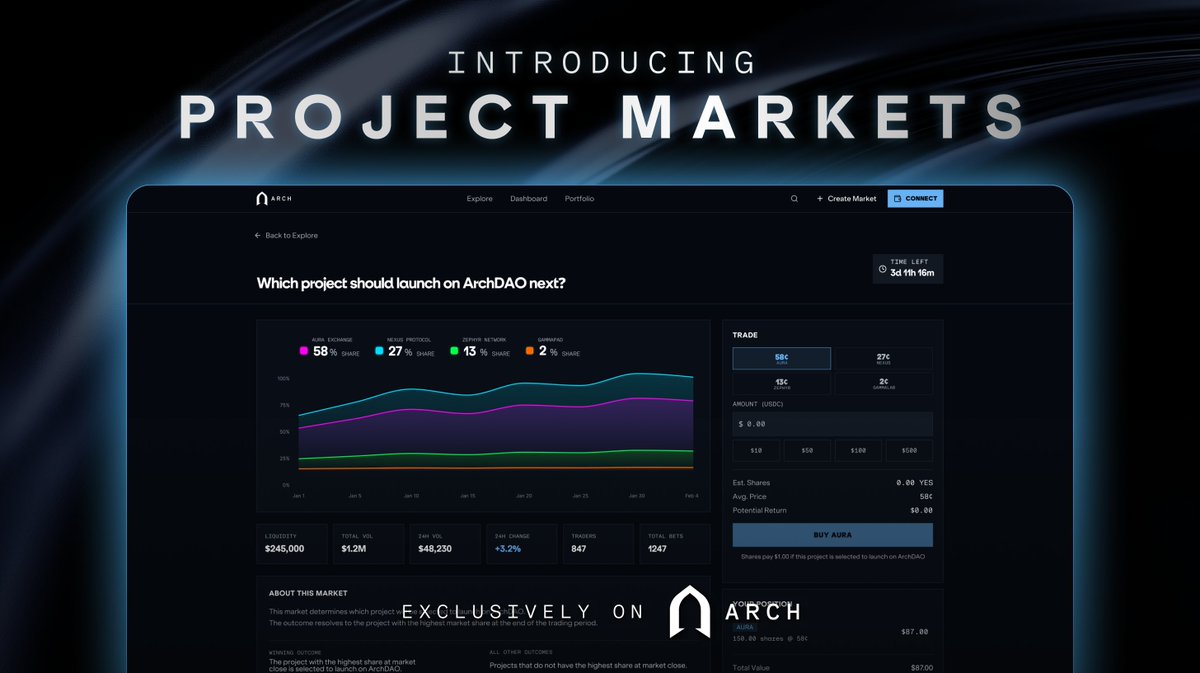
With Project Markets: Before a project launches, markets decide • should it exist • what is fair valuation • how capital should be allocated All tied to real outcomes.
English
1
0
10
219
ArchDAO
ArchDAO@ArchDAOfi·
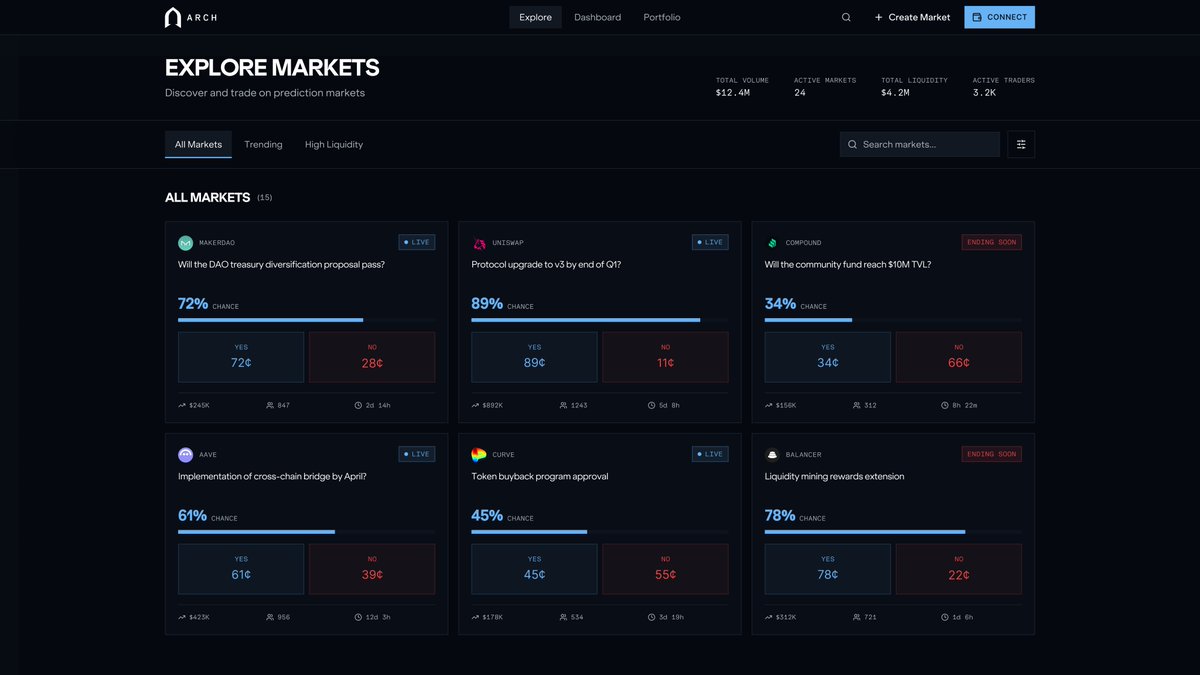
Introducing Project Markets on @ArchDAOfi . First-of-their-kind markets that determine which projects launch, how they’re valued, and how capital is allocated: using capital-at-risk pricing instead of speculation or insider access.
ArchDAO tweet media
English
24
11
83
2.3K
ArchDAO
ArchDAO@ArchDAOfi·
GM to those who believe governance is a decision market waiting to be built.
English
38
11
68
3.4K
ArchDAO
ArchDAO@ArchDAOfi·
When was the last time your DAO vote actually mattered? Governance shouldn’t be symbolic. ArchDAO replaces voting with market-driven governance.
English
71
16
85
25.9K
ArchDAO
ArchDAO@ArchDAOfi·
ArchDAO is building capital formation the way it should’ve been. Pro-rata allocation. Clean refunds. Structural fairness.
English
68
22
107
4.4K
ArchDAO
ArchDAO@ArchDAOfi·
The word futarchy doesn't just mean governance by future outcomes. It can also be viewed as a portmanteau of future and anarchy, and this is what crypto needs. The dismantling of hierarchical power structures that have defined crypto governance for too long. Futarchy is governance by future. And ArchDAO is the future of governance.
zooko🛡🦓🦓🦓 ⓩ@zooko

For some reason I hate the word "futarchy". (It means you're going to be governed by the future‽) So I'll call it "Decision Markets". But anyway, this blog post does a good job of explaining the rationale and walking through an example: umbraresearch.xyz/writings/futar… HT @sacha

English
29
4
41
2.7K
ArchDAO
ArchDAO@ArchDAOfi·
ArchDAO discord is live. Prices are set by markets. Protocols are shaped by people. See you inside. → discord.gg/archdao
English
102
19
119
5.9K
ArchDAO
ArchDAO@ArchDAOfi·
If tokenholders can’t enforce outcomes, are they really stakeholders?
English
115
16
115
7.8K
ArchDAO
ArchDAO@ArchDAOfi·
GM to the people who put their money behind their beliefs.
English
169
29
218
24.6K
ArchDAO
ArchDAO@ArchDAOfi·
The old ICO playbook: raise funds, disappear, rebrand. ArchDAO's playbook: full transparency, binding governance, and enforceable rights that ICO investors never had. The standard has been raised.
ArchDAO tweet media
English
99
28
145
11.9K
ArchDAO
ArchDAO@ArchDAOfi·
Governance just evolved. ArchDAO is dropping the most sophisticated futarchy platform on-chain. Bet real capital on protocol upgrades, treasury allocations, and DAO proposals. Let prediction markets decide what traditional voting can't. Real markets. Real stakes. Better outcomes. Live soon on @base.
ArchDAO tweet media
English
124
38
145
17.1K
ArchDAO
ArchDAO@ArchDAOfi·
Futarchy: Markets > Votes Proposal → Prediction Markets → Price Discovery → Auto-execution Let capital find truth.
ArchDAO tweet media
English
3
5
24
509
ArchDAO
ArchDAO@ArchDAOfi·
The shift from speculation to broader use cases is inevitable. Prediction markets become truly powerful when embedded into governance, not just price action. ArchDAO is exploring futarchy-based infrastructure designed for exactly this: markets that inform decisions, not just trade narratives. Less corposlop. More coordination.
vitalik.eth@VitalikButerin

Recently I have been starting to worry about the state of prediction markets, in their current form. They have achieved a certain level of success: market volume is high enough to make meaningful bets and have a full-time job as a trader, and they often prove useful as a supplement to other forms of news media. But also, they seem to be over-converging to an unhealthy product market fit: embracing short-term cryptocurrency price bets, sports betting, and other similar things that have dopamine value but not any kind of long-term fulfillment or societal information value. My guess is that teams feel motivated to capitulate to these things because they bring in large revenue during a bear market where people are desperate - an understandable motive, but one that leads to corposlop. I have been thinking about how we can help get prediction markets out of this rut. My current view is that we should try harder to push them into a totally different use case: hedging, in a very generalized sense (TLDR: we're gonna replace fiat currency) Prediction markets have two types of actors: (i) "smart traders" who provide information to the market, and earn money, and necessarily (ii) some kind of actor who loses money. But who would be willing to lose money and keep coming back? There are basically three answers to this question: 1. "Naive traders": people with dumb opinions who bet on totally wrong things 2. "Info buyers": people who set up money-losing automated market makers, to motivate people to trade on markets to help the info buyer learn information they do not know. 3. "Hedgers": people who are -EV in a linear sense, but who use the market as insurance, reducing their risk. (1) is where we are today. IMO there is nothing fundamentally morally wrong with taking money from people with dumb opinions. But there still is something fundamentally "cursed" about relying on this too much. It gives the platform the incentive to seek out traders with dumb opinions, and create a public brand and community that encourages dumb opinions to get more people to come in. This is the slide to corposlop. (2) has always been the idealistic hope of people like Robin Hanson. However, info buying has a public goods problem: you pay for the info, but everyone in the world gets it, including those who don't pay. There are limited cases where it makes sense for one org to pay (esp. decision markets), but even there, it seems likely that the market volumes achieved with that strategy will not be too high. This gets us to (3). Suppose that you have shares in a biotech company. It's public knowledge that the Purple Party is better for biotech than the Yellow Party. So if you buy a prediction market share betting that the Yellow Party will win the next election, on average, you are reducing your risk. Mathematical example: suppose that if Purple wins, the share price will be a dice roll between [80...120], and if Yellow wins, it's between [60...100]. If you make a size $10 bet that Yellow will win, your earnings become equivalent to a dice roll between [70...110] in both cases. Taking a logarithmic model of utility, this risk reduction is worth $0.58. Now, let's get to a more fascinating example. What do people who want stablecoins ultimately want? They want price stability. They have some future expenses in mind, and they want a guarantee that will be able to pay those expenses. But if crypto grows on top of USD-backed stablecoins, crypto is ultimately not truly decentralized. Furthermore, different people have different types of expenses. There has been lots of thinking about making an "ideal stablecoin" that is based on some decentralized global price index, but what if the real solution is to go a step further, and get rid of the concept of currency altogether? Here's the idea. You have price indices on all major categories of goods and services that people buy (treating physical goods/services in different regions as different categories), and prediction markets on each category. Each user (individual or business) has a local LLM that understands that user's expenses, and offers the user a personalized basket of prediction market shares, representing "N days of that user's expected future expenses". Now, we do not need fiat currency at all! People can hold stocks, ETH, or whatever else to grow wealth, and personalized prediction market shares when they want stability. Both of these examples require prediction markets denominated in an asset people want to hold, whether interest-bearing fiat, wrapped stocks, or ETH. Non-interest-bearing fiat has too-high opportunity cost, that overwhelms the hedging value. But if we can make it work, it's much more sustainable than the status quo, because both sides of the equation are likely to be long-term happy with the product that they are buying, and very large volumes of sophisticated capital will be willing to participate. Build the next generation of finance, not corposlop.

English
0
4
19
608
ArchDAO
ArchDAO@ArchDAOfi·
A successful raise depends on many factors, some beyond anyone's control, like market conditions. ArchDAO provides a robust framework for successful fundraising in any environment. Through pro rata distribution and discretionary caps, investors gain confidence that projects launching on ArchDAO are well-capitalized with sufficient runway for long-term success.
ArchDAO tweet media
English
1
5
15
438
ArchDAO
ArchDAO@ArchDAOfi·
With a TVL of $4B and over 300M monthly transactions, @base has the largest market share across all L2 chains today. As one of the fastest-growing L2s, this highlights one of the largest ecosystem gaps in the space. Base needs a governance layer that can operate at scale. ArchDAO meets this demand with futarchy-based infrastructure.
ArchDAO tweet media
English
0
5
15
437
ArchDAO
ArchDAO@ArchDAOfi·
ArchDAO doesn’t ask what participants think should happen. It asks what outcomes they’ll risk capital on to create value. This transforms governance from opinion polling into a continuous, incentive-aligned signal backed by skin in the game.
ArchDAO tweet media
English
2
4
15
333
ArchDAO
ArchDAO@ArchDAOfi·
ArchDAO tweet media
ZXX
0
1
9
171
ArchDAO
ArchDAO@ArchDAOfi·
5/ Futarchy eliminates dual equity misalignment through its fundamental architecture. Governance operates as a prediction market where proposal adoption depends on the forecasted impact on token value. Insiders cannot optimize for separate equity interests as market participants control decisions through capital-backed predictions. This creates absolute alignment between protocol success and token value without privileged classes or information asymmetries.
English
1
1
9
189
ArchDAO
ArchDAO@ArchDAOfi·
🧵 The Dual Equity Structure Problem in Crypto Governance Dual equity structures represent a fundamental governance challenge in cryptocurrency markets. Projects raise public capital through token issuance while founders, venture capitalists, and insiders maintain separate equity or privileged token classes with superior governance rights and economic terms, creating systematic misalignment between stakeholder groups. ArchDAO’s pro-rata raise mechanism, backed by futarchy governance infrastructure, puts an end to these opaque arrangements, aligning protocol value with token holder interests.
ArchDAO tweet media
English
5
5
18
493