OffensiveOracle

5.7K posts

OffensiveOracle banner
OffensiveOracle

OffensiveOracle

@AstroDusler

⚽ insightful analysis, tactical breakdowns, and expert commentary on the world's favorite sport. For Tennis Follow @Probahis

Lviv เข้าร่วม Mart 2023
248 กำลังติดตาม2.3K ผู้ติดตาม
ทวีตที่ปักหมุด
OffensiveOracle
OffensiveOracle@AstroDusler·
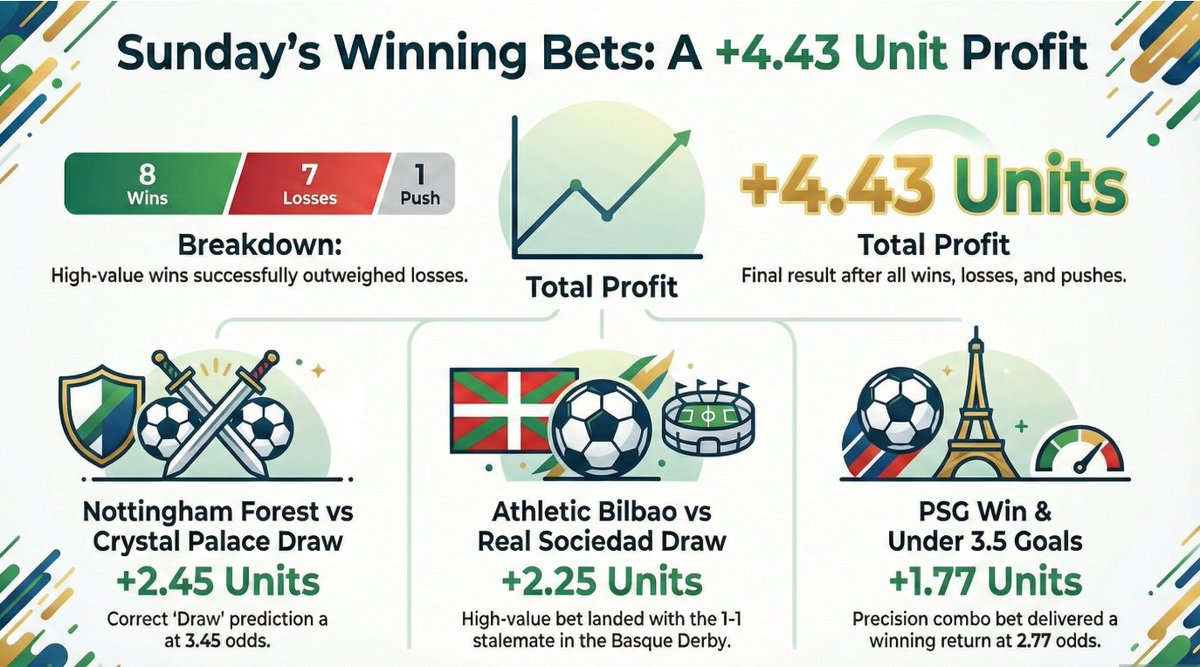
Sunday Football Round-Up: High-Odds Draws & PSG Precision Deliver (+4.43 Units) Sunday’s football action was a showcase of value betting. While heavyweights like Manchester City and Borussia Dortmund were dragged into chaotic high-scoring affairs that busted our "Under" angles, spectacular reads on high-odds draws in the Premier League and La Liga—combined with a clinical combo bet on PSG—ensured the Best Bets column finished the day with a healthy +4.43 units of profit. Here is how the action unfolded across the major leagues. 🏴󠁧󠁢󠁥󠁮󠁧󠁿 Premier League: The Day of the Draw & The United Thriller Nottingham Forest 1-1 Crystal Palace The Value Bet of the DayWe predicted a tight, scrappy affair at the City Ground, and the teams delivered exactly that. A 1-1 stalemate landed our biggest single winner of the day. Betting Result: WIN (Odds 3.45). The "Draw" selection paid out handsomely. Manchester Utd 3-2 Fulham Old Trafford ChaosManchester United edged a five-goal thriller against Fulham. While the defense looked shaky, the attack did enough to secure the 3-2 victory. Betting Result: WIN (Odds 1.63). The simple "United Win" was the right call, avoiding the trap of handicap markets. Aston Villa 0-1 Brentford Defensive MasterclassBrentford pulled off a shock 1-0 win at Villa Park. The solitary goal ensured the game stayed well under the total. Betting Result: WIN (Odds 1.76). "Under 2.5 Goals" landed safely. Tottenham 2-2 Manchester CitySpurs and City played out a pulsating 2-2 draw in North London. City failed to find the winner, sinking our moneyline wager. Betting Result: LOSS. 🇪🇸 La Liga: Basque Derby Deadlock & Madrid Scrape Through Athletic Bilbao 1-1 Real Sociedad Derby Day StalemateThe Basque Derby lived up to its intense, cagey billing. Neither side could find a decisive edge, resulting in a 1-1 draw that landed our high-value prediction. Betting Result: WIN (Odds 3.25). Another massive "Draw" winner. Real Madrid 2-1 Rayo VallecanoReal Madrid won, but it wasn't the dominant display we hoped for. A 2-1 victory meant they failed to cover the -1.25 Asian Handicap (winning by only 1 goal results in a half-loss). Betting Result: HALF LOSS. 🇫🇷 Ligue 1 & 🇮🇹 Serie A: PSG & Inter on Target Strasbourg 1-2 PSG Precision BettingPSG navigated a tricky trip to Strasbourg with a professional 2-1 win. The three goals stayed perfectly under the 3.5 hook, landing our high-odds combo. Betting Result: WIN (Odds 2.77). "PSG Win & Under 3.5" was the standout play in France. Cremonese 0-2 Inter MilanInter kept their title charge on track with a routine 2-0 win away from home. The Nerazzurri defense was rock solid, ensuring the "Under 3.5" component was never in doubt. Betting Result: WIN (Odds 1.96). Como 0-0 AtalantaA goalless draw meant our "Draw No Bet" on Como was a push. Betting Result: PUSH (Stake Returned). 🇩🇪 Bundesliga: Stuttgart Edge It, Dortmund Drama Stuttgart 1-0 Freiburg Tactical BattleStuttgart claimed the Baden-Württemberg bragging rights with a hard-fought 1-0 victory. In a tight contest, a single goal was enough to secure the three points and land our win bet. Betting Result: WIN (Odds 1.73). Dortmund 3-2 HeidenheimDortmund won, but they made hard work of it. A 3-2 goal-fest at Signal Iduna Park destroyed the "Under 3.5" prediction. Betting Result: LOSS. 💰 Betting Performance Recap The profit for the day was driven by the courage to back the Draw in two major fixtures (Nottingham and Bilbao) and the precision of the PSG combo bet. Nottingham vs Palace: Draw (3.45) ✅ +2.45 Bilbao vs Sociedad: Draw (3.25) ✅ +2.25 Strasbourg vs PSG: Win & Under 3.5 (2.77) ✅ +1.77 Cremonese vs Inter: Win & Under 3.5 (1.96) ✅ +0.96 Villa vs Brentford: Under 2.5 (1.76) ✅ +0.76 Stuttgart: Win (1.73) ✅ +0.73 Man Utd: Win (1.63) ✅ +0.63 Getafe vs Celta: Under 2.5 (1.42) ✅ +0.42 Como vs Atalanta: DNB (1.74) ↔️ Push Real Madrid: -1.25 AH (1.65) ❌ -0.50 (Half Loss) Spurs vs Man City: City Win ❌ -1.00 Dortmund: Win & Under 3.5 ❌ -1.00 Other Losses: Betis (Val X2), Angers, Sporting (CS), Galata (Under). Total Profit: +4.43 Units 📈
OffensiveOracle tweet media
English
5
1
5
3.4K
OffensiveOracle รีทวีตแล้ว
PB Tennis
PB Tennis@Probahis·
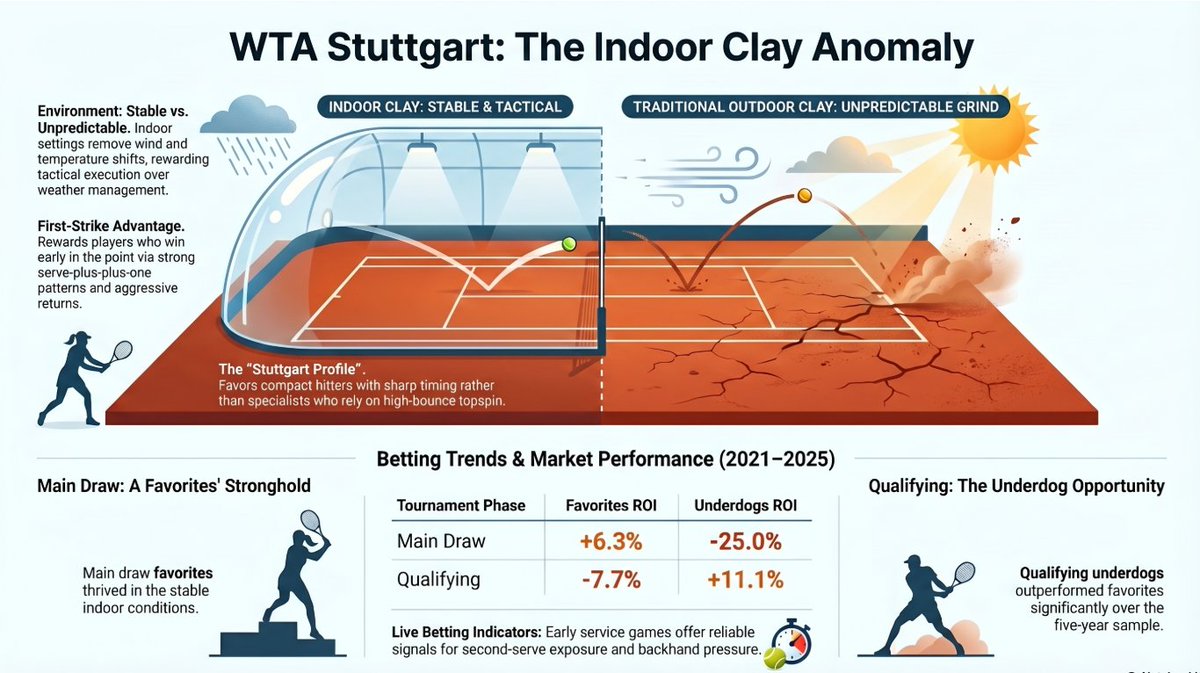
🇩🇪 WTA Stuttgart is one of the easiest clay events to misread. Yes, it’s clay. But it doesn’t play like the usual outdoor grind. Indoor conditions change the texture. The points feel cleaner. Timing matters more. Second serves get exposed fast. And players who can strike early tend to get rewarded more than the standard clay label suggests. Inside the Patreon breakdown: • why Stuttgart plays differently from the rest of the clay swing • why Clay 52 numbers need a specific indoor filter here • which player profiles rise in these conditions • how serve, return, and first-ball patterns should be priced • what to watch for live once the match starts This is not routine clay analysis. This is Stuttgart. 📘 Full FREE breakdown now live on Patreon.
PB Tennis tweet media
English
4
38
391
45.8K
OffensiveOracle รีทวีตแล้ว
PB Tennis
PB Tennis@Probahis·
🇩🇪 Not all clay plays the same — and Munich proves it. Still clay. Still demanding. But not dead clay. Not autopilot clay. And definitely not a tournament to price with lazy assumptions. A bit more first-strike reward. A real weather layer. A cleaner balance between clay fundamentals and proactive tennis. Inside the Patreon breakdown: • why Munich is its own clay puzzle • why Clay 52 stats matter here • which player types fit best • how to price serve, return, and rally patterns • what to watch for in-play This is not generic clay. This is Munich clay. 📘 Full FREE to read breakdown now live on Patreon.
PB Tennis tweet media
English
2
7
37
9.8K
OffensiveOracle รีทวีตแล้ว
PB Tennis
PB Tennis@Probahis·
🇪🇸 Barcelona is NOT just Monte Carlo 2.0. Still clay. Still slow. But cleaner rhythm. A little more first-strike reward. A little less chaos. If you're pricing ATP Barcelona like generic clay, you're burning EV. Inside the Patreon breakdown: • why Barcelona’s court profile matters • why Clay 52 stats should lead the analysis • which archetypes thrive here • how to adjust for serve, return, and rally patterns • what matters most for live trading This is not “standard clay.” This is Barcelona clay. 📘 Full FREE to read breakdown now live on Patreon.
PB Tennis tweet media
English
4
13
275
36.6K
OffensiveOracle
OffensiveOracle@AstroDusler·
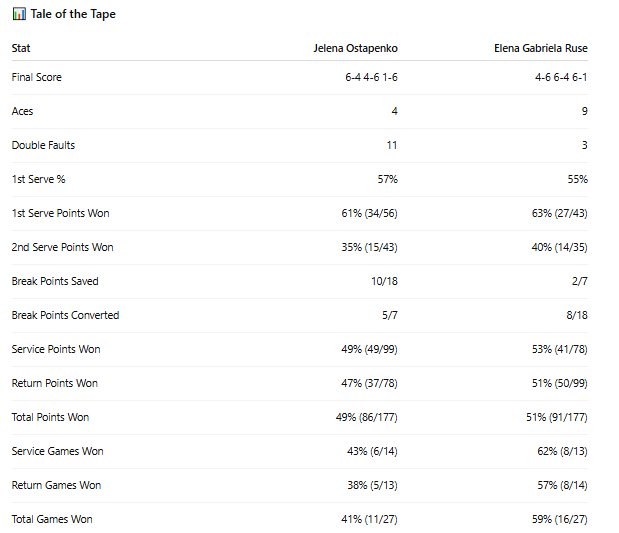
WTA Linz — Jelena Ostapenko vs Elena Gabriela Ruse 🧠 Form & Context 🇱🇻 Jelena Ostapenko ❌ Came in as the higher-ranked player and with much stronger Linz history, but once again the volatility in her game proved costly. 💥 The shotmaking was there in flashes, especially early, but she never established enough control behind her own serve. ⚠️ Eleven double faults and repeated pressure in service games made it very difficult for her to protect the lead after taking the first set. 🇷🇴 Elena Gabriela Ruse ✅ Produced a very strong comeback win, 4-6 6-4 6-1, to reach the semifinals. 🔁 After dropping the opening set, she settled into the match beautifully and became the steadier player in both return games and extended rallies. 🚀 This was another excellent week-building win for Ruse, who has now backed up her earlier Linz results with a real statement victory over a top-30 opponent. 🔍 Match Breakdown The match turned on scoreboard pressure and serve stability. Ostapenko won the first set, but even there the warning signs were already visible: too many shaky service games, too many double faults, and too many chances given to Ruse on return. Once Ruse stayed close, the momentum shifted hard. She served the cleaner match overall, hit more aces, committed far fewer double faults, and kept forcing Ostapenko to play under pressure. The biggest stat on the page is probably the break-point balance: Ostapenko saved 10 of 18 break points, which tells the whole story of how often she was under attack, while Ruse only had to save 2 of 7. From the second set onward, Ruse looked calmer, more physically secure, and much more reliable in the key moments. She won 51% of total points, converted 8 of 18 break chances, and completely dominated the deciding set 6-1. Ostapenko’s aggressive returning still created opportunities, but the serve collapse and lack of scoreboard control buried her. This ended up being exactly the kind of match that becomes dangerous for Ostapenko when she cannot get enough cheap holds. Ruse kept the contest alive long enough, extended the pressure, and was clearly the stronger player late. 🔮 Prediction The pre-match angle was that Ruse had a real chance if she could make this physical and competitive for long enough — and that is exactly what happened. Ostapenko had the bigger ceiling, but Ruse was the more stable, more durable, and ultimately more effective player once the match became a grind. Result: Ruse won in 3 sets, 4-6 6-4 6-1.
OffensiveOracle tweet media
English
0
1
1
756
PB Tennis
PB Tennis@Probahis·
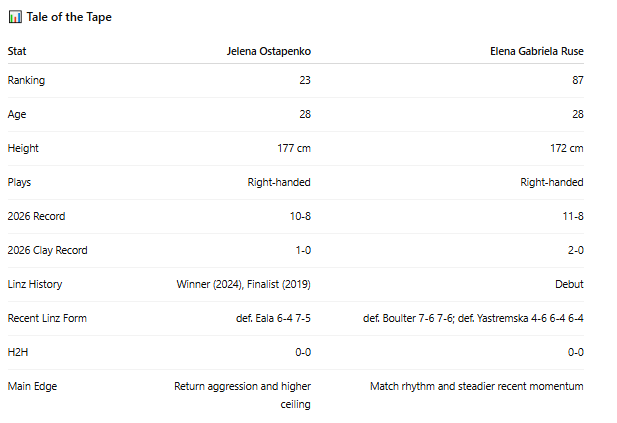
WTA Linz Jelena Ostapenko vs Elena Gabriela Ruse 🧠 Form & Context 🇱🇻 Jelena Ostapenko 📈 2026: 10-8 overall | 1-0 on clay ✅ Opened her Linz campaign with a straight-sets win over Alexandra Eala, 6-4 7-5. 🏆 This is a tournament where she has real history: champion in 2024 and finalist in 2019. 💥 The upside is still obvious, but the season has been volatile, with several losses after strong starts and a few physical interruptions earlier in the year. 🇷🇴 Elena Gabriela Ruse 📈 2026: 11-8 overall | 2-0 on clay ✅ Arrives in the quarterfinal after back-to-back wins over Katie Boulter and Dayana Yastremska. 🔁 Both wins in Linz were earned through resilience, especially the comeback against Yastremska from a set down. 🌱 This is her Linz debut, but she comes in with more match rhythm on the surface and a bit more week-to-week stability. 🔍 Match Breakdown This matchup looks closer than the rankings alone suggest. Ostapenko is the more dangerous player in terms of raw shotmaking, returning aggression, and ability to take control of rallies quickly. On clay, that matters even more when she is timing the ball well, because she can overwhelm second serves and immediately flip neutral rallies into attack. Ruse, though, is not walking into a bad spot. She has already handled two competitive matches this week, she is holding up physically, and her path has shown patience and toughness. Her game is more about staying solid, extending exchanges, and forcing the favorite to keep hitting. Against Ostapenko, that is often the right formula. The key question is whether Ruse can absorb enough pressure on return games and make Ostapenko hit one extra ball repeatedly. If the match becomes a clean first-strike contest, Ostapenko should be too strong. If it turns scrappy, with swings in momentum and plenty of extended games, Ruse has a real chance to make this uncomfortable. Ostapenko’s higher clay-level ceiling, stronger tournament history in Linz, and greater ability to generate breaks still give her the edge. But this does not look like a carefree favorite spot. Ruse has enough form and match toughness to push this deep. 🔮 Prediction Jelena Ostapenko has the bigger weapons and the more proven clay profile, and that should be enough to get her through if she stays reasonably disciplined in the key moments. Ruse is playing well enough to keep this competitive, especially if she can stretch rallies and make the match physical. Prediction: Ostapenko
PB Tennis tweet media
English
1
1
1
2.4K
OffensiveOracle
OffensiveOracle@AstroDusler·
ATP Monte Carlo Zizou Bergs vs Alexander Zverev 🧠 Form & Context 🇧🇪 Zizou Bergs ❌ Eliminated in the round of 16, 5-7 2-6. 📉 He came in with momentum after beating Rublev, but once the match turned into repeated second-serve pressure, he could not keep the baseline exchanges under control. 🩹 Seven double faults and 41 unforced errors summed up a performance where he was constantly under stress in his own service games. 🇩🇪 Alexander Zverev ✅ Advanced with a solid straight-sets win, 7-5 6-2. 🔒 This looked like a classic Monte Carlo Zverev performance: stable serving, heavy return pressure, and much cleaner ball tolerance in physical clay exchanges. 💪 He had to work through a competitive first set, but once Bergs’ serve started to wobble, he took over the match convincingly. 🔍 Match Breakdown The pre-match angle was that Bergs might have chances if he stayed competitive on serve and made the match long enough to test Zverev. Instead, the key weakness showed up immediately: Bergs simply could not protect his second serve well enough to make that script work. Bergs landed only 51% of first serves, while Zverev made 70%. That gap alone created a big structural edge. Zverev won 64% of first-serve points and 65% of second-serve points, while Bergs managed 62% behind the first serve but only 39% behind the second. On Monte Carlo clay, where second-serve stability matters even more, that is a huge difference. The return numbers made the separation even clearer. Bergs won 36% of Zverev’s first-serve return points, which is respectable, but only 35% on second-serve returns. Zverev, meanwhile, won 38% of Bergs’ first-serve points and a massive 61% of Bergs’ second-serve points. That meant almost every weaker Bergs service point became a danger zone. The break-point pattern reflected that control. Bergs faced pressure all afternoon, saving only 4 of 9 break points, while Zverev saved 1 of 3 and converted 5 of his 9 chances. Even though the first set stayed relatively tight on the scoreboard, the underlying match pressure was leaning toward Zverev almost the entire time. Ball security was another major separator. Bergs finished with 16 winners but 41 unforced errors, while Zverev produced 15 winners and only 23 unforced errors. That is the profile of one player having to force too much and another staying within a much cleaner, more repeatable pattern. So this was not a case of Bergs hanging around and then fading late in a pure endurance battle. It was more straightforward than that: Zverev served better, attacked the second serve far more effectively, and kept his level much cleaner from start to finish. 🔮 Prediction The general matchup read favored Zverev, but the actual result was even clearer than a routine clay-court control job. Bergs had enough form to make the opener competitive, yet once Zverev established return pressure, the match moved firmly in one direction. 🧩 Verdict: Zverev was the clearly superior player on the day, and the serve/return numbers made the straight-sets result feel fully deserved.
English
0
1
1
608
PB Tennis
PB Tennis@Probahis·
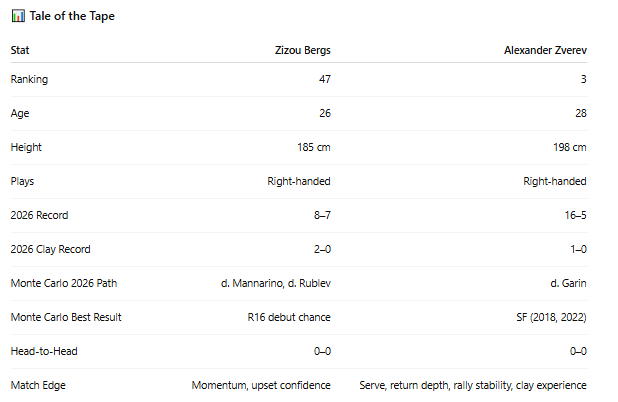
ATP Monte Carlo Zizou Bergs vs Alexander Zverev 🧠 Form & Context 🇧🇪 Zizou Bergs (#47, right-handed; 185 cm) 📈 2026: 8–7 overall | 2–0 on clay ✅ Comes into this match with real momentum after beating Mannarino and then crushing Rublev 6-4, 6-1. 🔁 Confidence is clearly up, but this is still a major step in class, especially in a clay matchup that is more likely to become physical and tactical than explosive. 💥 Bergs can hurt opponents when he plays first-strike tennis and keeps the score pressure on, but the longer the rallies get, the more his margin usually shrinks. 🇩🇪 Alexander Zverev (#3, right-handed; 198 cm) 📈 2026: 16–5 overall | 1–0 on clay ✅ Opened his Monte Carlo campaign with a hard-fought three-set win over Garin and has already made semifinals in both Indian Wells and Miami this season. 🏆 This is a setting he knows well: Zverev is on Thursday’s order of play in Monte Carlo and has twice reached the semifinals here before, in 2018 and 2022. 🔒 His biggest edge here is stability: heavier court conditions tend to reward his backhand solidity, depth, and ability to stay composed through long baseline exchanges. 🔍 Match Breakdown This is the first match on Court Rainier III, and the forecast for Monte Carlo around start time is sunny and about 18°C. Those conditions are not extreme, but they still point more toward a classic Monte Carlo clay match than a fast, lively one. That matters because Bergs’ upset path is pretty narrow. He needs to serve well early, play aggressive scoreline tennis, and stop Zverev from settling into repeatable backhand patterns. If Bergs is constantly playing second shots from neutral or defensive positions, this matchup quickly tilts toward the favorite. Zverev does not need to do anything spectacular here. He just needs to make the match physical, extend return games, and keep forcing Bergs to hit one extra ball. On this surface, that usually becomes a problem for the underdog over two full sets. Bergs has enough form to stay competitive for stretches, but Zverev’s combination of serve security, movement, and rally tolerance gives him the cleaner baseline. 🔮 Prediction Bergs has earned respect this week and should not be dismissed after the Rublev win. Still, this is a much tougher stylistic test. Rublev gave him pace to redirect; Zverev is more likely to drag him into disciplined, heavy exchanges and expose any dip in patience or second-serve quality. The underdog can make this tricky for a set if he starts hot, but over the full match Zverev looks far more reliable in Monte Carlo conditions. Straight sets is the most likely outcome, with one tight set more realistic than a real upset push. 🧩 Prediction: Zverev
PB Tennis tweet media
English
2
1
5
3.2K
OffensiveOracle
OffensiveOracle@AstroDusler·
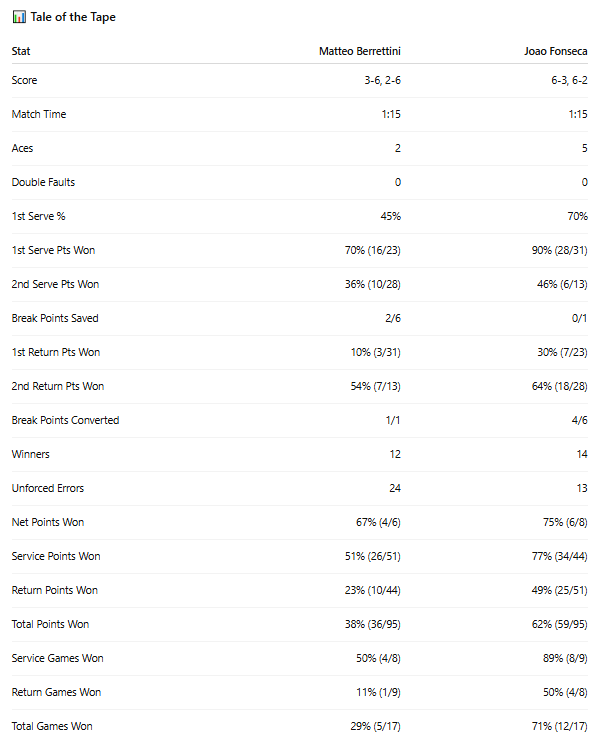
ATP Monte Carlo Matteo Berrettini vs Joao Fonseca 🧠 Form & Context 🇮🇹 Matteo Berrettini ❌ Eliminated in the round of 16, 3-6 2-6. 📉 The concern coming in was whether he could protect his serve often enough and avoid getting dragged into too many neutral exchanges. 🩹 Instead, he never established scoreboard pressure and was constantly playing from behind in service games. 🇧🇷 Joao Fonseca ✅ Advanced with a very clean straight-sets win, 6-3 6-2. 🚀 This was a much more complete performance than just “young clay comfort” — he served brilliantly, returned with authority, and stayed the steadier player throughout. 💪 For a 19-year-old on Monte Carlo debut, this was a seriously mature top-level clay performance. 🔍 Match Breakdown The pre-match angle was that Monte Carlo’s slower clay would reduce Berrettini’s easy serve advantage and give Fonseca more chances to extend points. That part was correct — but the real story was even more decisive: Fonseca was simply far better in the serve/return battle from the first ball. Berrettini only landed 45% first serves, while Fonseca made 70%. That gap completely shaped the match. Fonseca won 90% of first-serve points and 46% of second-serve points, while Berrettini managed 70% and 36% respectively. On a clay court where second-serve resilience matters, that is a huge separation. The return numbers were just as telling. Berrettini won only 10% of Fonseca’s first-serve return points. That is basically no pressure at all. Fonseca, on the other hand, won 30% of Berrettini’s first-serve return points and 64% on second-serve returns, which meant almost every weaker Berrettini service point became a problem. The break-point pattern reflects that control. Fonseca converted 4/6 break chances, while Berrettini got only 1 break chance the whole match and took it. That is why the match never really felt balanced despite Berrettini’s reputation and raw power. Another big separator was ball security. Berrettini finished with 24 unforced errors against just 12 winners, while Fonseca posted 14 winners and only 13 unforced errors. That is the profile of one player forcing the action efficiently and the other pressing without stability. So in the end, this was not a long Monte Carlo grind where Fonseca outlasted him late. It was more straightforward than that: Fonseca served better, returned better, handled second-ball exchanges better, and kept his level much cleaner from start to finish. 🔮 Prediction The direction of the read was right — Fonseca was the better fit for this matchup in these conditions — but the scoreline was more one-sided than expected. This was not Fonseca surviving a battle; this was Fonseca taking control of the match with authority. 🧩 Verdict: Fonseca was the clearly superior player on the day, and the serve/return numbers made the upset feel fully deserved rather than surprising.
OffensiveOracle tweet media
English
0
1
1
800
PB Tennis
PB Tennis@Probahis·
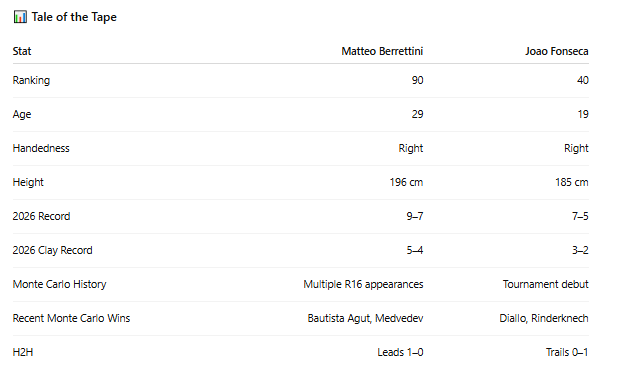
ATP Monte Carlo Matteo Berrettini vs Joao Fonseca 🧠 Form & Context 🇮🇹 Matteo Berrettini (#90, right-handed) 📈 2026: 9–7 overall | 5–4 on clay ✅ Arrives in the last 16 after a huge straight-sets win over Daniil Medvedev in Monte Carlo. 🔁 Clay season has still been mixed overall, with early losses in Buenos Aires, Santiago, Marrakech, and Miami. 🏠 Has some Monte Carlo experience, with multiple previous round-of-16 appearances here. 🇧🇷 Joao Fonseca (#40, right-handed) 📈 2026: 7–5 overall | 3–2 on clay ✅ Has started his Monte Carlo debut strongly with wins over Gabriel Diallo and Arthur Rinderknech. 💥 Already showed his ceiling this spring with wins over Karen Khachanov and Tommy Paul at Indian Wells. 🌱 Still only 19, but his clay comfort, movement, and rally tolerance make this a very interesting spot. 🔍 Match Breakdown This is a much trickier matchup for Berrettini than the ranking gap from his peak reputation might suggest. His serve and forehand can still take over stretches of a match, and the Medvedev scoreline proves the weapons are very much alive. But Monte Carlo is not a surface that flatters one-dimensional first-strike tennis for long. The court profile described in the notes is slow, high-bouncing, and physically demanding, which reduces pure serve impact and puts more weight on return quality, movement, and patience. That is where Fonseca gets interesting. He looks naturally better suited to this environment right now: younger legs, heavier clay background, better tolerance for long rallies, and a return game that can keep Berrettini from coasting through service games. If Berrettini is landing a big first serve percentage and finishing quickly behind the forehand, he can control the match. But if Fonseca keeps getting looks at second serve and extends baseline exchanges, the dynamic starts to tilt. The biggest question is whether Berrettini can sustain scoreboard pressure often enough before the rallies become physical. Fonseca does not need to overpower him; he just needs to make this a clay match rather than a serve-plus-one match. 🔮 Prediction Berrettini has the bigger proven weapons and the confidence boost of that Medvedev demolition, so writing him off would be dangerous. But stylistically, this feels like a strong Monte Carlo setup for Fonseca. The Brazilian’s movement, return discipline, and patience in extended exchanges should give him plenty of chances, especially if he can drag Berrettini into repeated second-serve patterns and longer service games. This looks like one of those matches where Berrettini can win if he stays on the front foot, but the overall court conditions and rally profile slightly favor Fonseca. Over three sets, that edge becomes more meaningful. Prediction: Joao Fonseca
PB Tennis tweet media
English
1
1
8
3.9K
OffensiveOracle
OffensiveOracle@AstroDusler·
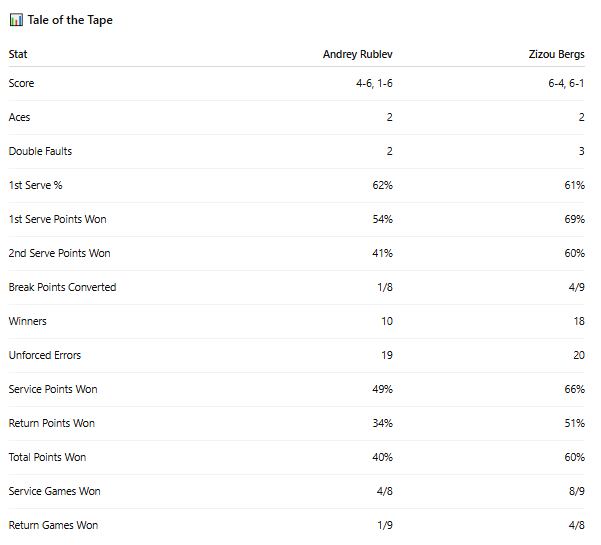
ATP Monte Carlo — Andrey Rublev vs Zizou Bergs Post-Match Review 🧠 What the Match Confirmed 🇧🇪 Zizou Bergs fully backed up the pre-match upset case and delivered one of the best wins of his season. ✅ Won 6-4, 6-1 in just 1 hour 18 minutes ✅ Controlled the key pressure points, saving 7 of 8 break points ✅ Won 60% of total points and 51% of return points ✅ Outplayed Rublev both on serve and from the back of the court 🇷🇺 Andrey Rublev never established the weight of shot or scoreboard pressure expected from the favorite. ❌ Won only 49% of service points ❌ Won just 41% of second-serve points ❌ Converted only 1 of 8 break points ❌ Won only 5 of 17 games overall 🔍 Match Breakdown This was exactly the kind of Monte Carlo match where Rublev’s theoretical edge could disappear if he failed to protect his serve and impose his forehand early. That is exactly what happened. Bergs was sharper in almost every meaningful area. He served better, returned better, handled pressure better, and looked more composed throughout the match. His 69% won behind first serve and 60% behind second serve gave him a much sturdier platform than Rublev ever found. On the other side, Rublev won just 54% of first-serve points and 41% of second-serve points, which is far too soft for a player who relies on first-strike control. The return numbers tell the story even more clearly. Bergs won 46% of Rublev’s first-serve return points and 59% of his second-serve return points, which is a huge figure in a straight-sets clay win. Rublev simply could not get enough cheap points, and once rallies started, Bergs absorbed the pace well and redirected with confidence. Rublev did create chances, but the match turned heavily on what happened in the big moments. He had 8 break points and converted only once. Bergs had 9 break points and converted 4. That difference alone explains the scoreboard. There was also a clear difference in execution quality. Bergs finished with 18 winners to Rublev’s 10, while the unforced-error count stayed nearly even (20 to 19). So this was not just Rublev imploding. Bergs actively outplayed him, producing more damage without losing control. 💡 Why the upset happened The concern before the match was that slow clay could reduce Rublev’s serve-plus-one edge and pull the contest into longer, more uncomfortable exchanges. That concern proved accurate. Bergs made Rublev play too many neutral balls, got deep returns back consistently, and never let the Russian settle into clean forehand domination. Once Rublev started missing early or failing to hurt Bergs with the first blow, the match shifted fully into the Belgian’s preferred rhythm. 🔮 Final Verdict This was not a lucky upset or a random bad day. Bergs earned it. He was the better player in nearly every category and handled the tactical shape of the match much better than Rublev. For Rublev, this is a disappointing clay loss because Monte Carlo is usually one of the events where his heavy baseline game can do real damage. Instead, he looked vulnerable behind second serve, flat in pressure moments, and unable to turn scoreboard pressure into momentum. For Bergs, this is a statement win. Beating Rublev 6-4, 6-1 on Monte Carlo clay is the kind of result that can genuinely change the tone of a week.
OffensiveOracle tweet media
English
0
1
2
778
PB Tennis
PB Tennis@Probahis·
ATP Monte Carlo Andrey Rublev vs Zizou Bergs 🧠 Form & Context 🇷🇺 Andrey Rublev 📈 2026: 12-7 overall | 1-0 on clay ✅ Opened his Monte Carlo campaign with a 6-4, 1-6, 6-1 win over Nuno Borges. 🏆 This is a venue where he has real pedigree: champion in 2023, finalist in 2021, and last 16 here in 2025. 🔁 The bigger picture is a little mixed, though. He has had some strong weeks in Doha and Dubai, but also took early losses in Indian Wells and Miami. 💥 His top-end baseline power is still the biggest weapon in this matchup, especially when he gets forehand control early. 🇧🇪 Zizou Bergs 📈 2026: 7-7 overall | 1-0 on clay ✅ Came through the first round in Monte Carlo with a clean 6-4, 6-3 win over Adrian Mannarino. 🔄 He has been competitive at tour level without fully breaking through, with wins over players like Struff, Brooksby, Auger-Aliassime, and Mensik this season. 🧱 His game is built more on solid tempo, compact returning, and staying engaged in rallies than on overwhelming first-strike tennis. 🚨 He already beat Rublev this year in Miami, so the belief factor is there. 🔍 Match Breakdown This matchup becomes more interesting on Monte Carlo clay than it would be on a quicker court. Rublev is the superior clay-court player overall, both in terms of career level and tournament history. He is more explosive from the baseline, heavier off the forehand wing, and more proven physically over demanding clay matches. On pure class and long-term clay comfort, he deserves favorite status. But Bergs is not a comfortable opponent for a player who can drift mentally. He has already shown that he can frustrate Rublev, and his game is compact enough to make this a physical, rhythm-based contest rather than a free-hitting one. The biggest tactical question is whether Rublev can consistently win the matchup on his own serve-plus-one patterns. Monte Carlo’s slow, heavy spring clay slightly compresses the gap by lowering serve value and raising the importance of return depth and rally tolerance. That matters here, because Bergs is good enough to make a lot of Rublev service games feel uncomfortable if he keeps returns deep and avoids giving away cheap errors. Rublev still has the more damaging ball. If he gets time on the forehand, he can push Bergs behind the baseline and take control quickly. Bergs, meanwhile, has a better chance if he keeps points extended, drags Rublev into repeated backhand exchanges, and forces him to hit one extra ball. The longer the rallies and the more awkward the scorelines get, the more this can become mentally tricky for the Russian. Bergs also enters with some quiet momentum. He is not carrying elite clay numbers, but he is playing with enough confidence to believe he belongs in these matches. That makes him dangerous against a favorite who is clearly better on paper but not always stable from point to point. 🔮 Prediction Rublev should still be favored because he owns the bigger clay résumé, the higher ceiling, and the heavier baseline game. He also has much more Monte Carlo know-how, which matters on a court that rewards patience and repeated pattern building. Still, this does not look like a straightforward matchup. Bergs has already beaten him once this season, and his ability to stay competitive in rallies gives him a real path to making this physical and uncomfortable. If Rublev serves efficiently and lands first forehands with intent, he can control the match. If the contest turns into a grind with plenty of neutral rallies, Bergs has the tools to hang around. Prediction: Rublev. Bergs has enough structure and confidence to take stretches of the match, but Rublev’s clay weight of shot and superior experience should carry him through in the end.
PB Tennis tweet media
English
1
0
1
2.4K
OffensiveOracle
OffensiveOracle@AstroDusler·
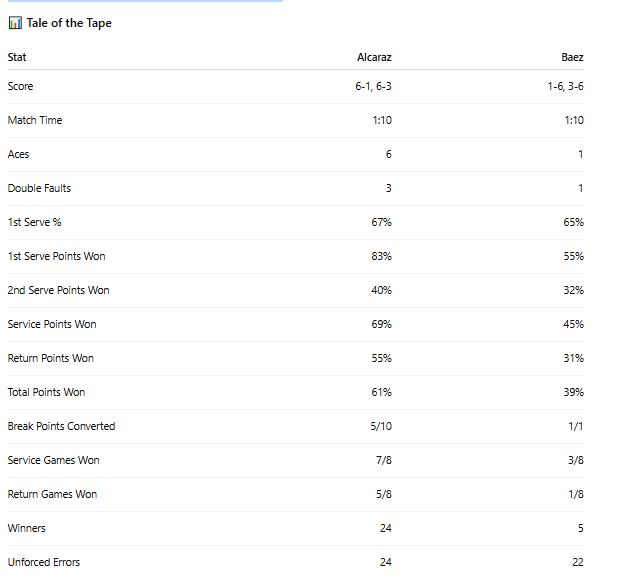
ATP Monte Carlo — Carlos Alcaraz vs Sebastian Baez Post-Match Review 🧠 What the Match Confirmed 🇪🇸 Carlos Alcaraz delivered exactly the kind of Monte Carlo performance the pre-match setup pointed toward. ✅ Won 6-1, 6-3 in just 1 hour 10 minutes ✅ Controlled the match with return pressure, depth, and superior rally tolerance ✅ Won 61% of total points and broke serve 5 times ✅ Dominated Baez’s second serve, winning 68% of second-serve return points 🇦🇷 Sebastian Baez never found enough protection on serve to make this competitive. ❌ Won only 45% of service points ❌ Won just 32% of second-serve points ❌ Held only 3 of 8 service games ❌ Produced only 5 winners across the entire match 🔍 Match Breakdown The pre-match angle was right on target: this was always going to be about whether Baez could survive long enough in baseline exchanges and protect his serve often enough to stay on the scoreboard. He could do neither. Alcaraz’s biggest edge came exactly where expected — on return and in extended clay patterns. Baez’s serve had too little penetration for these conditions, and once rallies started, Alcaraz had the heavier ball, the better shape, and the cleaner transition from defense to attack. That forced Baez into passive positions almost immediately. The second-serve numbers tell the whole story. Baez won only 7 of 22 second-serve points, while Alcaraz won 15 of 22 on Baez’s second delivery. That is total scoreboard control. Once that gap appears on slow clay, the underdog has almost no room to breathe. Even though Alcaraz finished with 24 unforced errors, it did not matter because the pressure he created was constant. Baez could not turn neutral rallies into offense and ended with only 5 winners, which is far too low to threaten a player of this level. 🔮 Prediction Review The call was Alcaraz in 2 sets, and the reality was even more one-sided than that. What held up from the read: Monte Carlo conditions clearly favored Alcaraz’s topspin, movement, and patience Baez’s serve was too vulnerable in this matchup Alcaraz’s return depth and second-serve pressure were decisive Long, physical clay exchanges tilted heavily toward Alcaraz The only thing Baez really managed was avoiding a total collapse in a few service games. But structurally, this was never close. Verdict: pre-match read was correct, and the matchup played out almost exactly as expected — arguably even more comfortably for Alcaraz than projected.
OffensiveOracle tweet media
English
0
1
1
912
PB Tennis
PB Tennis@Probahis·
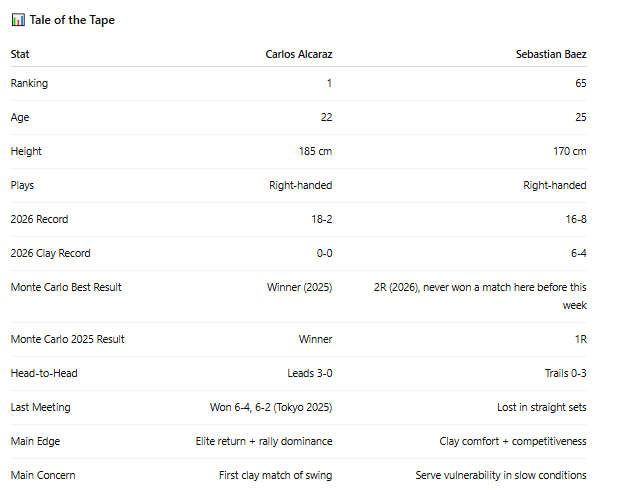
ATP Monte Carlo Carlos Alcaraz vs Sebastian Baez 🧠 Form & Context 🇪🇸 Carlos Alcaraz (#1, right-handed, 185 cm) 📈 2026: 18-2 overall | 0-0 on clay ✅ Australian Open champion, Doha champion, Indian Wells semifinalist 🏆 Arrives as the defending Monte Carlo champion after winning the title here in 2025 🔁 Leads the H2H 3-0, and Baez has yet to take a set from him in completed tour-level meetings 💥 Monte Carlo conditions suit him perfectly: heavy topspin, elite movement, patience in long rallies, and constant return pressure 🇦🇷 Sebastian Baez (#65, right-handed, 170 cm) 📈 2026: 16-8 overall | 6-4 on clay ✅ Opened Monte Carlo with a straight-sets win over Wawrinka 🔁 Has had some solid runs this year, including the Auckland final and clay wins in South America, but results have been uneven ❌ Monte Carlo has never been a happy stop for him: four previous appearances, four first-round exits before this week 🩹 Clay remains his natural surface, but his last-52-week clay profile is clearly below Alcaraz’s level in hold strength, return pressure, and rally control 🔍 Match Breakdown is for Patreon members for a coffee price.
PB Tennis tweet media
English
2
2
5
2.6K
OffensiveOracle
OffensiveOracle@AstroDusler·
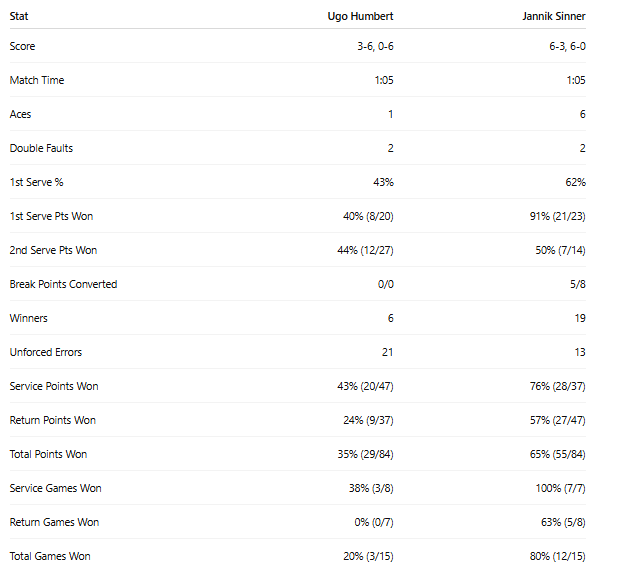
ATP Monte Carlo — Ugo Humbert vs Jannik Sinner 🧠 Result & Context 🇮🇹 Jannik Sinner delivered exactly the kind of performance expected from a top-tier clay contender, brushing aside Ugo Humbert 6-3, 6-0 in just 1 hour and 5 minutes. This was a complete Monte Carlo-type win: heavy return pressure, clean baseline control, and no real dips. Humbert’s lefty serve and first-strike patterns never got established, while Sinner immediately turned the match into a depth-and-discipline contest from the back of the court. For Humbert, the biggest issue was that the match was played almost entirely on Sinner’s terms. He never earned a single break point, struggled badly behind both first and second serve, and could not generate enough cheap points to keep the scoreboard close. 🔍 Match Breakdown The stats show a total mismatch. Humbert landed only 43% first serves, and that instantly put him in trouble. Even worse, he won just 40% of first-serve points and 44% of second-serve points, which is never enough to survive against an elite returner. Sinner constantly got looks on return and converted that pressure into 5 breaks from 8 chances. Sinner, by contrast, was untouchable on serve. He made 62% first serves and won a huge 91% of those points. Humbert won only 2 of 23 first-serve return points, which meant Sinner was holding comfortably while applying pressure almost every Humbert service game. From the baseline, the contrast was just as sharp. Sinner finished with 19 winners to 13 unforced errors, while Humbert had only 6 winners and 21 unforced errors. That gap tells the whole story: Sinner was both cleaner and far more aggressive without losing control. The total-points split was brutal too: Sinner won 65% of all points, Humbert only 35%. On clay, that usually translates into a one-way match, and it did here. 🔮 What It Means This was not just a routine win — it was a statement opener for Sinner on clay. Even without prior clay matches this season, he looked immediately comfortable in Monte Carlo conditions and showed why his game keeps scaling so well on slower, higher-bouncing courts. For Humbert, this result underlines the same issue that often appears on clay against elite opposition: if the serve does not carry him, the matchup becomes very difficult. Against a returner and rallier of Sinner’s level, there was simply nowhere to hide. Verdict: Sinner was dominant from first ball to last and looked every bit like a serious title threat.
OffensiveOracle tweet media
English
0
1
1
758
PB Tennis
PB Tennis@Probahis·
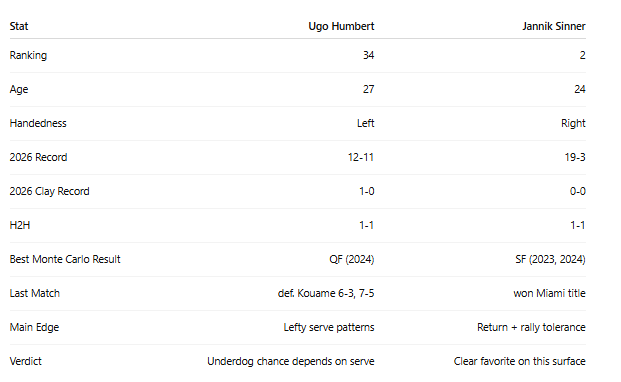
ATP Monte Carlo Ugo Humbert vs Jannik Sinner 🧠 Form & Context 🇫🇷 Ugo Humbert (#34, left-handed) 📈 2026: 12-11 overall | 1-0 on clay ✅ Opened his Monte Carlo run with a straight-sets win over Kouame. 🔁 Had a solid hard-court stretch earlier in the season, including an Adelaide final and a Rotterdam semifinal. ⚠️ Clay has historically been the least natural fit in his profile, and Monte Carlo’s slow, heavy conditions reduce the value of his best weapon: the lefty first serve. 🇮🇹 Jannik Sinner (#2, right-handed) 📈 2026: 19-3 overall | 19-2 on hard ✅ Arrives after back-to-back titles in Indian Wells and Miami, beating players like Zverev, Medvedev, Tiafoe, and Lehecka along the way. 🏆 Has already made two Monte Carlo semifinals and owns a very strong long-term clay profile. 💪 Even without a clay match yet this season, his baseline solidity, return pressure, and physical consistency make him extremely dangerous on this surface. 🔍 Match Breakdown is for Patreon members for 4,99 tier.
PB Tennis tweet media
English
2
0
3
1.8K
OffensiveOracle
OffensiveOracle@AstroDusler·
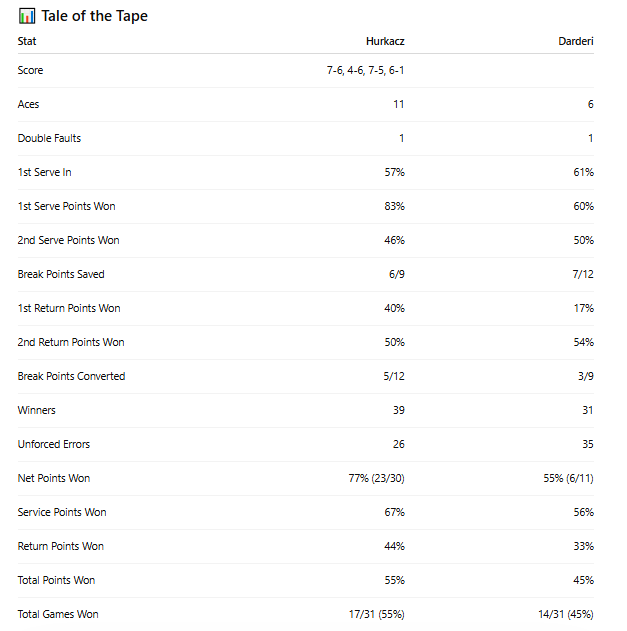
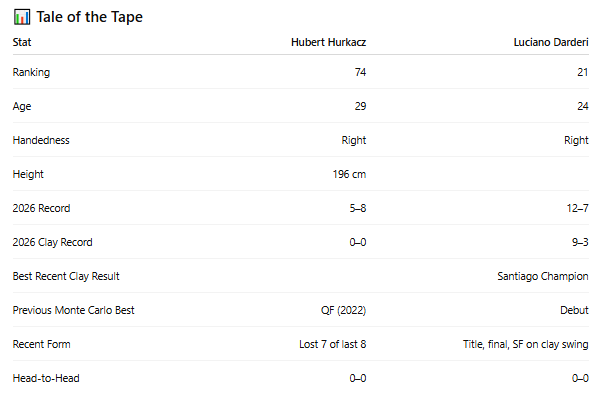
ATP Monte Carlo — Hurkacz H. vs Darderi L. 🧠 Form & Context Hubert Hurkacz 🎯 Serve carried the day: He won 83% of first-serve points and fired 11 aces, which allowed him to keep shortening rallies even on a slower clay court. ⚡ First-strike tennis worked: Hurkacz followed his serve well, won 77% of net points, and never let the match fully settle into Darderi’s preferred grinding baseline patterns. 🧱 Strong in the key moments: He saved 6 of 9 break points and converted 5 of 12, which proved decisive across the three sets. 📈 Big bounce-back win: After coming in with shaky form, this was a reminder that if his serve lands at elite level, he can still beat strong clay-court opponents. Luciano Darderi 🌱 Clay form was real, but not enough: He came in with the stronger clay momentum, but Hurkacz’s serve quality prevented him from fully dictating the physical style of match he wanted. ❌ Return impact fell short: Darderi won only 17% of return points on Hurkacz’s first serve, which left him chasing too often in service games. ⚠️ Too many loose moments: He finished with 35 unforced errors, and although he took the second set, he could not maintain that level deep into the match. 📉 Final-set drop-off: After pushing it to a decider, Darderi faded badly and won just one game in the third. 🔍 Match Breakdown This match turned on one main factor: Hurkacz’s serve held up far better than expected for Monte Carlo conditions. Pre-match, the natural angle was to expect Darderi’s clay comfort, movement, and heavier rally game to wear Hurkacz down over time. But Hurkacz completely changed that equation by serving at an elite level. Winning 83% behind the first serve on clay is massive, and it meant Darderi never consistently got the long, physical return games he needed. Hurkacz also did an excellent job of backing up that serve with aggressive patterns. The 23/30 won at net shows how often he was able to finish points early rather than letting Darderi extend them. That is exactly how to beat a player with stronger recent clay rhythm. Darderi still had his moments, especially in the second set, where he managed to drag the match into more uncomfortable territory and level things at one set all. But the third set was the clearest sign that the match had not really shifted his way. Instead of Hurkacz fading, it was Darderi who collapsed physically and rhythmically, while Hurkacz stayed sharp and ran away with it 6-1. In the end, Hurkacz not only served better, but also returned more effectively than expected. He won 40% of first-serve return points and 50% of second-serve return points on Darderi’s delivery, which is a very strong return performance in this kind of matchup. 🔮 Verdict Hubert Hurkacz beat Luciano Darderi 7-6, 4-6, 7-5, 6-1 by refusing to let the match become the kind of slow, grinding clay battle that would favor the Italian. His serve was the difference-maker, his net play was highly effective, and he handled the biggest moments better throughout the contest. Darderi had the surface profile and recent form edge on paper, but Hurkacz’s top-end serve level overruled those factors. Once the Pole kept points short and protected his service games with authority, the balance of the match changed completely. 🧩 Final take: This was a classic example of a clay-court read being overturned by elite serve execution. Hurkacz’s serve-plus-first-ball game stayed effective enough to neutralize Darderi’s clay advantages, and the result was fully deserved.
OffensiveOracle tweet media
English
0
1
3
699
PB Tennis
PB Tennis@Probahis·
ATP Monte Carlo Hubert Hurkacz vs Luciano Darderi 🧠 Form & Context 🇵🇱 Hubert Hurkacz (#74, right-handed, 196 cm) 📉 2026: 5–8 overall | 0–0 on clay ✅ Monte Carlo history is stronger than the current ranking suggests: QF in 2022, R16 in both 2023 and 2024. ❌ Form is the major concern here. He has lost seven of his last eight matches and arrives without a clay match played in 2026. 🔄 His serve remains the main weapon, but recent results show that once rallies extend, he has struggled to control matches. 🇮🇹 Luciano Darderi (#21, right-handed) 📈 2026: 12–7 overall | 9–3 on clay ✅ Comes in with excellent clay momentum: title in Santiago, final in Buenos Aires, semifinal in Marrakech. 💥 He is fully in rhythm on this surface and has already built a strong South American and spring clay swing. 🧱 His game profile fits this matchup well: heavier baseline ball, better clay movement, and much more comfort in long physical exchanges. 🔍 Match Breakdown This is a tricky first-round draw for Hurkacz because Monte Carlo is one of the worst possible environments for a player still relying heavily on first-strike tennis. On slower clay, especially in cool and heavier spring conditions, his serve loses some of its usual edge and rallies become more frequent. That shifts the matchup toward patience, point construction, and movement. That is exactly where Darderi should feel favored. He has already played a lot of winning clay tennis in 2026, and the results back it up. A 9–3 clay start, plus a title and another final, suggests he is not only comfortable on the dirt but currently thriving on it. Hurkacz does have better historical results in Monte Carlo than many would expect, so this is not a pure surface fade. He has previously made the quarterfinals here and clearly knows how to manage the conditions when confident. The issue is that his current level does not resemble the version that made those runs. The recent losing streak, the lack of 2026 clay reps, and the broader dip in form make him vulnerable. Darderi’s path to winning is straightforward: stretch points, test Hurkacz’s movement, attack the second serve, and keep making him play one more ball. Hurkacz’s path is much narrower. He likely needs a very high first-serve percentage, short service games, and quick scoreline pressure before Darderi settles into baseline patterns. If this becomes a physical, grinding clay match, Darderi should increasingly take control. 🔮 Prediction Luciano Darderi looks like the more natural fit for this matchup right now. He is in far better clay rhythm, has built strong confidence through deep runs this season, and enters with the kind of surface profile that can expose Hurkacz’s current weaknesses. Hurkacz’s Monte Carlo history gives him some upset potential, and his serve alone could keep sets tight. But over the course of a full clay match, Darderi appears more stable from the baseline, more prepared for long exchanges, and simply in much better form. 🧩 Prediction: Luciano Darderi . A tiebreak or one close set would not be surprising if Hurkacz serves well early, but the overall matchup leans clearly toward the Italian.
PB Tennis tweet media
English
1
0
6
3.5K
OffensiveOracle
OffensiveOracle@AstroDusler·
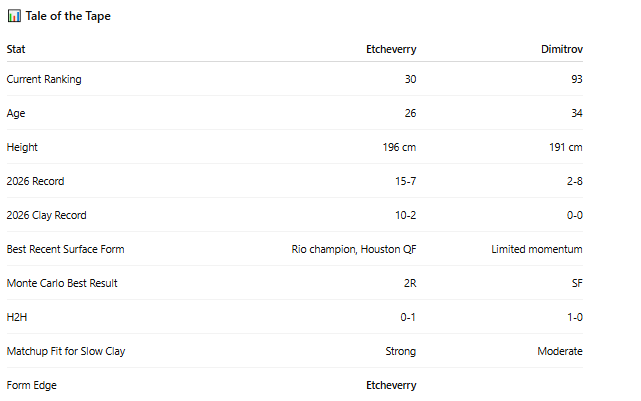
ATP Monte Carlo — Tomas Martin Etcheverry vs Grigor Dimitrov (Post-Match Review) ✅ Side was right: Etcheverry won ⚠️ Scoreline was slightly off: it went 3 sets, not 2 🧠 What the match confirmed The main pre-match read held up well: Etcheverry’s clay structure was stronger, even if Dimitrov made it much tighter than expected. Etcheverry won 54% of total points (76/142), which is usually a strong indicator that the better overall player on the day got through. He was clearly better behind first serve: 78% won vs Dimitrov’s 64%. He also won more on return overall: 37% return points won vs 29%. Most importantly, he was cleaner from the baseline:Etcheverry: 12 winners / 17 UEs Dimitrov: 26 winners / 35 UEs That is basically the whole match in one snapshot: Dimitrov produced more flashes, but Etcheverry was the more stable clay player. 🔍 Why it went 3 sets instead of 2 Dimitrov competed better than the raw 2026 form suggested. He served reasonably well on second serve too: 62% won, actually slightly above Etcheverry’s 57%. He kept the match close on the scoreboard:Service games won: Etcheverry 11/14 Service games won: Dimitrov 10/13 Both players converted all 3 break points they earned, so there was not a huge separation in key-game count. So while Etcheverry had the stronger clay profile overall, Dimitrov still had enough shotmaking and first-strike tennis to steal a set and keep the contest very live. 💡 What the stats say stylistically This turned into the exact kind of match Etcheverry usually survives on clay: fewer errors better first-serve efficiency better aggregate return numbers slightly better point construction over time Dimitrov’s 26 winners show he was dangerous, but 35 unforced errors on slow clay is too much against a player like Etcheverry, who is comfortable making the opponent hit extra balls over and over again. 🔮 Bottom line The original matchup angle was correct: Monte Carlo conditions favored Etcheverry’s rally tolerance, clay movement, and structural stability. The only part that missed was the margin. Dimitrov still had enough quality to push it deep, but the underlying numbers show that Etcheverry was still the more reliable clay player across the full match.
English
0
1
2
598
PB Tennis
PB Tennis@Probahis·
ATP Monte Carlo Tomas Martin Etcheverry vs Grigor Dimitrov 🧠 Form & Context 🇦🇷 Tomas Martin Etcheverry 📈 2026: 15-7 overall | 10-2 on clay ✅ Arrives in strong clay rhythm after a title run in Rio and another deep week in Houston. 🔁 His profile fits Monte Carlo well: heavy forehand, solid backhand stability, patience in long rallies, and reliable movement on slower clay. 💪 This is the kind of environment where his second-serve resilience and rally tolerance become more valuable than pure first-strike tennis. 🇧🇬 Grigor Dimitrov 📉 2026: 2-8 overall | 0-0 on clay ❌ Form is clearly shaky, with early losses piling up across the hard-court swing. 🏟️ Monte Carlo history is strong — semifinalist twice and multiple deep runs here — but current level is far below his peak years. ⚠️ On slow, high-bouncing clay, his one-hander can be pressured more often and his serve loses some of its usual edge. 🔍 Match Breakdown This matchup looks much more favorable for Etcheverry than the ranking gap alone might suggest. Monte Carlo usually rewards players who can absorb, reset, and build points with shape and depth. That strongly favors Etcheverry. He is already fully locked into clay patterns this season, and his game does not depend on quick free points. He is comfortable extending rallies, defending with balance, and forcing opponents to hit one extra ball over and over again. That is exactly the kind of match Dimitrov may struggle to control right now. Even though he owns the only head-to-head win, that meeting came indoors in Paris, which is a completely different environment. On Monte Carlo clay, the ball sits up more, rallies stretch longer, and second-serve pressure becomes more important. Those are not ideal conditions for a 34-year-old Dimitrov who is short on wins and confidence. Dimitrov still has the shotmaking to make patches of this match dangerous. His variety, touch, and ability to change direction can absolutely bother Etcheverry if he gets ahead in points. But over a full clay match, especially in heavier conditions, Etcheverry looks far more likely to win the physical and structural battle. 🔮 Prediction Etcheverry comes in with the better form, the clearer clay identity, and the more stable baseline profile for Monte Carlo conditions. Dimitrov’s experience at this event is the main reason this is not a complete mismatch, but current form and matchup dynamics still lean clearly toward the Argentine. The longer the points go, the more this should tilt Etcheverry’s way. If he starts getting regular looks on Dimitrov’s second serve and keeps the backhand exchanges heavy, he should be able to wear the Bulgarian down. 🧩 Prediction: Tomas Martin Etcheverry
PB Tennis tweet media
English
1
0
3
2.5K
OffensiveOracle
OffensiveOracle@AstroDusler·
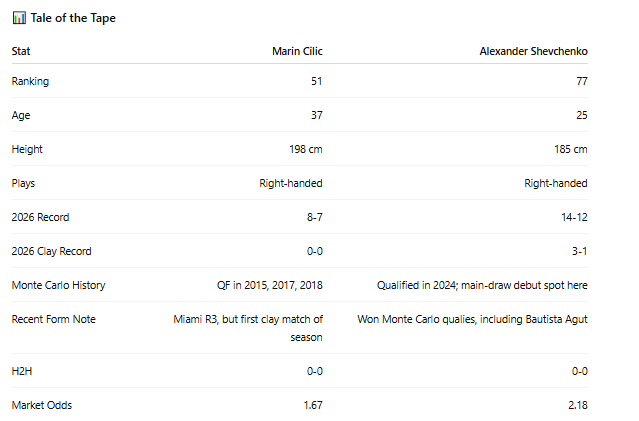
ATP Monte Carlo — Marin Cilic vs Alexander Shevchenko 🧠 Post-Match Read Marin Cilic proved the pre-match concern wrong in a pretty emphatic way. This was not a narrow escape or a serve-heavy steal. He controlled the match. The biggest story was the return dominance. Cilic won: 58% of Shevchenko’s 1st-serve return points 60% of Shevchenko’s 2nd-serve return points 5 of 7 break points 63% of return games That is massive. When a player is winning that much behind the opponent’s first serve, the matchup is no longer about clay comfort alone. It becomes scoreboard pressure from the first shot of the rally. 🔍 What decided it Cilic’s serve was also good enough to prevent the match from turning into the kind of physical grind that was expected: 76% won on 1st serve 4/5 break points saved 88% of service games held So instead of Monte Carlo exposing him, he used the serve to stabilize his own games and then absolutely tore into Shevchenko’s delivery. Shevchenko’s numbers were simply too weak: 45% won on 1st serve 40% won on 2nd serve only 43% of total service points won held just 3/8 service games That is not remotely enough against a player of Cilic’s quality, even on slow clay. 📉 Why the pre-match angle missed The logic on paper was fair: slower clay, first clay match of the season for Cilic, Shevchenko with qualifying rhythm, younger legs, longer-rally profile. But the match never really followed that script because Shevchenko’s serve and first-ball level were too poor. A few things flipped the expected dynamic: Cilic returned far more aggressively and cleanly than expected Shevchenko could not protect his serve at all Cilic kept scoreboard control from start to finish The rally tolerance question never became decisive because Cilic kept winning the important first exchanges In short: the matchup was supposed to become physical, but Cilic made it structural. 🔮 Takeaway going forward Cilic is still dangerous on clay when: the opponent has a vulnerable second serve he can get cheap control with first serve he is allowed to play front-foot return tennis Shevchenko remains tricky, but these numbers show that when his serve level drops, the whole match can unravel quickly. Prediction vs Result: DIFFERENT The pre-match lean was toward Shevchenko in 3, but the actual match was a clear Cilic performance built on return pressure and service-game stability.
English
0
1
1
650
PB Tennis
PB Tennis@Probahis·
ATP Monte Carlo Marin Cilic vs Alexander Shevchenko 🧠 Form & Context 🇭🇷 Marin Cilic 📈 2026: 8-7 overall | 0-0 on clay ✅ Strong hard-court wins this season over Mannarino, Altmaier, Shapovalov, Tien, Quinn, Popyrin, Nakashima 🔁 Still highly competitive in tight matches, but this is his first clay match of the season, which matters a lot in Monte Carlo conditions 🏟️ Excellent event history for a non-specialist here: three Monte Carlo quarterfinals and multiple Round-of-16 runs ⚠️ At 37, the key question is no longer shot quality, but how well the movement and second-serve protection hold up on slow clay 🇰🇿 Alexander Shevchenko 📈 2026: 14-12 overall | 3-1 on clay ✅ Already has clay rhythm: wins in Bucharest and two qualifying wins in Monte Carlo, including a straight-sets win over Bautista Agut 💥 Miami was a confidence boost: beat Arnaldi and Shelton, then pushed on to the third round 🔁 Comes in with more recent match reps on clay, better sliding rhythm, and a more natural tolerance for longer baseline exchanges ⚠️ Serve can still wobble, and his level can swing within matches, but the surface setup gives him a real opening 🔍 Match Breakdown is for Patreon Elites.
PB Tennis tweet media
English
2
0
2
2.2K
OffensiveOracle
OffensiveOracle@AstroDusler·
Rinderknech’s serve held up far better than expected, Khachanov’s return never bit, and Arthur controlled the match with cleaner attacking tennis. Pre-match edge to Khachanov looked reasonable on clay profile, but the actual match stats say Rinderknech was the better player on the day by a clear margin.
English
0
0
1
2.8K
PB Tennis
PB Tennis@Probahis·
ATP Monte Carlo Arthur Rinderknech vs Karen Khachanov 🧠 Form & Context 🇫🇷 Arthur Rinderknech (#27, right-handed, 196 cm) 📉 2026: 5-7 overall | 0-0 on clay ✅ Best recent run came in Dubai, where he beat Marozsan and Draper before falling to Rublev. ❌ Miami ended with a straight-sets loss to Terence Atmane, and his season still feels patchy overall. 🔁 Monte Carlo has never really opened up for him: two qualification exits in the last two years, plus a 1R loss in the main draw in 2022. 💥 His game is still built around first-serve damage and short points, which is not the most natural fit for this event. 🇷🇺 Karen Khachanov (#15, right-handed, 198 cm) 📈 2026: 9-8 overall | 0-0 on clay ✅ Picked up solid wins this year over Bautista Agut, Fucsovics, Mochizuki and Basavareddy. ❌ Results have still been uneven, with losses to Landaluce, Fonseca, Brooksby and Darderi. 🏆 Monte Carlo has treated him much better than Rinderknech: quarterfinalist in 2024, R16 in 2023, and multiple main-draw wins here over the years. 🧱 His heavier baseline game and better tolerance in physical rallies make him the more natural clay-court fit in this matchup. Head-to-Head: Rinderknech leads 1-0, but that win came on hard court in Adelaide back in 2022. 🔍 Match Breakdown This is one of those matchups where the surface matters a lot. Rinderknech can absolutely be dangerous when his first serve is landing and he gets to play on his terms, but Monte Carlo is rarely kind to that kind of profile. The court tends to reward patience, shape, and repeatable rally tolerance more than quick-strike serving. That usually means his biggest weapon loses some of its edge, while his movement and consistency get tested much more often. Khachanov is not a pure clay specialist either, but he is the steadier fit for this environment. He is stronger in longer exchanges, more comfortable absorbing and resetting from the baseline, and he has the heavier rally ball. That should matter if Rinderknech is forced into repeated second-serve points and extended backhand exchanges. The Frenchman’s path is pretty clear: serve big, keep points short, and avoid letting Khachanov settle into rhythm. If he starts earning lots of cheap holds, the match can become much tighter than expected. But if Khachanov is getting clean looks on second serve and making Rinderknech play one extra ball over and over, the dynamic swings toward the Russian. Monte Carlo history also points in one direction. Khachanov has shown he can build runs here. Rinderknech, by contrast, has never really looked comfortable enough in these conditions to turn this event into a platform. 🔮 Prediction Rinderknech has enough serve power to keep at least one set competitive, and the previous head-to-head win gives him a small confidence angle. But this surface still favors Khachanov’s more robust clay patterns, better baseline tolerance, and stronger tournament history. Unless Rinderknech serves at a very high level for long stretches, Khachanov should gradually take control through depth, physicality, and better point construction. 🧩 Prediction: Karen Khachanov Rinderknech can keep things close early, but over the course of the match the clay conditions should tilt this toward the higher seed.
PB Tennis tweet media
English
1
1
3
3.2K
OffensiveOracle รีทวีตแล้ว
PB Tennis
PB Tennis@Probahis·
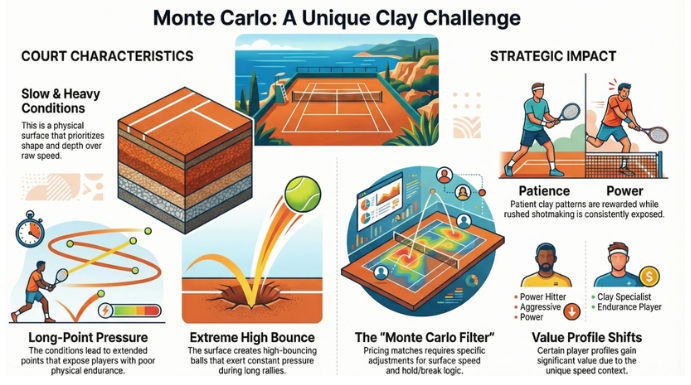
🌊 Monte Carlo is NOT just “clay season starts here.” This is one of the slowest clay Masters on the calendar. Heavy bounce. Long rallies. Serve value drops. Patience gets priced too low. If you're modeling Monte Carlo like a neutral clay event, you're probably burning EV. Inside the Patreon breakdown: • Why Monte Carlo plays slower than most expect • Why hold% needs to be downgraded • Why returners and grinders gain edge • Why tiebreak expectations should drop • Which player archetypes thrive — and who gets exposed This is not generic clay-court tennis. This is Mediterranean slow clay. 📘 Full deep dive now live on Patreon for FREE.
PB Tennis tweet media
English
5
20
259
34.9K
OffensiveOracle รีทวีตแล้ว
PB Tennis
PB Tennis@Probahis·
🎾🚨 Today’s clay card is live 🚨🎾 🌍 Bogota • Charleston • Bucharest • Marrakech • Houston 🔥 Selected value matches: Ortenzi–Riera Pegula–Shnaider Keys–Bencic Molcan–Navone Shelton–Tirante Etcheverry–Paul 💎 Full card on Patreon 👀
PB Tennis tweet media
English
1
1
2
4.6K
OffensiveOracle รีทวีตแล้ว
PB Tennis
PB Tennis@Probahis·
🎾🔥 Clay card today across: 🔥🎾 🇨🇴 Bogota 🇺🇸 Charleston 🇷🇴 Bucharest 🇲🇦 Marrakech 🇺🇸 Houston 👀✨ A few carefully selected value matches are up: ⚡ Maristany–Arango ⚡ Osorio–Ortenzi ⚡ Jovic–Kenin ⚡ Sakellaridis–Marozsan ⚡ Tien–Basavareddy ⚡ Hijikata–Tiafoe 💎 Full card on Patreon. 🚨
PB Tennis tweet media
English
1
2
4
4.8K
OffensiveOracle รีทวีตแล้ว
PB Tennis
PB Tennis@Probahis·
🎾 01.04.26 clay card is live 🎾 Today’s board features: 🟢 GOOD 🟠 MID 🟡 SMALL ⚪ TINY Top names on the card: Riera, Yuan, Parks, Sakkari, Bolt 👀🔥 Bogota, Charleston, Bucharest, Marrakech and Houston are all covered. Full card is on Patreon. 🚨
PB Tennis tweet media
English
1
2
3
4.3K
OffensiveOracle รีทวีตแล้ว
PB Tennis
PB Tennis@Probahis·
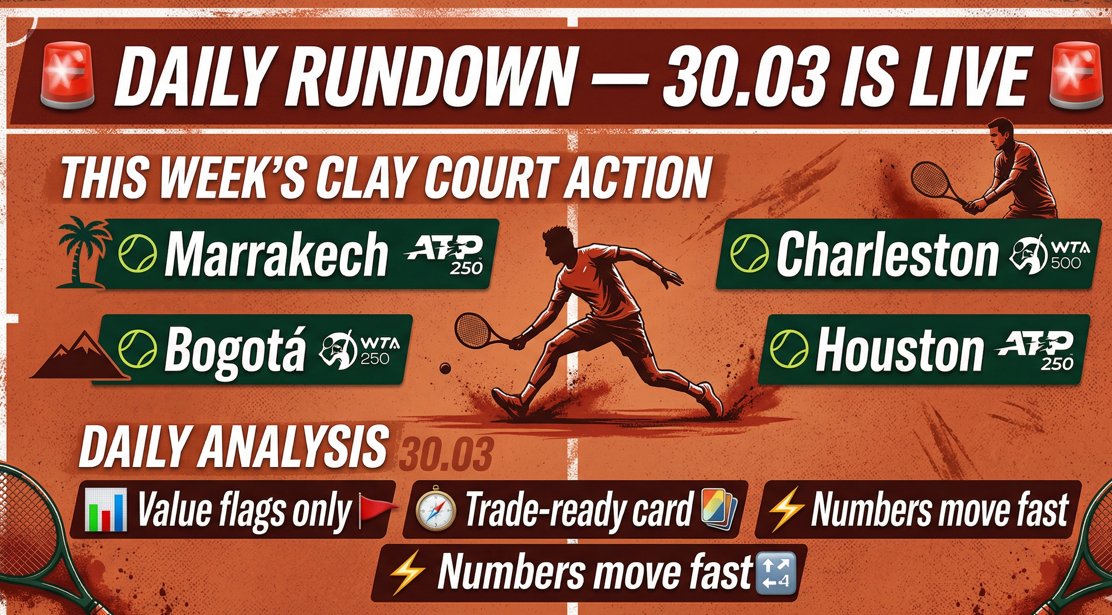
🚨 DAILY RUNDOWN — 30.03 IS LIVE 🚨 🎾 Marrakech • Bogotá • Charleston • Houston 📊 Value flags only | 🧭 Trade-ready card | ⚡ Numbers move
PB Tennis tweet media
English
1
1
2
3.6K
OffensiveOracle รีทวีตแล้ว
PB Tennis
PB Tennis@Probahis·
🚨 MIAMI DAILY RUNDOWN — 24.03 IS LIVE 🚨 🎾 ATP + WTA slate covered 📊 Value flags only | 🧭 Trade-ready angles | ⚡ Early numbers
PB Tennis tweet media
English
1
1
7
6.9K
OffensiveOracle รีทวีตแล้ว
PB Tennis
PB Tennis@Probahis·
🚨 MIAMI DAILY RUNDOWN — 23.03 IS LIVE 🚨 🎾 ATP + WTA card covered | 📊 Value flags only | ⚡ Early edges before the market moves
PB Tennis tweet media
English
1
1
3
4.1K