
Chuks Abanum

28.7K posts

Chuks Abanum banner
Chuks Abanum

Chuks Abanum

@BeyondKodes

Tech Evangelist, AI Engineer, Software Engineer & Solutions Architect #Javascript #PHP #Laravel #Instructor #Mentor #OliliFood #Vent #Hizo #DTH #Blockchain #AI

Nigeria เข้าร่วม Şubat 2015
1K กำลังติดตาม528 ผู้ติดตาม
Chuks Abanum
Chuks Abanum@BeyondKodes·
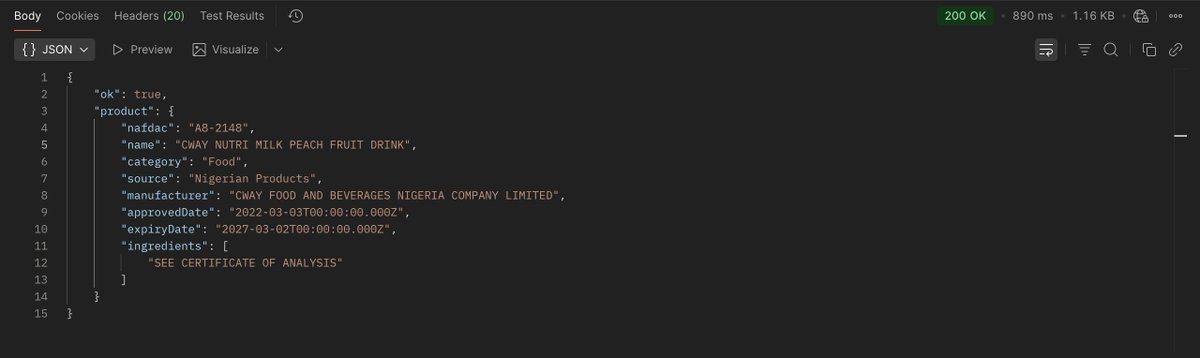
nice work on this. one thing on the parser breaking if NAFDAC changes their layout though. you could let the parser run first since it’s cheap and fast, and if it fails or the data comes back weird (missing fields, bad formats etc), do a quick check on the raw response. if it’s just an error page or rate limit you log it and move on. but if the HTML looks like real content and the parser still choked, that probably means the structure changed so you fall back to an LLM to extract the fields as JSON. validate the output either way cos LLMs will make stuff up. and every time the LLM fallback fires, log it and flag your team so someone updates the parser. LLM just buys you time, parser stays the primary path. means your API stays up even when NAFDAC eventually decides to redesign.
English
0
0
1
30
Emmanuel
Emmanuel@ez0xai·
the API is live and free devs can finally build: - product verification apps - e-commerce safety checks - inventory systems - shopping assistants docs: 9jacheckr.xyz Github: github.com/emmanueltaiwo/… build something cool
English
5
17
186
3.1K
Emmanuel
Emmanuel@ez0xai·
i built an API that verifies NAFDAC numbers in Nigeria Everyone's been asking how the NAFDAC verification API actually works here's exactly how it works 🧵
Emmanuel tweet media
English
86
185
1.1K
36.7K
Chuks Abanum
Chuks Abanum@BeyondKodes·
…And every single time, the same question crawls into my head. Why can’t this be us? Why can’t this be Nigeria? I am supposed to be on holiday. I am supposed to be enjoying myself. But my mind will not leave me alone. I see a clean street and I think of home. I see a working traffic light and I think of home. I see electricity that has not gone off in three days and I think of home. I see a police officer and nobody flinches, and I think of home. It never stops.
Chuks Abanum@BeyondKodes

x.com/i/article/2034…

English
0
1
3
40
Chuks Abanum
Chuks Abanum@BeyondKodes·
We’re slaving our lives away. This can’t be what life is supposed to be.
English
0
1
1
38
Chuks Abanum รีทวีตแล้ว
Dami’ Adenuga
Dami’ Adenuga@DAMIADENUGA·
Susan has been battling with this for the past 20 years. Soliciting for financial help for her 30m naira surgery. Her account details below; Susan Chizhim 6328101813 Fidelity Kindly RT this, the least you can do to support and help 🙏🏻
Dami’ Adenuga@DAMIADENUGA

Susan Chizhim has been battling with a rare long term chronic infection called “RHINOCLEROMA”since she was 10 and still shows up at work for her daily bread 😢 This is one of the true Nigerians that genuinely need help. According to her, surgery is gonna cost about 30Million.

English
98
14.2K
19.1K
630.8K
Chuks Abanum
Chuks Abanum@BeyondKodes·
Posture may seem like a small detail in daily life, but it has a powerful impact on overall health. Poor posture can lead to back pain, neck strain, headaches, reduced breathing capacity, and long-term spinal problems. In today’s digital age — where many people sit for long hours using computers and smartphones — maintaining proper posture has become more challenging than ever. AI is emerging as a practical tool that helps individuals become more aware of their posture and make healthier adjustments. One of the biggest problems with posture is lack of awareness. People often slouch without realizing it. AI-powered posture systems use cameras, wearable sensors, or motion detection technology to monitor body alignment in real time. When the system detects slouching or imbalance, it sends gentle reminders to correct posture. This immediate feedback helps build better habits. Wearable posture devices are a growing example. Small sensors placed on the upper back can detect spinal alignment. If the user leans forward excessively for too long, the device vibrates lightly as a reminder to sit upright. Over time, this trains the body to maintain healthier positioning naturally. Beyond physical health, posture also influences confidence and mood. Standing upright improves breathing and can positively affect mental well-being. AI-supported posture correction therefore contributes not only to spinal health but also to overall wellness. Importantly, AI does not replace medical professionals. It serves as a supportive tool that encourages awareness and consistency. Proper posture ultimately depends on individual effort, but AI provides guidance and accountability. As technology continues to evolve, posture improvement systems will become even more precise and personalized. With AI acting as a daily reminder and coach, individuals can reduce pain, improve physical alignment, and build healthier habits that support long-term well-being.
Chuks Abanum tweet media
English
0
0
2
20
Chuks Abanum
Chuks Abanum@BeyondKodes·
Navigation has evolved from paper maps and road signs to intelligent, real-time digital guidance. Today, AI plays a central role in making navigation systems smarter, faster, and more accurate. Whether people are driving, walking, cycling, flying, or sailing, AI enhances how they move from one location to another with greater efficiency and safety. Traditional navigation systems relied on static maps and fixed routes. They could tell you how to reach a destination, but they could not adapt well to sudden changes like accidents, road closures, or heavy traffic. AI transforms navigation by analyzing live data from millions of sources—GPS signals, traffic cameras, mobile devices, weather systems, and road sensors—to provide real-time updates. For example, navigation platforms such as Google Maps by Google and Waze use AI to analyze traffic flow continuously. If an accident occurs or congestion builds up, the system automatically suggests alternative routes. This dynamic rerouting saves time, reduces fuel fuel consumption, and lowers driver stress. Energy conservation is another benefit. By selecting optimal routes, AI reduces fuel consumption and emissions. This contributes to environmental sustainability. Importantly, AI-driven navigation does not replace human control; it enhances decision-making. Drivers still choose whether to follow suggestions, but AI provides better information. As transportation systems become more connected and data-driven, AI will continue refining navigation accuracy. From daily commutes to international travel, AI-powered navigation is reshaping how people move, making journeys smoother, safer, and more predictable.
Chuks Abanum tweet media
English
0
0
3
22
Chuks Abanum
Chuks Abanum@BeyondKodes·
Homes are no longer just physical spaces made of walls and furniture they are becoming intelligent environments. AI is transforming ordinary houses into smart homes where devices communicate, learn habits, and respond automatically. Home automation powered by AI goes beyond convenience; it improves energy efficiency, security, comfort, and overall quality of life. At the center of AI-powered home automation is learning. Unlike traditional automation that follows fixed schedules, AI studies patterns. It learns when you wake up, when you leave for work, what temperature you prefer at night, and even how lighting affects your mood. Over time, the system adapts to your behavior without needing constant manual adjustments. For example, a smart thermostat powered by AI can monitor daily routines and adjust temperature automatically. If it notices that you usually leave home at 8 a.m., it reduces energy usage after that time and cools or heats the house shortly before you return. Devices like Google Nest Thermostat from Google use AI to optimize temperature control and save energy. As technology advances, homes will become even more interconnected. Appliances, security systems, lighting, and climate control will communicate seamlessly. AI will continue improving personalization, efficiency, and safety. Automating home devices with AI is not just about luxury — it is about creating smarter living spaces that adapt to human needs, reduce stress, conserve resources, and improve everyday life.
Chuks Abanum tweet media
English
0
0
2
22
Chuks Abanum รีทวีตแล้ว
Alex Onyia
Alex Onyia@winexviv·
This is Master Chisom. The mathematics teacher from Evergreen Schools Enugu. His students won all the 1st, 2nd and 3rd position in Junior Category of South East Maths Olympiad 2026. He has been silently shaping generations. Let’s celebrate his birthday today!
Alex Onyia tweet media
English
1.2K
6K
29.3K
368.6K
Chuks Abanum รีทวีตแล้ว
Jesse Jagz Abaga
Jesse Jagz Abaga@Jessejagz·
Any leader who can’t deliver in 4 years won’t deliver in 400 years. 99% of Nigerian politicians today have ZERO results to show. Vote the demons OUT in 2027!
English
343
5.7K
13.9K
163.1K
Chuks Abanum
Chuks Abanum@BeyondKodes·
In today’s fast-moving world, time is one of the most valuable resources. People juggle work, family, communication, planning, learning, and personal goals—all within the same 24 hours. AI-powered virtual assistants are becoming essential tools that help manage these responsibilities more efficiently. They are no longer just voice-controlled tools that set alarms; they are evolving into intelligent digital partners that organize, remind, suggest, and even anticipate needs. AI virtual assistants work by understanding natural language. This means you can speak or type in everyday language, and the system understands your intent. Instead of memorizing commands, you simply say, “Schedule a meeting tomorrow at 10 a.m.” or “Remind me to call the client next week,” and it takes care of the task. Popular assistants like Siri by Apple, Google Assistant by Google, and Amazon Alexa by Amazon demonstrate how AI integrates into daily life. They manage calendars, answer questions, control smart home devices, and provide real-time updates. Importantly, AI assistants are designed to support—not replace—human judgment. Users still make decisions, but the assistant reduces friction in executing them. As AI continues to improve, virtual assistants will become even more context-aware and proactive. They may anticipate needs before users even ask. For example, reminding you to carry an umbrella based on weather forecasts or suggesting follow-ups after meetings. AI virtual assistants are transforming from simple tools into reliable digital partners. By handling repetitive tasks, organizing information, and supporting communication, they free up time and mental energy for more meaningful work and personal growth. In a world full of distractions, AI assistants help create focus, structure, and clarity.
Chuks Abanum tweet media
English
0
0
5
19
Chuks Abanum รีทวีตแล้ว
David Hundeyin
David Hundeyin@DavidHundeyin·
As I analysed earlier for @sov_media, Senegal's win against Morocco wasn't "just" a football game. It was a globally televised lesson in defiance and resistance. The usual suspects were never going to take it lying down. This was telegraphed.
English
145
2.5K
6.2K
213.3K
Chuks Abanum
Chuks Abanum@BeyondKodes·
Farming has always been one of the most important human activities. It feeds families, supports economies, and sustains communities. But modern agriculture faces serious challenges labor shortages, climate change, unpredictable weather, pests, soil degradation, and rising costs. AI-powered robots are emerging as practical tools that help farmers work smarter, not just harder. AI robots bring intelligence into the field. Unlike traditional machines that follow fixed instructions, AI robots can analyze their environment, make decisions, and adapt in real time. They use cameras, sensors, GPS, and machine learning to understand crops, soil, and weather conditions. One major benefit is precision farming. Instead of treating an entire field the same way, AI robots can examine each section individually. They can detect which plants are healthy and which are stressed. For example, if certain crops lack nutrients or show early signs of disease, the robot can identify the exact location and recommend targeted treatment. This reduces waste and improves yield. Companies like Blue River Technology, acquired by John Deere, develop smart machines that use computer vision to manage crops with precision. These innovations show how technology and agriculture are becoming closely connected. In everyday language, AI robots help farmers grow more food with less waste, less guesswork, and fewer losses. They make farming more efficient, data-driven, and sustainable. As agricultural challenges increase, AI-powered robotics will continue to play a key role in ensuring food security, improving farm profitability, and building a smarter future for farming.
Chuks Abanum tweet media
English
0
0
2
15
Chuks Abanum รีทวีตแล้ว
David Hundeyin
David Hundeyin@DavidHundeyin·
As for me, whenever Nigeria calls me, I will answer. It's my home and there's nothing I can do about it. It's a trash country, but it's my trash country. I don't have another one. But having said that, I won't be jumping up and being a hero like I did in 2023. Not because I have a problem with lighting myself on fire and suffering alone, but because I saw firsthand that it does not work. You people want heroes, but heroes are not what you need. All a hero is in Nigeria is a dead guy that becomes a symbol for late night igbo-smoking and rhythmic swaying to a fake-deep Burna Boy tribute soundtrack. A hero is a completely useless thing in Nigeria. What you people need is a full-spectrum nationwide rebellion that is so vicious, bloody and violent that it will alter the entire course of West African history. What you don't need is another individual hero who will end up dead or in jail so that you will tweet "Free XYZ" or enthusiastically smoke igbo while singing along to the posthumous Burna Boy tribute song. So never ask me to "come back and lead" anything. When I come back, it will be the same way I left Abuja - arm in arm with thousands of my contemporaries marching down Shehu Shagari Way in unison. It won't be to become yet another useless Nigerian hero symbol that cannot change the price of garri in the market.
English
227
2.1K
6.2K
232.5K
Chuks Abanum
Chuks Abanum@BeyondKodes·
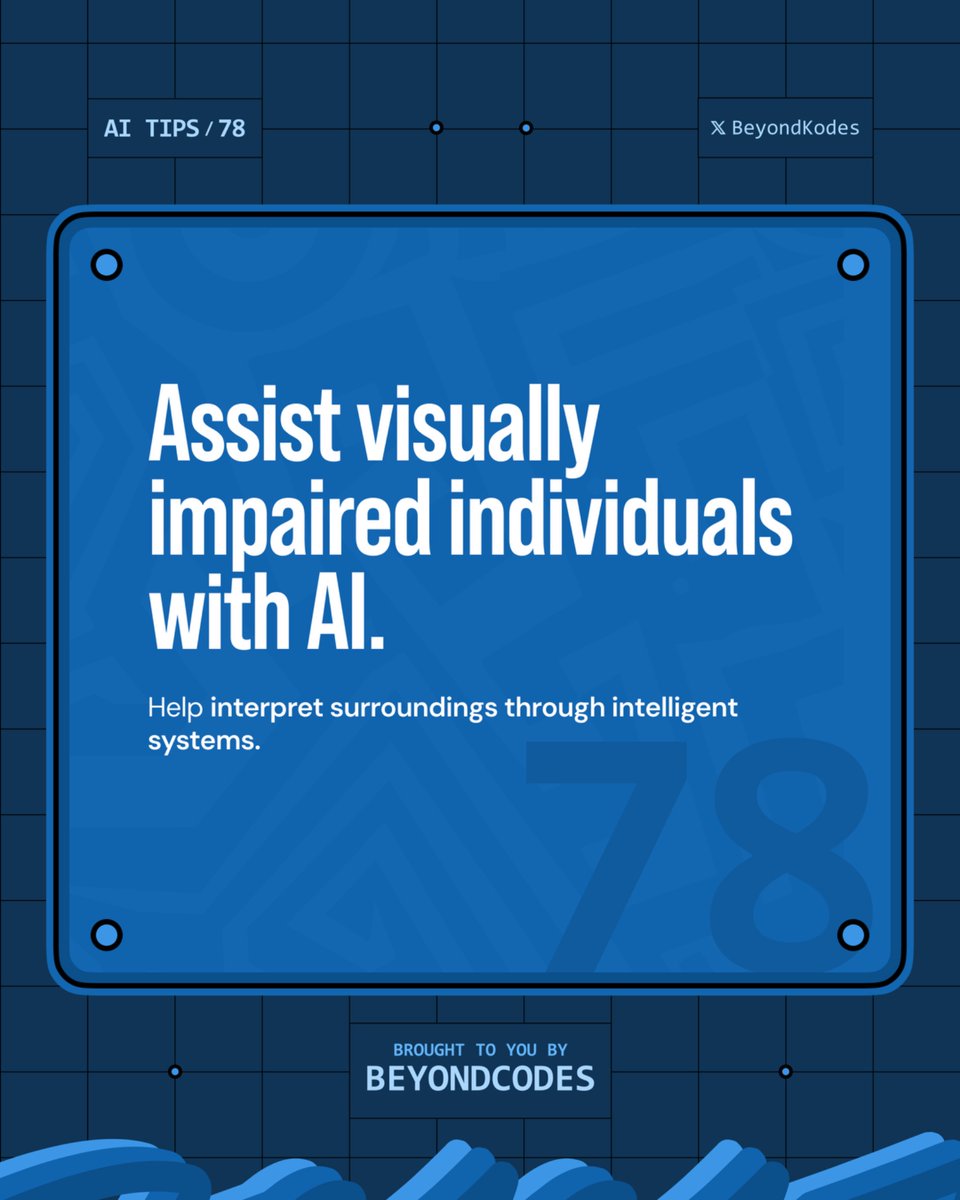
For millions of people around the world, vision loss affects how they navigate, read, work, and interact with their environment. Daily activities that many take for granted — crossing the street, reading a menu, identifying a product on a shelf can become complex challenges. AI is helping bridge that gap by transforming technology into a supportive companion that increases independence, safety, and confidence. One of the most powerful ways AI assists visually impaired individuals is through computer vision. AI systems can analyze images captured through smartphones or smart glasses and describe what is happening in real time. For example, a user can point their phone camera toward a room, and the AI will describe objects, people, colors, and spatial positions. This turns a camera into a voice that explains the world. Apps like Seeing AI, developed by Microsoft, use AI to read text aloud, recognize faces, identify currency, and describe scenes. Instead of struggling to read printed documents or labels, users can simply scan them and hear the information instantly. AI also supports employment opportunities. By making documents accessible, assisting with communication, and enabling independent navigation, AI reduces barriers in the workplace. This promotes inclusion and equal participation. It acts as a guide, a reader, a navigator, and sometimes even a social assistant. Importantly, AI solutions continue to improve as they learn from real-world usage. The more they are used, the more accurate and helpful they become. However, human-centered design remains essential. Technology must respect privacy, dignity, and user control. When used responsibly, AI does more than provide convenience it restores confidence. It allows visually impaired individuals to move through the world with greater independence, access information more easily, and participate more fully in everyday life. In this way, AI is not just advancing technology; it is advancing inclusion.
Chuks Abanum tweet media
English
0
2
5
43
Chuks Abanum
Chuks Abanum@BeyondKodes·
In today’s digital world, almost everything runs on networks banks, hospitals, schools, businesses, even smart homes. A network intrusion happens when an unauthorized person or system gains access to a network with harmful intent. This could mean stealing sensitive information, disrupting services, installing malware, or spying on users. As cyber threats become more advanced, traditional security methods alone are no longer enough. This is where AI becomes a powerful defense partner. Networks generate enormous amounts of data every second. Every login attempt, file transfer, email, and device connection leaves a digital footprint. For humans, monitoring this volume of activity in real time is nearly impossible. AI excels in analyzing large streams of data quickly and continuously. It studies patterns of normal network behavior and learns what is typical for users, devices, and systems. Once AI understands what “normal” looks like, it becomes very effective at spotting what is “abnormal.” Cloud service providers such as Microsoft use AI in platforms like Microsoft Defender to protect users from evolving cyber threats. These tools combine machine learning, behavioral analytics, and automated response systems to enhance security across digital environments. AI also supports proactive security. Instead of only reacting to attacks, it can predict vulnerabilities by analyzing patterns and identifying weak points in the network. Organizations can then fix these weaknesses before hackers exploit them. However, AI does not replace cybersecurity professionals. Human experts still investigate alerts, make strategic decisions, and design security policies. AI enhances their capabilities by providing faster detection and deeper insights. In everyday language, AI helps protect digital spaces the way surveillance cameras and alarm systems protect physical buildings only smarter and faster. As cyber threats continue to grow in complexity, AI-driven intrusion detection will become even more essential. By turning massive amounts of network data into actionable intelligence, AI strengthens digital defense systems and helps organizations stay one step ahead of attackers.
Chuks Abanum tweet media
English
0
2
3
29
Chuks Abanum
Chuks Abanum@BeyondKodes·
Mental wellness is just as important as physical health, yet it is often overlooked or misunderstood. Many people struggle silently with stress, anxiety, burnout, depression, or emotional fatigue. AI is increasingly becoming a quiet but powerful support system in this space, helping individuals understand their mental state, access help faster, and manage their emotional well-being in practical ways. One of the biggest challenges in mental wellness is self-awareness. People often don’t realize they are mentally exhausted until it starts affecting their work, relationships, or physical health. AI-powered tools can help bridge this gap by analyzing patterns in behavior, language, sleep, and activity. For example, AI can observe changes in how someone types, speaks, or interacts with apps and gently signal when stress levels may be rising. This early awareness helps people take action before things become overwhelming. Importantly, AI reduces stigma. Many people avoid seeking help because they fear judgment. AI offers privacy and neutrality. Users can open up freely, knowing they are not being judged. This encourages more people to take the first step toward caring for their mental health. That said, AI works best as a support system, not a replacement for human care. Serious mental health conditions still require trained professionals. AI’s strength lies in early support, daily check-ins, awareness, and accessibility. AI helps people pause, reflect, and breathe in a fast-moving world. It listens when no one else is around, it helps turn emotions into understanding and by doing so, AI is quietly helping millions of people support their mental wellness, one conversation, one insight, and one moment of clarity at a time.
Chuks Abanum tweet media
English
0
2
4
21
Chuks Abanum
Chuks Abanum@BeyondKodes·
Biometric security is becoming a common part of modern life. Instead of using passwords alone, many systems now use physical and behavioral features such as fingerprints, facial recognition, voice, or even eye scans to verify identity. These features are unique to each person, making biometric security more personal and harder to copy. AI plays a major role in making biometric security more accurate, faster, and safer. Biometric systems generate a large amount of data when scanning fingerprints, faces, or voices. AI helps analyze this data and identify the unique patterns that belong to each individual. It does not just look at the surface; it studies tiny details that humans may not notice. This makes identification more precise and reduces the chances of mistakes. For example, when you unlock your phone using your face, AI analyzes multiple points on your face, such as the distance between your eyes, the shape of your nose, and the structure of your jaw. This creates a unique digital profile. Even if someone looks similar to you, the AI can detect the differences. Devices like the iPhone use AI-powered systems such as Face ID to provide secure access. However, AI still works alongside human supervision. Security professionals monitor systems and handle situations that require human judgment. AI supports them by providing accurate identification and alerts. It makes security more personal, more accurate, and harder to break. By analyzing unique human characteristics and detecting fraud, AI helps protect devices, accounts, buildings, and sensitive information. As technology continues to grow, AI-powered biometric security will become even more important in keeping people and their data safe in an increasingly digital world.
Chuks Abanum tweet media
English
0
1
1
18