David Bitner

6.8K posts

David Bitner

David Bitner

@Bitner_speaks

Commercial Real Estate, Finance, Economics, Culture & History retweets mostly

San Francisco, CA เข้าร่วม Ağustos 2017
583 กำลังติดตาม569 ผู้ติดตาม
David Bitner รีทวีตแล้ว
Rohan Paul
Rohan Paul@rohanpaul_ai·
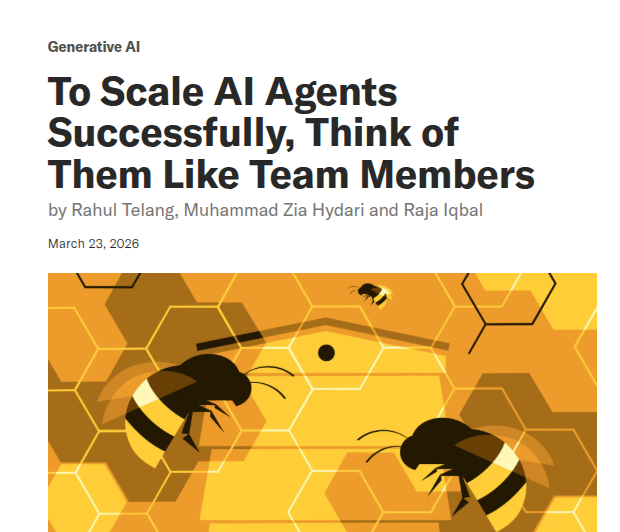
Harvard Business Review just published a piece. A good AI agent needs a job description, limits, and a manager. Because, AI agents can fail like employees with too much access and too little supervision. firms keep treating agents like normal software, even though the real risk is not bad text but bad actions. That changes 4 things: each agent needs its own identity and permissions, its own trusted data sources, hard rule checks between a model and any real transaction, and a full audit trail of what it read, decided, and did. So the safe rollout path is an autonomy ladder where agents start with drafts and recommendations, then move to guarded retrieval, then supervised actions, and only later get narrow bounded autonomy.
Rohan Paul tweet media
English
34
63
250
20.2K
David Bitner รีทวีตแล้ว
Jeremiah Johnson 🌐
Jeremiah Johnson 🌐@JeremiahDJohns·
Can't decide which is crazier - the guy who thinks he could beat a grizzly bear, or the guy who thinks he'd lose a fight to a rat.
Jeremiah Johnson 🌐 tweet media
English
781
237
8.8K
765.6K
David Bitner รีทวีตแล้ว
Tommaso Porzio
Tommaso Porzio@PorzioTommaso·
Brilliant paper! AI automate tasks, not jobs. The impact of AI on a given job, thus depend on whether the AI-exposed task is easy to unbundle from other job-tasks or not.
Luis Garicano 🇪🇺🇺🇦@lugaricano

Famously (there is a beautiful Works in Progress piece on this) in 2016, Geoffrey Hinton told an audience in Toronto that medical schools should stop training radiologists, since AI would soon outperform them at reading scans. Ten years later, there are more radiologists than ever, and they earn more than they did then. Hinton was right about the task, but he was wrong (so far!) on the future of the radiology profession. Times have never been better for them. The gap between those two claims, the difference between tasks and jobs, is the subject of a paper I have written with Jin Li and Yanhui Wu, and that we release today: "Weak Bundle, Strong Bundle: How AI Redraws Job Boundaries." (Very relatedly we are also finishing the first draft of our book "Messy Jobs" on AI and Jobs!! You will be the first to hear). We start from the observation that the growing literature on AI and labor markets measures the AI shock by task exposure: people count how many tasks AI can perform in a given occupation AI can perform, and infer that more exposure means more displacement. Eloundou et al. published a paper in Science in 2024 that started this literature, and many follow the same logic. The inference they make is that the more exposed tasks, the worse the outcomes. This is incomplete, because labor markets price jobs, not tasks. A radiologist does not just sell image classification, but does many other jobs: triages cases, communicates with other physicians, trains residents, makes the difficult decisions, and signs a diagnosis. The market buys a bundled service. The question AI poses is not whether it can do one task inside the bundle. The question is whether that task can be pulled out. Thread (1/3) dropbox.com/scl/fo/689u1g7…

English
3
14
69
18.8K
David Bitner รีทวีตแล้ว
Alex Imas
Alex Imas@alexolegimas·
Ever since Coursera courses became very good, only to have basically no impact on higher ed, I've come to the belief that the biggest role of formal ed is to act as a commitment device for students to actually consume the information. AI will be transformative, but AI w/o that commitment element will likely lead folks like you and I to learn more efficiently (but we were going to do the learning anyway), and have little impact otherwise.
English
48
93
1.3K
125K
David Bitner รีทวีตแล้ว
Lenny Rachitsky
Lenny Rachitsky@lennysan·
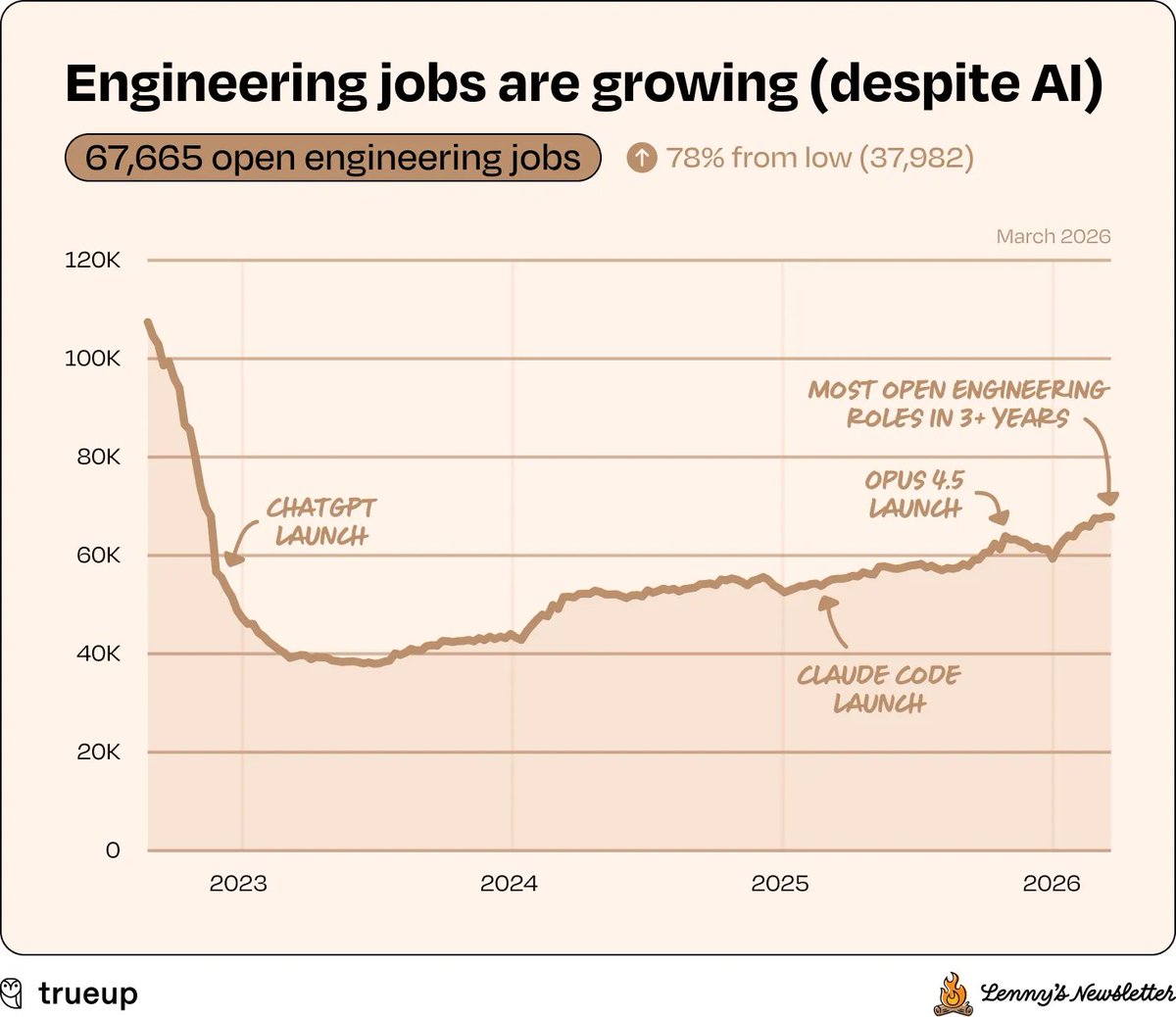
Engineering job openings are at the highest levels we’ve seen in over 3 years There are over 67,000 (!!!) eng openings at tech companies globally right now, with 26,000 just in the U.S. We don’t know if there would have been more open roles if not for AI or if AI is actually leading to more open roles, but since the start of this year, the increase in open eng roles is accelerating even more.
Lenny Rachitsky tweet media
Lenny Rachitsky@lennysan

STATE OF THE PRODUCT JOB MARKET IN EARLY 2026 In spite of the headlines about layoffs and AI taking jobs, we’re actually seeing a lot of promising signs in tech hiring, and some interesting new trends: 1. PM openings are at the highest levels we’ve seen in over three years 2. AI hasn’t slowed the demand for software engineers (at least not yet) 3. AI roles in general are absolutely exploding 4. Design roles have plateaued 5. The Bay Area is increasing in importance 6. Remote work opportunities continue to decline 7. Despite ongoing layoffs, the overall number of tech jobs continues to grow More in 🧵

English
131
230
1.7K
532.7K
David Bitner รีทวีตแล้ว
Ernie Tedeschi
Ernie Tedeschi@ernietedeschi·
So far, entry-level share of employment in legal, financial, & office admin occupations doesn't look functionally different from pre-2023 trends (the population is aging so important to benchmark). A bit above trend for legal, a bit below for finance, in line for office admin.
Ernie Tedeschi tweet media
CG@cgtwts

Anthropic CEO: “50% of all entry-level Lawyers, Consultants, and Finance Professionals will be completely wiped out within the next 1–5 years." grad students and junior hires are cooked.

English
1
18
74
17.7K
David Bitner รีทวีตแล้ว
Mike Zaccardi, CFA, CMT 🍖
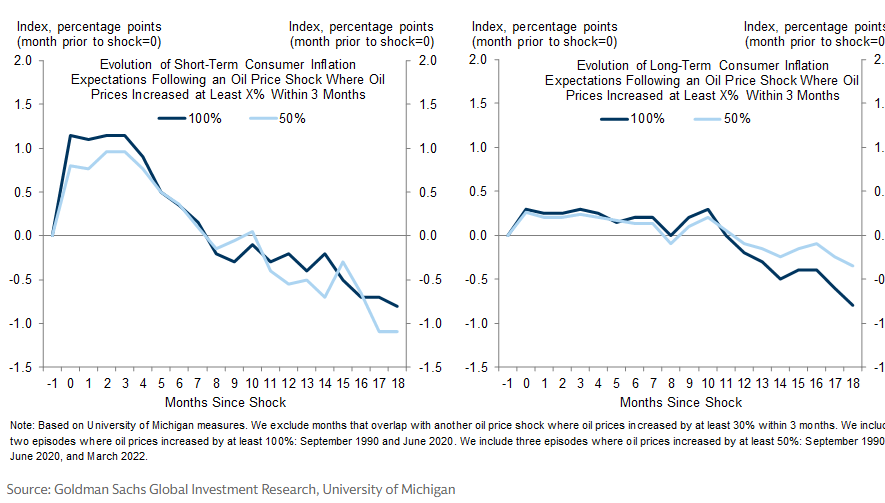
GS: Over the Past 40 Years, Even Major Oil Price Shocks Did Not Leave Long-Lasting Effects on Consumer Inflation Expectations
Mike Zaccardi, CFA, CMT 🍖 tweet media
English
5
27
110
6K
David Bitner รีทวีตแล้ว
Seb Johnson
Seb Johnson@SebJohnsonUK·
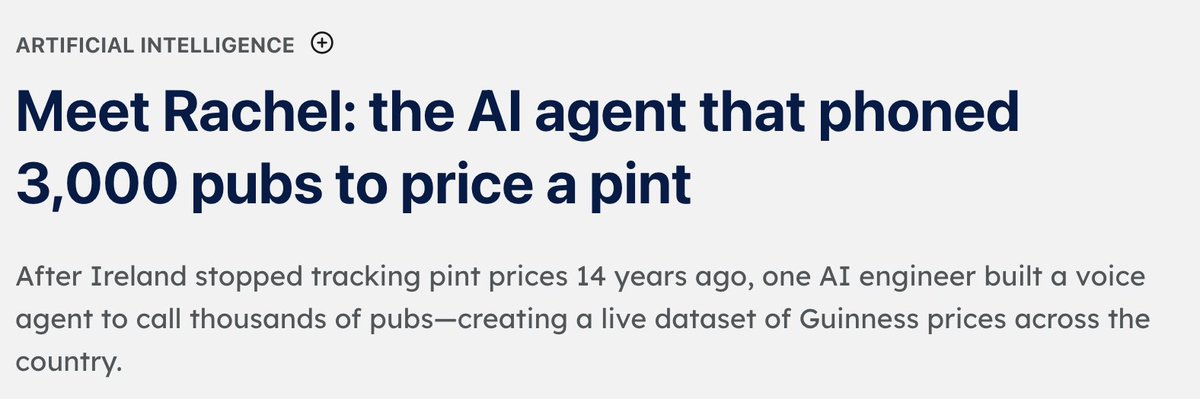
"AI is going to cure cancer and create abundance for everyone" Meanwhile in Ireland:
Seb Johnson tweet media
English
77
338
6.9K
379.3K
David Bitner รีทวีตแล้ว
Alex Imas
Alex Imas@alexolegimas·
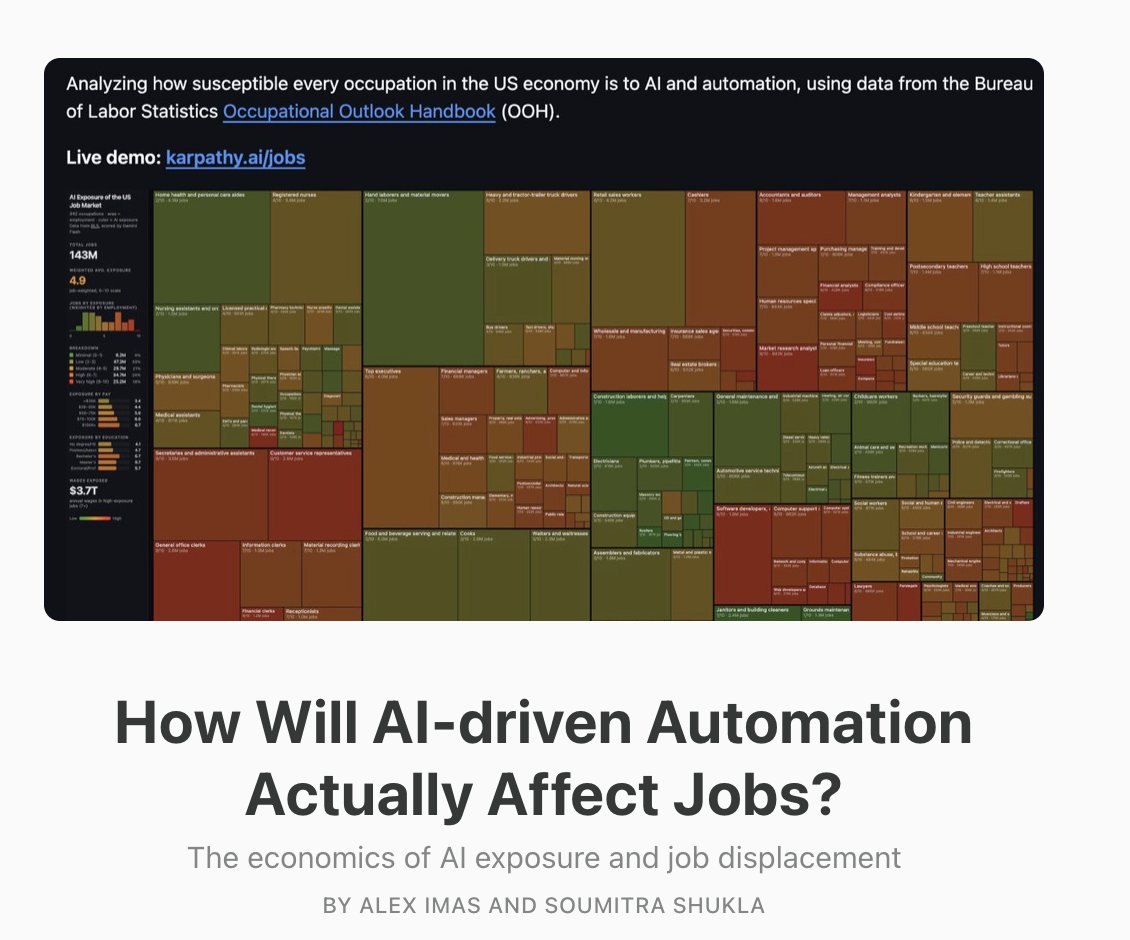
After a brief hiatus, new post with @soumitrashukla9: "How Will AI-driven Automation Actually Affect Jobs? The economics of AI exposure and job displacement" There has been a lot of discussion in the media, X, substack, etc about AI driven displacement. We felt like it'd be worth working out the actual economics of when AI automation will actually lead to displacement, versus the exact opposite (more hiring, higher wages). A short summary🧵: AI "exposure" measures are not meant to predict displacement or job automation. Exposure can lead a job loss, or it can lead to more hiring and higher wages. It all depends on how 1) automated tasks interact with non-automated tasks (to what extent they're complements), 2) how consumer demand in that sector responds to prices (elasticity of consumer demand), and 3) the dimensionality of the job (the number of tasks a job has). One conclusion: we should be less worried about consultants and more worried about truckers and warehouse workers than we currently are. Link: substack.com/home/post/p-19…
Alex Imas tweet media
English
15
78
268
78.6K
David Bitner รีทวีตแล้ว
Jeffrey Gundlach
Jeffrey Gundlach@TruthGundlach·
People ask about muni’s and I typically don’t have much to say. But now, looking at the deficits caused by absurd spending, and tax policies accelerating revenue erosion, I can say avoid all General Obligation muni’s in California, Illinois & New York. I’ve never bought a GO.
English
0
338
3.2K
772.9K
David Bitner รีทวีตแล้ว
The Mossad: Satirical and Awesome
Message to the jihadists. Chuck Norris is in heaven. There are no more virgins.
English
216
2K
20.9K
566.1K
David Bitner รีทวีตแล้ว
Rohan Paul
Rohan Paul@rohanpaul_ai·
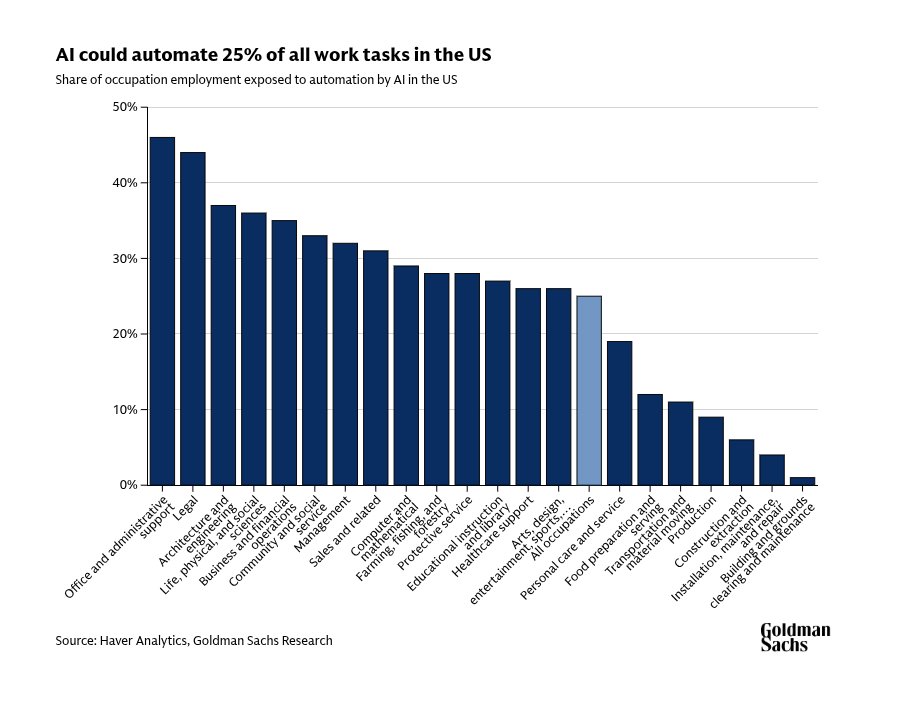
Goldman Sachs released a report analyzing how AI will shift the job market. - Found that AI could automate tasks making up 25% of work hours in the US. - Globally this exposes about 300mn jobs to some level of automation. - This transition is expected to take around 10 years to fully unfold. - During this period roughly 6% to 7% of workers might face displacement. If this happens smoothly the unemployment rate would only rise by 0.6%. - But the technology will also create entirely new categories of work. - Building the physical infrastructure for AI requires massive labor. The US alone needs 500,000 new workers by Dec-30 to handle electrical power demands. - Construction jobs related to data centers already grew by 216,000 since Oct-22.
Rohan Paul tweet media
Goldman Sachs@GoldmanSachs

According to Goldman Sachs Research, 300 million jobs globally could be exposed to AI automation over the next decade. However, AI is also likely to help create jobs—particularly in the buildout of the power and data center infrastructure required to sustain the boom: click.gs.com/t3et

English
43
89
432
70.3K
David Bitner รีทวีตแล้ว
Mike Zaccardi, CFA, CMT 🍖
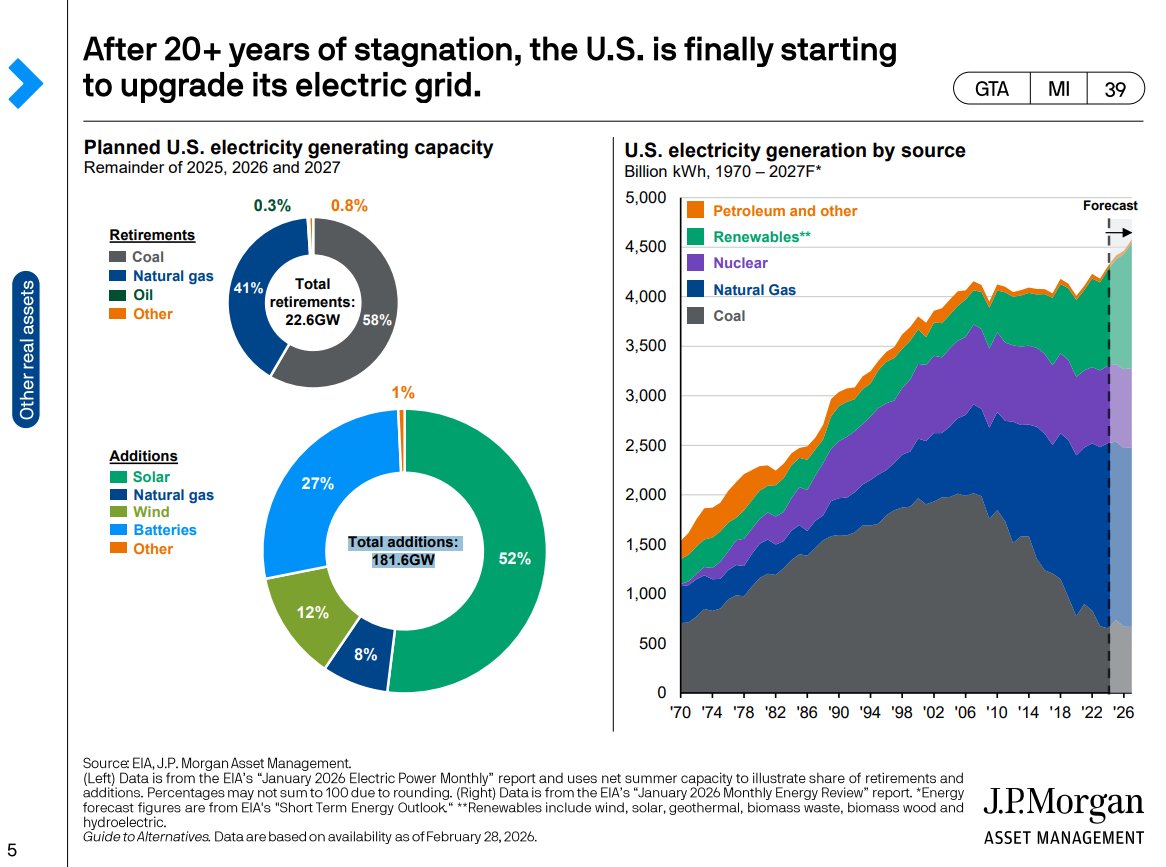
JPMAM: After 20+ years of stagnation, the US is finally upgrading its electric grid
Mike Zaccardi, CFA, CMT 🍖 tweet media
English
0
21
101
6.8K
David Bitner รีทวีตแล้ว
Derek Thompson
Derek Thompson@DKThomp·
Observation by @jasonfurman: If you zoom all the way out, the Trump economy’s first 14 months look very very very similar to the Biden economy’s last 14 months, but most people have changed their mind about whether the economy is good.
Derek Thompson tweet mediaDerek Thompson tweet media
English
48
51
445
99.8K
David Bitner รีทวีตแล้ว
Trung Phan
Trung Phan@TrungTPhan·
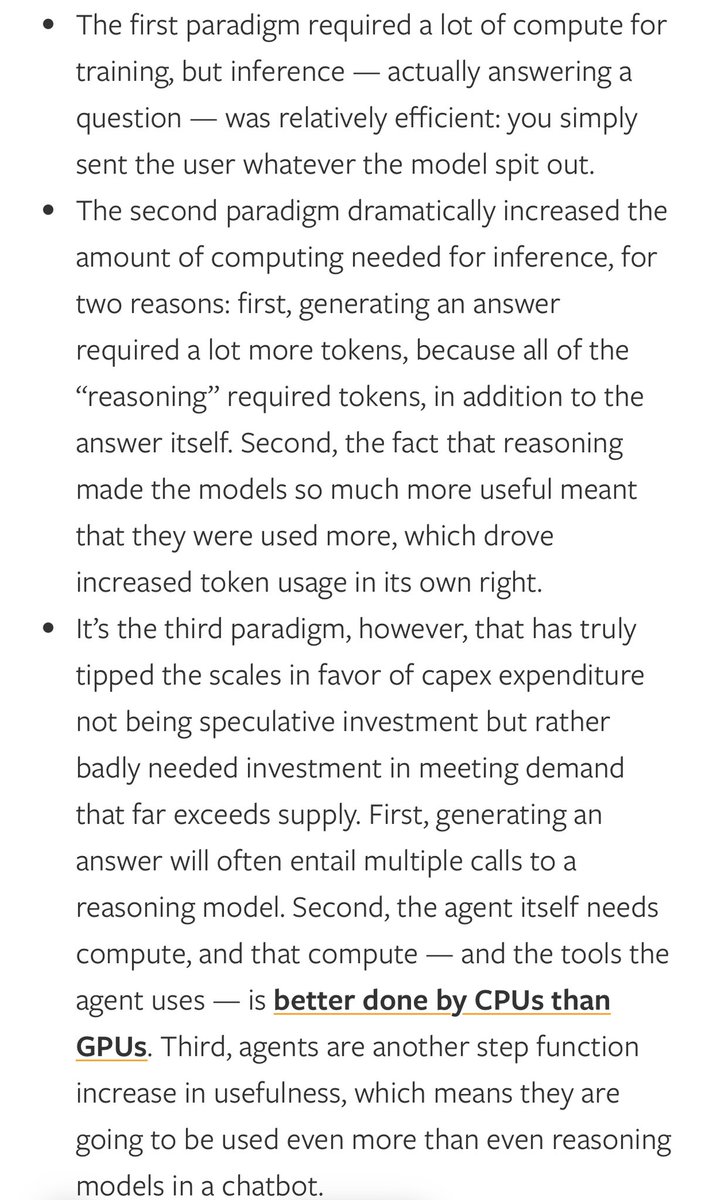
Ben Thompson makes the case for why the rise of AI agents justifies $650B hyperscaler capex spend. The first paradigm of GenAI was AI chatbots. It required a lot to compute to train but not as much on inference. High token demand required a lot of users. The second (reasoning) and third (AI agents) paradigms require much more inference tokens. Crucially, with AI agents, the number of power users required to drive token demand through the roof is a lot less than the number of people needed to do chat queries (eg. one person running 50 coding agents will be massive demand).
Trung Phan tweet mediaTrung Phan tweet media
Stratechery@stratechery

Agents Over Bubbles Agents are fundamentally changing the shape of demand for compute, both in terms of how they work and in terms of who will use them. They're so compelling that I no longer believe we're in a bubble. stratechery.com/2026/agents-ov…

English
15
26
214
59.5K
David Bitner รีทวีตแล้ว
Ramez Naam
Ramez Naam@ramez·
Indoor living area per person has roughly tripled in the US since 1950.
Ramez Naam tweet media
English
94
196
1.8K
275.7K
David Bitner รีทวีตแล้ว
NBER
NBER@nberpubs·
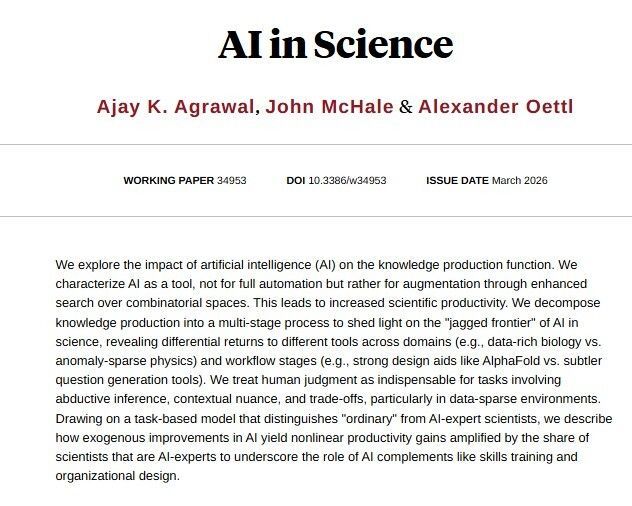
Studying where AI actually helps in science by modeling four stages of research. AI excels at screening vast possibilities, but human judgment remains key for new ideas, from @professor_ajay, John McHale, and Alexander Oettl nber.org/papers/w34953
NBER tweet media
English
3
52
225
37.3K