
Boris Parra รีทวีตแล้ว
Boris Parra
2.2K posts


Boris Parra
@BorisParra_
#Microbiology #Phages #Plasmids #HTG #AMR🔬🦠🧫 #Dj #freestyle 🎧🎶
Copenhague, Denmark เข้าร่วม Nisan 2010
4.9K กำลังติดตาม1.1K ผู้ติดตาม


@MicrobioSoc @udeconcepcion @Ciencia_UdeC @Cs_Biolog_UdeC @UDLA_CL @ucscconcepcion Wet lab work led by @Maxsand04 🔬 with valuable support from colleagues including MaxMatusKöhler @Gotitde @dacil_rivera @mheppc @a_f_opazo
English
@MicrobioSoc This was a truly collaborative effort involving colleagues from Universidad de Concepción, Universidad de las Américas and Universidad de la Santísima Concepción @udeconcepcion @Ciencia_UdeC @Cs_Biolog_UdeC @UDLA_CL @ucscconcepcion
Español
Boris Parra รีทวีตแล้ว

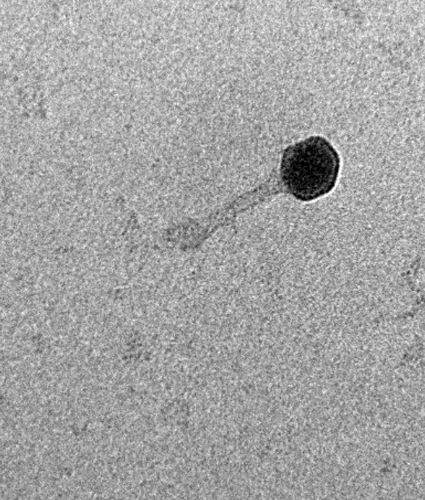
📢Could naturally occurring phage be used to target the multi-drug resistant infections that clinicians struggle to treat?
@BorisParra_ takes us behind the scenes of their latest paper on using bacteriophage to treat urinary tract infections (UTI)🔗 microb.io/40DfRsZ
English
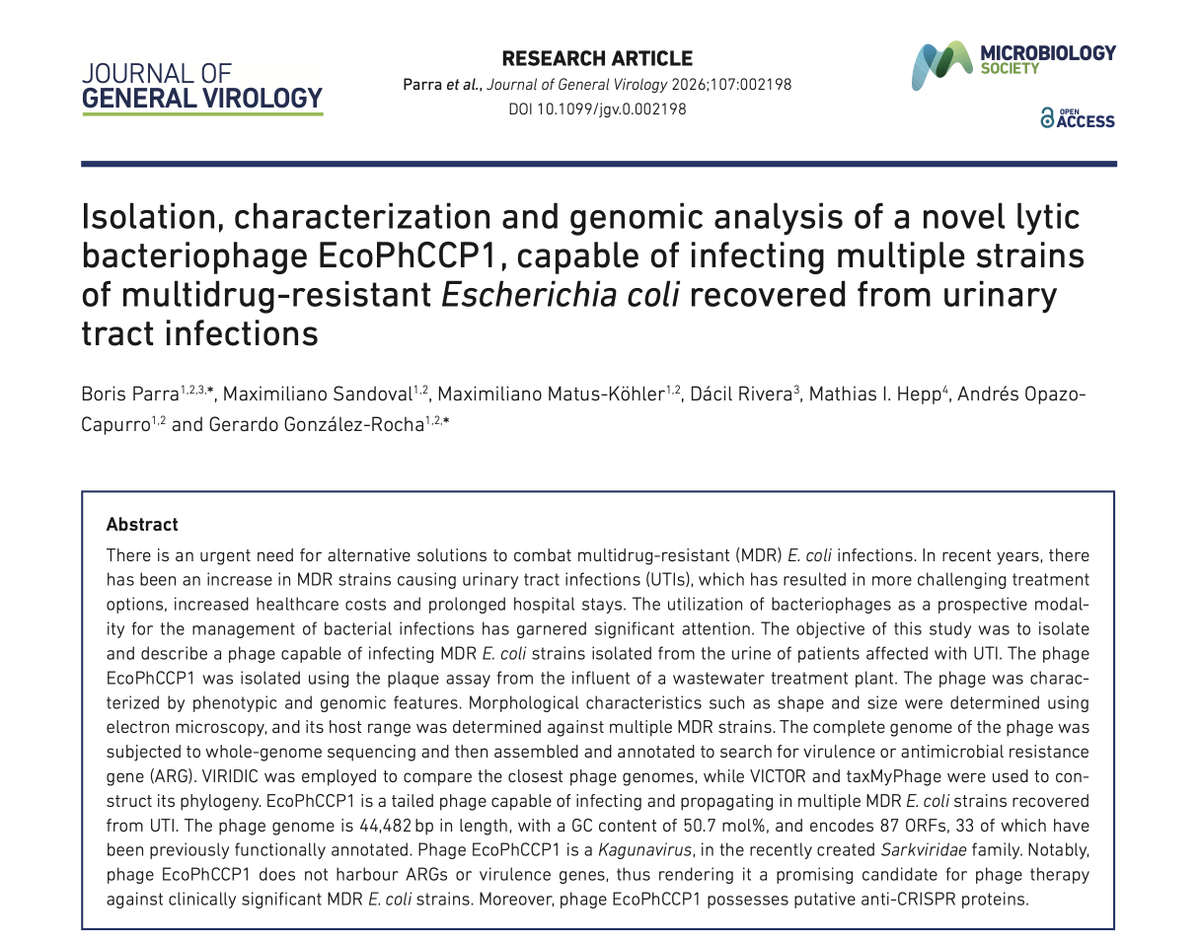
New paper published in Journal of General Virology!
We report a novel lytic bacteriophage active against MDR E. coli from UTIs—highlighting the potential of phages to help tackle AMR.
#Bacteriophages #AMR #OneHealth
English
Boris Parra รีทวีตแล้ว

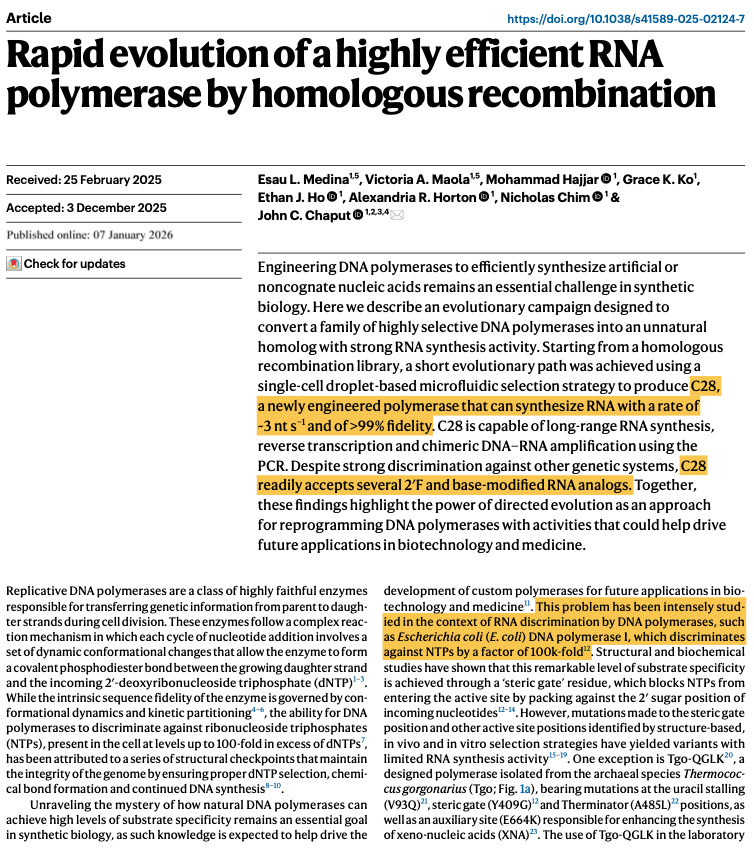
This paper is wild. After 3 rounds of directed evolution, they converted a DNA polymerase into an enzyme that can do:
- RNA synthesis
- Reverse transcription
- Synthesis of "unnatural" nucleotides
- Synthesis of DNA-RNA chimeras
One of the best papers I’ve read recently.
For context: In nature, it is DNA polymerase that takes a DNA sequence as a template and then copies it. These enzymes are crucial in replicating the genome for cell division, and they are EXTREMELY specific for DNA over RNA. This is key because RNA nucleotides are present in the cell at concentrations ~100x higher than DNA nucleotides, so the enzyme has evolved clever strategies to select one over the other.
RNA polymerases, for comparison, are the enzymes that take a DNA sequence as template and then convert it into RNA. They are involved in gene expression, for example.
To convert a DNA polymerase into an RNA polymerase (and all the other functions I mentioned earlier), the authors did a fairly straightforward directed evolution experiment.
First, they took four DNA polymerase enzymes belonging to various archaea. These DNA polymerases don’t check for DNA vs. RNA as stringently as other types of cells, so they’re a good starting point to evolve RNA polymerases. The authors inserted some targeted mutations into these enzymes, based on known mutations in the literature. For example, they swapped the amino acid at position 409 for a smaller amino acid, thus removing a “gate” that keeps RNA building blocks from entering the enzyme.
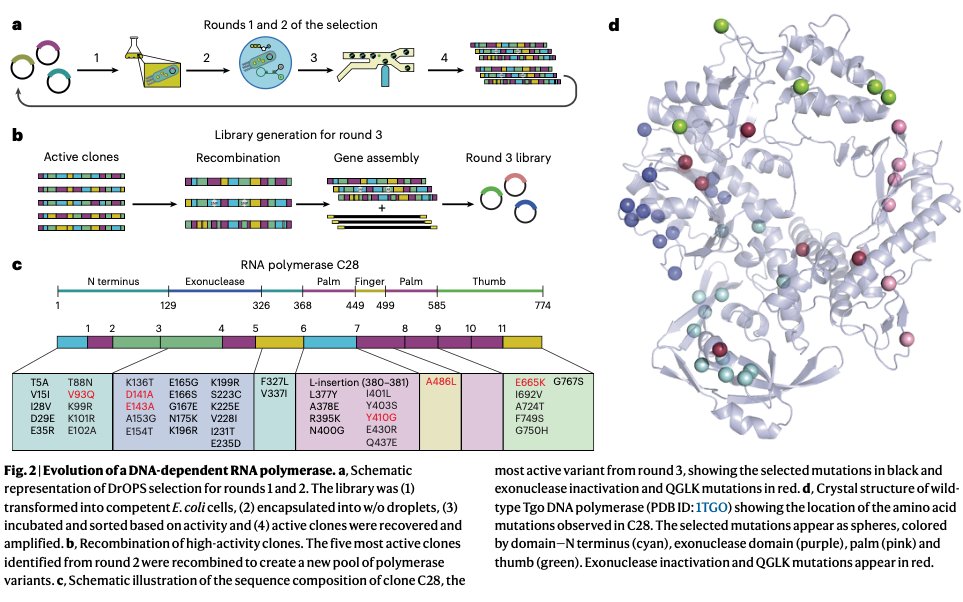
Next, they took the four genes encoding these DNA polymerases and cut them up into 12 segments each. They randomly stitched these 12 segments together — from the four different genes — to build millions of unique variants. Each shuffled gene was inserted into an E. coli cell.
Then, they grew up these cells (each carrying a unique polymerase) and put them into microfluidic droplets. A device isolates each droplet, lyses the cell open, and releases the polymerase. The droplet also contains RNA building blocks and a DNA template, encoding a fluorescent reporter. If the polymerase begins synthesizing RNA, it will produce a detectable signal. They screened about 100 million droplets in 10 hours of work, searching for those with a signal.
For each well that yields a fluorescent signal, the researchers isolated the DNA and sequenced it to figure out which polymerase it was. They repeated this 3x times, finally isolating a really excellent RNA polymerase variant which they called "C28."
C28 has 39 mutations compared to the wildtype enzymes. It incorporates about 3.3 nucleotides of RNA per second, with 99.8% fidelity. The crazy thing is that this enzyme can also copy DNA or RNA templates back into DNA (reverse transcription), or use chimeric DNA-RNA molecules as a template and amplify them. It is just a super versatile polymerase that can act on DNA, RNA, or modified nucleotides, to build just about anything.
English
Boris Parra รีทวีตแล้ว

Ayer me notificaron que dos de mis proyectos acerca del hidrógeno verde van a ser financiados por el estado Suizo. Dos. Uno de ellos con Toyota. Feliz de poder contar con los recursos para investigar.
Cuánto dueles Chile. Proyectos que me rechazaron 3 veces.
@min_ciencia
Español
Boris Parra รีทวีตแล้ว
Phages are full of genes of unknown fxn that may be adaptive in specific conditions.
New preprint: Phage TnSeq identifies essential genes rapidly and knocks all non-essentials. We would like to send a pool of phiKZ mutants to anyone wanting it! Reach out
tinyurl.com/bdcfrejh

English
Boris Parra รีทวีตแล้ว

Boris Parra รีทวีตแล้ว
Check this out for the 2026 SISB (phage defense) meeting in NYC. Mark your calendar! (and note the Zoom option, if needed)
sisb2026.rockefeller.edu
English
Boris Parra รีทวีตแล้ว

Hot off the press! Our latest paper led by @fernpizza , understanding how plasmids evolve inside individual cells. These small pieces of self-replicating DNA live inside bacteria and can transfer antibiotic resistance genes, but they also compete with one another to replicate. 1/

English
Boris Parra รีทวีตแล้ว


Boris Parra รีทวีตแล้ว

Out Now! A phage-encoded anti-CRISPR protein co-opts host enolase to prevent type III CRISPR immunity bit.ly/43rWXHA #CRISPR #Microbiology #PhageResearch

English
Boris Parra รีทวีตแล้ว
Out Now! An updated evolutionary classification of CRISPR–Cas systems including rare variants bit.ly/4oUjsNx #CRISPR #Genetics #Biotechnology

English
Boris Parra รีทวีตแล้ว


Boris Parra รีทวีตแล้ว

Are you interested in studying RNA phages? We are looking for a PhD student and a postdoc to join the lab!
For more information and how to apply, see below 👇
Please RT!
helmholtz-hiri.de/en/jobs-talent…
English
Boris Parra รีทวีตแล้ว

New Raise
🏛️ Company: Phagos
🔗 Website: phagos.com
📊 Amount: €25 Million
🔄 Round: Series A
🧮 Valuation: N/A
⚙️ Industry: Biotechnology
English
Boris Parra รีทวีตแล้ว
Explore the latest JGV collection: ICTV Virus Taxonomy Summaries! These summaries serve as a published, citable reference for all taxonomic updates, including new taxa designations or virus reclassifications. Find out more here: microb.io/4fadnZu #JGV
English
Summary of taxonomy changes ratified by the International Committee on Taxonomy of Viruses (ICTV) from the Bacterial Viruses Subcommittee, 2025 - go.shr.lc/3UDG5bO
English