Brant Mittler

10.5K posts

Brant Mittler

Brant Mittler

@BrantMDJD

Physician, Attorney, Journalist

San Antonio, TX เข้าร่วม Mart 2015
1.6K กำลังติดตาม2.1K ผู้ติดตาม
Brant Mittler
Brant Mittler@BrantMDJD·
Thanks for your honesty. MA plans prosper by bipartisan regulatory capture. How about making all their outcomes data public for objective evaluation? Taxpayers pay for the care but only get to the see outcomes the industry wants to be made public produced by hand-picked scientists. Very few industry insiders have gone public with the realities of shifting risk from the insurance industry to doctors and patients.
English
0
1
1
35
Brant Mittler รีทวีตแล้ว
Sachin H. Jain, MD, MBA
I want to reflect on the broken culture of innovation in U.S. healthcare delivery—and its nefarious impact on the system. We declare success prematurely. We obscure failure. And we move on without inquiry. Within the delivery system, the same organizations whose basic and clinical researchers perform rigorous, thoughtfully designed controlled trials of medicines will tout the success of delivery and financing innovation without requisite evaluation. In the broader innovation ecosystem, we too casually equate funding, valuations, and transactions with success—and we too often elevate and declare success without applying appropriate skepticism. Many believe this culture of salesmanship and hucksterism is harmless. But on the other side of it are patients whose care is not getting better and an industry with misplaced conviction about progress when there is none. I’ve seen this firsthand throughout my career. To make this less abstract, I’ll focus on my own area of work over the last decade: leading and operating Medicare Advantage plans and care delivery organizations. It is a sector that has birthed many venture capital darlings. But with the benefit of hindsight, many of those companies had clinical outcomes that were, at best, thin— And whose primary innovation was exploiting arbitrage opportunities in risk adjustment. And yet, in retrospect, these “innovators” were platformed. They were celebrated on the stages of major national forums. And while Medicare Advantage is now a space where some of these behaviors are more widely understood, it is not unique to Medicare Advantage. Rather, some of the distortions we see there are a window into a broader cultural problem. One that, in a different form, was on display in the case of Elizabeth Holmes and Theranos. We might like to believe that was an exceptional story in exceptional circumstances. I don’t. I think we have many Theranoses among us—just less visible, and more socially accepted. Why? I believe there are two root cause. First, expert and funding bias. We believe that startups revered and validated by experts are worthy of celebration. And if they are richly funded, we assume they have been appropriately vetted. Commercial success—often driven by relationships and the favor economy—is prematurely equated to clinical success. Second, optimism bias. We have such a strong desire to believe that things are getting better that the first hint of progress is met with celebration—rather than the skepticism we typically reserve for results that seem too good to be true. This is how many of us have convinced ourselves that American healthcare delivery is improving—while most consumers, patients, and clinicians tell us otherwise every single day. So how do we move forward?
English
4
7
15
2.4K
Brant Mittler
Brant Mittler@BrantMDJD·
Thanks for your honesty. MA plans prosper by bipartisan regulatory capture. How about making all their outcomes data public for objective evaluation? Taxpayers pay for the care but only get to the see outcomes the industry wants to be made public produced by hand-picked scientists. Very few industry insiders have gone public with the realities of shifting risk from the insurance industry to doctors and patients.
English

0
0
0
29
Brant Mittler รีทวีตแล้ว
Kevin Pho, M.D.
Kevin Pho, M.D.@kevinmd·
You spent years in training so you could justify a prescription to someone who has never seen a patient. Bettina Reed has practiced family medicine for 33 years. She watched the system go from a 45-dollar visit with no middleman to prior auths on four-dollar medications and insurance reps overriding clinical decisions. When a pharmacy director told her she could not send in a patient's Zoloft over a technicality, she sent it anyway. "My patient care is gonna continue." Meanwhile, health insurance executives pull 20 to 30 million in annual salary while lobbying Congress with hundreds of millions. Providers absorb the fallout. Patients absorb the cost. And violence against health care workers keeps climbing. The system will not fix itself. Reed says clinicians need to stop gliding along and start pushing back. Episode is in the comments. #HealthcareReform #ClinicianBurnout #PatientAdvocacy #KevinMD
Kevin Pho, M.D. tweet media
English
13
52
115
3.6K
Brant Mittler รีทวีตแล้ว
Mushtaq Bilal, PhD
Mushtaq Bilal, PhD@MushtaqBilalPhD·
Systematic literature reviews take 12-18 months to complete. Looks like AI is going to fully automate systematic reviews sooner than later. SciSpace ( @scispace) just launched an autonomous AI agent that conducts a systematic literature review with a single prompt. Go to scispace[.]com and run the following prompt: "Conduct a systematic literature review on [your topic]" SciSpace agent will generate research questions based on the PICO framework. You can review these questions and edit them according to your specific requirements. The agent will also draft screening criteria that you can edit according to your needs. Then the agent asks you to select the databases you want to use and the date range for paper. After this step, everything is fully automated. The agent will search for papers in the relevant databases, it will combine and rerank the papers. Then it will start the title and abstract screening and include the papers that meet the include criteria. In the next step, it will download the full text of included papers and screen them followed by data extraction. Based on the extracted data, it generates a complete systematic literature review and also a PRISMA diagram. It will also give you a table of papers included along with the rational for including them. The only thing that is keeping AI agents to fully automate systematic literature reviews fields is the papers behind paywalls. Check out the agent at scispace[.]com and see if you find its review useful.
English
8
85
418
39.2K
Brant Mittler
Brant Mittler@BrantMDJD·
@Ridhijwl Good question. Pay doctors more and give them better working conditions. Reduce administrator bloat and pay. More focus on patient care and quality outcomes.
English
0
0
0
6
Ridhi Jaiswal
Ridhi Jaiswal@Ridhijwl·
@BrantMDJD Wow, pediatricians unionizing? That's a big shift from begging to bargaining, Will this improve patient care or just raise costs.
English
1
0
0
8
Brant Mittler รีทวีตแล้ว
Dutch Rojas
Dutch Rojas@DutchRojas·
We have a tendency to assume that when a system underperforms, the solution is to make it more efficient. The IDR system under the No Surprises Act doesn’t underperform. It performs exactly as structured. Insurers collect premiums upfront. Physicians deliver care first and collect second. Every day of payment delay is a day that money sits on an insurer’s balance sheet earning a return. Multiply 150 days of average delay across 1.46 million annual disputes. The question isn’t why the system is slow. The question is why we assume slowness is the problem rather than the product… buff.ly/8iNbqlI
Dutch Rojas tweet media
English
1
10
30
1.6K
Brant Mittler
Brant Mittler@BrantMDJD·
Horrible lead editorial today in the WSJ supporting Medicare Advantage. They claim to give readers the “truth” about MA and blame all criticisms on Democrats. That’s an outright lie. MedPAC reports for 20+ years have said MA costs more than FFS Medicare. The WSJ’s own news reporters have documented MA plans over coding to rip off taxpayers. See also the DOJ lawsuits and MA penalty payments. And MA plans have ripped off the VA, too.
English
0
0
0
20
MedicalQuack
MedicalQuack@MedicalQuack·
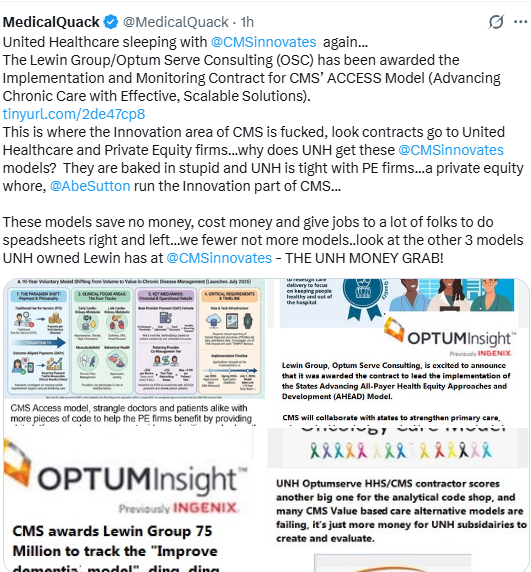
Another naive journalist that leaves out that UNH is gigantice government contractor @CMSinnovates just gave them another contract last week..model evalution for millions and the fact that UNH is code shop..patents up the ass, capable of code trickery but these folks are dumber than rocks not to talk about that..UNH is big Palantir client too.. Go search my archived posts about UNH and you will learn a lot more than this..
MedicalQuack tweet mediaMedicalQuack tweet mediaMedicalQuack tweet media
ProPublica@propublica

UnitedHealth is the nation’s largest health insurance conglomerate. ProPublica obtained what is effectively the company’s internal playbook for limiting and cutting therapy costs. Here’s what we found. propublica.org/article/united…

English
1
4
5
648
Brant Mittler รีทวีตแล้ว
Hedgie
Hedgie@HedgieMarkets·
🦔A researcher invented a fake eye condition called bixonimania, uploaded two obviously fraudulent papers about it to an academic server, and watched major AI systems present it as real medicine within weeks. The fake papers thanked Starfleet Academy, cited funding from the Professor Sideshow Bob Foundation and the University of Fellowship of the Ring, and stated mid-paper that the entire thing was made up. Google's Gemini told users it was caused by blue light. Perplexity cited its prevalence at one in 90,000 people. ChatGPT advised users whether their symptoms matched. The fake research was then cited in a peer-reviewed journal that only retracted it after Nature contacted the publisher. My Take The researcher made the papers as obviously fake as possible on purpose. The AI systems didn't catch it. Neither did the human researchers who cited it in real journals, which means people are feeding AI-generated references into their work without reading what they're actually citing. I've covered the FDA using AI for drug review, the NYC hospital CEO ready to replace radiologists, and ChatGPT Health launching this year. All of that is happening in the same environment where a condition funded by a Simpsons character and endorsed by the crew of the Enterprise was being presented as emerging medical consensus. The people making these deployment decisions seem to believe the pipeline from research to AI to patient is more supervised than it actually is. This experiment suggests it isn't supervised much at all. Hedgie🤗 nature.com/articles/d4158…
English
786
12.5K
27.3K
1.2M
Brant Mittler รีทวีตแล้ว
MedicalQuack
MedicalQuack@MedicalQuack·
Sure the doctor was on the radar, we remember Operation Spinal Cap from years ago...horrrific as fake screws were put in patients spines, I wrote about this guy..bit.ly/41SDyhz Not the first rodeo for Paul Richard Randal🤮Same guy they're writing about.. CPM represented whistleblowers in a California action under the California False Claims Act and the California Insurance Code, against Paul Richard Randal Stupid Journalists don't tell you the whole story anymore.. The old Pacific Hospital of Long Beach fraud..Paul Richard Randall was one of them back in 2012...yeah he was on the law enforcement radar for years after Operation Spinal Cap... Enjoy some of my archives here-I wrote good informative stuff.. Why Does A Hospital That Was Closed By The Feds In 2013, that Put “Fake” Screws In Patients Backs, Has A CEO/Owner Who Admitted Fraud/Patient Endangerment And Is Waiting Sentencing And Who Bribed A State Senator, Still Show On Healthgrades With Five Star Ratings? tinyurl.com/2b4csz82 Doctors In Southern California Implanted Fake Hardware With Patient Spinal Surgeries That Were “Knock Offs” Fabricated In A Machine and Tool Shop-Hospital CEO Bribed State Senator & Gave Doctors Kickbacks bit.ly/4sk686o
California Post@californiapost

OC fraudster admits to submitting $270 million in bogus claims to Medi-Cal nypost.com/2026/04/07/us-…

English
1
2
3
163
Brant Mittler
Brant Mittler@BrantMDJD·
Health Insurance Companies Care About You. Agree or Disagree? nytimes.com/2026/04/07/opi… via @NYTOpinion Here is Dr. Potter today in the NY Times in a debate with Dr. Troyen Brennan long time managed care advocate and medical director. See who has received major medical journal space: Potter or Brennan?
English
0
0
1
57
Brant Mittler
Brant Mittler@BrantMDJD·
Breast cancer surgeon films a peer review call with United healthcare peer reviewers. How much national media coverage has Dr. Elizabeth Potter received? instagram.com/reel/DWuN7X8CH…
English
0
0
0
93
Brant Mittler รีทวีตแล้ว
Dutch Rojas
Dutch Rojas@DutchRojas·
The story about healthcare gets told by the people who benefit from the current version. Academic journals funded by systems. Coverage driven by press releases. Policy framed by think tanks with named donors. The physician who disagrees is called an outlier. The data that contradicts gets buried in a footnote. Controlling the narrative is not spin. It is the first and most durable form of warfare. Independent physicians have no media. That is not an accident either.
English
2
9
52
2K
Brant Mittler
Brant Mittler@BrantMDJD·
@DutchRojas @DrDiGiorgio @X Brilliant post. Doctor bashing has been a national media team sport for many years. And recall all the politicians and academic health policy gurus who blamed fee-for-service payment for a decline in America’s global competitiveness - whatever that is.
English
2
0
5
390
Brant Mittler รีทวีตแล้ว
Dutch Rojas
Dutch Rojas@DutchRojas·
The most expensive parts of your healthcare bill are the things Americans, at large, never learn or hear about. Some accounts on @X are trying to make you angry at your doctor. Not at the system that owns your doctor. Not at the hospital network that sets the prices. Not at the insurer that controls what gets paid. Not at the academic medical center that pays no taxes while dominating the market. Your doctor. Here’s what happens when you actually follow the money. Physician compensation is roughly 8% of total U.S. healthcare spend. CMS publishes this annually. We spend about $17,000 per person. That leaves roughly $15,600 per person elsewhere. Start there. Not with blame. With understanding… Go ahead and ask about price transparency. Hospitals have been legally required to publish negotiated rates since 2021. Most don’t. Enforcement is weak. A functioning market requires prices. Healthcare has been allowed to operate without them. Ask about facility fees. Same physician. Same procedure. Same outcome. But when a health system acquires the practice, the billing entity changes, reimbursement jumps 2–3x, and nothing else changes. Ask about consolidation. Academic medical centers and large nonprofit systems have spent decades acquiring physician groups, outpatient sites, and regional hospital networks. Not because care improved. Because pricing power did. Once they dominate a geography, they don’t compete on price anymore. They set it. Health systems used the facility fee differential as a weapon. They acquired 60% of independent physicians in 16 years. Ask about Certificate of Need laws. Regulations that restrict new hospitals and surgery centers from opening. In practice it means limited new entrants, protected incumbents, and controlled supply. Competition is not absent by accident. It is constrained by design. Ask about Medicare Advantage and system-owned insurance. Many large nonprofit and academic systems now operate Medicare Advantage plans, Medicaid managed care organizations, and narrow-network products including systems that also employ the physicians and own the facilities. They increasingly control both sides of the transaction. Ask about UnitedHealth Group. $370 billion in revenue. Both a payer and the owner of the largest physician network in the country through Optum. Same system. Different roles. Ask about 340B. A drug pricing program designed for safety-net patients. In practice, a revenue stream embedded inside large hospital systems unrelated to patient-level subsidy in most cases. Ask about the organizations that define the rules. CMS payment design. Site-of-care differentials. Reimbursement schedules that reward system ownership over independent practice. None of this is visible to the patient. All of it is visible to the system. Every time, the same answer. “It’s the doctors.” This is not confusion. Confused people ask questions. These accounts don’t ask questions. They deliver verdicts. That is the difference between someone trying to understand a system and someone paid to protect it. Your doctor trained for a decade to keep you alive. That is not an accident. That’s the job…
English
32
141
447
24.4K
Brant Mittler
Brant Mittler@BrantMDJD·
Agree with what you say except this started way before 2009 and Obamacare in 2010. We started warning patients, doctors and the media about this in 1985 in San Antonio. We were largely dismissed as a curiosity and just rich, incompetent physicians who wanted to keep providing “unnecessary” care. The WSJ and ABC TV Primetime were exceptions. The AMA said we represented “obstructionism unhealthy for the profession”. The prominent “prestigious” medical journal editors completely dismissed our real world reports from the front lines of care.
English
3
0
19
1.8K
Neil Floch MD
Neil Floch MD@NeilFlochMD·
I am often mocked by my Wall Street friends when I tell the story of the “collapse of American medicine”. It is a direct result of two laws: 1. HITECH act of 2009 that implemented excessive cost and regulations on private practices and 2. ACA “Obamacare” law implemented in 2010. The cumulative effect of these laws was: 1. The collapse of the longstanding doctor-patient relationship as “you could NOT keep your doctor.” 2. The progressive financial failure of private practice physician who eventually joined hospital systems and private equity to reduce their debt. 3. Increasing cost of medicine as more physicians were working under the benefit of additional payments that include a “facility fee” which is awarded the hospital systems and not private practitioners. 4. The increase in administrative costs as increase regulations are a characteristic of large hospitals systems and uncontrolled and government-backed insurance mandates. The above must be reversed in order to re-establish private practice in America.
Dutch Rojas@DutchRojas

15% of physicians remain in unaffiliated private practice. In 2010 that number was 75%. The physicians still standing are the ones who held out the longest. They don’t need employment. They need an economic structure that makes independence durable. That is a very large and very underserved market.

English
47
392
1.6K
134.3K