
CRE Analyst

607 posts

CRE Analyst banner
CRE Analyst

CRE Analyst

@CREanalyst1

The commercial real estate industry’s #1 provider of real-world training. Commercial Real Estate and other investing content.

เข้าร่วม Mart 2020
330 กำลังติดตาม3.8K ผู้ติดตาม
ทวีตที่ปักหมุด
CRE Analyst
CRE Analyst@CREanalyst1·
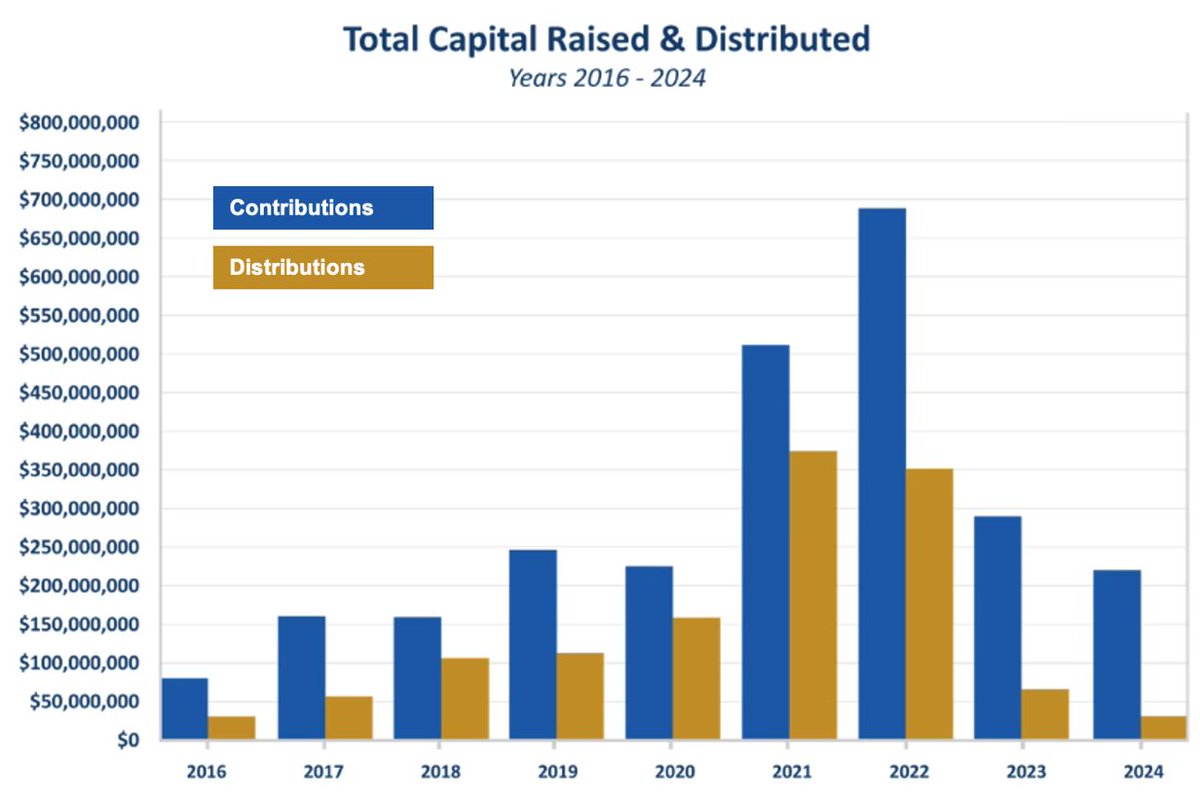
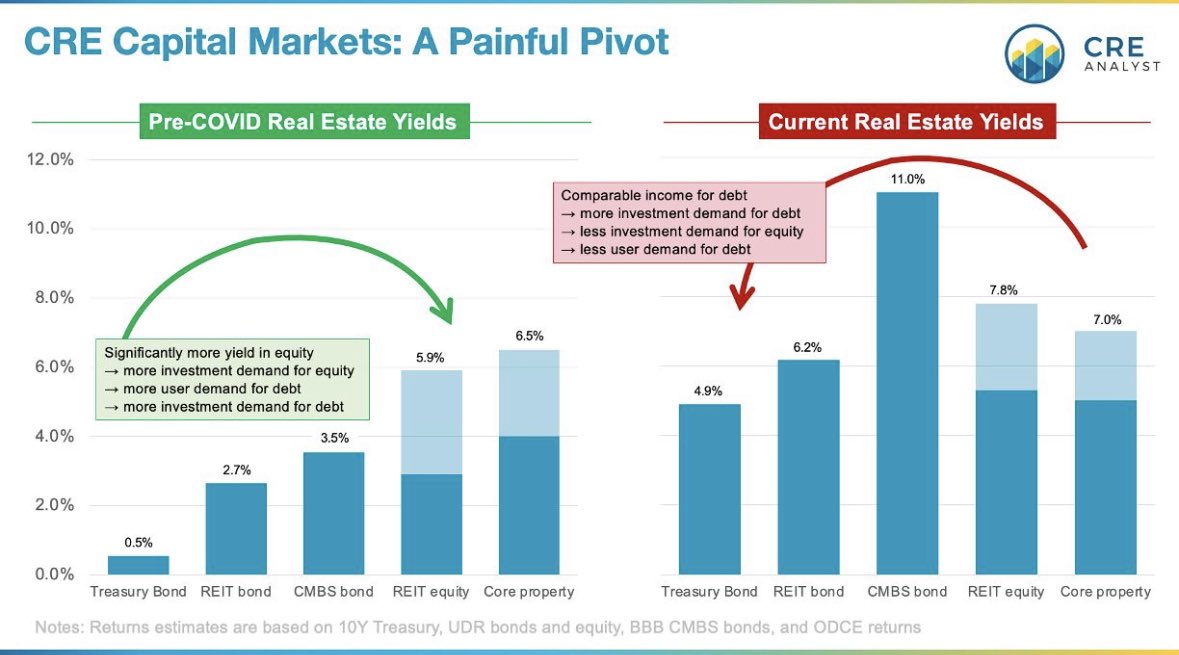
The CRE domino effect... ----- A quick review ----- 1. CRE capital markets were orderly pre-COVID Yields were low, but strong economic growth and mild new supply led investors to take more risk in hopes of getting more returns. Aside from extremely low base rates, relative risk/return was stable and orderly. 2. Capital bonanza During the pandemic, the Fed cut rates and injected $4+ trillion into the capital markets. Relative yields remained orderly but several conditions hit extreme levels: (i) interest rates, (ii) cash, (iii) transaction volumes, and (iv) property values. 3. The Fed's domino When inflation sparked from 2% to 9%, the Fed aggressively hiked rates and pulled trillions of credit out of the debt markets. ----- A picture is worth a thousand words ----- This chart summarizes how CRE capital markets responded to the Fed's domino... 1. Borrowing rates spiked, allowing lenders to finally get paid for taking credit risk. -- Treasuries: 1% -> 5% -- BBB bonds: 3% -> 6% -- BBB CMBS: 4% -> 11% 2. "Relative value." Why would an investor buy a property with a 5% cap rate when the investor could be a real estate lender and get 6% yields? There may be a good answer: Equity continues to generate higher yields if investors allocate value to future growth, but higher coupons for lending make it difficult for investors (especially when they expect a recession/slowdown in growth) to get excited about equity. 3. Everyone's a lender. Capital is flooding into debt markets, where investors can (at least in theory) get coupons above cap rates. 4. But where are the borrowers? In order to originate debt, lenders need borrowers, and borrowers don't generally want to pay coupons that are 2x higher than recent rates. And they certainly don't want to pay 12%+ pref equity rates. No equity means no borrowers. Prices will fall until yields and confidence lure equity investors back into the market. ----- Our hypothesis ----- Until a more normalized order is restored in the real estate capital markets, the following counterparties will remain in a painful cold war... Lenders vs. borrowers: -- Lender: Want to borrow 8% money? -- Borrower: No. Buyers vs. sellers: -- Seller: Want to buy my property at a 5% cap rate? -- Buyer: No. Sponsors vs. investors: -- Sponsor: Want to invest in my deal? It offers a 7% equity return. -- Investor: No. We believe real estate markets will re-establish a normal order of risk/return, but the path to a "new normal" could take years to achieve with at least a few surprises along the way. But as Sam Zell once said to a conference full of real estate investors: "Where the f*#% else are you going to go?"
CRE Analyst tweet media
English
2
11
43
13.9K
CRE Analyst
CRE Analyst@CREanalyst1·
More distress: office or apartments? It's complicated... Office vacancy rates are 20%+, values are down 50%+, and delinquency rates are higher than the GFC. Apartments have been more of a slower burn, but total estimated distress in apartments exceeds total office distress. Key question: will 'potential' distress turn into actual distress? [Consistently impressed with MSCI's real estate insights.]
CRE Analyst tweet media
English
4
1
5
1.5K
CRE Analyst
CRE Analyst@CREanalyst1·
Hindsight may be 20/20, but this wasn’t just a bad deal. Textbook definition of getting fleeced… Property: Apartments built in early 1980s Purchase price: $111M Acquisition: 2022 Leverage: 75% Syndicated equity: $21.5M Equity placement fee: $1.9M Sponsor acquisition fee: $2.2M Going-in cap rate: 3% Assumed exit cap rate: 4.4% Sponsor promote: 50% over a 10% Underwritten investor returns: 18.5% IRR, 1.7x multiple One-off deal? Not at all. This syndicator put out $1.2B near the peak of the market 3-4 years ago. Look out below.
CRE Analyst tweet media
English
6
1
10
3.5K
CRE Analyst
CRE Analyst@CREanalyst1·
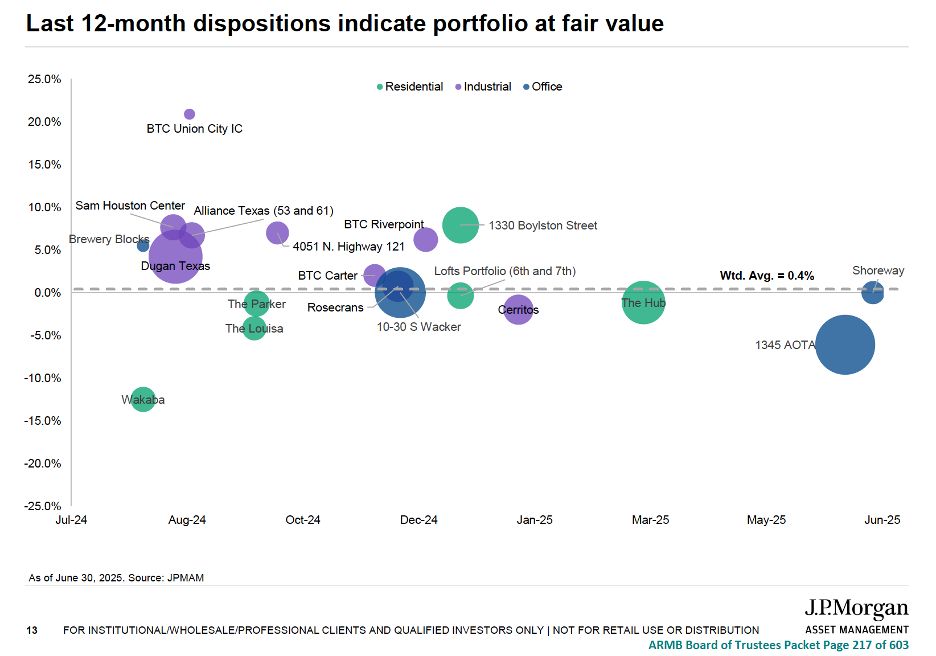
"Clearly too high. Let's just say it." 'The ODCE overall is marked to a 4.6% cap rate as of last quarter. Industrial is at a 3.9%, apartments are at a 4.5%, office is at a 6%. [To invest in core funds today] you have to be comfortable allocating into those valuations...' -- Non-core investment manager '...which are clearly too high. Let's just say it.' -- Leading real estate fundraiser ...but we are consistently selling properties above their carrying marks. -- Leading core fund Core funds, which make up a relatively small share of the real estate capital markets but serve a critical role by defining pricing for the highest quality assets, remain on the sidelines thanks to redemption queues. The three-year culprit: many investors don't believe those funds' carrying values. But there are three different perspectives on this key tension: 1. Managers of more opportunistic funds are wisely pointing out their competitive advantages. i.e., investors in their funds don't have to buy in at low cap rates. 2. Fundraisers are conveying how difficult it continues to be to raise core capital in the face of redemption queues, lower REIT values, and lower secondary values. 3. Core fund managers are saying they're regularly selling above their marks, suggesting they aren't actually overvalued at all. [This slide is from one of the largest fund's recent pitch deck to a large investor.] Where do you land? PS -- Kudos to Nancy Lashine for continuing to bring the tensions that define real estate capital trends to light by having engaging conversations with guests like Tom Gilbane on Park Madison's Real Estate Capital podcast.
CRE Analyst tweet media
English
0
0
2
777
CRE Analyst
CRE Analyst@CREanalyst1·
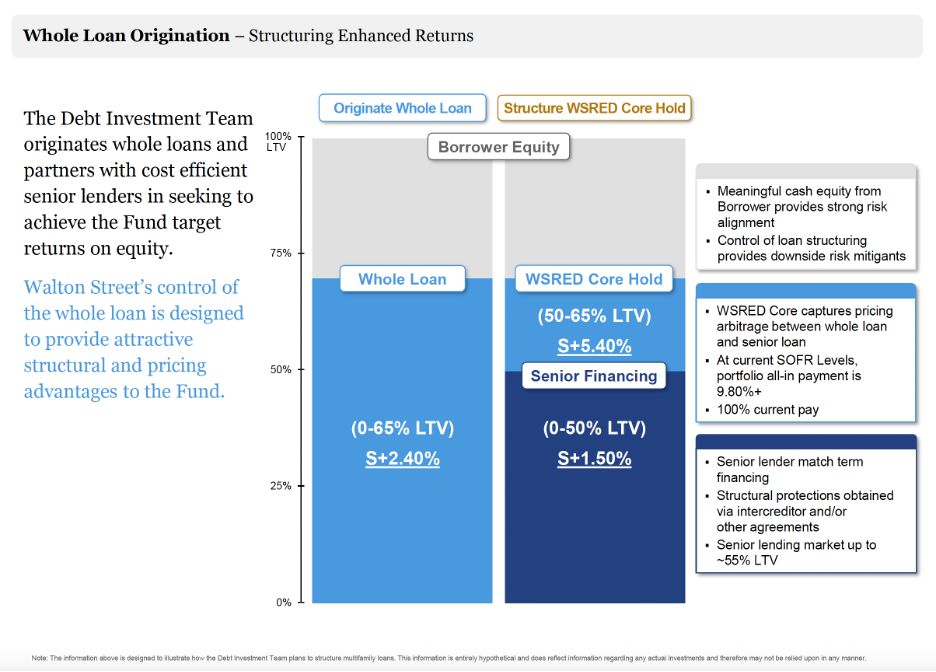
How to manufacture 10% returns from debt investing in a 4% market... 1. Take some credit risk: Risk-free bonds are around 4%. Corporate bonds generate an incremental 100 bps over risk-free rates, and real estate lending generates, say, 150-300 bps. 2. Take some floating rate risk: Generate a little extra spread by financing shorter-term business plans. 3. Borrow: Magnify returns by giving the safest portion of the investment to a lower cost of capital provider. "At current SOFR Levels, portfolio all-in payment is 9.80%+" Lots of ways this industry darling approach could evolve in the coming months and years. What's your guess?
CRE Analyst tweet media
English
0
0
1
718
CRE Analyst
CRE Analyst@CREanalyst1·
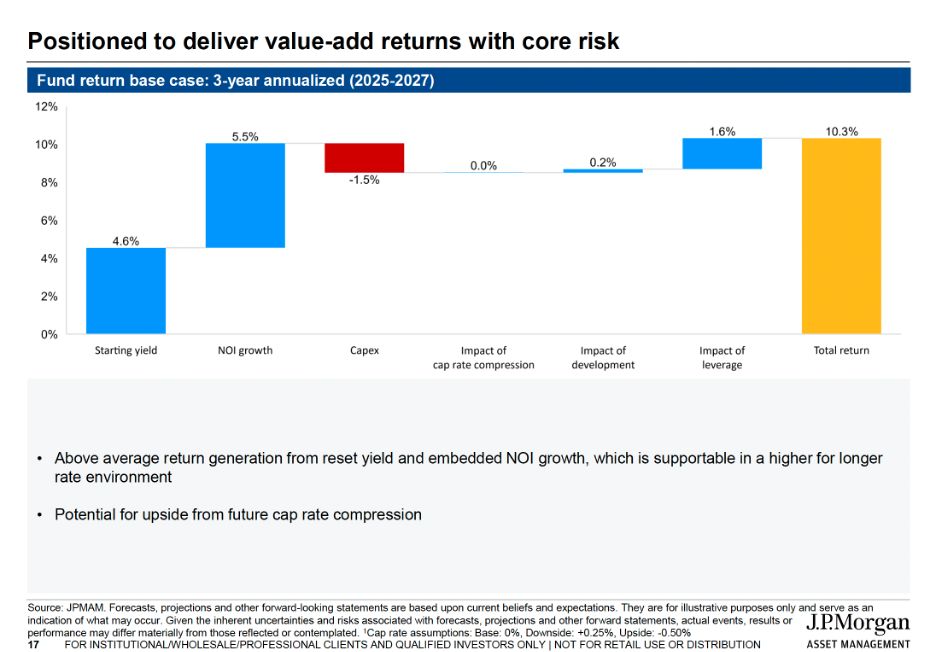
JPM's core recipe: 'Value-add returns with core risk' 'Generational entry point' JP Morgan's Strategic Property Fund (one of the oldest and largest core funds in the ODCE index) is pitching clients on the following return outlook: -- Going-in income yield = 4.6% -- Income growth = 5.5% -- CapEx burn = 1.5% -- Favorable leverage = 1.6% -- Total returns = 10%+ The Fund has made enormous progress with its redemption queue, generating $4-5B of liquidity (primarily through sales), $3-4B of redemption requests rescinded last year, and is gearing up to make new bets in alternative real estate sectors. But at 4.6% going-in cap rate, betting on 300 bps of net cash flow growth. Buying it? PS -- stay tuned for JPM's entire pitch deck.
CRE Analyst tweet media
English
0
0
2
552
CRE Analyst
CRE Analyst@CREanalyst1·
Same labs, different marks Two years ago, life science real estate was hanging on to its reputation as a belle of the real estate ball. ULI and PwC ranked it 4th out of 27 property types for investment prospects. Reality took a sharp turn, though, thanks to falling post-COVID demand and slower biomed capital flows. Alexandria (a $15B REIT and the industry’s bellwether) is down 35% over the last 2 years. …down 35% over 2 years. Now the private side. Blackstone bought BioMed Realty in 2016 in BREP VIII, then recapitalized it in 2020 into a perpetual core-plus life sciences vehicle. We requested, received and reviewed documents from one of the vehicle's largest LPs, which suggest that the Blackstone BioMed vehicle is down only about 17% over the last two years. Public prices, down 35%. Private NAVs, down 17% over the same window. Same sector. Similar exposure. Same time period. Different marking systems. What are we missing?
CRE Analyst tweet media
English
0
0
1
445
CRE Analyst
CRE Analyst@CREanalyst1·
"Risks are mounting and complacency only compounds them" (KKR) Is private credit a generational opportunity or a slow moving train wreck? Here's a recent KKR take: "...the evolution of global credit markets reminds us that progress is never guaranteed. In the present environment, market participants need to be thoughtful and proactive." "...the market is long capital and demand, but short product and ideas. Dispersion often obscures the bigger picture, which makes credit selection more important than ever. Some corners of the market feel more challenged than others, with risk and crowding often concentrated in the most familiar or well-trodden segments." "While we remain optimistic about the road ahead, we would be remiss as credit investors if we didn’t acknowledge that risks are mounting and that complacency only compounds them." ---- Quick background ---- Two and a half years ago, we thought the real estate industry was steaming toward a massive financing gap ("Less debt, higher rates, and a flat/inverted yield curve have created a meaningful capital disconnect for real estate borrowers..."), which we thought would lead to a lot of focus on private credit: We pointed out that investors were responding to the "easiest fundraising pitch of all time" by chasing equity-like returns for debt-like risk. But we also speculated that the "the path to deploying this capital could be bumpy," predicting a surge of capital chasing equity-like returns for debt-like risk, compressed returns, scaling difficulties, and meaningful downside risk. How does the private credit rage end? A) Generational yield opportunity B) Orderly rebalancing C) Implosion D) Other
CRE Analyst tweet media
English
2
0
3
624
CRE Analyst
CRE Analyst@CREanalyst1·
Subject: You might want to sit down for this Dear Investor, I need to be direct. Our property is under severe pressure. We refinanced at the peak, maximized distributions, and skipped on capex. It felt good at the time, but now the shine is gone. Cash flow barely covers debt service. Expenses keep climbing. The loan is coming due, and the bank will not refinance it. Our options are limited: 1. Put in more money. 2. Cut spending. 3. Refi with sharks and watch cash flow disappear. 4. Kick the can and let our kids deal with it. None of this looks good, but, unless someone has a printing press, I don't see another way out. Sincerely, Sam Wilson ============= PS — Is this where the United States government stands today? The surge in gold and crypto raises real questions about reserve currency status, and what that could mean for the value of the dollar and real estate.
CRE Analyst tweet media
English
1
0
0
635
CRE Analyst
CRE Analyst@CREanalyst1·
Nothing to see here... 1. AI stocks now represent 43% of S&P 500 market cap, the highest concentration since the 1960s. 2. The top 4 AI companies are spending $300B+ annually on capex vs. $150B pre-AI trend. 3. Only 1 in 20 AI business integrations show measurable ROI (MIT study). 4. Investor risk-taking now exceeds dot-com bubble levels (JPM data). 5. AI companies are trading at 38x forward PE vs. 22x for non-AI stocks. 6. Real interest rates historically hit 4% during comparable capex booms. 7. Non-AI companies already showing negative earnings growth. 8. Some models project $25 trillion in "optimal" AI investment vs. current $800B spent. 9. Manufacturing costs could approach zero if productivity promises materialize. 10. Historical precedent: Revolutionary technology and financial bubbles often coincide. The market has made an extraordinary bet on AI transformation, concentrating nearly half of its value in companies whose returns remain largely theoretical. Whether this represents visionary investment in the next industrial revolution or dangerous speculation will likely be determined by execution timelines that remain highly uncertain. The gap between transformational potential and current measurable returns has created a fascinating tension where both technological revolution and market correction could prove inevitable. CRE isn't exactly caught in the middle but is certainly exposed if the AI frenzy proves to be a bubble. What do you think? A. AI is completely overhyped. B. AI will change the game but on a slower-than-anticipated timeline. C. AI is worth the type.
CRE Analyst tweet media
English
3
0
1
577
CRE Analyst
CRE Analyst@CREanalyst1·
A real estate Rorschach test. What do you see in this chart? A. Overpriced private real estate B. Underpriced real estate stock C. Overpriced non-real estate stocks D. Something else
CRE Analyst tweet media
English
2
0
2
512
CRE Analyst
CRE Analyst@CREanalyst1·
“You say goodbye, and I say hello” New Yorkers: “Wall Street still runs through Manhattan, but you can’t ignore that more finance jobs are heading south.” “It feels like New York raised finance, and Texas is reaping the benefits of lower costs and looser rules.” “Maybe a handful of front-office roles are in Texas, but it's still just a cost savings play.” “New York is expensive and crowded. Texas offers room to grow, literally and financially.” "They'll be back here at some point." Texans: “It used to be you had to leave Texas to make it big in finance. Now the jobs are right here.” “Finance jobs here aren’t just back-office anymore. We’ve got investment bankers, hedge fund managers, even family offices relocating.” "Everyone talks about these jobs being related to cost savings elsewhere, but it's really about ease of doing business. Firms are tired of being abused." “I know people moving here from both coasts. They want opportunity without the headaches.” “We’re not trying to beat New York. We’re just creating a second hub, and it’s working.” ---- Quick background ---- Financial activities employment in the major Texas cities (Dallas, Houston, San Antonio, Austin) compared to financial activities employment in New York, North Jersey and Long Island. Thirty years ago... New York: 720k jobs Texas: 359k jobs Twenty years ago... New York: 728k jobs Texas: 476k jobs Ten years ago... New York: 705k jobs Texas: 567k jobs Today... New York: 776k jobs Texas: 763k jobs Side note: Financial activities employment in the big California cities is down 7% (50K jobs) over the last ten years. Are these shifts reactive/temporary, purely cost motivated, all about regulation, a mix of factors?
CRE Analyst tweet media
English
0
0
3
468
CRE Analyst
CRE Analyst@CREanalyst1·
Goldman Sachs thinks CRE is on "firmer footing," but there's a catch... On a relative basis, CRE is due... "Improving sentiment, valuations, liquidity and positive supply/demand fundamentals point to attractive entry points and relative value opportunities in real estate, including private real estate which has underperformed other asset classes like private equity, infrastructure, and credit markets over the last three years." But this time might be different... "We anticipate that the nature of the real estate recovery will diverge from the post-global financial crisis (GFC) experience. We are now operating in an environment defined by structurally higher interest rates and inflation. Therefore, we expect a larger share of total return in the future to come from income growth rather than cap-rate compression. Investors must also navigate divergence across regions." How do you interpret this chart: A) The red line (CRE) reflects the new normal. B) Nothing can underperform forever, and CRE will bounce back. C) Something else? [comment below]
CRE Analyst tweet media
English
1
1
4
1K
CRE Analyst
CRE Analyst@CREanalyst1·
Who has made more over the last few years: real estate investors or their lawyers? Quotes from anonymous partners on how they justify the Big Law grind... "My love of money exceeds my hate of BigLaw. It's as simple as that. I grew up in poverty and now have more money than maybe the entire aggregate of all my ancestors combined." "I recently looked up the median household income in my little hometown - it is the same as my monthly draw. I am going to collect these checks until I can’t anymore because I want my spouse and kid to not have to do the same." "I tell people don’t do it for the money. Do it for a shit ton of money." "Money. Seriously, it ain’t rocket science." "I make millions of dollars a year. At this point it's not about my life, it's about my family's life and setting my kid up for what I view as an extremely uncertain future." "Earning potential is heavily firm dependent, but the gulf between equity partners and average in-house compensation can be massive. At my firm, for example, a first-year equity partner is earning around $2 mil and it only goes up from there with a high end over $20 mil. By the end of a career and with smart investment and lifestyle decisions, a decent number of equity partners at my firm are approaching / surpassing 9 figure net worth because compounding returns are magical." PS -- $1000/hr used to go a long way, even in Big Law. Now it might get you an associate. Will rates continue to grow in a slower market and in the face of AI?
CRE Analyst tweet media
English
1
0
1
887
CRE Analyst
CRE Analyst@CREanalyst1·
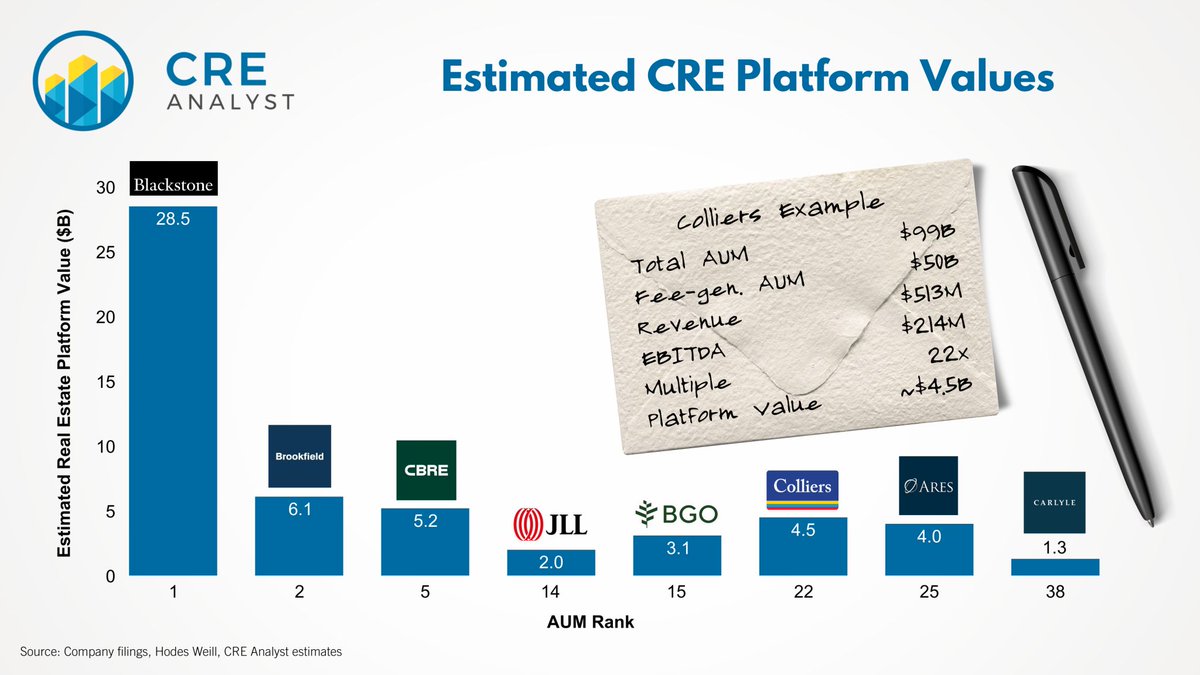
AUM is overrated. The real game is platform value. Harder to measure, but it’s what drives strategy. Our two cents... 1. Blackstone stands alone. $339B in AUM, $279B in fee-AUM, premium multiple. A category of one. 2. Margins matter. JLL’s LaSalle runs at ~21% margin. Colliers’ Harrison Street-driven platform at ~42%. As AUM scales, margins expand, which makes allocators like Harrison Street and Blackstone powerful. 3. Fee-generating AUM > AUM. Just look at Brookfield’s relative decline. Private credit gets a lot of attention but core debt doesn't create much platform value. 4. Valuations swing. Hodes Weill: 13x–20x earnings for platforms. Why the gap? Durable, high-yielding funds command premiums. 5. Potential arbitrage? CBRE IM: ~$5B value (~9% of enterprise). Colliers IM: ~$4.5B (~40%). Similar business, wildly different weightings. How could they close the gap? CBRE should: -- Grow AUM immediately -- Buy bolt-on managers -- Diversify into infrastructure -- Otherwise sell or IPO the investment management business Colliers should: -- Guard margins -- Brand as a mini-Blackstone. Sun Life should: -- Leverage back door control of BGO -- Sell to CBRE Platform value shapes appetite. Appetite shapes markets. That’s why we follow the dollars. Want to dig deeper? DM us to explore our upcoming FastTrack cohort.
CRE Analyst tweet media
English
1
1
6
1.3K
CRE Analyst
CRE Analyst@CREanalyst1·
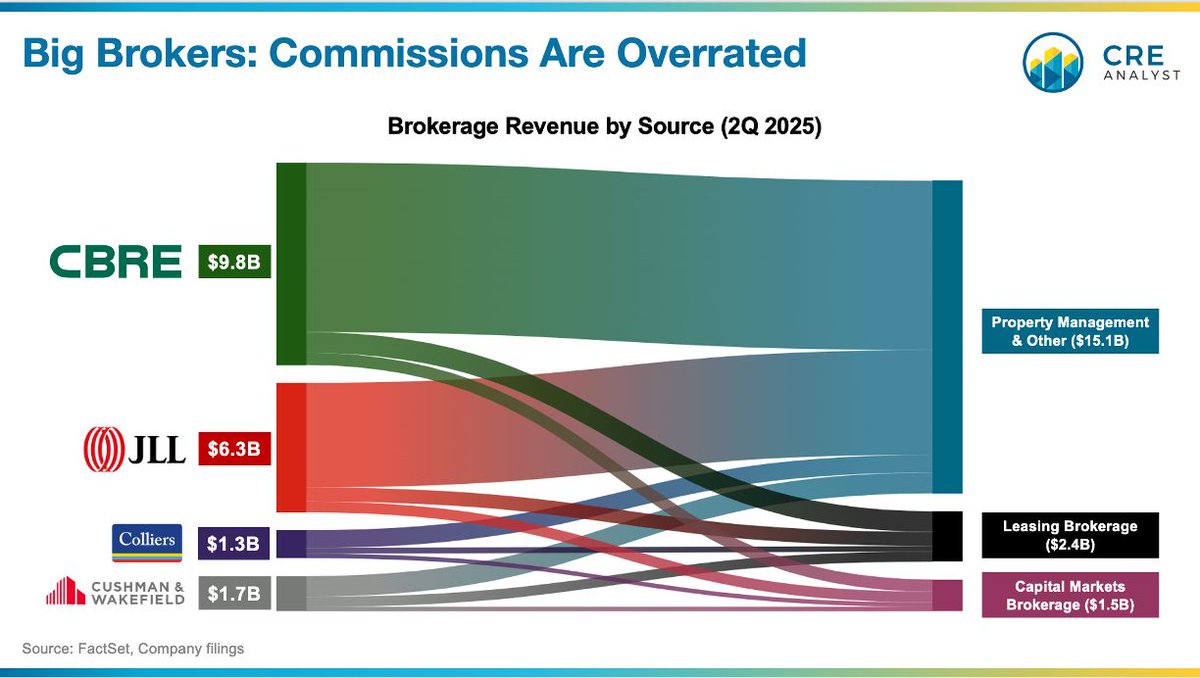
Commissions are now just 20% of big brokers' revenue. The game has changed. Huge implications for all brokers and owners. Navigating new realities... ---- Quick background ---- Ten years ago, big firms lived off transactions. But deal commissions account for only 21% of revenue now. The real engine at the largest firms is property/facilities management. Old model: -- "Name your fee, we will do anything to win this business" -- Person to person relationships -- Bigger often meant better -- Easy to fire, short tenures -- Data was an afterthought New model: -- “We value you but…” -- Commoditized service -- Higher switching costs, longer tenures -- Data tug of war -- Room for smaller, hungrier brokerages ---- For owners ---- 1. Forget one offs. They want multi year, portfolio wide. 2. Tie compensation to KPIs. Pay for outcomes, not effort. 3. Share verified savings or upside. 4. They will push shared services. Incentivize performance with performance target-triggered ROFOs. 5. Coverage matters. Name the people, not just the logo. 6. Own your data or you will pay for it twice. 7. Create a case study. They invest when they can showcase. 8 Govern like a board with regular reviews and scorecards. 9. Plan the exit. Staff, vendors, and data handoff are what make your “out” real. 10. Don't forget about sharpshooters. Smaller firms often fight hardest for individual deals. ---- For the largest brokerages ---- Kudos for creating cash generation machines and stabilizing the industry in the process. Are you concerned about losing talent? ---- For brokers at other shops ---- The recurring revenue pivot pleases shareholders but dulls hunger, which could be your opening. ---- For owners of other shops ---- Great brokers typically thrive at the tip of the spear and are demotivated by process management. Do you see opportunity to pick up talent?
CRE Analyst tweet media
English
1
0
6
1.2K
CRE Analyst
CRE Analyst@CREanalyst1·
Dillard’s and Trademark just bought a B mall. Here’s why it makes sense.... Pricing: -- ~20% cap rate -- 80% below its peak value -- Buying out of an orderly bankruptcy liquidation Capital allocation: -- Dillard’s is profitable (~9% margin) -- What do you do with cash? Cost control > investing in apparel -- At least this is accretive vs. distributing cash Control and expertise: -- Dillard’s gets flexibility to re-tenant and reshape the environment -- Trademark adds a proven track record of repositioning malls The bigger play? -- The Dillard family members are large shareholders -- They're all in on retail and all in on Texas and Florida -- If Longview works, this could be a repeatable playbook Kudos to FastTrack guest speaker Terry Montesi for continuing to pioneer retail opportunities! More info: hubs.ly/Q03FnbSV0
CRE Analyst tweet media
English
1
0
2
866
CRE Analyst
CRE Analyst@CREanalyst1·
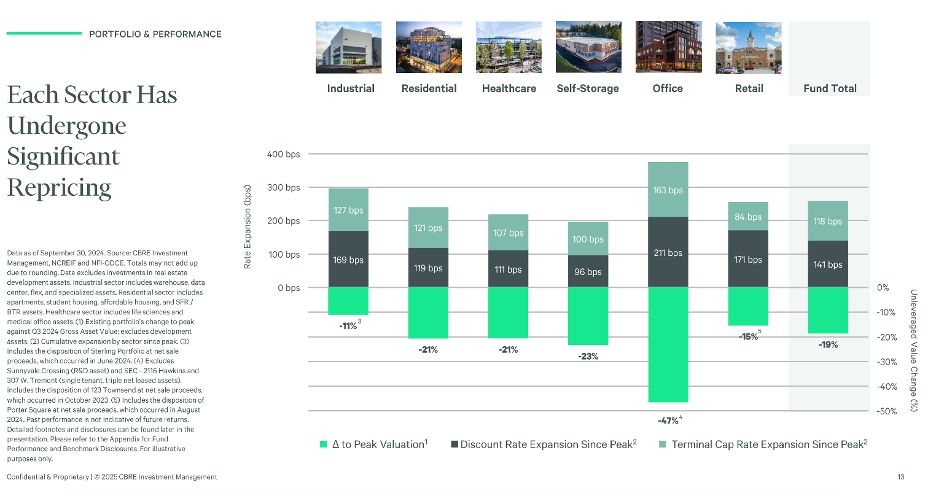
Cap rates and discount rates are up, and values are down. Dissecting these moves by sectors... Reversion estimates, discount rates, and NOI growth assumptions have all changed materially across asset classes but in different ways. If you think discount rate adjustments would be faster to be re-adjusted, then office and industrial should come back faster than residential and storage. Devil's in the details, but interesting slide from a CBRE pitch deck. Did you know that CBRE's core fund has outperformed the ODCE index every year since the fund was launched in 2013? PS -- this chart is a good example of what we cover in our FastTrack course, in practice, showing that investors approach assets with much more nuance than the media and pundits. Want to dive in? DM us to explore joining our upcoming cohort. Only a few spots remaining.
CRE Analyst tweet media
English
3
1
16
2.2K
CRE Analyst
CRE Analyst@CREanalyst1·
The rich get richer. A consolidating industry. Real estate funds raised over the last few cycles: About 4,000 Number of $3B+ funds: 66 Platforms with multiple $3B+ funds: 13 Blackstone, Brookfield, and a few other giants aren't just playing the game. They are rewriting the rules. Why does this matter? 1. Scale Wins: Big funds have more firepower. They can buy better assets, weather downturns, and move faster than the rest. In a storm, the biggest ships stay afloat. 2. Institutional Muscle: These firms bring in strict management, deep controls, and sharp operations. They're bigger than a few individuals and set the standard for how real estate is run. The sector is no longer a playground for small players. 3. Global reach: The top sponsors are everywhere. They hunt for deals in New York, London, Singapore, and beyond. This global push means more diversification and more ways to win. 4. Innovation engine: With size comes resources. These giants are driving new tech and new sourcing pipelines, and they're not always price takers. They have the money and the mandate to push the industry forward. 5. Transparency and trust: Big funds answer to big investors. That means more reporting, more oversight, and better alignment. The days of “trust me” are over. Now, it’s “show me.” What does this mean for everyone else? The middle is getting squeezed. And although many small operators have found a niche, they too are finding fundraising more difficult. Our bet: the big are getting bigger, and they’re just getting started. Interested in leveling up in a more competitive environment? DM us to explore our upcoming FastTrack cohort. The last cohort hit 90 NPS.
CRE Analyst tweet media
English
1
0
3
956
CRE Analyst
CRE Analyst@CREanalyst1·
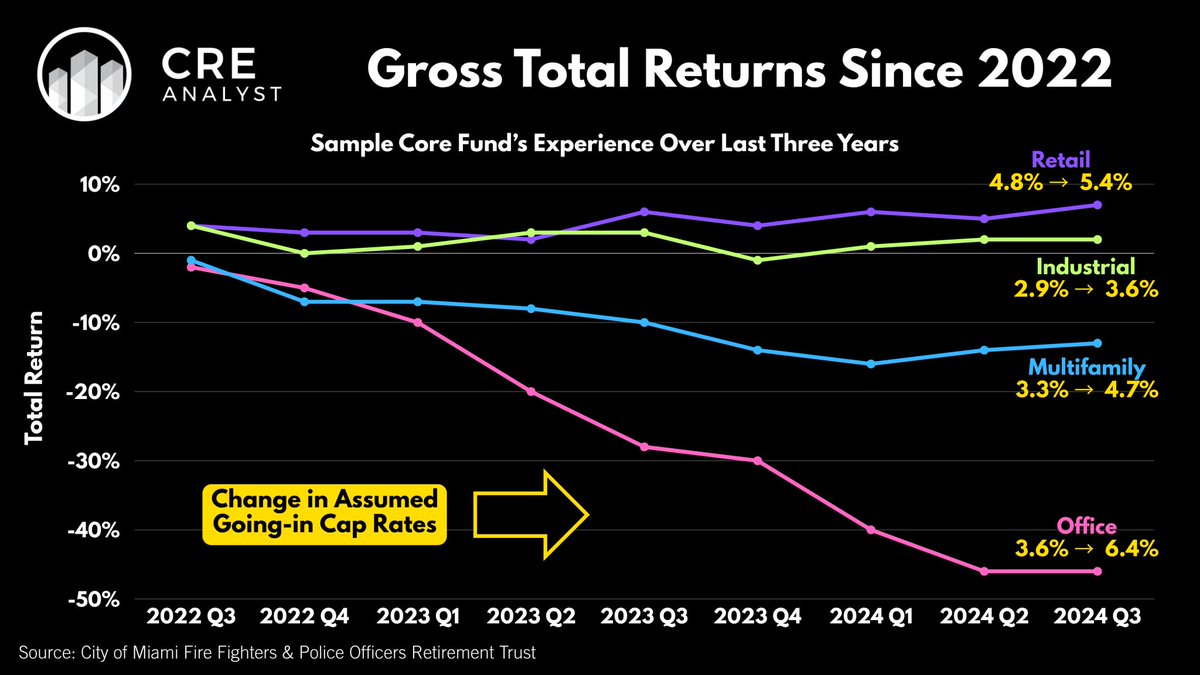
A rare look inside the valuation guts of a top-ranked core fund: Retail • Golden child • +60 bps cap rate expansion • High single-digit total returns Industrial • Largest allocation • +70 bps expansion • Just treading water Multifamily • +140 bps cap rate expansion • -10% to -20% total returns • Income growth helping… barely Office • Nearly -50% total returns • +180 bps cap rate expansion • Still a dirty word with institutions ---- Takeaway ---- Headlines don’t define markets. You need to be able to follow the dollars to navigate this market. DM us to join the next FastTrack cohort. ---- Want the details? ---- Comment “valuation” and we’ll send you the original deck, which includes allocations, benchmarks, discount rates, cap rates, rent growth assumptions, etc.
CRE Analyst tweet media
English
2
0
0
686
CRE Analyst
CRE Analyst@CREanalyst1·
This is not just the loss of a successful executive who, by 43, had already reshaped our industry. It is the loss of a generational talent whose best work still lay ahead. Our deepest condolences to the family, friends, and colleagues of Wesley LaPatner.
CRE Analyst tweet media
English
2
2
4
902