
Jamie Collins

914 posts

Jamie Collins banner
Jamie Collins

Jamie Collins

@CollJamie

Biostatistician, SAS-lover, R-learner, outcomes researcher, she/her. associate prof @harvardmed, biostatistician @BWHResearch @OrACORe_BWH

Boston, MA เข้าร่วม Şubat 2016
331 กำลังติดตาม530 ผู้ติดตาม
Jamie Collins รีทวีตแล้ว

Matthew Harkey
Matthew Harkey@Harkey_MS·
🔬 NIH’s new policy to cap indirect costs at 15% is a huge blow to research🧪 💰 Less funding for operations = fewer resources for science. ⚠️ Small institutions may struggle to sustain research. 🏛️ This could impact the future of NIH-funded projects. 🔗 grants.nih.gov/grants/guide/n…
English

1
7
12
4.1K
Jamie Collins รีทวีตแล้ว
Jay Giri
Jay Giri@jaygirimd·
🧵 Many “hot takes” about the reduction of @NIH indirect grant costs to 15%. Let’s lay out the facts about the university grant management process & accounting. And then use this to project likely short and longer term impacts of the policy.
Jay Giri tweet media
English
58
289
1.1K
431K
Jamie Collins รีทวีตแล้ว
Aleksandar Rajkovic
Aleksandar Rajkovic@Aleks_Rajkovic·
Universities aren’t “siphoning” research funds—overhead (indirect costs) covers essential expenses like lab space, utilities, admin support, & compliance with federal regulations. Without it, research wouldn’t happen. Federal agencies negotiate these rates, and they’re standard across institutions. Not a ripoff—just the cost of science. This move will weaken our biomedical prowess and many educational programs that create scientists you employ. #ResearchFunding #SciencePolicy #nih #science #stem #research #indirect
English
7
4
107
9K
Jamie Collins รีทวีตแล้ว
Phil Metzger
Phil Metzger@DrPhiltill·
It seems few people know what an “indirect cost” is or why it has to be 40-60%. The reason the government forced universities to raise their indirect costs up to (typically) 40-60% was to force a huge amount of regulations on the universities while also minimizing the bookkeeping to comply with those regulations. This includes the work by contract managers, compliance lawyers, accountants, safety management, etc., who are required by the government per the terms of the contract. If universities had to allocate all those categories of labor to each contract hour-by-hour it would require too much bookkeeping, which would waste money. (I’m setting aside for now the question of whether or how much the regulations are wasting money and only discussing how you bookkeep the effort to comply with the regulations.) So to save money, while also requiring universities to do these types of work, the government requires universities to roll those categories of labor into “cost pools” that must be allocated as a percent of the technical work in each of the contracts. While the actual “overhead” might be only 15%, these pooled labor charges that are required by the government are typically much more. Second, the government doesn’t allow the universities to figure out their own indirect rates. These rates are determined by the federal government through audits every couple of years. The government then sends a document telling the university what rate to use for its cost pools. For example, the University of Colorado was told by the DHHS to use 54% (colorado.edu/controller/sit…) and U. Nebraska was told by DHHS to use 55.5% (uofnelincoln.sharepoint.com/sites/UNL-Spon…). 40-60% is not only reasonable to fulfill the terms of the contract, it is the rate that the government tells the university it can charge for all the work the government requires the university to do. So if the government wants to reduce the indirect rate to 15%, then it needs to do one of these two things: Either (A) eliminate all the federal regulations that force the universities to do those categories of work (compliance, accounting, management, safety management, tracking harmful chemicals, etc.) Or, (B) stop requiring universities to pool those real costs into the “indirect cost” category and allow universities to include them in the “direct costs” of the contract. If the government chooses (A), then the safety rails have been entirely removed. (Even if the government lowers the regulations without entirely eliminating them, the costs they impose will still be real costs that probably come out to more than 15%.) Or, if it chooses (B), then the direct costs will go way up and research will actually be less efficient because all the bookkeeping, not more efficient. But if the government caps the indirect rate at 15% without doing either (A) or (B), then it will be impossible to do research for the federal government without going bankrupt. That’s the worst possible choice. It will kill research in the US. Is that what we want? I can explain it for you but I can’t understand it for you. It’s up to the reader not to be ignorant.
English
91
288
1K
135.9K
Jamie Collins รีทวีตแล้ว
npj Digital Medicine
npj Digital Medicine@npjDigitalMed·
This study explored how #LLMs handle multiple clinical tasks at once, finding that performance decreases as the number of tasks and notes increases. High-capacity models showed strong accuracy and efficiency, managing up to 50 tasks with significant cost savings, making them suitable for scaled healthcare applications. nature.com/articles/s4174…
npj Digital Medicine tweet media
English
0
20
39
3.5K
Jamie Collins
Jamie Collins@CollJamie·
Nelson & Arbeeva. Narrative review of machine learning in rheumatic and musculoskeletal diseases for clinicians and researchers. The Journal of rheumatology. 2022. Parikh et al. Addressing bias in artificial intelligence in health care. Jama. 2019.
English
0
0
0
79
Jamie Collins
Jamie Collins@CollJamie·
I was honored to give the ARP distinguished lecture at #ACR24 - AI in Rheumatology Practice — Unpacking the Toolkit. AI is here - we all need to understand its limitations and ensure its use is ethical and effective. acrconvergencetoday.org/arp-distinguis…
English
2
2
21
711
Jamie Collins
Jamie Collins@CollJamie·
A few references: He et al. The practical implementation of artificial intelligence technologies in medicine. Nature medicine. 2019. McMaster et al. Artificial intelligence and deep learning for rheumatologists. Arthritis & Rheumatology. 2022.
English
0
0
0
56
Jamie Collins รีทวีตแล้ว
OARSI
OARSI@OARSInews·
✈️We are thrilled to announce the introduction of the OARSI 2025 World Congress Travel Support Award for Early Career Investigators for #OARSI2025! Apply during the abstract submission process (includes submission of 1 page letter and short CV). congress.oarsi.org/awards
English
0
10
11
1.3K
Jamie Collins
Jamie Collins@CollJamie·
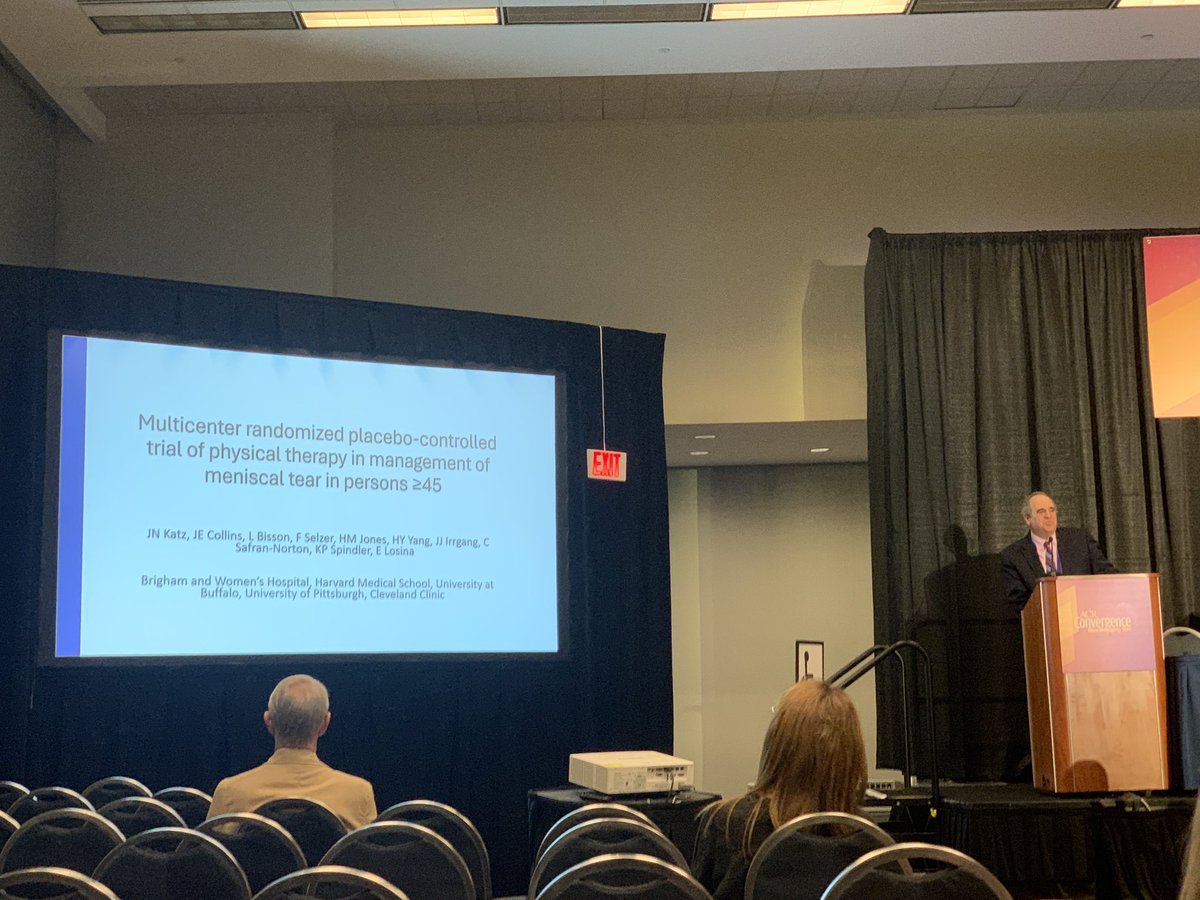
We are so excited to have Dr. Jeff Katz present the results of the @OrACORe_BWH TeMPO trial at #ACR24! Abstract # 1665: Multicenter Randomized Controlled Trial of Physical Therapy (PT) or Sham PT in Persons with Knee Pain, Meniscal Tear, and Osteoarthritic Imaging Changes
Jamie Collins tweet media
English
1
2
6
698
Jamie Collins รีทวีตแล้ว
Johanna Bolander
Johanna Bolander@JohannaBolander·
The deadline is extended so don't miss your chance #early #career #osteoarthritis #investigators! The @OARSInews @OARSI_ECI peer mentoring program is not just unique but also a great opportunity for professional development and building your network!
Johanna Bolander@JohannaBolander

Early OA-career investigator alert! Applications for the second edition of the @OARSInews @OARSI_ECI peer mentoring program is up an you can apply trough the QR code below. A unique opportunity to receive constructive feedback to further develop your peer reviewing skills!

Berlin, Germany 🇩🇪 English
0
6
7
1.2K
Rheum Cat
Rheum Cat@rheum_cat·
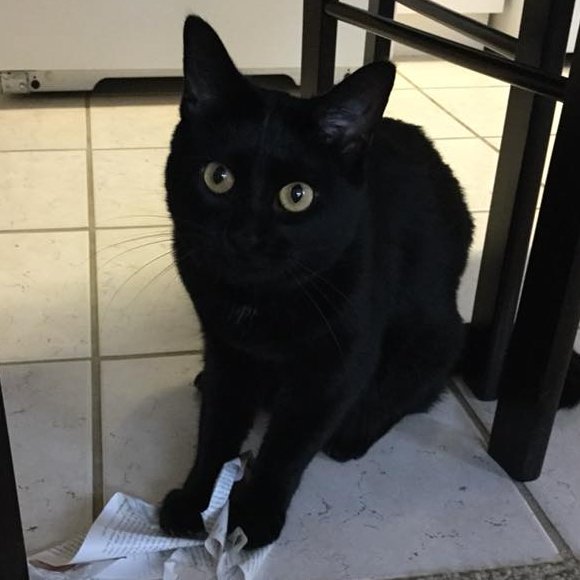
What are these called?
Rheum Cat tweet media
English
4
0
2
2K