Connected Data

5.8K posts

Connected Data banner
Connected Data

Connected Data

@Connected_Data

Connecting Data, People & Ideas since 2016. Using relationships, meaning, context in Data to achieve great things #KnowledgeGraph #GraphDB #AI #SemTech

The World เข้าร่วม Nisan 2016
2.5K กำลังติดตาม6.5K ผู้ติดตาม
ทวีตที่ปักหมุด
Connected Data
Connected Data@Connected_Data·
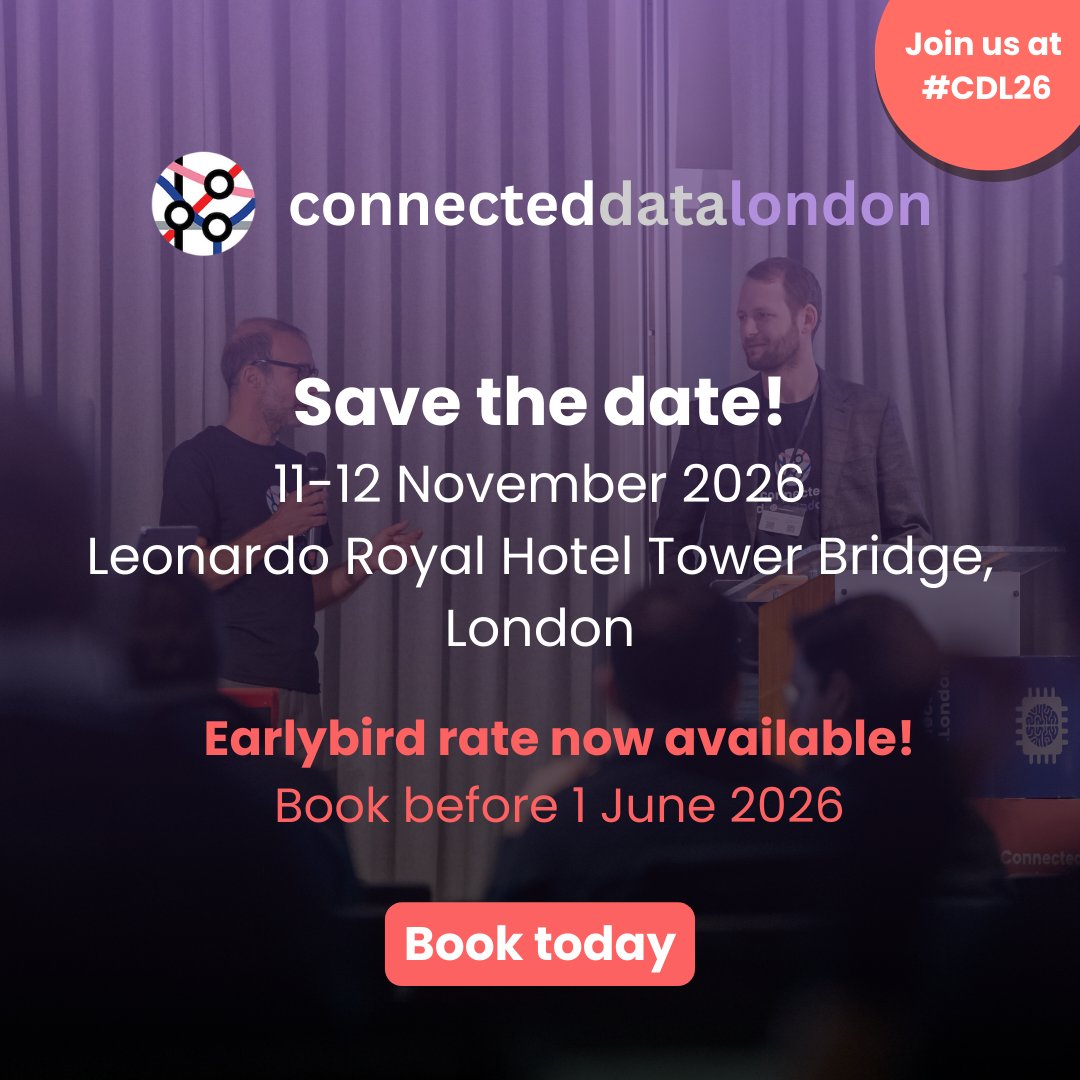
Save the Date: Connected Data London 2026 🚀 We are celebrating 10 years of Connected Data London! Join us on 11–12 November 2026 at the Leonardo Hotel Tower Bridge as we bring together the world’s leading pioneers in Knowledge Graphs, AI, and Linked Data for our milestone anniversary edition. To kick off the countdown, we are proud to announce our first four speakers: 🎤 Keynote: William Tunstall-Pedoe Founder of Unlikely AI and the pioneer behind the technology that powers Amazon Alexa. Joined by: 🔹 Malcolm Hawker – Thought leader and CDO at Profisee. 🔹 Juan Sequeda – Principal Fundamental Researcher at ServiceNow. 🔹 Jessica Talisman – Semantic Architect and Founder of The Ontology Pipeline. From technical masterclasses to world-class keynotes, CDL 2026 will be our most ambitious event yet. Get your Super Earlybird pass here 👉 2026.connected-data.london/?utm_source=tw… Find out more on our blog post: connected-data.london/post/cdl-2026-… #CDL2026 #ConnectedData #10thAnniversary #KnowledgeGraphs #AI #DataStrategy #LondonTech
Connected Data tweet media
English
0
1
2
276
Connected Data
Connected Data@Connected_Data·
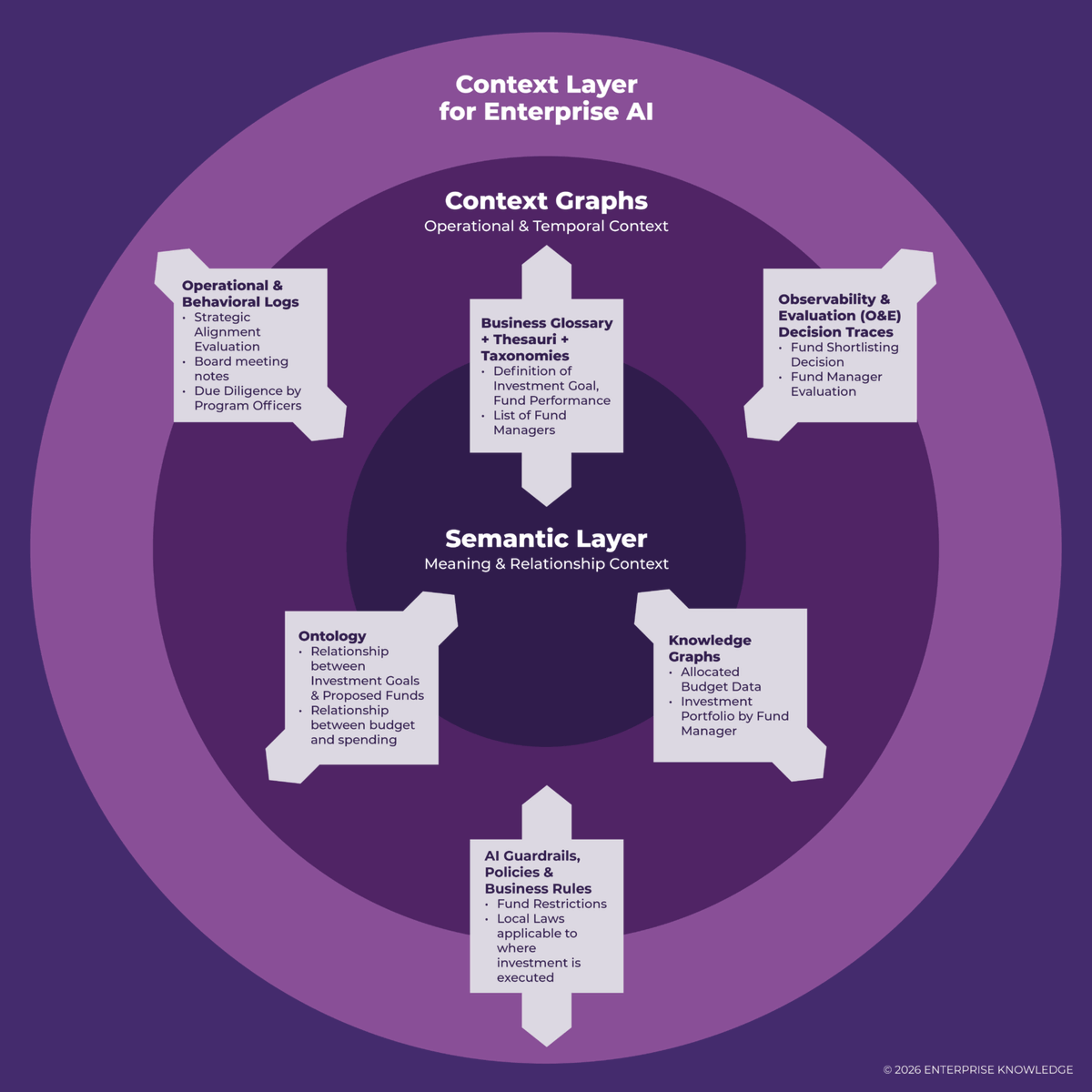
What is the Difference Between a Semantic Layer and a Context Layer?  When to Use a Knowledge Graph vs. a Context Graph Everyone's talking about AI agents. But most are skipping a critical foundation. Your AI can find data. But can it reason about it? There's a crucial — and often confused — distinction in enterprise AI architecture right now: The Semantic Layer defines what your data means. Shared terminology, definitions, relationships between assets. It's the "single source of truth" backbone that connects knowledge across your org. The Context Layer goes further. It wraps that semantic structure with how data is actually used — in real time. Think: user roles, access rights, workflow state, business rules, past decisions, and behavioral signals. The difference matters enormously for AI agents. An AI without a semantic layer makes things up. An AI without a context layer gives you textbook answers that ignore real-world operations. The analogy: A semantic layer tells your AI what "revenue" means. A context layer tells it why revenue is down this quarter and what to do about it. As Lulit Tesfaye at Enterprise Knowledge puts it — this shift from "finding data" to "reasoning and understanding context" is what separates experimental AI from production-grade AI. If your organization is investing in GenAI or agentic workflows, the question isn't "do we need this?" — it's "what do we need to support our use cases now, and what do we grow into?" enterprise-knowledge.com/what-is-the-di… #EnterpriseAI #KnowledgeManagement #SemanticLayer #AIAgents #DataStrategy #GenAI #KnowledgeGraph -- Connected Data London 2026 has been announced! 11-12 November, Leonardo Royal Hotel London Tower Bridge 📝 connected-data.london/post/cdl-2026-… Join us for all things #KnowledgeGraph #Graph #analytics #datascience #AI #graphDB #SemTech #Ontology 🎟 Ticket sales are open. Benefit from early bird prices with discounts up to 30%. 2026.connected-data.london/?utm_source=tw… 📺 Sponsorship opportunities are available. Maximize your exposure with early onboarding. Contact us at info@connected-data.london for more.
Connected Data tweet media
English
0
1
8
204
Connected Data รีทวีตแล้ว
The Year of the Graph
Beyond Context Graphs: How Ontology, Semantics, and Knowledge Graphs Define Context What are context graphs, what are they good for, and why are they dubbed AI’s trillion-dollar opportunity? What does context mean actually, and how can it be defined using graphs and ontologies? And how can different types of graphs and graph technologies power AI? Gartner highlighted Data Management, Semantic Layers, and GraphRAG as Top Trends in Data and Analytics for 2026. Startups and incumbents in the graph technology space are making progress, while graph is becoming the fastest growing segment in AI research. A comprehensive, up-to-date repository, visualization, and analysis of offerings across the graph technology space has been unveiled. New and existing combinations of Graphs and AI are being used to power use cases such as software engineering productivity and supporting enterprise needs at Netflix scale. New graph database products, features, and benchmarks are available. Use cases as well as research and development on ontologies are on the rise too, including topics such as Enterprise Architecture, visual tooling, and quality assessment for LLM-assisted use of ontologies. And yet, the most widely discussed topic in the world of graph technology – and beyond – for this past couple of months has been context graphs. So what are context graphs and where do they fit in the graph technology landscape? In this issue of the Year of the Graph, we explore progress in Ontology, Semantics, Knowledge Graphs, Graph Databases and Analytics, and how these technologies can help define context and power AI. Read here 👉 yearofthegraph.xyz/newsletter/202… cc @SteveHedden @lettria @BarrasaDV @AlexanderErdl @raphaelmansuy @AvagyanVitali @shasbe @Franzinc @SurrealDB @cognee_ @michael_galkin
The Year of the Graph tweet media
English
1
9
42
1.4K
Connected Data
Connected Data@Connected_Data·
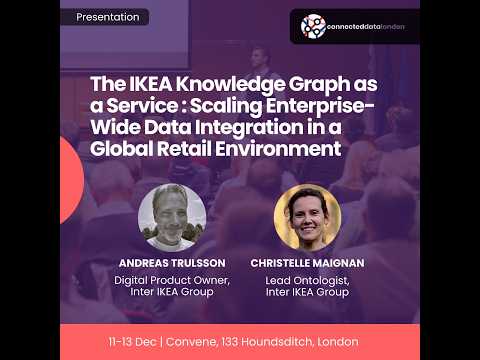
The IKEA Knowledge Graph as a Service: Scaling Enterprise-Wide Data Integration in a Global Retail Environment This presentation explores the journey of implementing a knowledge graph service across a decentralised retail franchise system. We discuss how the IKEA knowledge graph team, after demonstrating significant improvements in online sales through knowledge graph solutions, is now tackling the challenge of expanding their graph to benefit diverse stakeholders. The talk focuses on the strategic approach to offering the IKEA Knowledge Graph as a service to teams, addressing key challenges such as data ownership, governance, onboarding, and training in a non-tech-centric environment. Crucially, it emphasises the importance of effective stakeholder communication in building trust and securing buy-in across the organisation. youtube.com/watch?v=xsaeYL… -- Christelle Maignan. Lead Ontologist, Inter IKEA Group Christelle Maignan is a senior consultant at Semantic Partners and the Lead Ontologist on the IKEA Knowledge Graph team. Christelle is responsible for leading and aligning IKEA ontology development initiatives, onboarding stakeholders, and supporting/up-skilling resources. -- Welcome to Connected Data London's #ThrowbackThursday Every Thursday at 3pm GMT, we are releasing gems from our vault on #YouTube Tune in and learn from leaders and innovators; subscribe to our channel and watch premieres as they are released!  #knowledgegraph #graphdatabase #graph #AI #datascience #analytics #semtech #ontology
YouTube video
YouTube
English
0
1
4
163
Connected Data รีทวีตแล้ว
The Year of the Graph
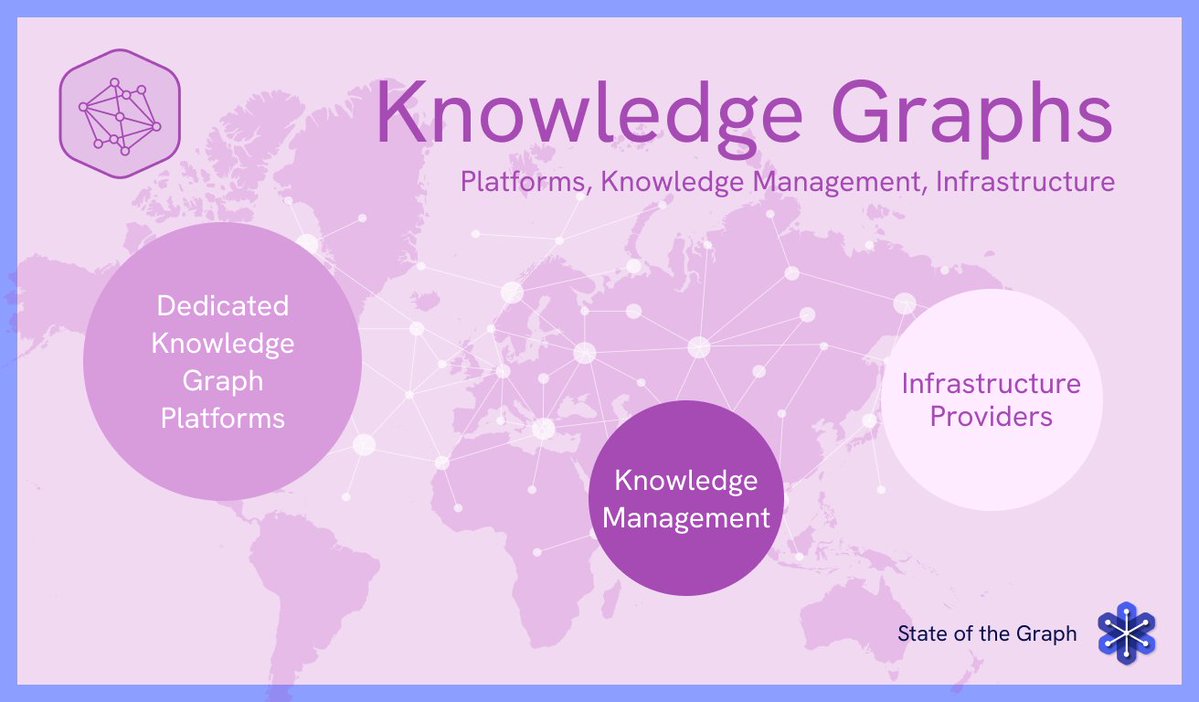
Mapping the Knowledge Graph Continent State of the Graph is continuing its tour of the ecosystem with a first deep dive into the Knowledge Graphs category. Knowledge graphs organize information as a network of entities and relationships, often with semantic meaning, so systems can work with connected context rather than isolated records. The Knowledge Graph market is estimated to be worth USD 1.07 billion in 2024 and is projected to reach USD 6.94 billion by 2030 at a Compound Annual Growth Rate (CAGR) of 36.6% during the same period, according to MarketsandMarkets. For each knowledge graph offering, the State of the Graph catalog captures: * How it models knowledge (property graph-centric, RDF/OWL-centric, or converged property+RDF). * Which graph and query languages it supports (for example, Cypher, Gremlin, SPARQL, GraphQL, proprietary graph queries). * How you construct, integrate, and update the KG (ingestion, automated KG construction, real-time querying, multi-hop reasoning). * Which semantic and metadata capabilities are available (metadata management, ontologies, inferencing, semantic data fabric, lineage, harmonization). * How users explore and curate the graph (visualization, KG exploration, low-code tools, collaboration, curation workflows). * How it supports GenAI (for example, GraphRAG, embeddings, vector search, and agentic AI integration), and how tightly those AI features are coupled to the KG. * Which trust and explainability features it provides (provenance, lineage, schema governance, audit trails, fact grounding, hallucination mitigation, compliance, uncertainty). The knowledge graph catalog brings together dedicated KG platforms, infrastructure providers, and knowledge‑centric search and management tools into a single, structured picture, so you can see who is doing what, where they overlap, and where they differ. stateofthegraph.com/2026/03/17/map… -- The Year of the Graph's Spring 2026 newsletter issue on all things #KnowledgeGraph, #GraphDB, Graph #Analytics / #DataScience / #AI and #SemTech is coming soon. Subscribe and follow to be in the know. Reach out if you'd like to be featured 👇 yearofthegraph.xyz/newsletter
The Year of the Graph tweet media
English
0
3
13
403
Connected Data
Connected Data@Connected_Data·
Beyond Technology: The Human blueprint for building an Enterprise Knowledge Graph Building a knowledge graph in an enterprise is more than a technical project. It is a human and organizational journey. At its core, it requires collaboration across teams, alignment of business priorities, and the creation of a shared language for data and knowledge.  Enterprises that embark on this journey face a series of people-centered decisions.  Where should the process begin in order to build trust and momentum?  Should you cultivate in-house expertise or rely on external partnerships?  How do you assemble a multidisciplinary team that blends business insight with technical skill?  What practices encourage adoption, alignment, and enthusiasm across stakeholders, especially at the leadership level?  What team structure builds the right balance between subject matter expertise, ontological rigor, and product delivery? In this talk, Tara Raafat shares lessons from working with organizations of different sizes and industries, from small firms to global corporations.  Together, we will explore the critical conversations and decisions that shape a successful knowledge graph initiative.  We will discuss how to secure executive sponsorship, manage expectations, and bring diverse stakeholders into alignment.  We will also look at timelines for building confidence, selecting the right early use cases, and demonstrating tangible value.  This is framed in the context of the unique cultural and organizational challenges that every enterprise faces depending on its size, business type, and stage of both technological and knowledge maturity. Link to talk: 2025.connected-data.london/talks/beyond-t… -- Tara Raafat. Head of Metadata and Knowledge Graph Strategy, Bloomberg Dr. Tara Raafat is the head of Metadata and Knowledge Graph Strategy in Bloomberg’s CTO Office, where she leads the development of Bloomberg’s enterprise Knowledge Graph and semantic metadata strategy, aligning it with AI and data integration initiatives. -- Connected Data London 2025 brought together leaders and innovators. Were you there? 🎥 Watch the sessions: 2025.connected-data.london 📩 Join the community: connected-data.london/?utm_source=tw… Welcome to Connected Data London's #TeaserTuesday Every Tuesday, we share teasers from #CDL25 on our channels Tune in and learn from leaders and innovators; subscribe and watch premieres as they are released!  Join community legends and new voices in #CDL25 for all things #KnowledgeGraph #Graph #analytics #datascience #AI #graphDB #SemTech #Ontology
English
0
0
2
132
Connected Data รีทวีตแล้ว
The Year of the Graph
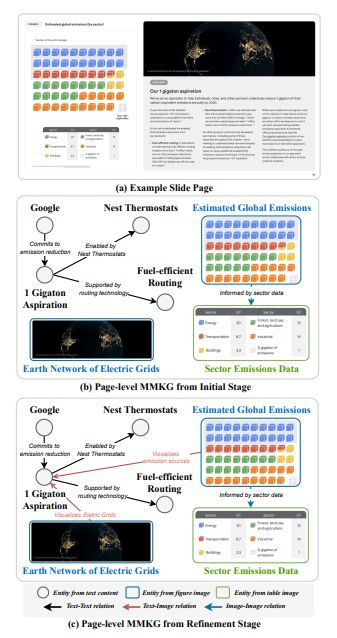
MegaRAG Automatically Builds Knowledge Graphs from Visual Documents Traditional RAG systems struggle with complex multimodal documents like technical reports and slide decks. New research from National Taiwan University and E.sun Financial Holding Co., Ltd introduces MegaRAG, a system that automatically constructs Multimodal Knowledge Graphs (MMKGs) to enhance cross-modal reasoning. Retrieval-augmented generation (RAG) enables large language models (LLMs) to dynamically access external information, which is powerful for answering questions over previously unseen documents. But they struggle with high-level conceptual understanding and holistic comprehension due to limited context windows, which constrain their ability to perform deep reasoning over long-form, domain-specific content such as full-length books. To solve this problem, knowledge graphs (KGs) have been leveraged to provide entity-centric structure and hierarchical summaries, offering more structured support for reasoning. However, existing KG-based RAG solutions remain restricted to text-only inputs and fail to leverage the complementary insights provided by other modalities such as vision. On the other hand, reasoning from visual documents requires textual, visual, and spatial cues into structured, hierarchical concepts. To address this issue, new research from National Taiwan University and E.sun Financial Holding Co. Ltd introduces a multimodal knowledge graph-based RAG that enables cross-modal reasoning for better content understanding. The method incorporates visual cues into the construction of knowledge graphs, the retrieval phase, and the answer generation process. Experimental results across both global and fine-grained question answering tasks show that the approach consistently outperforms existing RAG-based approaches on both textual and multimodal corpora. How it works under the hood: Two-Stage KG Construction: Instead of processing isolated text chunks, MegaRAG takes a page-based approach. It first extracts entities and relations from each page in parallel using multimodal LLMs, treating figures and tables as standalone entities. The initial graph is then refined using a novel subgraph retrieval mechanism that provides global context while maintaining scalability. Cross-Modal Grounding: The refinement stage is key - for each page, MegaRAG retrieves a contextual subgraph from the initial knowledge graph and uses it to identify missing cross-modal relationships. For example, connecting a text mention of "electric vehicle sales increased" with a nearby bar chart showing EV data. Unified Retrieval Architecture: MegaRAG uses GME (General Multimodal Embedder) to create a shared vector space for text, images, and structured knowledge. This enables seamless text-to-text, text-to-image, and hybrid retrieval within the same framework. Modality Bias Solution: Rather than processing text and visual content together (which often leads to text domination), MegaRAG uses a two-stage generation pipeline that separately reasons over textual knowledge graphs and visual content, then synthesizes the results. Results: Consistent outperformance across global and local QA tasks, with particularly strong gains on slide-based datasets where visual content is critical. The system achieved 64.85% accuracy on SlideVQA compared to the next best baseline at 27.66%. Paper: arxiv.org/abs/2512.20626 Code: github.com/AI-Application… #OpenSource #RAG #GraphRAG #GenAI #MulitmodalData #EmergingTech #QA -- The Year of the Graph's Spring 2026 newsletter issue on all things #KnowledgeGraph, #GraphDB, Graph #Analytics / #DataScience / #AI and #SemTech is coming soon. Subscribe and follow to be in the know. Reach out if you'd like to be featured 👇 yearofthegraph.xyz/newsletter
The Year of the Graph tweet media
English
1
6
27
1.1K
Connected Data
Connected Data@Connected_Data·
Ontology Learning and Knowledge Graph Construction: A Comparison of Approaches and Their Impact on RAG Performance Retrieval-Augmented Generation (RAG) systems combine Large Language Models (LLMs) with external knowledge, and their performance depends heavily on how that knowledge is represented. Research by Tiago da Cruz, Bernardo Tavares, Francisco Belo investigates how different Knowledge Graph construction strategies influence RAG performance. They compare a variety of approaches: standard vector-based RAG, GraphRAG, and retrieval over Knowledge Graphs built from ontologies derived either from relational databases or textual corpora. Results show that ontology-guided Knowledge Graphs incorporating chunk information achieve competitive performance with state-of-the-art frameworks, substantially outperforming vector retrieval baselines. Moreover, the findings reveal that ontology-guided Knowledge Graphs built from relational databases perform competitively to ones built with ontologies extracted from text, with the benefit of offering a dual advantage: * They require a one-time-only ontology learning process, substantially reducing LLM usage costs * They avoid the complexity of ontology merging inherent to text-based approaches. Paper: arxiv.org/abs/2511.05991… Code: github.com/tiagocrz/KGs_f… #LLMs #RAG #GraphRAG #EmergingTech #GenAI #OpenSource -- Connected Data London 2025 brought together leaders and innovators. Were you there? 🎥 Watch the sessions: 2025.connected-data.london 📩 Join the community: connected-data.london Join community legends and new voices in #CDL25 for all things #KnowledgeGraph #Graph #analytics #datascience #AI #graphDB #SemTech #Ontology
Connected Data tweet media
English
0
2
15
699
Connected Data รีทวีตแล้ว
The Year of the Graph
The Year of the Graph@TheYotg·
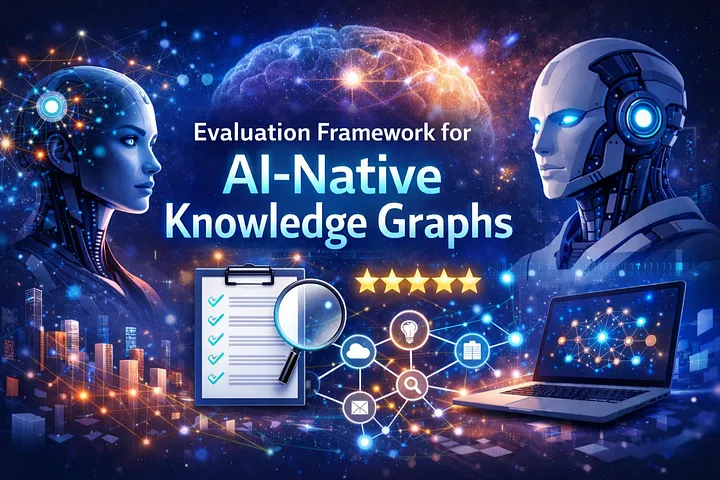
A Unified Framework for AI-Native Knowledge Graphs, Part 3: Evaluation Framework Fanghua (Joshua) Yu introduced Generative Knowledge Modeling (GenKM): a practical methodology for building “living” generative knowledge graphs that connect unstructured documents, extracted entities/relations, higher-level communities, and semantic concepts. After modeling and operators of AI Native knowledge graphs, he defines the evaluation framework. Evaluation is a first-class concern in Generative Knowledge Modeling (GenKM) because Generative Knowledge Graphs (GenKG) pipelines combine deterministic graph operators with probabilistic generative operators. As a result, system quality must be assessed end-to-end, phase-by-phase, and with evidence traceability. This chapter defines evaluation objectives and metrics aligned to the seven GenKG lifecycle phases (formalized in next article), and provides a minimal set of widely used public datasets that can be used to bootstrap benchmarking. It lists: * Evaluation Principles * Evaluation Artifacts (What to Build Once and Reuse) * Metrics by Lifecycle Phase * Common Datasets for Evaluation The article offers a detailed Evaluation Framework with references to reusable benchmarks and datasets. @yu-joshua/a-unified-framework-for-ai-native-knowledge-graphs-1c12c090a36f" target="_blank" rel="nofollow noopener">medium.com/@yu-joshua/a-u… #EmergingTech #Evaluation #GenAI #DataEngineering #DataModeling -- The Year of the Graph's Spring 2026 newsletter issue on all things #KnowledgeGraph, #GraphDB, Graph #Analytics / #DataScience / #AI and #SemTech is coming soon. Subscribe and follow to be in the know. Reach out if you'd like to be featured 👇 yearofthegraph.xyz/newsletter
The Year of the Graph tweet media
English
0
2
20
1.2K
Connected Data
Connected Data@Connected_Data·
RDF Is a Knowledge Representation Model. LPG Is a Decision Infrastructure The debate between a Labelled Property Graph (LPG) and RDF has been ongoing for more than a decade. It is often framed as a question of which model is more expressive, more semantic, or more suitable for a Knowledge Graph. That framing misses a more important distinction. RDF, standardised by the World Wide Web Consortium, is fundamentally a knowledge representation framework. It defines how facts are expressed and how those facts can be interpreted through formal semantics. A LPG, by contrast, is a structural model optimised for computation over relationships. In the current landscape of AI systems, this difference is no longer theoretical. When graphs power retrieval pipelines, digital twins, decision support systems, or contextual reasoning engines, their runtime behaviour matters more than their declarative purity. The question shifts from how knowledge is represented to how decisions are enabled. This article argues that RDF and LPG operate at different architectural layers. One formalises meaning. The other operationalises context. Table of Contents: * The Category Mistake in the LPG versus RDF Debate * What RDF Actually Optimises For * What LPG Actually Optimises For * Knowledge Representation versus Decision Infrastructure * GraphRAG as a Stress Test * Applied Knowledge Graph Revisited * Where RDF Excels sergeyvasiliev.substack.com/p/rdf-is-a-kno… -- Connected Data London 2025 brought together leaders and innovators. Were you there? 🎥 Watch the sessions: 2025.connected-data.london 📩 Join the community: connected-data.london Join community legends and new voices in #CDL25 for all things #KnowledgeGraph #Graph #analytics #datascience #AI #graphDB #SemTech #Ontology
Connected Data tweet media
English
0
1
12
423
Connected Data รีทวีตแล้ว
The Year of the Graph
The Year of the Graph@TheYotg·
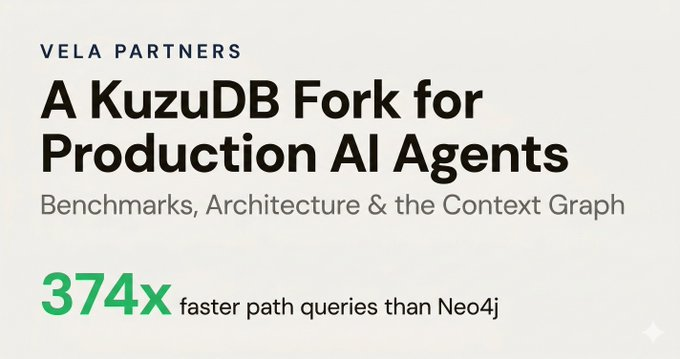
Why Graph Memory Works, and KuzuDB for Production AI Agents Every startup building AI agents is going to hit the memory wall. Agents will need to remember what they learned. They'll need to trace why a decision was made. They'll need to share knowledge across a fleet of agents. That's a graph problem. Vela Partners are constantly running experiments that push the limits of what autonomous agents can do. As a quant venture capital firm they think beyond a single asset class. Part of that means stress-testing agent architectures in domains where the feedback loops are fast and unforgiving, the way an AI-native hedge fund would test its models against live markets. That work is where they first needed graph memory: agents making continuous decisions need to remember what worked and why. A relational database tells you what happened, but it cannot efficiently answer why. The pattern generalizes to any multi-agent domain. Vela's Oxford research partnership has produced over ten peer-reviewed publications on quantified decision-making. A consistent finding: the structure of relationships between signals and outcomes carries predictive information that the signals alone do not. The context graph is the production embodiment of that finding. Graph memory is how to make causal structure queryable at the speed agents need. When the KuzuDB project moved on to new things last year, Vela Partners had already built an AI agent memory system on top of it. Their agents make hundreds of decisions daily, and the context graph is what lets them reason about chains of cause and effect across sessions. So they forked KuzuDB and added concurrent multi-writer support, because when you have multiple AI agents writing to a shared knowledge graph simultaneously, you need that. The original KuzuDB allows only one writer at a time. In Vela Partners' architecture multiple agents write to the context graph simultaneously. Serialized writes would bottleneck the entire system and get worse as the agent count grows. They added concurrent multi-writer support. They now own this dependency fully, pull improvements from the community selectively, and carry no upstream abandonment risk. vela.partners/blog/kuzudb-ai… #OpenSource #AgenticAI #DataEngineering #SoftwareEngineering #GraphMemory #GenAI #EmergingTech -- The Year of the Graph's Spring 2026 newsletter issue on all things #KnowledgeGraph, #GraphDB, Graph #Analytics / #DataScience / #AI and #SemTech is coming soon. Subscribe and follow to be in the know. Reach out if you'd like to be featured 👇 yearofthegraph.xyz/newsletter
The Year of the Graph tweet media
English
0
2
9
440
Connected Data
Connected Data@Connected_Data·
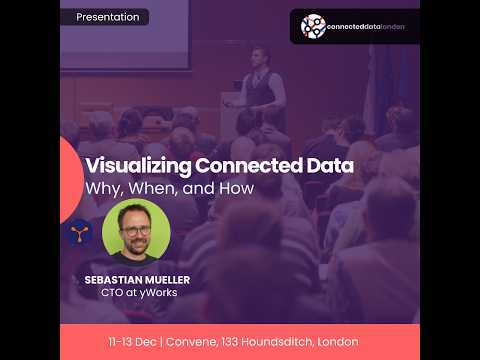
Visualizing Connected Data: Why, When, and How Connected data often lends itself perfectly to visualization, but not all visualizations add value. In this talk, you will learn when to use visualization and how to maximize its benefits. Drawing on over 20 years of professional experience, Sebastian will illustrate the key moments when visualization is essential, the tools available for creating effective visualizations, and the reasons why these tools are invaluable for gaining insights into connected data. Through practical examples and expert insights, this talk will equip you with the knowledge to make your data visualizations truly impactful. youtube.com/watch?v=XTnUjt… -- Sebastian Mueller. CTO at @yworks Sebastian has been working professionally in the field of graph visualization for over 20 years. He is a frequent speaker at graph-related conferences, consistently earning high ratings for his presentations at Neo4j's "NODES" conferences. -- Welcome to Connected Data London's #ThrowbackThursday Every Thursday at 3pm GMT, we are releasing gems from our vault on #YouTube Tune in and learn from leaders and innovators; subscribe to our channel and watch premieres as they are released! #knowledgegraph #graphdatabase #graph #AI #datascience #analytics #semtech #ontology
YouTube video
YouTube
English
0
2
8
370
Connected Data
Connected Data@Connected_Data·
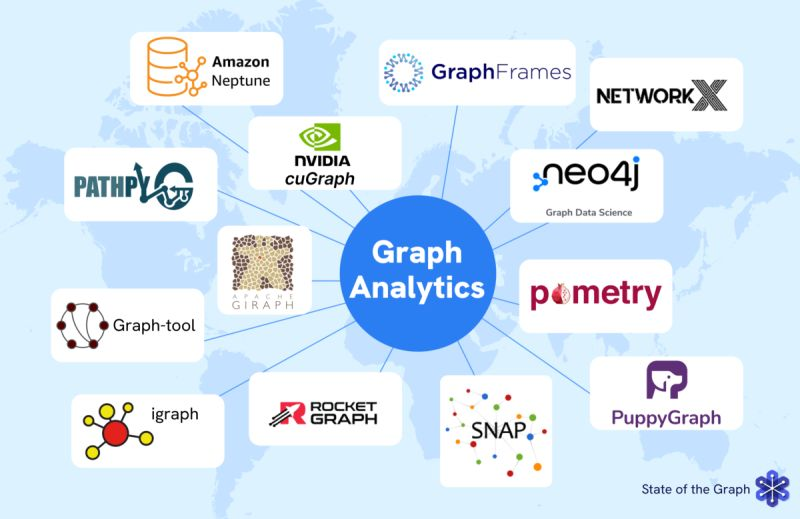
A visual map of the Graph Analytics landscape Graph analytics uses graph queries and algorithms to uncover patterns and relationships in connected data, from fraud rings and attack paths to recommendation paths, communities, and influence. It sits at a key intersection in the graph stack, where data platforms, algorithms, and applications come together to reveal structure you can’t see in rows and columns. The State of the Graph recently published an open access catalog of all offerings in the Graph Analytics category, with detailed information for each one. Today they published a visual aid to help navigate this landscape. 📌 Explore the catalog and visualization: stateofthegraph.com/graph-analytic… #visualization #graphanalytics #algorithms #datascience -- Connected Data London 2025 brought together leaders and innovators. Were you there? 🎥 Watch the sessions: 2025.connected-data.london 📩 Join the community: connected-data.london Join community legends and new voices in #CDL25 for all things #KnowledgeGraph #Graph #analytics #datascience #AI #graphDB #SemTech #Ontology
Connected Data tweet media
English
0
2
4
273
Connected Data รีทวีตแล้ว
The Year of the Graph
The Year of the Graph@TheYotg·
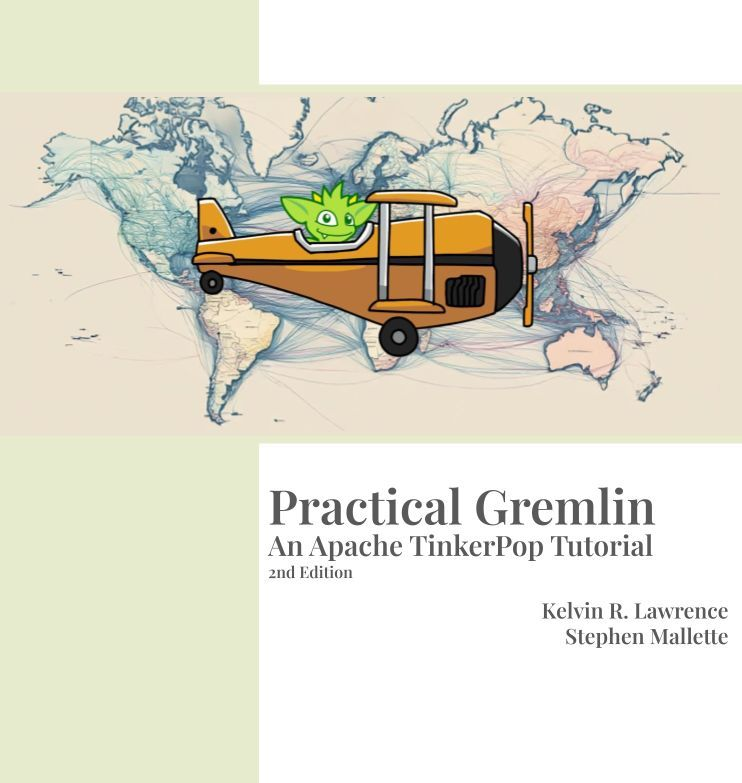
The Second Edition of Practical Gremlin: An Apache TinkerPop Tutorial is officially published Gremlin is a graph traversal language and virtual machine developed by Apache TinkerPop of the Apache Software Foundation. Gremlin works for both OLTP-based graph databases as well as OLAP-based graph processors. "Practical Gremlin" is a popular, free, open-source book and tutorial by Kelvin Lawrence that teaches Gremlin. It provides hands-on examples, recipes, and best practices for querying graph databases using a sample dataset of worldwide airline routes. It functions as a "getting started" guide, featuring hints, tips, and sample queries for beginners and experienced users. The book uses the "air-routes" dataset, featuring 3,504 airports and 50,637 routes to demonstrate how to use Gremlin for real-world data problems. It covers the core concepts of graph databases, how to write efficient traversals, and how to use the Gremlin Console. It is available online via GitHub and as a free eBook, and it is designed to work with any graph system that supports Apache TinkerPop. The book is a widely recognized resource for learning how to query graph data, focusing on practical, actionable examples rather than just theory. But there are many changes in Gremlin since the release associated with the first edition, and many readers were learning from material that no longer reflected the state of the language. A core contributor and long-time maintainer of Apache TinkerPop and Gremlin, Stephen Mallette has helped define the standards and architecture behind some of the world’s most prominent graph systems. In 2023, he started talking to Kelvin Lawrence with the idea of updating the book. What followed was a deep effort to modernize and refine the book. Every single example was executed against Apache TinkerPop 3.8.0, reviewed, and updated to reflect the latest semantics and best practices. Entirely new content was added to cover significant language changes, all while keeping the focus tight and purposeful. The new edition is leaner and more focused, centered squarely on Gremlin the language rather than the broader TinkerPop ecosystem. It’s meant to take readers deeper into querying, helping them build fluency and confidence step by step. The official TinkerPop Reference documentation is comprehensive, but Practical Gremlin continues to serve as a true guidebook, walking readers through the language in a way that’s approachable and progressive. The new edition now lives at its official home, where it’s automatically published as a living book that is continuously updated as new content arrives. krlawrence.github.io/graph/ #OpenSource #Books #NewRelease #Tutorial -- The Year of the Graph's Spring 2026 newsletter issue on all things #KnowledgeGraph, #GraphDB, Graph #Analytics / #DataScience / #AI and #SemTech is coming soon. Subscribe and follow to be in the know. Reach out if you'd like to be featured 👇 yearofthegraph.xyz/newsletter
The Year of the Graph tweet media
English
0
2
7
504
Connected Data
Connected Data@Connected_Data·
Combining Data from Structured and Unstructured Sources to create High-Quality Knowledge Graphs An important obstacle for adopting knowledge graph technology in enterprise is that so much enterprise-level data is originally stored in unstructured formats, or in some structured format such as tables – though not as graph data. Therefore, an inevitable first step in adopting graph technologies is to convert these data sources into high-quality knowledge graphs. This tutorial walks through the different steps of this process and covers a suite of tools and technologies one can use to construct knowledge graphs, run interactive visualizations, and leverage agentic workflows for use cases which need high-quality knowledge graphs. In this tutorial we will: Use entity resolution from Senzing to merge OpenSanctions, Open Ownership, and GLEIF datasets. Load the structured data as Polars dataframes to construct a knowledge graph in KùzuDB. Annotate the graph for semantic modeling using the FollowTheMoney vocabulary to represent anti-corruption investigations and the BODS vocabulary to represent beneficial ownership. Add synthetic data for wire transfer transactions among the fraud rings within the graph, to simulate the tradecraft of money laundering. Develop agentic workflows in BAML to extract entities and relations from news articles about the entities named in the graph. Leverage graph algorithms in NetworkX: Louvain partitioning to identify subgraphs as potential fraud rings within graph, and betweenness centrality to rank individuals of interest within each subgraphs. Visualize the subgraphs using yWorks yFile, emphasizing the links to known risks. Overall, we'll leverage insights from the steps above to identify patterns of fraud tradecraft within the graph, as a fraud analyst at a bank would do. This pattern of integrating structured and unstructured data sources into a high-quality knowledge graph is an incredibly common need in the real world. Downstream, there may be many kinds of use cases, e.g., graph analytics, dashboards, GraphRAG, question/answer chat bots, agents, and so on. Link to Masterclass: 2025.connected-data.london/talks/combinin… -- Paco Nathan. Principal DevRel Engineer, Senzing @pacoid is a Principal DevRel Engineer at Senzing.com leading the Knowledge Graph practice area, and is a computer scientist with +40 years of tech industry experience and core expertise in data science, natural language, graph technologies, and cloud computing. -- Connected Data London 2025 brought together leaders and innovators. Were you there? 🎥 Watch the sessions: 2025.connected-data.london 📩 Join the community: connected-data.london Welcome to Connected Data London's #TeaserTuesday Every Tuesday, we share teasers from #CDL25 on our channels Tune in and learn from leaders and innovators; subscribe and watch premieres as they are released! Join community legends and new voices in #CDL25 for all things #KnowledgeGraph #Graph #analytics #datascience #AI #graphDB #SemTech #Ontology
English
1
3
11
386
Connected Data รีทวีตแล้ว
The Year of the Graph
The Year of the Graph@TheYotg·
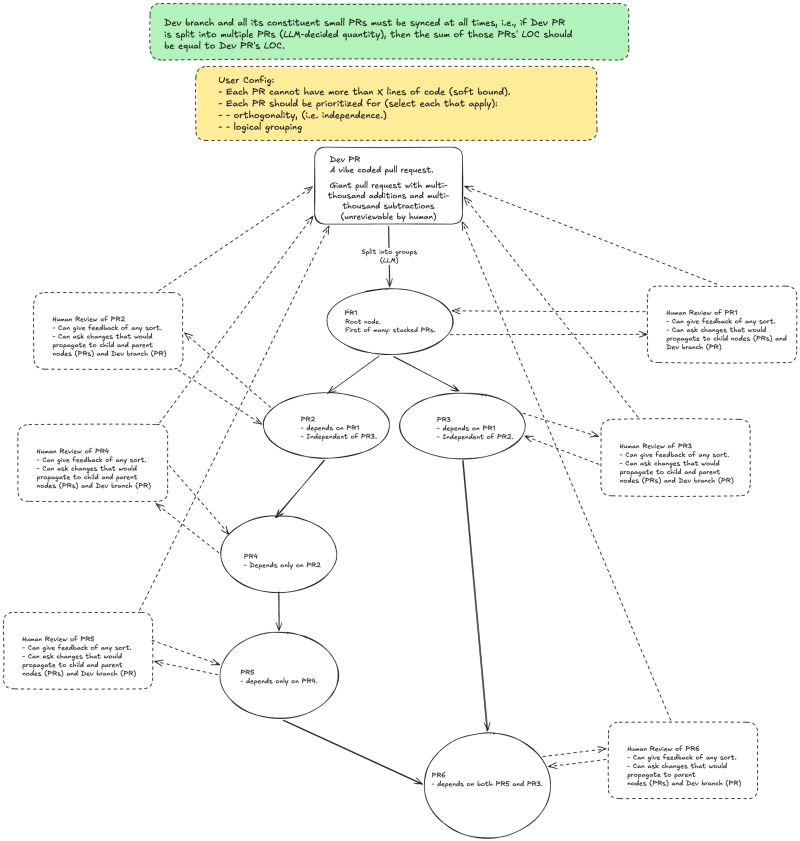
pr-split: Decomposing large PRs into a Directed Acyclic Graph of small, reviewable stacked PRs Vibe coding with AI assistants can produce massive pull requests that no one wants to review. A 2,000 line PR with changes across dozens of files is a review bottleneck: teammates skim it, rubber stamp it, or just ignore it. pr-split turns that monolith into a stack of focused, bite-sized PRs teams can review with confidence. Each sub-PR has a clear purpose, minimal scope, and explicit dependencies, so reviewers know exactly what changed and why. pr-split takes a large pull request (local branch, fork PR number, or user:branch), sends the diff to an LLM for analysis, and produces a split plan: a set of smaller, focused PRs arranged in a dependency DAG. Each sub-PR gets its own branch, commit, and GitHub PR targeting the correct base. What it does 1. Extracts the merge-base diff between your branch and the base (same view as GitHub's PR page) 2. Sends the diff to the configured LLM, which groups hunks into logical sub-PRs with dependency ordering 3. Validates the plan: full coverage (every hunk assigned exactly once), no cycles, no merge conflicts between independent groups 4. Shows you the plan (table + dependency tree) and asks for confirmation 5. Creates branches, commits, pushes, and opens GitHub PRs in topological order 6. For diffs exceeding the model's context window, automatically chunks the diff and processes sequentially, carrying forward the group catalog across chunks github.com/vitali87/pr-sp… #OpenSource #SoftwareEngineering #VibeCoding #AIAssistants #AICoding #EmergingTech #LLMs -- The Year of the Graph's Spring 2026 newsletter issue on all things #KnowledgeGraph, #GraphDB, Graph #Analytics / #DataScience / #AI and #SemTech is coming soon. Subscribe and follow to be in the know. Reach out if you'd like to be featured 👇 yearofthegraph.xyz/newsletter
The Year of the Graph tweet media
English
1
2
23
1.2K
Connected Data
Connected Data@Connected_Data·
Context Graphs Community Group in the W3C Context graphs are advanced data structures that map relationships between enterprise entities (people, systems, documents) and the actions or decisions connecting them. The intent for context graphs is capture the "why" behind decisions, including constraints, precedents, and provenance, enabling AI agents to understand, act, and reason with context. The World Wide Web Consortium (W3C) is the main international standards organization for the World Wide Web. W3C Community Groups can produce reports which, while not being W3C Recommendations, can serve as prototype for future W3C Working Groups. Recently, the W3C Context Graphs Community Group was formed. Its mission is to develop specifications, vocabularies, and best practices for representing and resolving contextual misalignment between global knowledge representations (e.g., organizational knowledge bases, ontologies, policies, and shared data models) and local interpretation contexts (e.g., user intent, operational setting, execution constraints, or domain-specific framing) in decision systems and human–AI workflows. Many decision and information systems implicitly assume that the shared knowledge model and the local context at the point of interaction are aligned. In practice, this alignment frequently fails: terms carry different meanings across organizational, temporal, or operational boundaries; assumptions embedded in global models do not hold locally; and key context required to interpret state, policy, or meaning is absent, unavailable, or ambiguous at the point of use. These failures are distinct from data quality or optimization problems—they represent a structural interoperability gap in how context is communicated, validated, and resolved across systems. A Context Graph treats this gap as a first-class, interoperable artifact: a structured representation of the contextual prerequisites required for valid interpretation, their dependencies, and their resolution status. The Community Group will formalize: (1) a core data model for expressing contextual prerequisites and resolution state, (2) a minimal vocabulary for describing common categories of contextual mismatch, and (3) optional protocol guidance for structured clarification and safe stopping conditions when required context cannot be resolved. The goal is to enable independent systems to detect contextual misalignment, request missing prerequisites, and converge on a locally valid interpretation before downstream computation or decision-making proceeds. This group will develop one or more specifications for representing Context Graphs, including: (1) a core data model for contextual prerequisites and their dependencies, (2) vocabularies for expressing resolution status and common categories of global–local contextual mismatch, and (3) optional protocol guidance for structured clarification and safe stopping conditions when required context cannot be resolved. The group will also produce use cases, requirements, test vectors, and best-practice guidance for implementers in knowledge management, enterprise decision workflows, and human–machine / human–AI systems. This group intends to publish Community Group Reports, including specification-style documents and supporting notes (e.g., use cases, requirements, and implementation guidance). Who should participate: Practitioners and researchers in knowledge representation, semantic web technologies, ontology engineering, decision science, AI/ML systems integration, enterprise knowledge management, and human–computer interaction. Developers building systems where shared knowledge models must be interpreted across diverse operational contexts are especially encouraged to join. The Group's Chair, Ron Itelman, published a note exploring the parallels between what Shannon's Information Theory meant for formalizing Information and what the Group's work aims to do for Context. Information and Context: linkedin.com/posts/ronitelm… Context Graphs Community Group w3.org/community/cont… #ContextGraphs #EmergingTech #Community #Standards -- Connected Data London 2025 brought together leaders and innovators. Were you there? 🎥 Watch the sessions: 2025.connected-data.london 📩 Join the community: connected-data.london Welcome to Connected Data London's #TeaserTuesday Every Tuesday, we share teasers from #CDL25 on our channels Tune in and learn from leaders and innovators; subscribe and watch premieres as they are released! Join community legends and new voices in #CDL25 for all things #KnowledgeGraph #Graph #analytics #datascience #AI #graphDB #SemTech #Ontology
Connected Data tweet media
English
0
3
13
527
Connected Data รีทวีตแล้ว
The Year of the Graph
The Year of the Graph@TheYotg·
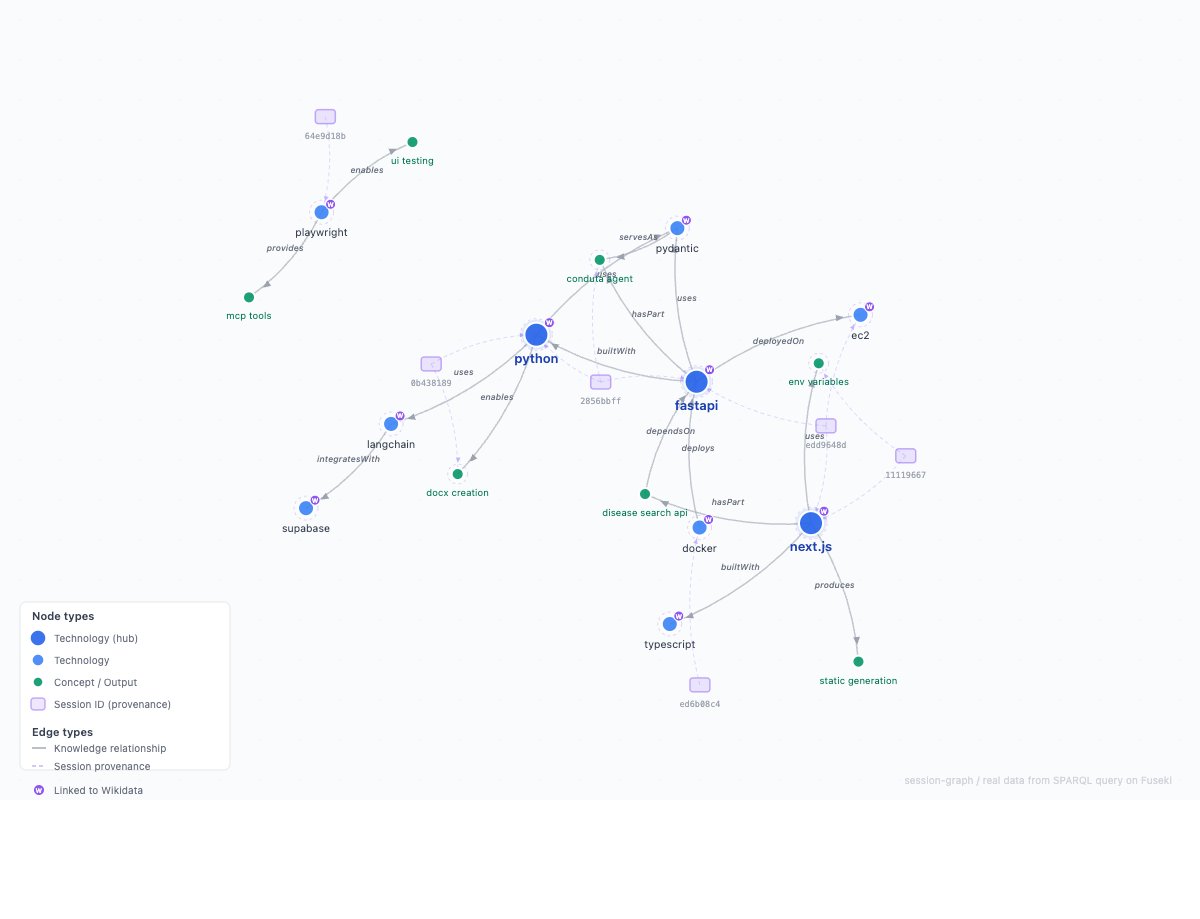
session-graph: Turn your scattered AI coding sessions into a queryable knowledge graph Developers use 5+ AI tools every day -- Claude Code, ChatGPT, Cursor, Copilot, Grok, DeepSeek, Warp. Each session is an isolated silo. Knowledge dies when the tab closes. They solve the same problem three times across different tools and cannot find any of them. Existing solutions are single-platform and flat-file. They give you search over one tool's history, not structured relationships across all of them. A grep over session logs does not tell you that FastAPI uses Pydantic or that Neo4j is a type of graph database. It just gives you walls of text. session-graph promises to fix this. session-graph extracts structured knowledge triples -- (subject, predicate, object) -- from all your AI coding sessions, links entities to Wikidata for universal disambiguation, and loads everything into a SPARQL-queryable triplestore with full provenance back to the source conversation. Features: * Multi-platform: Ingests Claude Code, ChatGPT, DeepSeek, Grok, and Warp into a single unified graph. No other tool does this. * Formal ontology: Composes 5 W3C/ISO standards (PROV-O, SIOC, SKOS, Dublin Core, Schema.org) instead of inventing a custom schema. * Wikidata linking: Entities are disambiguated against 100M+ Wikidata items via owl:sameAs. "k8s", "kubernetes", and "K8s" all resolve to Q22661306. * Full provenance: Every knowledge triple traces back to the exact source message, session, platform, and file path. * Federated queries: SPARQL can query your local graph and Wikidata in a single query. Once the graph database has data, you don't need to write SPARQL by hand. session-graph ships with a Claude Code skill (devkg-sparql) that translates natural language questions into SPARQL queries, runs them, and returns formatted results. By @RobertoShimizu github.com/robertoshimizu… #SoftwareEngineering #AICoding #EmergingTech -- The Year of the Graph's Spring 2026 newsletter issue on all things #KnowledgeGraph, #GraphDB, Graph #Analytics / #DataScience / #AI and #SemTech is coming soon. Subscribe and follow to be in the know. Reach out if you'd like to be featured 👇 yearofthegraph.xyz/newsletter
The Year of the Graph tweet media
English
4
4
30
1.3K
Connected Data
Connected Data@Connected_Data·
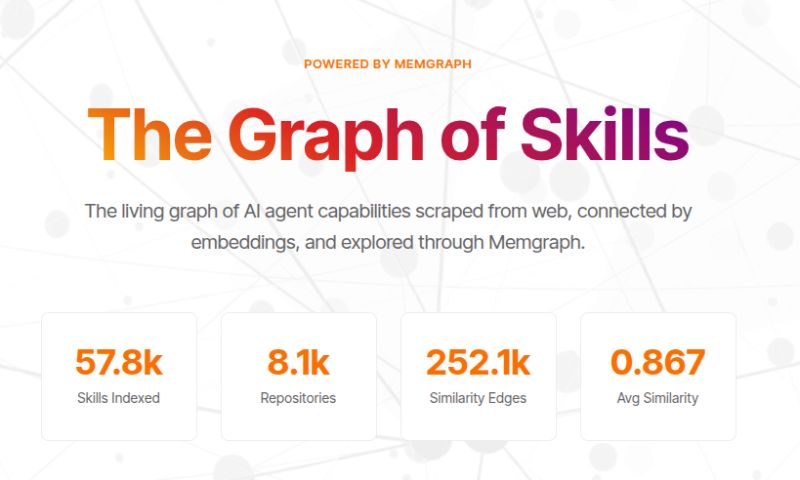
The Graph of Skills A living graph of AI agent capabilities scraped from web, connected by embeddings, and explored through Memgraph. Skills in organizations should not be a static list, but a living graph that reveals how capabilities connect. Asking a question in organization about Python skills, should pull all relevant skills that drive your agent capabilities. Agent Skills are the procedural memory you keep in your head on how to solve a particular problem, which can be very valuable, whether you are aware of that or not. You are constantly adapting and changing that procedural memory since the task is usually not fully deterministic, hence it cannot be a script. Agent skills could hold all the operational knowledge, allowing agents to operate semi-autonomously or autonomously to solve the particular operational problem. If you have hundreds or thousands of skills in your organisation, the question is: how are you going to maintain them, how will they learn and evolve, and how will agents access them? If the tool's API changes, so should the skills, which causes a cascade of events across the files. Then the question becomes: how are those connected and correlated? This is what graphs as a structure are built for. Ante Javor built the graph of skills with @memgraphdb meant to serve as a test bench for running the evolution, traceability, and access to skills. skillinsight.io #EmergingTech #AgenticAI #GenAI #Visualization -- Connected Data London 2025 brought together leaders and innovators. Were you there? 🎥 Watch the sessions: 2025.connected-data.london 📩 Join the community: connected-data.london Join community legends and new voices in #CDL25 for all things #KnowledgeGraph #Graph #analytics #datascience #AI #graphDB #SemTech #Ontology
Connected Data tweet media
English
0
0
9
278
Connected Data
Connected Data@Connected_Data·
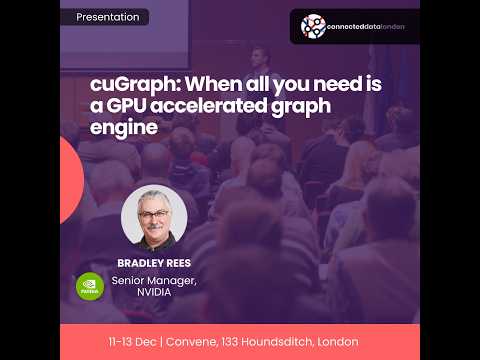
cuGraph: When all you need is a GPU accelerated graph engine There is an assumption that if you have graph data that you must have a graph database. That is not the case. This talk presents the open-source cuGraph graph engine and talk about recent scalability and performance numbers. The talk also dives into how a graph engine can fit into applications, include those with a graph database. youtube.com/watch?v=-tmo-T… -- Bradley Rees. Senior Manager, NVIDIA Brad Rees is a Senior Manager at NVIDIA and lead of the RAPIDS cuGraph team. Brad specializes in complex analytic systems, primarily using graph analytic techniques for social and cyber network analysis. His technical interests are in HPC, machine learning, deep learning, and graphs. Brad has a Ph.D. in Computer Science from the Florida Institute of Technology. -- Welcome to Connected Data London's #ThrowbackThursday Every Thursday at 3pm GMT, we are releasing gems from our vault on #YouTube Tune in and learn from leaders and innovators; subscribe to our channel and watch premieres as they are released! #knowledgegraph #graphdatabase #graph #AI #datascience #analytics #semtech #ontology
YouTube video
YouTube
English
0
1
5
395