

Dylan Spicker
15 posts

Dylan Spicker
@DylanSpicker
Statistics. Assistant Professor at UNBSJ. They/Them. 🏳️🌈🏳️⚧️
New Brunswick เข้าร่วม Nisan 2010
79 กำลังติดตาม49 ผู้ติดตาม

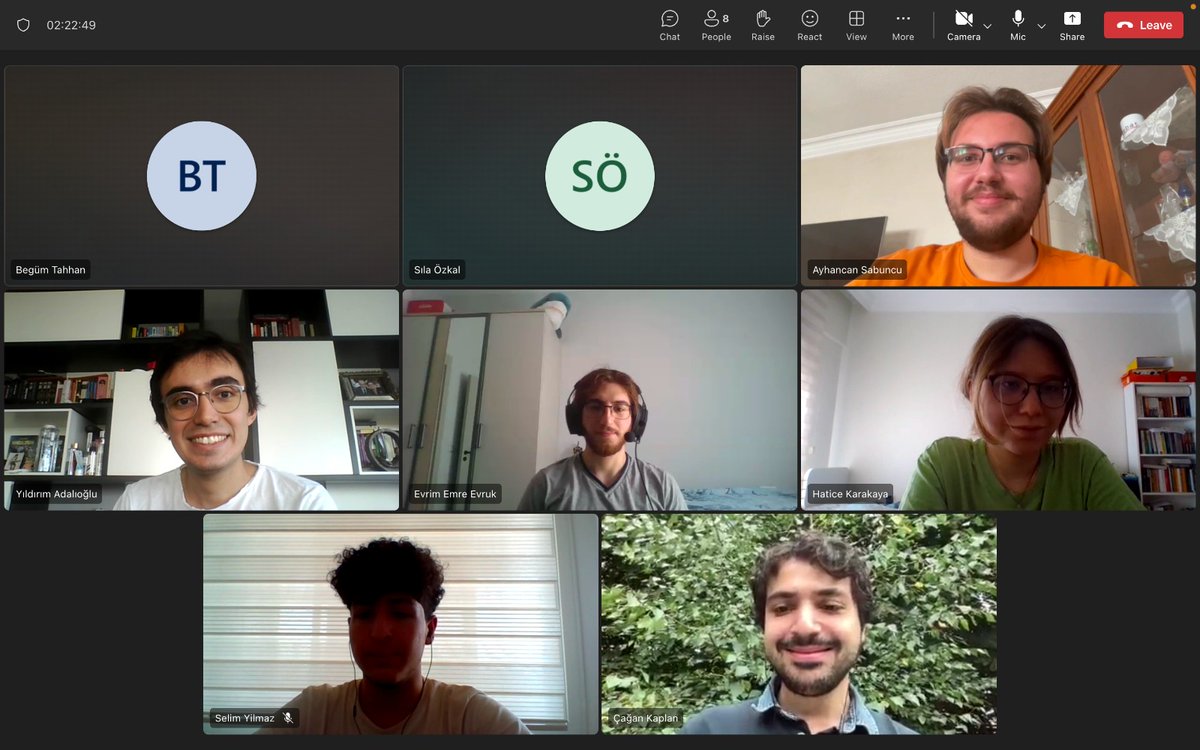
As Advanced Studies student group, in our meeting, we started discussing the survival analysis lectures of the Statistical Methods for Life History Analysis course for our project about the survival analysis of cancer patients. We wish you all a fruitful study :) @DylanSpicker

English
@VMSuriyakumar Great work!
I have only given it a first pass, so apologies if this is obvious. If I understand correctly, the claim is that "worsenalization" is specific to model-dataset combinations? That is, this is not probabilistic when models are applied to randomly distributed variates?
English
Preparing to teach introductory statistics this coming term, and I am confronted with the usual dilemma of explaining the unbiased variance estimator...
Thoughts on simply dividing by 'n' until bias in estimation is introduced later on? #StatsTwitter
English
@statacake I think that given the 98%+ missingness it is probably reasonable to assume that by matter of practice race was not recorded for these data. This makes me feel like it is more a matter of how the data are being recorded, policies there, etc.
English
@statacake If the record came from only the citation file, it appears almost certain that it would be missing. (Over 98% of these records). I don't see any real difference between whether race is recorded here.
English
Twitter can you help with this data puzzle
A dataset of police stops includes subject race and whether a citation was issued. Race is missing for ~30%
Of those issued a citation, 3% have race recorded.
Of those not issued a citation, 97% have race recorded.
Any ideas why?
English
@statacake Interesting. I wonder if it is a Chicago problem.
The Chicago readme states "Data includes warnings and arrests, but is missing warnings".
This appears to be a typo, but I wonder if Chicago data contains "warnings" under "citations" which could be the bulk of the stops?
English
@DylanSpicker I'm just looking at the Chicago dataset, which shows about 30% 'citation' - I'm now wondering if there's an issue with that variate since if across all locations it's a 5% citation rate, that would seem pretty odd for this location
English
@statacake Is this looking across all locations? And how much does the data skew towards "no citation"?
The reported coverage rates (github.com/stanford-polic…) and your results seem to suggest that something like 95% of the total records would have to be "no citation". Is it that dramatic?
English
Notes:
- This is from the Stanford Open Policing Project openpolicing.stanford.edu
- About 15% of the 'no citation' group were arrested (all arrests have race recorded). This explains some, but nowhere near all, of the discrepancy.
- It is possible I've got a bug in my code.
English
@statacake I think that for those who have little to no R experience, the burden of learning ggplot2 (or tidyverse broadly) is not appreciably larger than the burden of learning base R graphics.
The big struggle is all of us coming from years of experience with base R.
English
Question for #RStats folks: is it worth the time investment to use ggplot2 in an intro stats class (2nd year undergrad, first time using R) where the only graphical work is histograms and scatter/bar/box/qq plots? I'm unsure how much overhead (if any) it adds over base graphics
English
@statacake I suppose that I should've asked for your thoughts in xi before making it perhaps the central symbol in the draft of our manuscript. Oops !
English
I still refuse to ever use the monstrosity that is 'xi' though
English
You know your paper might be a bit long when you've run out of Greek letters you can easily remember and have to look up the alphabet on Wikipedia to finish off your notation
English