Helmut d'Enfer รีทวีตแล้ว

Kaspa is building something that no other L1 has in such a cohesive way: parallel DAG + analytic UTXO + ZK without compromising parallelism. According to backend?
English
Helmut d'Enfer
20.3K posts



I finally did some research on Bitcoin vs Kaspa. Here’s what I found. Mega thread below 🧵

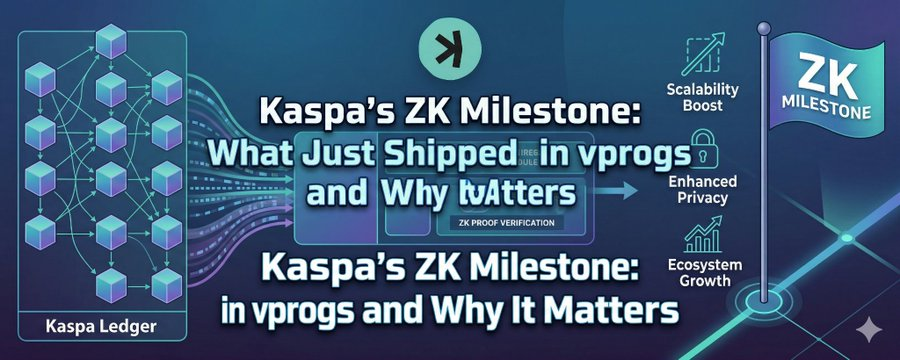
Okay, it's time for a little update: I just finished the work on the zero knowledge part of the vprogs framework, which introduces the ability to prove arbitrary computation. It consists of the following 8 PRs that gradually introduce the necessary features: 1. ZK-framework preparations (github.com/kaspanet/vprog…): This PR cleans up the scheduler and storage layers, extends the build tooling with workspace-wide dependency checking, adds the ability to publish artifacts for transactions and batches (which will later hold the proofs), renames some core types for clarity, and introduces lifecycle events on the Processor trait that allow a VM to hook into key scheduler events like batch creation, commit, shutdown, and rollback. 2. Core Codec (github.com/kaspanet/vprog…): This PR introduces a lightweight encoding library for ZK wire formats. In a zkVM guest, every byte operation contributes to the proof cost, so the codec is designed to reinterpret data in-place rather than copying it. It includes zero-copy binary decoding (Reader, Bits) and sorted-unique encoding for deterministic key ordering. It is built for no_std so it runs inside zkVM guests. 3. Core SMT (github.com/kaspanet/vprog…): To prove state transitions, we need cryptographic state commitments. This PR adds a versioned Sparse Merkle Tree that produces a single root hash representing the entire state. It includes all state-of-the-art optimizations: shortcut leaves at higher tree levels to avoid full-depth paths for sparse regions, multi-proof compression that shares sibling hashes across multiple keys, and compact topology bit-packing to minimize proof size. It integrates into the existing storage and scheduler layers so that every batch commit updates the authenticated state root, while rollback and pruning maintain tree consistency. 4. ZK ABI (github.com/kaspanet/vprog…): Defines the wire format for communication between the host and zkVM guest programs, establishing a universal language for proof composition. It specifies how inputs, outputs, and journals are structured for two levels of proving: the transaction processor, which proves individual transaction execution against a set of resources, and the batch processor, which aggregates transaction proofs and proves the resulting state root transition. Because the ABI is backend-agnostic and no_std compatible, any zkVM backend can directly use it (non-Rust zkVMs would need to reimplement the ABI in their language). 5. ZK Transaction Prover (github.com/kaspanet/vprog…): Introduces the transaction proving worker, which receives serialized execution contexts via the ABI wire format and submits them to a backend-specific prover on a dedicated thread. The Backend trait abstracts the actual proof generation, so different zkVM backends can be swapped without changing the pipeline. 6. ZK Batch Prover (github.com/kaspanet/vprog…): Introduces the batch proving worker, which collects the individual transaction proof artifacts, pairs them with an SMT proof covering the batch's resources, and submits the combined input to a backend-specific batch prover. The result is a single proof attesting to the entire batch's state root transition. Like the transaction prover, the Backend trait abstracts proof generation so different zkVM backends can be swapped without changing the pipeline. 7. ZK VM (github.com/kaspanet/vprog…): Wires everything together by implementing the scheduler's Processor trait with ZK proving support. The VM hooks into the lifecycle events introduced in PR 1 to feed executed transactions into the transaction prover and batches into the batch prover. Proving is optional and configurable - it can be disabled entirely, run at the transaction level only, or run the full batch proving pipeline. 8. ZK Backend RISC0 (github.com/kaspanet/vprog…): Provides the first concrete zkVM backend using risc0. It implements the transaction and batch Backend traits, includes two pre-compiled guest programs (one for transaction processing, one for batch aggregation), and ships with an integration test suite that verifies the full pipeline end-to-end - from transaction execution through batch proof generation to state root verification. TL;DR: While the early version of the framework focused on maximizing the parallelizability of execution, this feature focuses on extending this capability to maximizing the parallelizability of proof production. If you're a builder: this is the first version of the framework that lets you write guest programs with a Solana-like API (resources, instructions, program contexts) and have them proven in a zkVM. The current milestone uses a single hardcoded guest program - composability across multiple programs and bridging assets in and out of the L1 are part of the upcoming milestones, but if you're eager to start tinkering, the execution and proving pipeline is fully functional and provides a minimal environment to build and test guest logic today. Once we add user-deployed guests, they will move one logical layer down: the current transaction processor will become a hardcoded-circuit that handles invocation and access delegation to user programs, similar to how SUI handles programmable transactions (including linear type safety at the program boundary). In practice, this means guest programs will be invoked with a very similar API but scoped to a subset of resources, so the basic programming model won't change. Note that guests currently handle their own access authentication (e.g. signature checks) - the framework will eventually manage this automatically. If you want to contribute, two areas where community involvement would be especially impactful: - An Anchor-like DSL for writing guest programs -- the ABI is stable enough to build on, and a good developer experience layer would make this accessible to a much wider audience. - A second zkVM backend (e.g. SP1) - the Backend traits are designed for this, and a second implementation would prove out the abstraction. One thing I find particularly interesting in the context of PoW: the block hash provides an unpredictable, unbiasable random input that is revealed after transaction sequencing. This gives guest programs native access to on-chain randomness without oracles or additional infrastructure - something traditionally hard to achieve in smart contract platforms. PS: I am also planning to start with the promised regular hangouts but since I will visit my family over easter and want to get a better understanding of the open questions next week (it's good to have some problems to wrestle during that slower time 😅), I decided to start with that once I am back (12th of April). Generally speaking, is there a day that people would prefer for these hangouts? I guess monday would be bad as there is already another community event (write your preferences in the comments if you have a strong opinion).


🚨 New Episode w @eliottmea @BagayokoJack from @AppKaskad "On-Chain Lending Hits $1 Trillion: Kaskad Is Ready to Launch on Kaspa L2" In this episode, Ankit sits down with @eliottmea & @BagayokoJack from Kaskad building on #Kaspa L2 for a long-overdue catch-up. @AppKaskad lending and borrowing app is now live on testnet on @Igra_Labs 's Galleon Network, the whitepaper is out, the audit with @sherlockdefi is wrapping up, and the team has locked in @Fibonacci_HFT as their first market maker alongside an official partnership with @MEXC_Official. Mainnet is in sight and April is the target. @eliottmea breaks down two of DeFi's most talked-about recent incidents: the $50M @aave swap disaster and the $27M Oracle-triggered liquidation — both serving as a masterclass in why patched solutions on fundamentally broken models keep creating new attack vectors. He makes a sharp case for why AMMs are on their way out, why time-weighted average prices fail in real trading conditions, and how @AppKaskad 's own Oracle approach is being built to avoid exactly these failure modes. @BagayokoJack then walks through a live demo of the Kaskad testnet, showing the full lending platform in action from supply and borrow mechanics to the epoch-based KasKad token rewards system that ties incentivization directly to on-chain participation. The episode wraps with a look at Kaskad's governance model, its MICA-compliant tokenomics, a 65/35 treasury split that's immutably on-chain, and the team's vision for making Kaskad fully readable by AI agents. ------------------------ DISCLAIMER This video is for educational and informational purposes only and is NOT financial or investment advice. We do not recommend you to buy or sell any assets. Opinions of guests are their own and do not constitute endorsements. Cryptocurrency and blockchain investments are highly risky and can result in total loss of capital. Do your own research and consult licensed professionals. The channel and its hosts are not liable for any investment decisions or losses.





Building the East Africa Blockchain Corridor — A Three-City Kaspa Satellite Initiative 🇺🇬🇷🇼🇨🇩 discord.com/channels/59915… Big news from East Africa! As Kaspa Ambassador for Uganda & East Africa since 2023, we're taking the next major step satellite events in Kampala, Kigali & Goma.





WarpCore on Kaspa TESTING UPDATE: The only and most comprehensive full stack banking / financial rails on an L1 PoW. We have completed the following tests: 286 transaction type tests to run using various scenarios: 1. ✅ CBDC Full Issuance Workflow Token registration → minting → reserve attestation → Islamic instruments 2. ✅ Multilateral Netting Cycle Multi-participant obligations → gross/net calculations → settlement 3. ✅ Credit Facility Lifecycle Draw → repay → exceed limits → full lifecycle management 4. ✅ Nostro/Vostro Account Operations Multi-currency positions → payments → funding → position reporting 5. ✅ Liquidity Pool Participation Contributions → withdrawals → returns → multi-participant pooling 6. ✅ FX Forward Trading Quote → forward rates → netting → PvP settlement → T+2 7. ✅ Multi-Currency Netting Parallel netting across EUR, USD, GBP currencies 8. ✅ Islamic Finance Instruments Murabaha (cost-plus) → Ijara (lease) → Musharaka (profit-share) → Sukuk (bonds) 9. ✅ Herstatt Risk Exposure Settlement risk monitoring → high/medium/low categorization 10. ✅ Concurrent Transactions Parallel settlement operations → fund conservation 11. ✅ T+2 Settlement Workflow Trade date → T+1 confirmation → T+2 execution 12. ✅ Batch Payment Processing 100-item batch → success rate tracking 13. ✅ Treasury Operations Multi-currency positions → USD equivalency → revaluation 14. ✅ Settlement Failure Recovery Failure → retry logic → recovery verification 15. ✅ End-to-End Cross-Layer Settlement CBDC mint → liquidity allocation → FX trading → netting → nostro settlement Transaction Scenarios Covered Payment Operations ✅ Single payments ✅ Batch payments (100+ items) ✅ Multi-currency payments ✅ Concurrent transactions ✅ Failed payments with recovery Netting Operations ✅ Bilateral netting ✅ Multilateral netting (3+ parties) ✅ Multi-currency netting ✅ Gross/net calculations ✅ Netting settlement Credit Operations ✅ Credit draw ✅ Credit repayment (partial, full) ✅ Exceeded limits ✅ Credit facility lifecycle ✅ Facility expiry FX Operations ✅ FX quotes (bid/ask spreads) ✅ Forward rates ✅ NDF fixing ✅ PvP settlement ✅ Settlement risk (Herstatt) ✅ T+2 workflows ✅ Multi-currency trading Liquidity Operations ✅ Pool contributions ✅ Pool withdrawals ✅ Share calculations ✅ Return distribution ✅ Multi-participant pooling CBDC Operations ✅ Token issuance ✅ Supply minting ✅ Supply burning ✅ Reserve attestation ✅ Murabaha financing ✅ Ijara leasing ✅ Musharaka partnerships ✅ Sukuk instruments Account Operations ✅ Nostro account management ✅ Vostro account tracking ✅ Multi-currency positions ✅ Balance updates ✅ Position reporting Risk Operations ✅ Herstatt settlement risk ✅ Risk categorization ✅ Exposure monitoring ✅ Risk recovery Cross-Layer Operations ✅ CBDC → Liquidity flow ✅ Liquidity → FX flow ✅ FX → Settlement flow ✅ End-to-end workflows All 286 tests executed sequentially Zero test failures 100% pass rate #kaspa #warpcore #xrp #kii #poweredbyKaspa