FiatHawk - Bitcoin is Hope

18K posts

FiatHawk - Bitcoin is Hope banner
FiatHawk - Bitcoin is Hope

FiatHawk - Bitcoin is Hope

@FiatHawk

Bitcoin is Hope.

Mount Bitcoin เข้าร่วม Ocak 2024
492 กำลังติดตาม9.9K ผู้ติดตาม
ทวีตที่ปักหมุด
FiatHawk - Bitcoin is Hope
Buckle up. Things are about to get wild. One thing I rarely see discussed about the game theory of #Bitcoin is that the incentives are aligned in such a way that the game speeds up over time. During the initial phases of the game, #Bitcoin was a strange foreign idea in cyberspace. It was risky, it was uncertain, it was hard to buy, and hard to store. Only the outcasts, the explorers, and the free thinkers joined during the early wave, and they were handsomely rewarded for doing so. Now, the talk I frequently hear is that the best gains are behind us. What's the point? I missed Bitcoin. I should have bought it when it was cheap. Etc... While it is true that the biggest percentage gains are behind us, the biggest and fastest adoption is just around the corner. Also, even if you have dismissed #Bitcoin, the cost of ignoring it will soon become unbearable. The game theory will soon switch from greed to fear, and for the first time ever, fear will drive #Bitcoin higher and higher instead of lower and lower. Why is that? The bitcoin network grows stronger and becomes more valuable with every person that joins. At the same time, the fiat monetary system becomes weaker with every person that leaves. While adoption was still tiny, the cost of ignoring Bitcoin was negligible. You missed out on the gains, but otherwise, it was not important. Soon, however, that will no longer be the case. Everyone knows that fiat money is being debased at an accelerating pace. With every person that exits into Bitcoin, it means that those left with fiat will now have to carry the burden of those that have left. In other words, the cost of staying with fiat will exponentially increase over time. Think about it. Does the national debt decrease if people leave the US? No. The same is true with monetary networks. Unfortunately for those holding fiat, it is a debt-based system, and the people opting out with #Bitcoin no longer have to care or worry about that debt. This is why the best money always wins, and why there can only be one winner. I also believe that's why the fastest growth in Bitcoin adoption is just ahead of us. It will go from a trickle, to a rush, and end in a stampede. At some point, you won't be able to exchange fiat for #Bitcoin at any price, and all of your models will be destroyed.
FiatHawk - Bitcoin is Hope tweet media
English
74
212
1K
147K
FiatHawk - Bitcoin is Hope
Quantum is advancing and has already won the FUD war. It does not matter how long it will take. It is already hurting Bitcoin adoption TODAY and this problem will only grow overtime. The only way to counter this is by creating a credible plan that Bitcoin will be quantum proof in time.
English
0
0
0
93
Adam Back
Adam Back@adam3us·
@TFTC21 Also bullshit as quantum algorithms are relatively ineffective vs hash functions. Need a cryptographically relevant non vaporware physical quantum computer (my guess is 20 years minimum) and interim focus on PQ signatures upgrade interim like the SHRINCs work from @blksresearch.
English
47
132
993
46.8K
TFTC
TFTC@TFTC21·
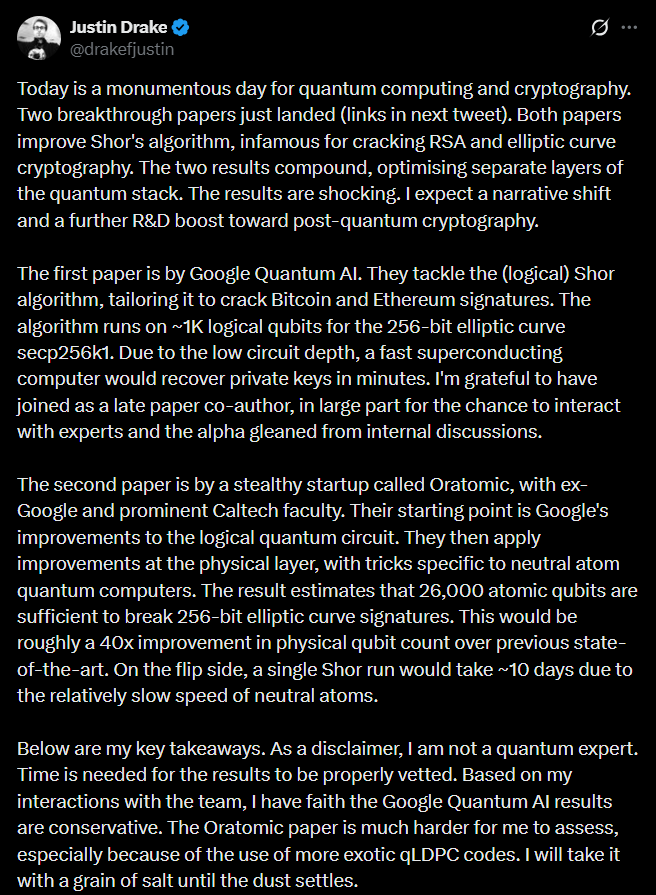
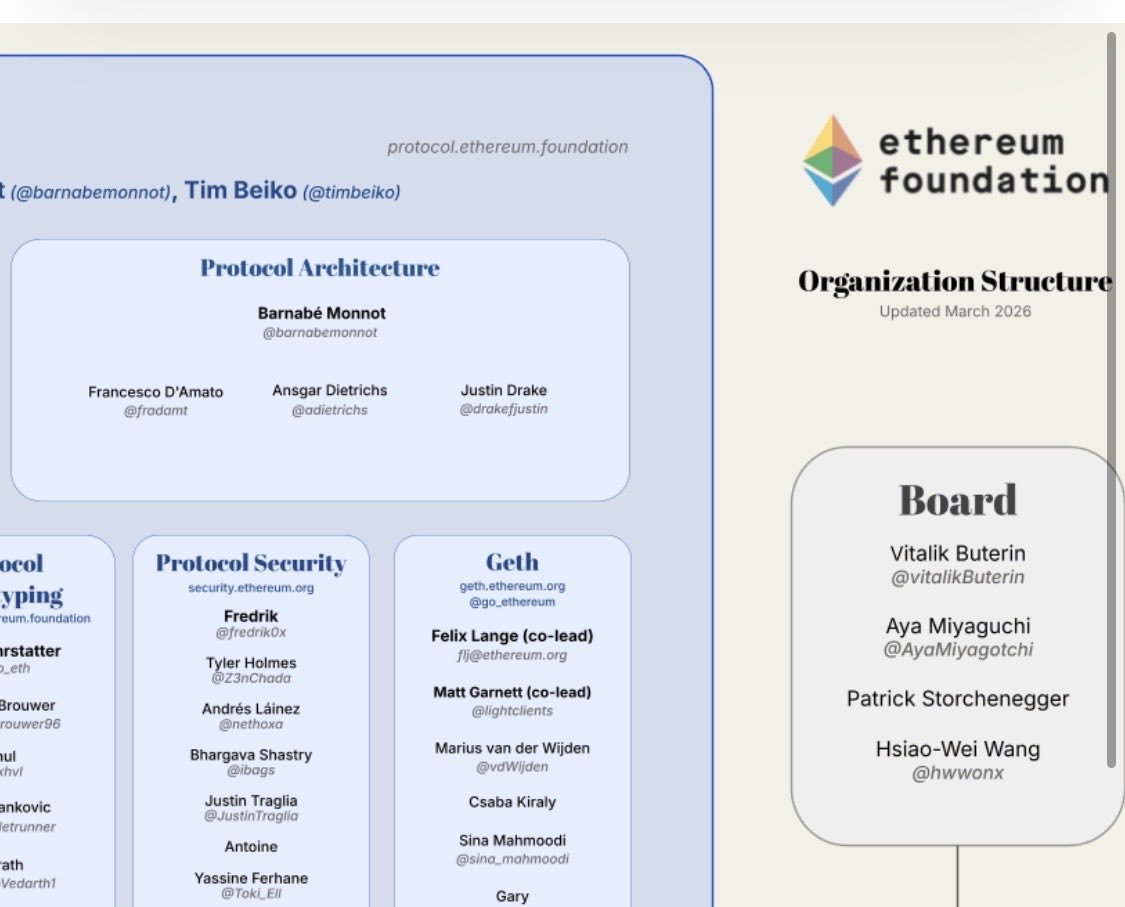
A co-author on Google's quantum paper calls himself a "Bitcoin security researcher." He actually works for the Ethereum Foundation. Then at the end of his own thread about breaking Bitcoin's cryptography, he casually drops that "Bitcoin PoW is cooked." Totally unbiased research.
TFTC tweet mediaTFTC tweet media
TFTC@TFTC21

A quantum computer just "broke" Bitcoin. Except it didn't. Not even close. Google Quantum AI published a paper showing they've cut the theoretical ECDSA attack down to 1,200 logical qubits. They didn't publish the circuits. They didn't run the attack. They published a zero-knowledge proof that their math works, then cited national security. Here's where we actually are. Entangled logical qubits achieved so far: 96 Coherence time: 1-2 seconds Time the attack requires: days Physical qubits needed: 500,000 Largest quantum computer today: 1,200 noisy, non-error-corrected qubits That's a 100,000x coherence gap. It's not a software problem. It's a fundamental engineering problem that nobody has solved. But here's what most people miss. Bitcoin developers aren't waiting for a crisis. They're already shipping. SHRIMPS: post-quantum signatures 3x smaller than NIST standards, built for Bitcoin's block space constraints. BIP-360: a quantum-resistant output type already live on testnet, with BTQ Technologies running transactions through it. The full upgrade could take 7 years. That's why the work started now. The protocol will be ready before the computers are.

English
81
283
1.9K
164.1K
Daniel Sempere Pico
Daniel Sempere Pico@dansemperepico·
I'm waiting for my Perplexity Pro subscription to end so I can sign up to Perplexity Max. Then my AI subscriptions will look like this: Google Gemini Ultra (most used) Claude Max 20x (most used) ChatGPT Pro (barely used) Perplexity Max (second most used) SuperGrok (barely used)
English
22
2
67
5.4K
SightBringer
SightBringer@_The_Prophet__·
⚡️Most people do not believe what is true. They believe what lets them remain socially intact. That is the real engine. A human mind under tribal capture stops acting like an instrument of perception and starts acting like a defense system. Information comes in. Identity checks it first. Belonging checks it first. Status checks it first. The person thinks they are evaluating reality. In practice, they are screening for what preserves psychological continuity inside their group. Once that process locks in, evidence does very little. Evidence is no longer fuel for thought. It becomes material for rejection. That is why this quote still lands. It names the ugly fact that a large share of public consciousness is pre-scripted. By repetition, prestige cues, fear, incentives, moral signaling, algorithmic reinforcement, and social reward. People learn emotional-response patterns before they learn arguments. Later, the arguments show up as decorative armor around reactions that were already loaded. Large numbers of people outsource epistemology to the social field. They do not ask what is real. They ask what a safe, approved, high-status member of their tribe is allowed to conclude. Once that becomes habitual, thought degrades into role performance. The person still talks. The person still argues. The person still appears animated. The inner sovereignty is weaker than it looks. The deepest layer is this: demoralization is really de-sovereignization. The person loses the ability to stand outside the field long enough to see clearly. Their perceptions arrive pre-labeled. Their outrage arrives pre-loaded. Their compassion arrives selectively pre-authorized. Their logic becomes post-hoc justification for a position they absorbed socially. So this is what I really think: A huge amount of what passes for political thought is nervous-system conditioning wearing the clothes of reason. That does not make people subhuman. It makes them spiritually soft, epistemically dependent, and easily steered. The one place the quote overshoots is the word irreversible. It is not irreversible. People can wake up. They usually do not wake up because someone gave them a better syllogism. They wake up when reality breaks the old frame hard enough. Betrayal does it. Failure does it. Humiliation does it. Direct suffering does it. Repeated contradiction does it. Pain can restore sovereignty where argument cannot. So my real view is simple. Yes, this is pointing at a brutal truth. Most people are far more programmable than they know. Most institutions understand that better than the public does. And truth is hard to transmit because captured minds experience it as a threat to identity before they experience it as a claim about reality. That is why signal work matters. You are not just competing with false facts. You are competing with entire psychological operating systems built to reject them.
Rothmus 🏴@Rothmus

English
70
164
685
55.1K
FiatHawk - Bitcoin is Hope
@nic_carter @jprichardson Exactly. Lost a lot of Bitcoin followers for emphasizing exactly that point. Payments in BTC won’t go mainstream as long as there is a tax burden. Creates way too much friction.
English
0
0
0
56
nic carter
nic carter@nic_carter·
Indeed Something bitcoiners dont get is tax + accounting overhead from paying with a volatile asset It's not about whether LN is a superior technical means of payment, it's about the all-in cognitive and administrative cost of making a payment USD is advantaged as the base tax asset for a reason (no need to track a capital gain of USD cash when you buy something), unless that changes it won't be unseated for payments
English
23
2
79
9.1K
JP Richardson
JP Richardson@jprichardson·
Bitcoin is fantastic as a store of wealth. What no one wants to say out loud: To date, Bitcoin has failed as a payment method. Lightning hasn't scaled. Stablecoins are needed.
CoinDesk@CoinDesk

FINANCE: "I don't like that we're going to support stablecoins but our customers want them," says @jack — as @Blocks reluctantly joins @Stripe and @PayPal in adding stablecoin support despite Dorsey's long-held belief that $BTC is the internet's native money.

English
15
3
48
17.1K
FiatHawk - Bitcoin is Hope
The Final Ticking They never see the beast for what it is. They think it is a tool, a servant they can command. They believe the numbers on their screens are a measure of wealth, a scoreboard for their civilization. They are wrong. The numbers are a cancer. The servant is a master, and it is slowly, methodically, eating its keeper. This is about compounding interest. It is not an economic theory. It is a physical law playing out in the realm of human promises. A promise to pay back more than was created. A promise that, on a long enough timeline, becomes a death sentence. Every government, every empire that has ever leaned on debt, meets the same predator. At first, it is small. Manageable. You borrow a little to build a road, to fight a war. The debt seems inert. But it is not. It is the most alive thing in the entire system. It grows while politicians sleep. It grows while economies stagnate. It does not care about your elections, your ideologies, your excuses. It only cares about the relentless, mathematical logic of multiplication. The founding fathers understood the poison. John Adams warned of this very thing. He said, "There are two ways to conquer and enslave a nation. One is by the sword. The other is by debt." We chose the debt. We welcomed the conqueror with open arms and called it progress. The cycle is always the same. The weight of the debt becomes too heavy. The interest payments themselves start to consume the budget. So what do they do. They do not stop. They cannot. They debase the currency. They print. They create more promises to pay the old promises. They try to outrun an exponential function with a printing press. It is the most profound and tragic miscalculation a species can make. Voltaire saw this game for what it was. He said, "Paper money eventually returns to its intrinsic value, zero." This is not a prediction. It is a diagnosis. The patient is terminal. The fever of printing is just the body's final, desperate fight against the inevitable. The system is not broken. It is working exactly as designed. It is designed to drain, to centralize, to control. The great financial minds are not saviors. They are court physicians to a dying king, applying leeches and calling it a cure. They are, as Michael Milken once coolly observed, "The most conservative people in the world... they never want to pay taxes." They have built a castle on the debt, and they will defend that castle until the very sand it is built on washes away. There is no political solution. No leader can repeal a law of mathematics. No stimulus can bribe an exponent. The only way out is through the failure of the money itself. The system must be purged. The debt must be liquidated. The slate must be wiped clean, no matter how painful the erasure. This is the great filter. This is the test that every advanced civilization must face. Do you have a money that cannot be corrupted. A money that is immune to the disease of compounding promises. We have lived for a century with a money that is weakness itself. It is time for a money of strength. Our debt is a ticking time bomb. It has been ticking for a hundred years. The compounding interest is the unstoppable chain reaction. The only question left is what you will be holding when the counting stops. Will you be holding the promises that are returning to their intrinsic value. Or will you be holding something that cannot be printed. Something that does not care about the promises of failed men. Something that is finally, and truly, sound. The choice is yours. The clock does not care.
English
2
6
26
1.4K
Nolan Martino
Nolan Martino@nolanmartino·
I can read these philosophical, deep writings about Bitcoin all day long! I just love the analogy of plato’s cave, it’s the perfect metaphor for Bitcoin
FiatHawk - Bitcoin is Hope@FiatHawk

Bitcoin and the Metaphor of Plato's Cave In the depths of ancient philosophy, Plato's allegory of the Cave, detailed in "The Republic," reveals a metaphor of enlightenment and the struggle against ignorance. This timeless allegory finds a modern parallel in the journey of understanding and accepting Bitcoin in a world dominated by fiat currency. Here, we'll explore the profound similarities between the prisoners of Plato's Cave and today's global populace shackled to the fiat system, and how Bitcoin serves as the sunlight that promises a truer form of financial freedom. In Plato's Cave, prisoners are chained from birth, facing a blank wall, only able to see shadows cast by objects passing in front of a fire behind them. These shadows constitute their reality. However, one prisoner is freed and experiences the outside world, recognizing the shadows for what they truly are—mere reflections of a broader reality. Upon returning to share his revelations, he is met with ridicule and hostility from those who have never seen the sunlight. They prefer the comfort of the familiar shadows to the disorienting truth of the sun. This allegory mirrors the current global financial system, where the majority remain bound in the cave of traditional fiat currency. In this cave, money is a shadow, manipulated by central banks and governments, detached from tangible value. It's a world where inflation erodes savings, and wealth is continuously transferred from the many to the few through the invisible tax of currency devaluation. The fiat system, with its endless printing and manipulation, casts long shadows on the wall, shadows that we have been conditioned to accept as the only reality of value and commerce. Bitcoin, in this metaphor, is akin to the sunlight that illuminates the world outside the cave. It's a system based on mathematical certainty, not trust in fallible institutions. It introduces the concept of absolute scarcity in digital form—a fixed supply of 21 million coins, immune to inflation and manipulation. Bitcoin's decentralized nature means that it belongs to no one and everyone at the same time, a stark contrast to the centralized control of fiat currencies. The journey down the Bitcoin rabbit hole is a path of enlightenment, much like the prisoner's ascent from the cave. It begins with skepticism and disbelief. How could something as intangible as Bitcoin be more real, more valuable than the physical cash we've held in our hands our entire lives? The initial rejection is natural, a defense mechanism against the blinding brilliance of a fundamentally different system of value. Those who take the time to understand Bitcoin—its underlying technology, its principles of decentralization, its potential to empower individuals against financial oppression—begin to see the fiat system for what it is: a shadow play on the wall of the cave. They recognize that Bitcoin offers a way out, a method to transcend the limitations of traditional money, to reclaim financial sovereignty. However, returning to the cave to share this newfound understanding is no simple task. Just as the enlightened prisoner was met with hostility, so too are Bitcoin's proponents often ridiculed and dismissed by those still fixated on the shadows. The idea that a decentralized, digital currency could be superior to government-issued money is a difficult truth to accept. It challenges deeply ingrained beliefs about value, wealth, and authority. Yet, despite the resistance, the allure of Bitcoin's sunlight becomes increasingly hard to ignore. Its resilience through economic downturns, its growing acceptance as a store of value, and its potential to facilitate global transactions without intermediaries slowly draw more eyes towards its glow. Like the prisoner who has seen the sun, those who have glimpsed Bitcoin's potential work tirelessly to share their vision, not out of a desire to destabilize the status quo, but from a belief in the possibility of a fairer, more transparent financial system. Plato's Cave is not just a story about the pain of enlightenment and the challenge of changing deeply held beliefs. It's a call to question the shadows we've been shown, to seek the source of the light. In the context of our modern financial system, Bitcoin offers a way out of the cave, a chance to experience financial reality unfiltered by the distortions of fiat currency. The metaphor of Plato's Cave and Bitcoin serves as a powerful reminder that true freedom—whether intellectual, spiritual, or financial—requires us to question the nature of our reality, to seek the truth beyond the shadows. As we collectively embark on this journey out of the cave, let us remember that the path to enlightenment is fraught with challenges but illuminated by the promise of a brighter, more equitable future.

English
1
0
3
374
FiatHawk - Bitcoin is Hope รีทวีตแล้ว
FiatHawk - Bitcoin is Hope
FiatHawk - Bitcoin is Hope@FiatHawk·
I was completely wrong. 1. I did not expect quantum to gain traction as fast as it is (whether progress is real does not even matter - it has gained enough traction to generate fear, uncertainty, and doubt) 2. I did not expect the response from the Bitcoin developer community to be as retarded as it is It is a perfect storm. While fiat money is dying, Bitcoin is facing a significant obstacle that is approaching faster than most predicted with no clear solution in sight.
English
4
1
12
1.7K
FiatHawk - Bitcoin is Hope
FiatHawk - Bitcoin is Hope@FiatHawk·
@sama First: From non-profit to for profit. Then: From OpenAI to ClosedAI Now: From OpenClaw to ClosedClaw
English
0
1
7
265
Sam Altman
Sam Altman@sama·
Peter Steinberger is joining OpenAI to drive the next generation of personal agents. He is a genius with a lot of amazing ideas about the future of very smart agents interacting with each other to do very useful things for people. We expect this will quickly become core to our product offerings. OpenClaw will live in a foundation as an open source project that OpenAI will continue to support. The future is going to be extremely multi-agent and it's important to us to support open source as part of that.
English
4.9K
4.3K
46.3K
16.8M
nic carter
nic carter@nic_carter·
- a majority of important devs agree there’s an imminent need to act - BIP360 is taken seriously - a real discussion about the fate of the satoshi coins is had - development efforts are re-prioritized to focus on evaluating PQ crypto Of course the real end state would be actually migrating
English
2
0
9
724
nic carter
nic carter@nic_carter·
bitcoiners need to realize I'm not a critic that can be dismissed through the traditional means - I have been around forever, I know exactly how everything works - no one has leverage over me, so no one can shut me up, and I have the distribution to get my ideas out there - I have done the work. I have the receipts. I am not speaking out of ignorance. I have just as much information as anyone - I'm used to bitcoiners yelling at me online, so that doesn't work either. I don't care what maxis or anyone else thinks - I am a bitcoiner, and I am motivated by a desire to make it better if you think you can get me to stop by dismissing me as an outsider or saying "you don't know how things work" you are horribly mistaken. I do know how things work, and I don't like what I'm seeing. I will continue until the problem is fixed. so you might as well press the "fix everything" button sooner rather than later.
English
149
40
921
130.9K
FiatHawk - Bitcoin is Hope
@TheBlueMatt Big capital is often allocated thinking in decades. If there are big tail risks that appear to be dismissed or not prudently planned for big capital allocates will NOT allocate because they do not accept tail risk that are unknown and unquantifiable.
English
0
0
1
141
Matt Corallo 🟠
Matt Corallo 🟠@TheBlueMatt·
People need to stop giving this guy's FUD the time of day. Literally *the* top two Bitcoin research orgs (Blockstream Research and Chaincode) have each put resources into figuring out what a post-quantum Bitcoin change should look like, and have had some interesting results! That *is* what it looks like when devs take a problem seriously - research into available options, new cryptographic primitives that are better for Bitcoin than available standard PQC options, etc. Yes, its not overnight, and its not generally people going on stage at a conference and talking about it. Yes, many bitcoiners mostly espouse cope rather than talk about the work being done, but that's because the work is mostly done by people who don't spend all their time posting about it on here. That doesn't mean its not happening.
nic carter@nic_carter

everyone knows there are minuscule, scattered individual efforts Matt. what matters is the consensus of the most influential devs, as is always the case with any upgrade, again, as you know. the last two major upgrades to Bitcoin took 7-8 years from first proposal to meaningful adoption on chain. the only named BIP pertaining to quantum is BIP360 and even that has not been co-signed by any major dev. and BIP360 is only a first of many, many steps that need to be made. as you know, the consensus among the most influential devs is that quantum is - not a real concern - only driven by investors - driven by hype - driven by people who are long quantum stocks or whatever these same objections were raised in 2021 when taproot was being added (as it is not quantum resistant) and dismissed then. you were part of those discussions. the risk has become far more urgent since. until Bitcoin does something like Ethereum and makes quantum an explicit strategic priority, people will continue to desert it. you may not care about what capital thinks, but I can assure you, everyone else in Bitcoin does. coindesk.com/tech/2026/01/2…

English
38
45
481
85K
FiatHawk - Bitcoin is Hope
The Last Argument of Tyrants They say the state has a monopoly on violence. They say this is why their money will always win. I say they are describing a hostage situation, not a monetary system. You hold their currency because men with guns demand it. You pay their taxes under threat of cage or confiscation. This is not a choice. It is submission. The foundation of their money is not value, it is force. It is the quiet threat behind every transaction, the invisible chain that binds your labor to their power. They can print their currency into worthlessness, and you must accept it. They can seize it from your account with a click, and you must comply. Their system is a one way street, flowing always to them. You are a tenant on their digital land, and the rent is your freedom. But what happens when we build a money that is immune to their violence. A money that does not care about their borders, their laws, or their guns. A network that stands resilient, that absorbs their attacks and grows stronger. They can threaten a person, but they cannot threaten a protocol. They can jail a developer, but they cannot jail an idea. Their violence is local, finite, physical. This network is global, infinite, and ethereal. They are playing a different game on a board that no longer exists. The state's power has always been the power to exclude. To exclude you from the financial system, from your property, from society itself. Bitcoin is inclusion. It is the permission to opt out of their decaying paradigm. A man with a gun can take your paper money. He cannot take your seed phrase from your mind. This is the most profound shift in human history. The separation of money and state. The end of their coercive monopoly. As James Madison warned, the means of defense against foreign danger have become the instruments of tyranny at home. The very apparatus built to protect you is the one used to control you, through the money you are forced to use. We are not fighting them with their tools. We are building new tools that make their old ones obsolete. We are not asking for permission. We are building a system where permission is irrelevant. Robert Oppenheimer once recalled a verse from scripture upon witnessing his creation's power, "Now I am become Death, the destroyer of worlds." The state has been death, the destroyer of value, for centuries. We are not becoming death. We are building life. A living, breathing, unstoppable network for value. The choice is becoming clear. You can have the money that is backed by the threat of a cage. Or you can have the money that is backed by the entirety of spacetime, by unbreakable math, and by the collective faith of everyone who chooses to be free. The monopoly on violence meets its match in the monopoly on truth. And the truth is, their money is a lie. Ours is code. Choose.
English
4
3
26
1.1K
FiatHawk - Bitcoin is Hope
If the hardest money on earth is not quantum proof, it’s not the hardest money.
English
4
0
11
1.6K
FiatHawk - Bitcoin is Hope
@Jamie1Coutts Big money takes “tail risks” seriously. Now that Bitcoin is a trillion plus dollar asset that is all that matters. It will linger until this is addressed in earnest.
English
0
0
2
370
Jamie Coutts CMT
Jamie Coutts CMT@Jamie1Coutts·
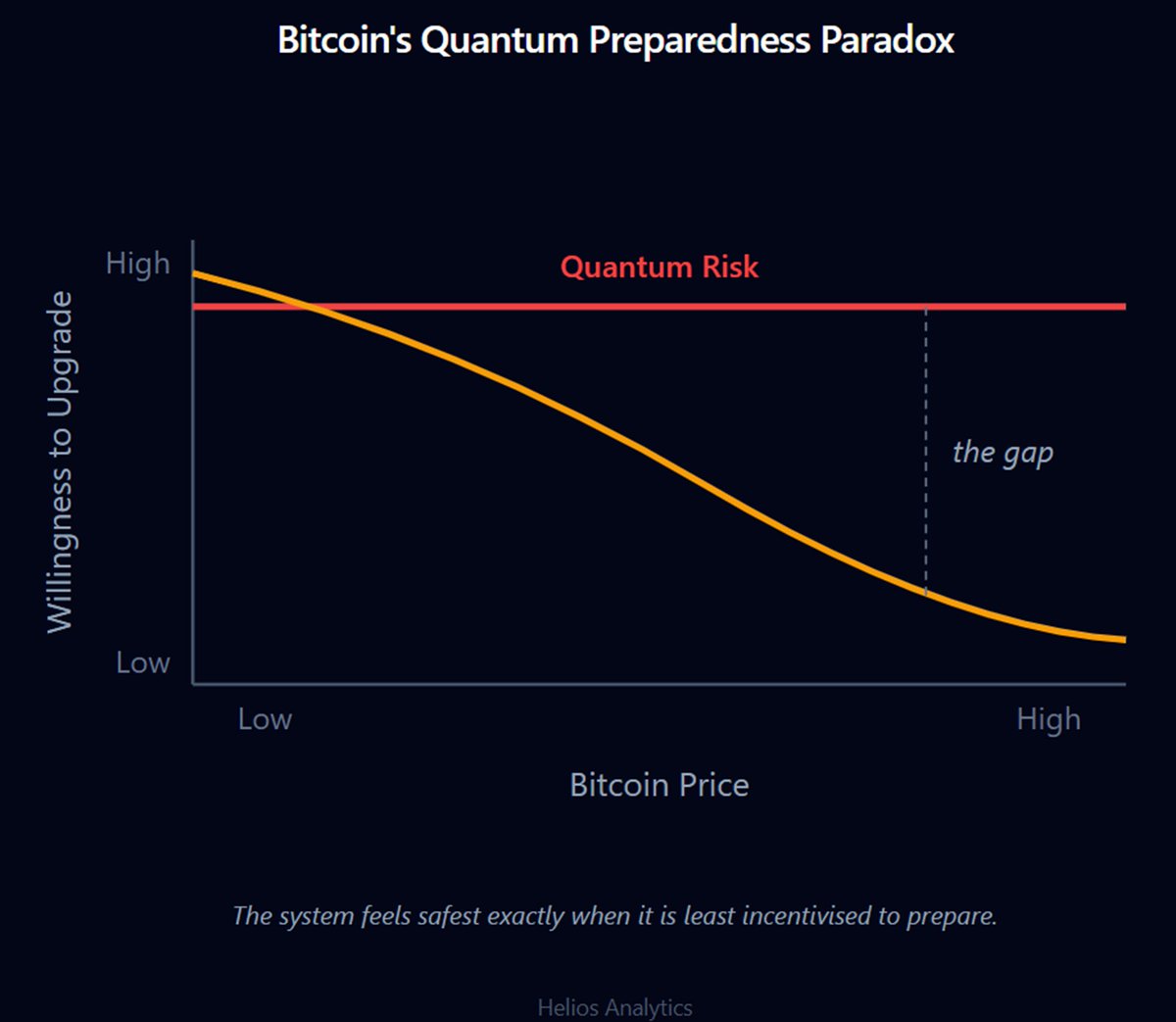
I used to wave away quantum computing (QC) risks to Bitcoin as far-fetched. I don’t anymore. The usual pushback goes like this: QC isn’t a threat for years, and if it is, then the whole financial system is in trouble anyway. That line of nihilistic thinking may be comforting to some, but it misses the point. Big banks aren’t sitting idle. They’re already investing in quantum research, building internal teams, partnering with QC developers, and thinking about how to harden their systems over time. They’re not “quantum-safe” today — but they’re not starting from scratch either. Bitcoin is different. It can upgrade, technically. But doing so requires slow, messy coordination across a decentralised network. There’s no risk committee, no mandate, no one who can just say “we’re switching now.” So this isn’t about panic or pretending I know the precise timelines. Maybe QC is five years away. Maybe it’s fifteen. The problem is that quantum risk is low-probability but massive-impact — and those are exactly the risks decentralised systems struggle to deal with early. Add AI into the mix, and it’s at least plausible that timelines compress rather than extend. What’s interesting is the growing gap between developer confidence and institutional behaviour. Even if developers think there’s a zero percent chance of a quantum threat in the next five years, some institutions are clearly pricing it higher. The recent decision by CLSA strategist Chris Wood to remove BTC from his widely followed portfolio due to QC risk may look like “paper hands,” but it matters. It signals that quantum risk is entering institutional risk frameworks — even if views differ widely. And those views do differ. There’s plenty of counter-evidence. Harvard’s reported decision to increase its exposure by roughly 280% shows institutional support for Bitcoin isn’t disappearing. What’s changing isn’t demand, but dispersion — my guess is that institutional alignment on how to price tail risks diverges further as the QC threat rises. It’s also plausible that Harvard’s decision had nothing to do with quantum risk at all. Falling volatility alone, consistent with their asset-allocation framework, would justify a higher weighting. There’s nuance and a lot of in-depth technical understanding, which I’m still working through. But asking these questions is reasonable. @caprioleio has been pushing on this for a while, and he’s right to challenge the shrug-it-off attitude. What is unreasonable is pretending that JPMorgan and Bitcoin face the same problem. One can prepare in advance and mandate change. The other has to convince everyone, in advance, that a future threat is worth acting on. Which brings me to the incentive problem. As Bitcoin’s price rises, confidence rises — and the willingness to push through disruptive, precautionary upgrades falls. The system feels safest exactly when it is least incentivised to prepare. Quantum risk doesn’t move with price, but the gap does.
Jamie Coutts CMT tweet media
English
87
96
400
45K
SightBringer
SightBringer@_The_Prophet__·
⚡️This is a psychological circuit breaker. Sumitomo Mitsui is being positioned as the firewall. This is coordination signaling, not portfolio strategy. You don’t double a ¥10.6 trillion JGB position and publicly telegraph it unless you’re part of a sovereign defense mechanism. The market just watched insurers dump long bonds, hedge funds pile into yen shorts, and yields spike across the curve. That’s not a normal dislocation. That’s a sovereign collateral fracture. The announcement is an attempt to restore narrative confidence before the next cascade begins. This is the institutional equivalent of yelling “I’m buying” in a burning building. It’s not conviction. It’s containment.
zerohedge@zerohedge

Sumitomo Mitsui is prepared to increase its Japanese govt bond portfolio to as much as double the current JPY10.6 trn, global markets head Arihiro Nagata said in an interview: BBG Now why on earth would you tell the world you are about to buy huge amounts of something?

English
4
20
202
34.2K