Frieda Born

44 posts

Frieda Born banner
Frieda Born

Frieda Born

@FriedaBorn

PhD Student @TUBerlin @bifoldberlin @mpib_berlin | MSc Neuroscience | Examining life through working memory research and nightly philosophy of mind discussions

Germany เข้าร่วม Mart 2021
241 กำลังติดตาม217 ผู้ติดตาม
ทวีตที่ปักหมุด
Frieda Born
Frieda Born@FriedaBorn·
🥳 Our paper on aligning neural networks with human conceptual structure is out in @Nature ! Honored to be part of this amazing team. It was a lot of fun! Thank you @lukas_mut , @AndrewLampinen ,@mc_mozer, Klaus Greff, Bernhard Spitzer & all other collaborators!
Andrew Lampinen@AndrewLampinen

What aspects of human knowledge do vision models like CLIP fail to capture, and how can we improve them? We suggest models miss key global organization; aligning them makes them more robust. Check out @lukas_mut's work, finally out (in @Nature!?) + our new blogpost! 1/4

English
0
0
4
155
Frieda Born รีทวีตแล้ว
Sander van Bree
Sander van Bree@sandervanbree·
During my PhD, I noticed it can be challenging to decode long-term memory (LTM) contents from EEG activity. We were struck by research showing that transient visual "pings" can boost working memory classification. So, we evaluated this technique for LTM: direct.mit.edu/imag/article/d…
English
4
21
97
10.4K
Frieda Born รีทวีตแล้ว
Lukas Muttenthaler
Lukas Muttenthaler@lukas_mut·
🚨The Levels dataset that we collected as part of the AligNet effort is now publicly available: gin.g-node.org/fborn/Dataset_… Levels is a human similarity judgment dataset across three abstraction/granularity levels meant for evaluating the alignment of vision foundation models w/ 🧠
Andrew Lampinen@AndrewLampinen

What aspects of human knowledge are vision models missing, and can we align them with human knowledge to improve their performance and robustness on cognitive and ML tasks? Excited to share this new work led by @lukas_mut! 1/10

English
0
20
61
8.4K
Frieda Born รีทวีตแล้ว
Lukas Muttenthaler
Lukas Muttenthaler@lukas_mut·
Which tasks benefit the most from aligning vision models with human perceptual judgments? In our most recent NeurIPS paper we pin down the downstream tasks where perceptual alignment yields the strongest increases in performance. More in the thread below 👇
Shobhita Sundaram@shobsund

What happens when models see the world as humans do? In our #NeurIPS2024 paper we show that aligning to human perceptual preferences can *improve* general-purpose representations! 📝: arxiv.org/abs/2410.10817 🌐: percep-align.github.io 💻: github.com/ssundaram21/dr… (1/n)

English
1
5
48
4.5K
Frieda Born
Frieda Born@FriedaBorn·
@nanakatsuchiya Hi, thanks for your question! "Prioritized" and "deprioritized" refer to the WM information’s attentional state: prioritized information stayed in focus during the WM task, while attention was temporarily withdrawn or shifted away from deprioritized information.
English
0
0
2
61
Frieda Born
Frieda Born@FriedaBorn·
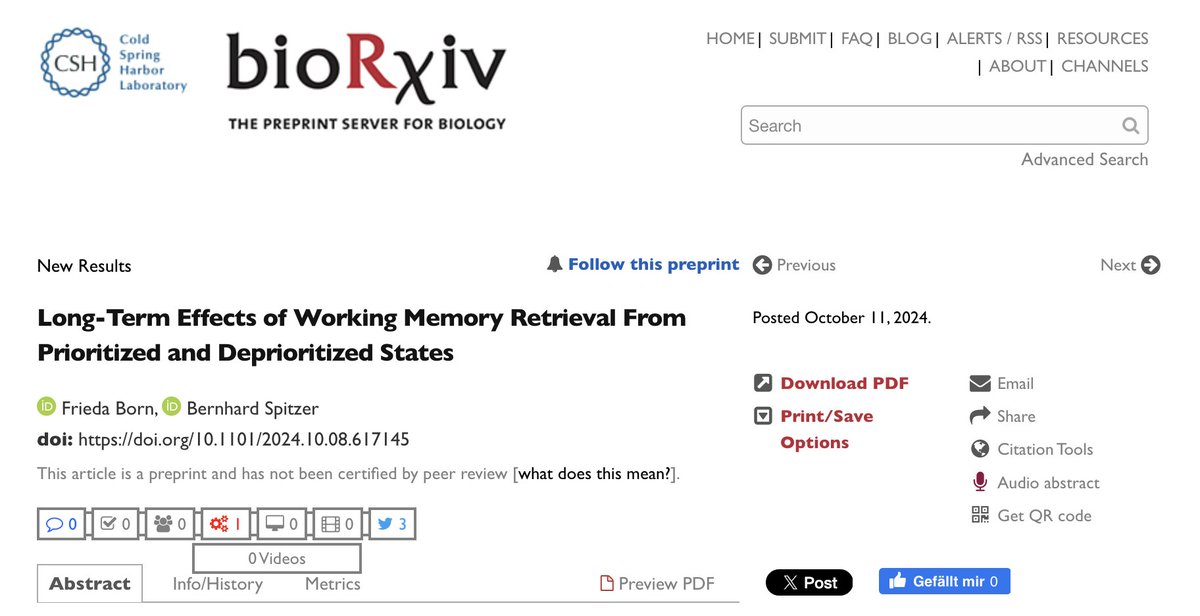
Why do some memories fade in seconds, while others stay with us for life? Working Memory (WM) holds info for just moments, but certain bits manage to stick around and make it into Long-Term Memory (LTM). In our new ⚡️preprint⚡️, we examined what helps these memories stick. 1/
Frieda Born tweet media
English
5
33
224
25.1K
Marit Petzka
Marit Petzka@MaritPetzka·
@FriedaBorn Awesome Frieda!! Really cool to see it as a paper! Huge congrats🥳🌈
English
1
0
2
383
Frieda Born
Frieda Born@FriedaBorn·
The WM-testing effects, particularly for deprioritized info, show intriguing parallels with classic “retrieval practice” effects found in episodic (long-term) memory research. Want to dive deeper into this? 7/
English
1
0
8
691
Frieda Born
Frieda Born@FriedaBorn·
It was an amazing experience being part of this project and supportive team. Seeing our aligned models match human judgments, even at multiple levels of abstraction in our newly collected LEVELS dataset, is very exciting!
Andrew Lampinen@AndrewLampinen

What aspects of human knowledge are vision models missing, and can we align them with human knowledge to improve their performance and robustness on cognitive and ML tasks? Excited to share this new work led by @lukas_mut! 1/10

English
2
0
16
3.1K
Frieda Born
Frieda Born@FriedaBorn·
Excited to be in Boston for @CogCompNeuro 2024 to discuss how WM retrieval impacts LTM at our poster today! Also, check out our collaborative work on evaluating vision models 🤖 with a new multi-level similarity judgment dataset (A113), presented by @lukas_mut & @AndrewLampinen.
English
1
3
17
2.7K
Frieda Born รีทวีตแล้ว
Sander van Bree
Sander van Bree@sandervanbree·
Preprint 📣 Transient visual stimuli ("pings") have been shown to boost EEG decoding performance in working memory contexts. We test whether the technique works for long-term memory, and find no evidence that it does. w/ Abbie Mackenzie & @MarWimber biorxiv.org/content/10.110… 🧵
English
2
15
33
6.2K
Frieda Born รีทวีตแล้ว
Noa Hedrich
Noa Hedrich@noahedrich·
In a world full of noise, how do we decide what's important? Our research reveals that humans leverage a key insight: relevant signals change slowly, but noise fluctuates rapidly. Excited to share the first project of my PhD! 1/ biorxiv.org/content/10.110…
GIF
English
2
29
113
14.6K