
ทวีตที่ปักหมุด
Jack Fuzz
2.7K posts


Jack Fuzz รีทวีตแล้ว

I wrote about 'The Wealth of Nations' as a classic of English Literature for @Liberty_Fund
econlib.org/econlog/the-we…
English
This was cool. Do read.
rohit@krishnanrohit
For any piece of advice there's an equally potent and opposite piece of advice. The only advice that stands the test of time is tautological. But it only makes sense once you've lived it. This is one of my favourite pieces I've written. strangeloopcanon.com/p/strange-loop…
English
Jack Fuzz รีทวีตแล้ว

Johan Cruyff died 10 years ago today. I idolized him as a kid, and one of my first truly long, obsessive pieces was a definitive history of his time in DC, which @PaulTenorio encouraged me to write. I’m still proud of it to this day. nytimes.com/athletic/18455…
English
Jack Fuzz รีทวีตแล้ว

My new "generative book," fully written by me, the last chapter is on how AI will revolutionize the sciences (and us): tylercowen.com/marginal-revol…
English
Jack Fuzz รีทวีตแล้ว

A personal essay, on how creative identity develops: michaelnotebook.com/dci/index.html
English
Jack Fuzz รีทวีตแล้ว
My excellent Conversation with Paul Gillingham, conversationswithtyler.com/episodes/paul-…, mostly about Mexico.
English
Jack Fuzz รีทวีตแล้ว

Jack Fuzz รีทวีตแล้ว

Why do new buildings seem, on average, uglier than old buildings? We discuss some options:
- Survivorship bias: only the beautiful old buildings have survived (we reject this option);
- Cycles of taste: everyone always finds new buildings uglier (we mostly reject this too);
- Ornament became too expensive because of rising labour costs (we reject this);
- Ornament became too cheap because of mechanisation and then became low status (we reject this);
- Some sort of Protestant or Puritan anti-beauty inheritance (we are doubtful);
- Some kind of elite status game, perhaps a response to democratisation or elite overproduction (we think there is promise here, but serious work is needed on the details).
I discuss this and more with @Aria_Babu and @bswud.
Apple podcasts: podcasts.apple.com/gb/podcast/did…
Spotify: open.spotify.com/episode/2pIka6…
Youtube: youtube.com/watch?v=qvueKt…

YouTube
English
Love.
BaseballHistoryNut@nut_history
Major League Baseball is aired in the morning for Japan. So technically they eat breakfast with it being on television. Here’s their #openingday commercial. No hyperbole, when I say this, it might be greater than any US MLB commercial I’ve seen. Well done and worth the watch for any baseball fan.
English
Jack Fuzz รีทวีตแล้ว

Tyler calls Paul Gillingham’s new book, Mexico: A 500-Year History, the single best introduction to the country's past—and one of the best nonfiction books of 2026. Paul brings both an outsider's eye and ground-level knowledge to Mexican history, having grown up in Cork—a place he'd argue gave him an instinctive feel for fierce local autonomy and land hunger—earning his doctorate on the Mexican Revolution under Alan Knight at Oxford, and doing his fieldwork in the pueblos of Guerrero.
In this episode, he and @tylercowen explore:
· Why Mexico held together after independence when every other post-colonial superstate collapsed
· What Cárdenas's land reform achieved vs. what it promised
· Whether Mexico has worried too much about land and not enough about human capital
· Where to find the best food in Manhattan
· The best two week-trip around Mexico
· What a cache of illicit Mexican silver sitting on a ship in the English Channel has to do with his next book.
· And much more.
Watch the full conversation here or at the links in the next post:
youtu.be/AaeXt_ocDKY?si…

YouTube
English
Jack Fuzz รีทวีตแล้ว

Jack Fuzz รีทวีตแล้ว





Jack Fuzz รีทวีตแล้ว

My previous post on LLMs for self-study has sparked considerable debate about the role of “traditional” higher education.
In response to some of the comments, I want to enumerate the arguments supporting the survival of “traditional” higher education. In my next post, I will assess how each might be affected by AI. Think of today's post as a taxonomy of arguments that I will review tomorrow in terms of their strength and robustness.
I count twelve.
First, signaling. The value of, let’s say, a degree from MIT is that you were smart enough to get into MIT and survive the grueling workload. The best example of signaling was the old way the British civil service selected its high-flyers: students with a first from Oxford in Literae Humaniores, not because they learned anything particularly useful there, but because it was hard to get in and hard to master all the Greek and Latin.
Second, credentialing. Societies, for a variety of reasons (some justified, some not), have decided that a degree is required to perform certain tasks. Sometimes, the requirement is statutory. For example, I cannot teach economics in a high school in Pennsylvania because I do not have a teacher’s certificate. Sometimes, the requirement is a social norm. Many firms insist that their recruits for many positions have a B.A.
Third, networking. The friendships, relationships, and (often) sentimental partnerships formed at a university are very valuable, as they occur at a key moment in life when students transition from adolescence to adulthood. Personally, networking was the most valuable component of my undergraduate education.
Fourth, peer effects in learning. This is distinct from networking. Being in a room with other smart students who challenge your thinking in real time, study groups, and classroom debate: the value is in the interaction during the learning process, not in the connections formed afterward. This was the most valuable aspect of my graduate education.
Fifth, commitment. Most students suffer from some form of time-inconsistency, and, in the absence of a formal degree, they would not complete more than a small fraction of the required work. Abysmal completion rates at Coursera courses illustrate the importance of this channel.
Sixth, curation of topics. Universities curate the topics and content that a well-balanced degree requires.
Seventh, skill acquisition. Students learn accounting, marketing, or biochemistry, and these skills are valued by the market.
Eighth, cultural capital. Students learn social norms and preferences that are valuable for positioning games in society and might have value in themselves (for example, university graduates tend to exhibit healthier behavior, even after controlling for selection and higher lifetime income).
Ninth, a “hold-out” period. Students are parked at universities while they mature, break links with their parents, and figure out what to do with their lives.
Tenth, proximity to the research frontier. The professor who teaches you monetary economics is also producing monetary economics. There is something qualitatively different about learning from someone working at the boundary of knowledge versus learning from someone, or something, that transmits existing knowledge well. This is not skill acquisition. It is exposure to how knowledge gets made.
Eleventh, assessment and feedback. The structured loop of writing, receiving criticism, and revising is a distinct mechanism from the discipline of showing up or the curation of content.
Twelfth, physical infrastructure. For many fields (chemistry, biology, engineering, medicine), the university provides labs, equipment, and supervised access to materials that cannot be replicated at home.
Some of these arguments are strong. Some of them are weaker than universities would like to believe. And some of them are about to be tested in ways they have never been tested before. Next time, I will go through each one.

English
Jack Fuzz รีทวีตแล้ว
Is AI the biggest change in education since the printing press? Yes.
This weekend, I decided to learn about the life and work of Erving Goffman purely out of personal interest. Goffman was one of the most influential sociologists of the 20th century and a professor at Penn. I had a few free hours after a tough week of travel and work, and thought it might be a good distraction.
I asked Claude to prepare a study plan based on my professional background, prior knowledge, and the hours I had available: an introduction to Goffman’s life and work, selections from his best and most influential writings, and an examination of his impact on social theory. The plan was outstanding. A top expert on Goffman would likely have done better. A 90th percentile real professor of sociology would not have, or at least not without serious effort.
As I read The Presentation of Self in Everyday Life (complete) and Asylums and Stigma (selections), I could ask Claude for clarification, connections to the wider literature, and links to material I already knew. The Q&A and the exploration of collateral ideas were so good that I ended up spending much more time than I anticipated. Last night I had to force myself to go to bed.
Did Claude get everything right? Perhaps not, but neither do I in my own graduate seminars. Even in my areas of top expertise, I often do not answer students’ questions precisely or correctly. One should not compare Claude to the perfect professor but to a real one. And every answer I could verify (I checked many) was at least a solid A-.
Am I an expert on Goffman now? Of course not. But I would say I am now familiar with an important thinker at the level a regular master’s course on modern sociological theory would produce in the week it dedicates to him. Doing the same work using Google alone would have taken much longer. I know because I have undertaken similar projects with other thinkers in the past. One had to spend considerably more time before reaching the core of the contribution.
I can now imagine someone designing self-learning courses in many fields that are better than what you can get outside the very top universities, at close to zero marginal cost. Where does that leave a normal university? I do not know.
But colleagues in departments that want to stop the spread of AI are deluding themselves. This type of technology does not come once a century. It comes once a millennium.

English
Jack Fuzz รีทวีตแล้ว

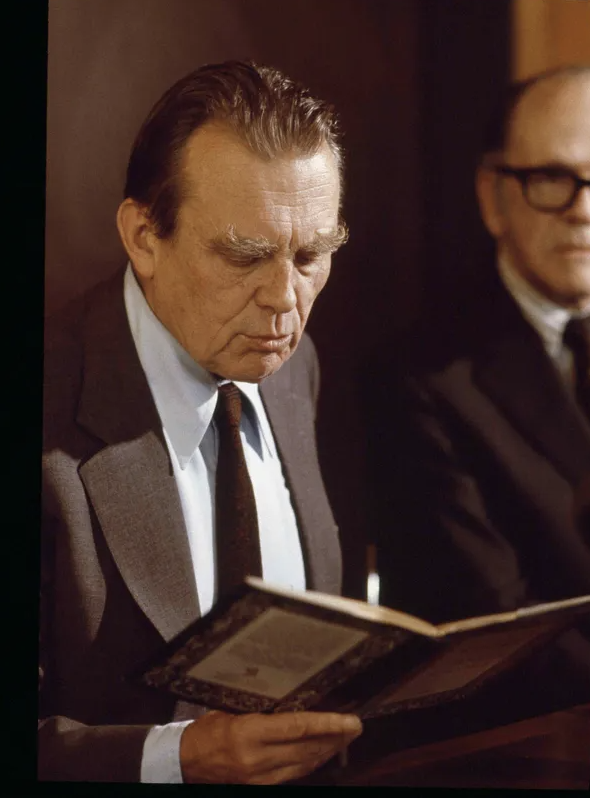
"I stare and stare. It seems I was called for this: To glorify things just because they are." ~ Czesław Miłosz, Nobel poet
English
Jack Fuzz รีทวีตแล้ว

Jack Fuzz รีทวีตแล้ว

I met up with @jacksondahl in Copenhagen and had a conversation about the value of lingering in confusion, using constraints to enable more creative work, how I journal, why love is like eating dogs, and many other things. You can find a recording below.
Jackson Dahl@jacksondahl
Henrik Karlsson returns to Dialectic. One of my 2025 highlights was meeting one of my favorite writers in Copenhagen and interviewing him on my fairly new podcast. It was a fan favorite. This conversation may have topped it. I talked to @phokarlsson about smashing mental models, navigating confusion, and why getting lost is part of creating the new. We discuss: - rejecting our mind's tendency to hold onto neat, legible ways of seeing (knowledge shields) - why risk should be unevenly distributed, and how Brian Eno uses success to take greater creative risk - why artists ought to embody a ballerina's balance - his obsession with artists' (Bergman, Grothendiek, Knausgaard's) private notebooks - why great art "spits you back out" - introspection as subject, not object - like Nick Cave and Rick Rubin - remembering what childlike desire is like - what he believes in, in the cosmic sense - his late grandfather Nils: an ordinary, extraordinary man Timestamps: 0:00 - Opening Highlights 1:28 - Intro to Henrik 4:05 - Thanks to Notion 5:58 - Begin: Attention, Boredom, Predictability, Aliveness, and Dérive 14:52 - Confusion and Clarity: Mental Balance, Breaking Mental Models, and Making It Through the Woods 31:37 - Henrik's Notebooks, Personal Constraints 40:54 - Introspection as Subject, Not Object: Nick Cave, Rick Rubin, and Attending Outward 46:56 - Creative Risks, Constraints, and the Labyrinth: Eno, Von Trier, Cage, and Herzog 1:03:47 - Agency, The Right Kind of Risk, and What Else Is Possible 1:23:29 - Desire: Trusting Excitement and "Galloping Down the Street" 1:30:44 - Why Good Ideas Come from the Edges and Keeping the Space to Sit in Your Ideas 1:44:58 - Physical Space and Isolation 1:51:19 - Jenga Towers: Why Great Art Has Space and Spits You Back Out 2:01:30 - Conviction, Belief, Navigating Murkiness with Firmness and Openness 2:15:54 - Short Essays and How Reading Is Like Running 2:22:27 - What Love Is Like and Befriend Those We Read 2:29:18 - Grandfather Nils and a Final Reminder Ep. 41: Henrik Karlsson - Strolling Through Life's Labrynths - is out now, below and on all platforms.
English
Good timing.
Conversations with Tyler@cowenconvos
Andy Weir, a previous guest on Conversations with Tyler and author of Project Hail Mary, now adapted into a major film, brings economic reasoning to science fiction. In his conversation with @tylercowen, @andyweirauthor explains why he mapped the economics of a lunar colony before writing Artemis, and how incentives shape even the most imaginative sci-fi worlds. 🎧 Revisit Tyler's conversation with Andy Weir: conversationswithtyler.com/episodes/andy-…
English