GigaScience

17.5K posts

GigaScience banner
GigaScience

GigaScience

@GigaScience

The #OpenScience journal from BGI & OUP publishing articles using/generating large datasets. And linked to @Giga_DB #opendata hosting/analysis repository

Hong Kong เข้าร่วม Ekim 2010
9.6K กำลังติดตาม10.4K ผู้ติดตาม
GigaScience
GigaScience@GigaScience·
Making machine learning research more transparent and reproducible: GigaScience Press integrates DOME standards into peer review and publishing workflows: doi.org/10.5334/dsj-20….
GigaScience tweet media
English
0
0
3
335
GigaScience
GigaScience@GigaScience·
How robust is your #cfDNA analysis? Our new study shows bioinformatics reprocessing choices matter less than you think. The effects of bioinformatics preprocessing on cell-free DNA fragment analysis: doi.org/10.1093/gigasc…
English
0
0
1
259
GigaScience
GigaScience@GigaScience·
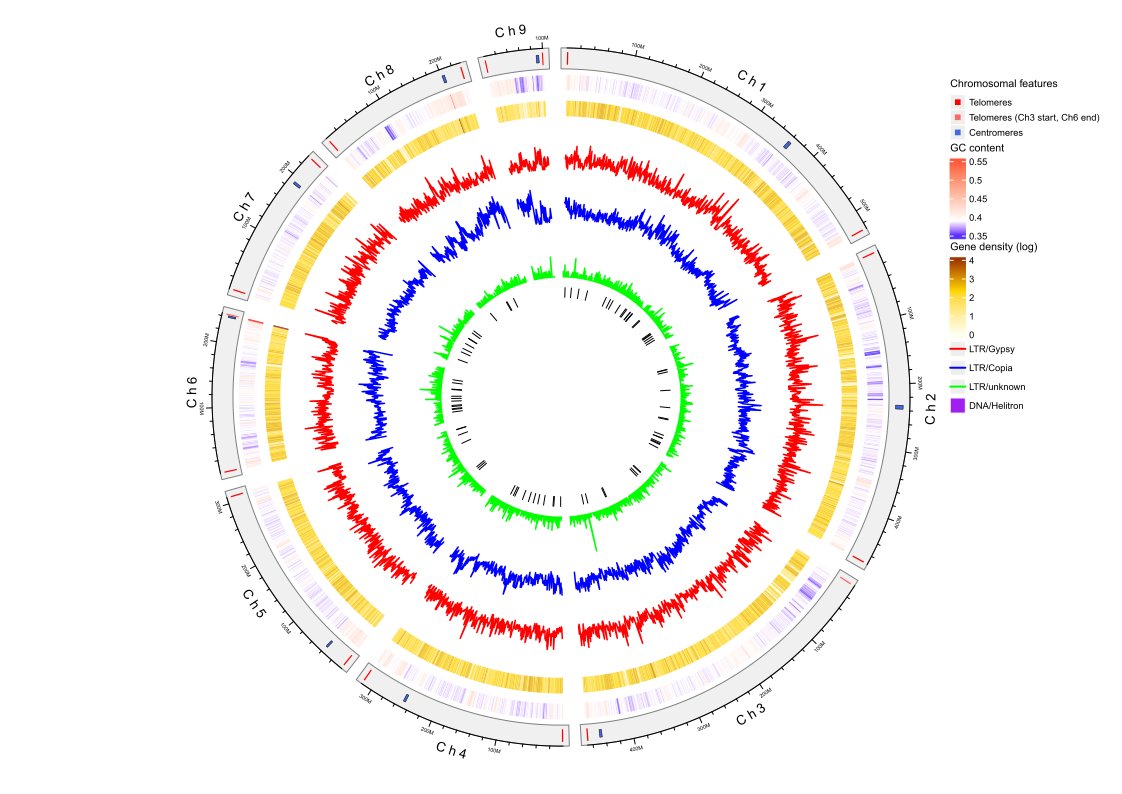
Giant chromosomes of a tiny plant - the complete telomere-to-telomere genome assembly of the simple thalloid liverwort Apopellia endiviifolia (Jungermanniopsida, Marchantiophyta): doi.org/10.1093/gigasc…
GigaScience tweet media
English
0
1
4
386
GigaScience
GigaScience@GigaScience·
Dear Authors, Readers, Editorial Board Members and Colleagues in the Academic Community, we are delighted to announce that Dr. Xun Xu has officially been appointed as Editor-in-Chief of GigaScience. See the announcement here: gigasciencejournal.com/blog/dr-xun-xu…
English
0
0
2
332
GigaScience
GigaScience@GigaScience·
A novel deep learning model for accurate and rapid prediction of IAV subtypes and host source WaveSeekerNet: accurate prediction of influenza A virus subtypes and host source using attention-based deep learning doi.org/10.1093/gigasc…
GigaScience tweet media
English
0
0
4
712
GigaScience
GigaScience@GigaScience·
A new #opensource interpretable genomic selection model designed for phenotype prediction. DeepAnnotation: A novel interpretable deep learning–based genomic selection model that integrates comprehensive functional annotations doi.org/10.1093/gigasc…
GigaScience tweet media
English
0
0
3
439
GigaScience
GigaScience@GigaScience·
Presenting new avenues for white matter abnormality-related classification of heterogeneous MRI data HeteroMRI: Robust white matter abnormality classification across multi-scanner MRI data doi.org/10.1093/gigasc…
GigaScience tweet media
English
0
0
2
262
GigaScience
GigaScience@GigaScience·
New in our T2T series, and the first published plant (and T2T) genome using CycloneSeq nanopore reads. Telomere-to-telomere African wild rice (Oryza longistaminata) reference genome reveals segmental and structural variation doi.org/10.1093/gigasc…
GigaScience tweet media
English
0
0
7
626
GigaScience
GigaScience@GigaScience·
Presenting metagenomic data from the analysis of microbial communities in mangrove sediments across Southeast China A holistic genome dataset of bacteria and archaea of mangrove sediments doi.org/10.1093/gigasc…
GigaScience tweet media
English
0
0
2
267
GigaScience
GigaScience@GigaScience·
A new platform for discovering new bioactive peptides and family-specific analogues, accelerating both natural product discovery and evolutionary research. PeptideMiner—neuropeptide discovery across the animal kingdom doi.org/10.1093/gigasc…
GigaScience tweet media
English
1
0
1
312
GigaScience
GigaScience@GigaScience·
A new GNN+DNN model, which combines molecular graphs and fingerprints through a graph attention network architecture. SynProtX: a large-scale proteomics-based deep learning model for predicting synergistic anticancer drug combinations doi.org/10.1093/gigasc…
GigaScience tweet media
English
0
1
0
248
GigaScience รีทวีตแล้ว
Helmholtz Munich | @HelmholtzMunich
Using AI and DNA Signals to Detect Living Microbes 👉 Read more in our news: t1p.de/t692x A research team at #HelmholtzMunich and @helmholtz_ai, led by Prof. Lara Urban, has demonstrated that artificial intelligence can distinguish between living and dead microorganisms by analyzing raw signal data from nanopore DNA sequencing. 🔬 Nanopore sequencing measures changes in electrical current as DNA strands pass through nanoscale pores, producing rich signal patterns beyond the DNA sequence itself. The researchers trained #AI models to infer microbial viability and applied them to a mock metagenomic datasets – simulating real-world samples such as soil, water, or the human microbiome, without the need to isolate individual organisms. 💡 This approach addresses a major limitation of genomic diagnostics: the difficulty in determining whether detected DNA originates from viable – and potentially infectious – microbes. The findings could significantly enhance the speed and accuracy of DNA-based diagnostics with applications in public health, clinical care, and environmental monitoring. @LaraUrban42 @Harika_Urel @GigaScience #Genomics #NanoporeSequencing #OneHealth #DNA
Helmholtz Munich | @HelmholtzMunich tweet media
English
1
2
6
477
GigaScience
GigaScience@GigaScience·
Old MacDonald had animal-associated microbiome contamination, E-I-E-I-O Reducing skin microbiome exposure impacts through swine farm biosecurity doi.org/10.1093/gigasc…
GigaScience tweet media
English
0
1
4
471
GigaScience
GigaScience@GigaScience·
Juncai Ma from CAS presenting on the Global Open Data Platform at the #ISOSC2025 workshop. Previously an author of the Global Catalogue of Microorganisms (GCM 2.0) paper we published doi.org/10.1093/gigasc…
GigaScience tweet media
English
1
0
1
207