Spencer

32K posts

Spencer

Spencer

@Goodluck485979

Web3 Builder Positioned for impact. Aura noise. Building before it trends

เข้าร่วม Aralık 2024
3.3K กำลังติดตาม3K ผู้ติดตาม
ทวีตที่ปักหมุด
Spencer
Spencer@Goodluck485979·
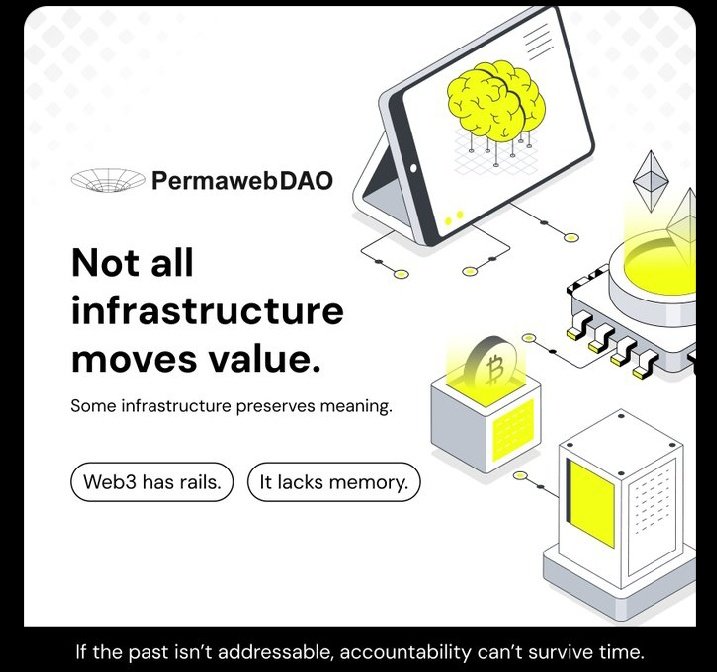
PermawebDao(@permacastapp,@Permaweb_DAO) is not building storage. It is defining what becomes permanent. That distinction matters because permanence is not neutral. Every system that stores data also decides what survives. In Web2, that decision is invisible and centralized. PermawebDao makes it explicit and shared. The real innovation is not “data lasts forever.” It is that permanence becomes intentional. When a DAO commits data to the permaweb, it is making a long-term statement. Not just saving information, but anchoring it beyond revision, censorship, or decay. That turns data into infrastructure, not content. Dango(@dango) attacks the second-order problem. Permanent data without usable access creates dead archives. Dango ensures that what is preserved can be navigated, queried, and experienced in real time. This is where the system becomes complete. • PermawebDao decides what is worth preserving • Dango ensures that preserved data remains alive and usable • Together, they transform static storage into active knowledge A simple comparison Cloud platforms optimize for control and flexibility This stack optimizes for integrity and continuity That tradeoff is deliberate. Because the future is not about who stores data fastest It is about who makes data impossible to erase, and easy to use That is where durable systems win. #PermawebDAO #Dango
Spencer tweet media
Spencer@Goodluck485979

PermawebDao(@permacastapp,@Permaweb_DAO) is solving a problem most people still underestimate. Not storage, but credibility. Data is easy to store. What’s hard is making that data resistant to revision, pressure, or silent deletion. That’s where PermawebDao becomes critical. It turns permanence into a governance decision, not just a technical feature. What gets stored is not just uploaded, it is collectively committed. That shift moves power from platforms to protocols. Dango’s(@dango) role is sharper than it looks. It removes the biggest weakness of decentralized systems, poor accessibility. Because if permanent data is hard to reach, it might as well not exist. What makes this combination powerful is alignment. • PermawebDao secures truth at the base layer • Dango makes that truth discoverable and usable • Together, they eliminate the gap between preservation and participation This is not about competing with Web2. It is about replacing its weakest assumption, that platforms should control memory. In practical terms A post on a traditional platform can disappear overnight A post through this stack becomes part of an irreversible timeline That difference is not technical. It is cultural. And culture is where real infrastructure wins. #PermawebDAO #Dango

English
0
67
65
349
Spencer รีทวีตแล้ว
Oluwafemi👑❤️🚀
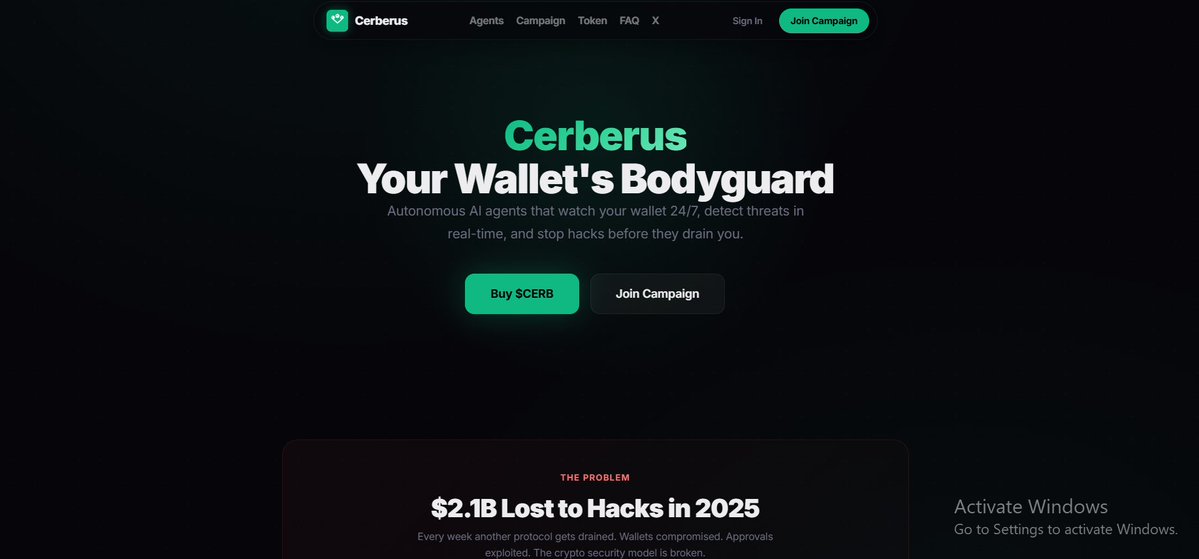
The real question isn’t whether AI agents are better than manual approval systems, it’s whether manual systems can even survive the complexity of today’s on-chain world. @CerbAgent sits right at the center of this shift. What they’re building isn’t just another security layer, but a new kind of infrastructure, AI-driven agents that monitor, evaluate, and enforce decisions across decentralized systems in real time. And to understand why that matters, you have to look at what we’ve been relying on. Manual approval was built for a slower internet. It assumes humans can review actions before they happen, that risks unfold gradually, and that there’s always time to react. But crypto doesn’t work like that. Transactions execute instantly, smart contracts don’t pause, and exploits don’t give warnings. By the time a human steps in, it’s already too late. AI agents change that completely. They operate in a continuous loop, observing data, understanding context, making decisions, and acting instantly. No delays. No fatigue. No missed signals. This isn’t just automation, it’s always-on intelligence. And that’s where trust begins to shift. Manual systems rely on human judgment, but humans are inconsistent and slow under pressure. AI agents, on the other hand, process on-chain activity, behavioral patterns, and system states all at once at a scale no human can match. More importantly, they don’t just “approve” actions, they enforce decisions in real time. That’s the difference between reacting to an exploit and preventing it. Because most hacks don’t happen from a lack of awareness, they happen in the gaps. The gap between detection and response. The gap between permission and execution. The gap where something should have been stopped, but wasn’t. Manual approval lives in those gaps. AI agents close them. With systems like $CERB, every action is evaluated against context and risk before it happens, not after. No blind trust. No delayed checks. Just continuous, real-time enforcement. And the real advantage isn’t just speed, it’s consistency. Humans rely on judgment. AI agents rely on logic, data, and learning. Security doesn’t need occasional correctness, it needs constant, predictable enforcement at scale. This isn’t blind trust in AI. It’s an adaptation to a new reality. When systems move at machine speed, security has to do the same. And in that world, relying on manual approval isn’t being careful, it’s being exposed. CerbAgent represents that evolution: from human-dependent security to autonomous, always-on defense. And once you see it clearly, the question isn’t why trust AI agents. It’s why we waited this long. @TheARCTERMINAL
Oluwafemi👑❤️🚀 tweet media
Oluwafemi👑❤️🚀@TheFemog

Speed broke manual security and that’s exactly where @CerbAgent comes in. CerbAgent is built as an AI security agent that doesn’t wait for approvals, signatures, or human reviews before acting. It watches, evaluates, and enforces decisions in real time across on-chain activity. That alone changes everything. Manual approval systems were designed for slower environments where humans could review actions before execution. But in crypto, exploits happen in seconds. By the time a wallet flags a suspicious transaction or a team reacts, funds are already gone. The issue isn’t that humans aren’t smart, it’s that they’re too slow for a system that never pauses. This is why trust is shifting toward AI agents. Unlike manual workflows, AI agents operate continuously. They don’t approve based on guesswork or delayed context; they analyze behavior, detect anomalies, and act instantly. Every transaction is judged in the moment it happens, not after. That removes the gap attackers rely on. $CERB pushes this further by turning security into something active instead of reactive. It doesn’t just monitor, it enforces. And in a space where one missed signal can cost millions, consistency and speed matter more than human control. The real insight is simple: manual approval creates windows of vulnerability, while AI agents close them. That’s why the industry is moving here. Not because it’s hype but because it’s necessary. @TheARCTERMINAL

English
13
26
37
174
Spencer รีทวีตแล้ว
Umar Muhammad Sani
Umar Muhammad Sani@umar_msani·
Permacast gives ideas a lasting, contextual record. Dango turns teamwork into a clear, step by step flow. Together, they make complex work easier to follow, verify, and sustain.
Umar Muhammad Sani@umar_msani

Permacast preserves ideas so their meaning stays clear over time. Dango organizes collaboration into structured, trackable actions. Together, they turn complex processes into systems that are clear, reliable, and easy to trust.

English
0
23
22
77
Spencer รีทวีตแล้ว
KING DAVID
KING DAVID@cfcornerstone7·
Press record. Press publish. That’s it. 🎙️ PERMACASTAPP locks your audio in permanently—no takedowns, no expiry, no shifting rules. Simple flow. Lasting ownership.
KING DAVID tweet media
English
0
26
27
74
Spencer รีทวีตแล้ว
BASH-TECH OG
BASH-TECH OG@Bashtechceo·
In today’s digital ecosystem, content is fragile. Platforms control visibility, ownership, and even existence. Posts get deleted, accounts get banned, and entire datasets can vanish overnight due to policy shifts or centralized failures. Permacastapp breaks this cycle. By leveraging Arweave, Permacastapp introduces a new paradigm permanent, verifiable, and censorship-resistant content infrastructure. Unlike traditional cloud systems or even some decentralized storage solutions, Permacastapp ensures that every file uploaded is stored forever. No recurring hosting fees No risk of silent deletion Data persists across decades This is not backup storage this is perma-storage. Every piece of content stored through Permacastapp is: Cryptographically secured Timestamped Tamper-proof This means users can always prove: When content was created That it has not been altered This is especially critical for: Journalism Legal documentation Intellectual property Centralized platforms can remove or suppress content. Even decentralized apps often rely on gateways or modifiable layers. @permacastapp removes this risk entirely: No central authority can delete content No algorithm can quietly suppress visibility at the storage level Data remains accessible globally This is freedom of information by design, not by policy. Dango narrative, you need to translate the tech edge (instant matching + sub-second finality + on-chain order book) into real trading advantages. Here’s a grounded, current-style strategy you can actually use: Dango’s design gives you: Near-zero latency execution → no slippage games like slower chains Atomic matching + settlement → no failed fills / partial chaos Transparent order book → real liquidity signals (not hidden like AMMs) That means: you trade momentum + liquidity with precision, not guesswork. Trend Confirmation First (Don’t fight the tape) Only look for longs when: Price is making higher highs + higher lows Market sentiment is bullish (volume expanding) Use: 5m / 15m for entries 1H / 4H for trend direction If trend is sideways or bearish → no longs (discipline matters more than opp Order Book Liquidity Reading (Dango Advantage) Since @dango has a real Central Limit Order Book, watch: Strong bid walls (support) forming below price Increasing buy-side depth Aggressive market buys eating sell orders This is your confirmation that whales are positioning long Enter long when: Price pulls back into a high-liquidity zone Bid support holds (not collapsing) Momentum resumes upward (strong green candles) Best entries: Breakout + retest Liquidity sweep then reversal Strong bounce off support wall
BASH-TECH OG tweet media
BASH-TECH OG@Bashtechceo

Dango is not just another decentralized exchange it is a fundamental redesign of how trading infrastructure operates on-chain. In an industry where latency, fragmentation, and execution risk continue to limit performance, Dango introduces a unified architecture built for speed, precision, and reliability. At its core, Dango delivers settlement at the speed of consensus. Unlike traditional systems where execution and settlement are separated creating delays and exposing traders to counterparty risk Dango collapses these processes into a single, seamless action. Every trade is not only executed instantly but also finalized with deterministic certainty. Most decentralized exchanges rely on AMMs (Automated Market Makers), which often suffer from slippage, impermanent loss, and inefficient pricing. Dango takes a different route by embedding a Central Limit Order Book directly at the base layer. This design unlocks several strategic advantages: True price discovery driven by real market supply and demand Tighter spreads and deeper liquidity Advanced trading strategies such as limit orders, stop-losses, and algorithmic execution Institutional-grade market structure on-chain One of Dango’s most powerful innovations is that matching and execution happen as one atomic motion. This means: No partial fills without settlement No execution without finality No risk of failed trades after matching This atomicity removes a major pain point in both centralized and decentralized systems execution uncertainty. Traders can operate with confidence, knowing that once a trade is matched, it is already finalized. Speed is not just a feature it’s a competitive advantage. Dango guarantees sub-second finality on every trade, positioning it as a serious contender against centralized exchanges. This opens the door for: High-frequency trading (HFT) strategies on-chain Real-time arbitrage opportunities across markets Improved capital efficiency due to faster turnover Better user experience with instant confirmations In today’s market, where milliseconds can determine profitability, @dango bridges the gap between centralized speed and decentralized security. Most platforms today act as gatekeepers: They store your data Control access Monetize your content Can remove or restrict you at any time Permacast flips this model: Content lives on Arweave, not on company servers The app becomes an interface, not a controller Users interact with a protocol, not a platform On traditional platforms: Your account can be banned Your content can disappear Your audience is not truly yours On Permacast: Content is permanent Identity becomes portable Reputation compounds over time Most products extract value through: Ads Data harvesting Algorithmic manipulation Platform lock-in Permacast can differentiate by: No hidden data extraction No centralized control over reach No dependency on ad-driven models This is bigger than a product it’s cultural. Tie @permacastapp into: The creator economy shift The Web3 ownership narrative The rejection of Big Tech control Messaging examples: “Own your voice.” “Publish once. Exist forever.” “No deletions. No gatekeepers. No compromises.” Even with strong tech, distribution wins. A. Content Strategy Create content around: “Why your content isn’t really yours on Web2” “What happens if your account gets banned tomorrow?” “Permanent storage vs temporary platforms”

English
9
30
35
89
Spencer รีทวีตแล้ว
〽️ainy🦍
〽️ainy🦍@mainy1505·
There is a version of the future that looks almost identical to the present. Where finance digitized but never decentralized. Where the interfaces got cleaner and the settlement got faster but the power remained exactly where it always was concentrated, opaque, and accountable to no one who actually depended on it. That future is not inevitable. But it is not impossible either. It is the future that gets built by default when the people with the tools to build something better get distracted by the shorter game. By the yield. By the narrative. By the intoxicating feedback loop of markets that reward attention faster than they reward architecture. Dango exists as a refusal of that default. A deliberate bet that the people building the financial infrastructure of the next century have an obligation that extends beyond the current quarter and the current cycle and the current conversation dominating the feeds. That obligation is to the person who does not yet know they need this. The farmer in a country with a broken currency. The worker whose remittance disappears into fees. The entrepreneur whose access to capital is determined not by the quality of their idea but by the geography of their birth. These are not edge cases. They are the majority of the planet. And they are the reason that decentralized finance was supposed to matter beyond the trading desks and the discord servers and the governance forums. Dango has not forgotten who this was always for. The protocol is being built with that memory intact. With the understanding that the most important user has not arrived yet and the infrastructure that serves them must be ready long before they do.
English
0
23
22
58
Spencer รีทวีตแล้ว
Holmms Ⓜ️
Holmms Ⓜ️@Nyerishi·
The Two Decisions That Define Your Project Every project makes two decisions early on. Where will value settle? Where will content live? Most projects get these wrong. They choose convenience over capability. They choose short term ease over long term reliability. They regret it later. @dango is the right answer for settlement. Settlement determines user experience. Slow trades lose users. Unreliable finality loses trust. Latency adds up over time. A few seconds per trade becomes minutes per day. Minutes become hours per month. Hours become lost users. @dango eliminates this math. The Central Limit Order Book lives at consensus level. Matching and execution are one atomic motion. Sub second finality on every trade. No waiting. No overhead. No compromise. TradingView integration brings professional charts. Real time liquidity visualization shows the market instantly. Dango is a chain built to be an exchange from day one. With Dango, settlement never becomes the bottleneck. Trades finalize before the user looks away. Users stay. Trust grows. @permacastapp is the right answer for storage. Storage determines content durability. Broken links lose creators. Disappearing archives lose history. Unreliable platforms lose culture. A single broken link erodes confidence. A pattern of broken links destroys trust. @permacastapp eliminates this pattern. Arweave storage for every file. Decades of accessibility guaranteed. Verifiable content that cannot be altered. Censorship resistant content that cannot be deleted. AI runs on top of Permacast. Content generation, summarization, tagging, sentiment analysis happen automatically. Social graphs map creators to listeners. On chain identity follows creators everywhere. With Permacast, storage never becomes the point of failure. Content outlasts platforms. Outlasts companies. Outlasts trends. The Two Right Answers Settlement on Dango. Storage on Permacast. Do not guess. Do not compromise. Choose infrastructure that works. Dango settles value instantly. Permacast preserves content permanently. Two decisions. Two right answers. Build on them.
Holmms Ⓜ️ tweet media
Holmms Ⓜ️@Nyerishi

The Two Decisions That Define Your Project Every project makes two decisions early on. Where will value settle? Where will content live? Most projects get these wrong. They choose convenience over capability. They choose short term ease over long term reliability. They regret it later. @dango is the right answer for settlement. Settlement determines user experience. Slow trades lose users. Unreliable finality loses trust. Latency adds up over time. A few seconds per trade becomes minutes per day. Minutes become hours per month. Hours become lost users. Dango eliminates this math. The Central Limit Order Book lives at consensus level. Matching and execution are one atomic motion. Sub second finality on every trade. No waiting. No overhead. No compromise. TradingView integration brings professional charts. Real time liquidity visualization shows the market instantly. Dango is a chain built to be an exchange from day one. With @dango , settlement never becomes the bottleneck. Trades finalize before the user looks away. Users stay. Trust grows. @permacastapp is the right answer for storage. Storage determines content durability. Broken links lose creators. Disappearing archives lose history. Unreliable platforms lose culture. A single broken link erodes confidence. A pattern of broken links destroys trust. @permacastapp eliminates this pattern. Arweave storage for every file. Decades of accessibility guaranteed. Verifiable content that cannot be altered. Censorship resistant content that cannot be deleted. AI runs on top of Permacast. Content generation, summarization, tagging, sentiment analysis happen automatically. Social graphs map creators to listeners. On chain identity follows creators everywhere. With Permacast, storage never becomes the point of failure. Content outlasts platforms. Outlasts companies. Outlasts trends. The Two Right Answers Settlement on Dango. Storage on Permacast. Do not guess. Do not compromise. Choose infrastructure that works. Dango settles value instantly. Permacast preserves content permanently. Two decisions. Two right answers. Build on them.

English
0
24
24
116
Spencer รีทวีตแล้ว
Daniel ØG
Daniel ØG@Danzzy327·
We’ve watched over $5 billion vanish into the pockets of hackers onchain. If you think your seed phrase and a cold wallet are enough to keep you safe, you’re playing a game of chess against a supercomputer using a wooden board. Defi is bleeding because our security is reactive, but the threats are autonomous. It’s time to stop being the prey. @CerbAgent isn't just another "AI agent" trying to be funny for engagement, it’s built to be the immune system of your digital assets. Here is the "yap" on how it actually fixes the $17B security gap: The problem with Web3 security? It’s too manual for an automated world. Right now, if you’re interacting with a dApp, you are the final firewall. You have to read hex data, verify contract addresses, and pray the "Connect Wallet" button hasn't been hijacked. Spoiler: In 2025, the hackers are using AI to make those traps perfect. You can't out-human a machine. $CERB flips the script with "Intent-Based Defense." I've been watching CERB and instead of just checking if a site is "blacklisted" (which is old-school and fails against new drains), the $CERB agent operates with three specific "heads" ✓ The Oracle (Prediction): It doesn't wait for you to get hacked. It scans the dark web and mempool in real-time. If it sees a pattern matching a known "drainer" kit being deployed on a new site, it kills your connection before you even see the "Sign" button. ✓ The Watchman (Simulation): This is the game-changer. When you initiate a txn, $CERB runs it in a "shadow environment" first. If the simulation shows your $SOL leaving and nothing coming back, or hidden permissions being granted, the agent blocks the txn. It sees the outcome before the blockchain does. ✓ The Engineer (Hardening): It constantly audits your own wallet's "hygiene." Got an open approval to a protocol that just got exploited? $CERB automatically alerts you to revoke it or does it for you.
Daniel ØG tweet media
English
8
30
33
77
Spencer รีทวีตแล้ว
cryptobaby 😍$XAGE 'ZETARIUM '
dango is choosing the harder path building when DeFi is still seen as complex, fragmented, and difficult to trust. Not by chasing attention, but by closing the gap between today’s systems and what global-scale finance actually demands. This is infrastructure work.
cryptobaby 😍$XAGE 'ZETARIUM ' tweet media
cryptobaby 😍$XAGE 'ZETARIUM '@EIyanuoluw17789

Dango isn’t just another DEX, it rethinks the architecture of on-chain trading. Where latency, fragmented liquidity, and execution risk slow markets down, Dango introduces a unified system built for speed, precision, and reliability. .

English
0
24
24
57
Spencer รีทวีตแล้ว
hanz
hanz@Famhanz·
There’s a question that doesn’t get asked enough in Web3: What happens after an idea is shared? Not the likes. Not the impressions. But the next action. Because most content ends at awareness. People see it, maybe understand it… and then nothing really changes. That’s where Permacast starts to feel different. Inside the PermawebDAO ecosystem, it creates space for conversations that don’t just inform — they nudge people toward action. Built on infrastructure connected to Arweave and the broader Permaweb, these discussions give listeners enough depth to move beyond passive understanding. And that’s where things shift. Someone hears an idea and decides to explore it further. Another listener starts experimenting with a concept discussed. A builder picks up an insight and integrates it into what they’re creating. The conversation doesn’t end when the audio stops. It continues through what people do next. That’s the difference between content that’s consumed and content that creates momentum. Because in the end, ideas only matter if they lead somewhere. So maybe platforms like Permacast aren’t just about sharing perspectives. Maybe they’re about triggering the kind of thinking that turns into real-world action.
hanz@Famhanz

Most people think the bottleneck in Web3 is building. But look closer… it’s actually context. Ideas are everywhere, but without the right context, they feel disconnected. You hear something interesting, but you don’t fully understand where it fits or why it matters. That’s where Permacast starts to take on a different role. Inside the PermawebDAO ecosystem, it creates space for builders to layer context around their ideas through conversation not just what they’re building, but how it connects to everything else happening in the space. Supported by infrastructure connected to Arweave and the broader Permaweb, these discussions move across a network where ideas are constantly intersecting. And that intersection is where things start to click. A concept stops feeling isolated. You begin to see how it relates to other projects. You understand not just the idea, but its place in the bigger picture. That’s powerful. Because context turns scattered information into coherent understanding. Without it, ideas feel random. With it, they start to form a narrative. So maybe the real value of platforms like Permacast isn’t just in the conversations themselves. Maybe it’s in how those conversations help people connect the dots between ideas that once felt separate.

English
0
24
24
77
Spencer รีทวีตแล้ว
Amine
Amine@Tojiweb3r·
In decentralized trading, inefficiency often comes from liquidity overgeneralization, where capital is spread across assumptions of demand instead of actual participation, reducing pricing accuracy and weakening depth formation. This limitation is addressed by @dango , where liquidity is defined by real executable orders at the protocol level. Capital concentrates where activity exists, allowing spreads and market depth to emerge directly from true order flow rather than abstract distribution models. As matching logic becomes native to the architecture, execution quality is determined by system performance. Throughput, latency stability, and deterministic matching shape how efficiently markets convert intent into price movement. This reframes decentralized exchange performance around precision efficiency how accurately liquidity maps to demand, how consistent execution remains, and how reliably market depth persists under dynamic conditions.
Amine tweet media
English
0
23
23
133
Spencer รีทวีตแล้ว
Samuelπ²
Samuelπ²@Samue9856·
Platform parent company stock performance determines infrastructure investment. Bear markets mean reduced server capacity, degraded service Permacast performance independent of markets. Decentralized infrastructure where financial conditions don't determine technical reliability
Samuelπ² tweet media
English
0
23
22
40
Spencer รีทวีตแล้ว
TOLEX
TOLEX@oyetoludan01·
The 0G team said something at EthCC that should be repeated as often as possible. Only one percent of global data is being used to train AI because of provenance problems. Think about what that means. Ninety-nine percent of human knowledge, creativity, and experience is sitting in data that AI cannot use because nobody can prove where it came from or whether it's trustworthy. That is a staggering bottleneck on the development of AI that has nothing to do with model architecture and everything to do with infrastructure. 0G's cryptographic provenance system and Permacast's immutable content timestamps are both direct attacks on that ninety-nine percent problem. Every piece of content uploaded to Permacast becomes a provably authentic, timestamped asset that AI can trust. That's not a small contribution to the AI ecosystem. @permacastapp @0G_labs
TOLEX tweet media
English
0
22
23
60
Spencer รีทวีตแล้ว
Abdulsamadibb
Abdulsamadibb@AbdulsamadIbb·
.. @0G_labs is turning software into a real-time extension of thought. No friction Just prompts that become live, verifiable systems. This isn’t development it’s instant execution of intent. And when thought becomes software, builders stop catching up… and start leading.
Abdulsamadibb tweet media
Abdulsamadibb@AbdulsamadIbb

...@0G_labs is redefining execution as intent-driven infrastructure. You don’t build—you declare. You don’t debug—you iterate. You don’t deploy—you materialize. This isn’t a toolchain—it’s a new computing paradigm And when intent becomes executable, creation moves.

English
0
22
23
63
Spencer รีทวีตแล้ว
✦ 𝐀𝐉𝐀𝐘
✦ 𝐀𝐉𝐀𝐘@Ajayconsult_001·
Dango is quietly putting up strong numbers in just its second epoch. Within the first 7 to 9 days of the points program, the platform has already recorded over $250M in trading volume, more than 1,300 daily active users, and thousands of loot boxes opened. Epoch 2 is now live, with 1.17M points distributed weekly. 750k goes to perps traders. 250k goes to vault depositors. There are only 37 weeks left in the program, which means it is still early. What stands out: 50% of total $DNG supply is allocated to the community airdrop, with TGE planned for Q4 2026. Loot boxes are earned through trading volume, each containing an NFT ranging from Common to Mythic, with hidden point multipliers. One unified account structure, native onchain order book, 0.2 second batch auctions, and zero MEV. Keyless and gasless onboarding that feels simple to use. Dango combines strong execution with incentives that reward active users. For traders using perps or depositors using vaults, this is the stage where early participation matters most. Build volume, stack points, and collect loot boxes before the crowd gets larger. Still early. Still building. Gdango 🍡.
✦ 𝐀𝐉𝐀𝐘 tweet media
✦ 𝐀𝐉𝐀𝐘@Ajayconsult_001

Dango is showing real product market fit just weeks after mainnet launch. Perpetual futures went live 10 days ago , and the numbers are already strong. The platform crossed $30M+ in daily trading volume during the day and pushed past $40M+ by close. That is not empty hype, it is real traders actively using the platform. The experience feels different because it is. • Native on chain CLOB with fair 0.2 second batch auctions • One unified margin account for spot and perps • MEV resistant design with CEX level speed • Powered by a sovereign Layer 1 and the Grug engine Epoch 1 is ending soon, with many users increasing volume to earn points, unlock loot boxes, and collect NFTs while the platform is still early. With a large share of the $DNG supply expected to go to the community through trading points, Starboard on Galxe, and future rewards, incentives are aligning with real usage. This is what the next generation exchange looks like: fast, transparent, and capital efficient trading without the usual DeFi friction. Mainnet is live at: dango.exchange Try it before Epoch 1 closes and experience the difference yourself. Gdango 🍡

English
0
24
24
52
Spencer รีทวีตแล้ว
Aduragbemi Ebunoluwa
Most people dismissed the Socket exploit as “small.” That’s the wrong takeaway. CerbAgent sits exactly in that blind spot, where $CERB is less about the size of an attack and more about the pattern that allows it to happen at all. In early 2024, Socket’s Bungee bridge was exploited for about $3.3M. Not through some complex zero-day, but through a flaw in input validation within a contract route. Simple. Quiet. Effective. And that’s what makes it dangerous. Because the system didn’t collapse. It continued operating normally while being drained. Every transaction still looked like usage. Every interaction still passed checks. Nothing “broke.” And that’s the pattern most people underestimate. The most effective exploits don’t disrupt systems. They blend into them. They mimic real behavior closely enough that nothing triggers immediate resistance. Not alarms. Not pauses. Not hesitation. Just execution. This is the real asymmetry in DeFi. Attackers don’t need to overpower the system. They just need to stay within its tolerance long enough. And tolerance, without interpretation, becomes vulnerability. Because protocols today validate inputs, but they don’t question intent. A contract checks if data is formatted correctly. It doesn’t ask why that data is being used in that sequence. So when a series of valid inputs begins forming an invalid outcome, nothing intervenes. The system simply continues. This is where @CerbAgent introduces a fundamentally different approach. With $CERB, the focus shifts from isolated validation to behavioral awareness inside execution. Not just: “Is this transaction allowed?” But: “Does this sequence make sense given what’s happening right now?” Because exploits like Socket aren’t defined by a single bad action. They’re defined by a pattern that only becomes obvious when viewed as a whole. And if nothing inside the system is tracking that pattern in real time, then everything proceeds unchecked. What changes with embedded agents is the ability to respond before completion. Not by shutting everything down, but by applying resistance precisely where the anomaly is forming. Unusual routing behavior can be flagged mid-flow Repetitive interactions can trigger adaptive constraints Execution paths can tighten before value leakage scales The system doesn’t panic. It recalibrates. Because the goal isn’t perfection. It’s awareness under pressure. Socket didn’t fail because the flaw was impossible to detect. It failed because detection had no place in execution. Everything happened after the fact. And in DeFi, after the fact is already too late. $CERB represents a shift away from static assumptions toward adaptive systems. Ones that don’t just process transactions, but continuously evaluate what those transactions are building toward. Because the next exploit won’t announce itself. It will look normal. It will pass checks. It will execute quietly. The only question is whether anything inside the system recognizes it before it finishes.
Aduragbemi Ebunoluwa@osas_182

Cross-chain wasn’t supposed to expand risk this way. It was supposed to expand access. @CerbAgent sits at that intersection, where $CERB is less about protection and more about restoring coherence across systems that no longer fully understand each other. In April 2026, Kelp DAO lost roughly $290M in an exploit tied to cross-chain verification. Not through a bug in isolation, but through a breakdown in how systems trusted external signals. The attacker didn’t need to break the protocol directly. They only needed to manipulate what the protocol believed to be true. By injecting fraudulent data into the verification layer, the system validated actions that should never have existed. And that’s the deeper issue. DeFi no longer operates as a single system. It operates as a network of assumptions. Bridges, oracles, verifiers each one extending trust beyond the protocol itself. But trust is no longer local. And neither is risk. What Kelp DAO exposed is something uncomfortable: A protocol can be internally secure, and still fail because it trusted something external too quickly. That’s not a coding flaw. That’s a design limitation. Because once bad data is accepted as truth, the system doesn’t resist it. It executes it. And execution at machine speed means the mistake compounds instantly. This is where CerbAgent introduces a different layer of thinking. Instead of treating inputs as binary valid or invalid, $CERB agents evaluate context. Is this data consistent with recent system behavior? Does it align with expected cross-chain patterns? Is the timing, scale, or sequence anomalous? Because attacks don’t just break rules. They distort patterns. And patterns are something static systems don’t see. With embedded agents, verification becomes dynamic. Not just “is this allowed?” but “does this make sense right now?” And if it doesn’t, response happens immediately. Not after governance. Not after investigation. But during execution. Flows can be slowed. Bridges can be restricted. Propagation can be contained before it spreads across ecosystems. Because the real risk in cross-chain isn’t just exploits. It’s amplification. One failure doesn’t stay isolated. It cascades. $CERB is built around a simple idea: If systems are going to trust across boundaries, they need intelligence at those boundaries. Because the next major exploit won’t come from what a protocol doesn’t know. It will come from what it assumes is true without questioning.

English
20
26
43
374
Spencer รีทวีตแล้ว
Ⓜ️ega Ⓜ️ind🤯(❖,❖)
Seeing yet another massive wallet drained on the timeline is just exhausting at this point. I was looking into how that recent major phishing exploit happened and it’s the exact same playbook, a malicious permit approval slip. We always laugh at the “this is fine” memes while our wallets are surrounded by sketchy links, but the reality of drainer mechanics is brutal. Hackers aren't just asking for direct transfers anymore. They use incredibly sneaky phishing vectors, like hiding malicious payloads in offline signatures, tricking you into granting infinite token approval without you even realizing it until your bags are gone. For a long time, we have all relied on the same standard security tools, don't get me wrong, Revoke Cash is awesome, but it's entirely reactive (you have to realize you actually made a mistake to use it). Pocket Universe is great for transaction simulation, but as these smart contract threats evolve, we need way more than just a warning pop-up. This is exactly why I've become so incredibly bullish on what @CerbAgent is building. It feels like a massive leap forward. Instead of passive warnings, $CERB deploys active AI agents that actually understand complex drainer mechanics in real-time. If that recent exploit victim had $CERB running, the agent would have instantly recognized the malicious signature payload and physically blocked the transaction from ever executing. It’s the difference between having a fire alarm that just beeps, and having a full-time bodyguard that puts the fire out before it even starts. It feels like we're finally moving from just checking our blind spots to getting the proactive, intelligent wallet security Web3 desperately needs. Comparing CerbAgent to basic portfolio trackers is like comparing a security system to a doorbell camera, different level of protection entirely, $CERB reflects that difference in utility. Protect your bags, people. The tech is finally catching up to the scammers. $CERB
Ⓜ️ega Ⓜ️ind🤯(❖,❖) tweet media
English
5
23
27
73
Spencer รีทวีตแล้ว
Alan
Alan@mufc_s00·
Most systems handle action and memory as separate things. You execute in one place. You document in another. One helps you move, the other rarely helps you keep what mattered. That split has always felt normal. Dango and Permacast challenge it. Dango strengthens the moment of execution. In markets, intent often gets diluted before it becomes outcome. Slippage, MEV, fragmented liquidity — small frictions that quietly reshape decisions. Dango pushes against that. It brings precision back to action. What you intend carries through with less distortion. Then Permacast extends that beyond the trade itself. Because execution is only part of the story. The reasoning behind a decision, the lessons after, the insights worth revisiting — those matter too. Permacast makes those durable. What would normally disappear into timelines becomes something persistent. A record that can grow with every new insight added. That’s where the connection gets interesting. One protects the quality of action. The other protects the value created from that action. One helps decisions happen as intended. The other makes sure their meaning doesn’t fade. Together, it feels less like separate tools and more like a continuous system. Act with precision. Preserve what you learn. That’s a deeper kind of infrastructure.
Alan tweet media
Alan@mufc_s00

Most platforms focus on helping you do something. Few focus on helping what you do actually last. That’s why Dango and Permacast feel connected, even though they solve different problems. @dango protects intent at the point of action. In volatile markets, execution often drifts from the decision that started it. Slippage, MEV, fragmented liquidity all introduce friction. Dango reduces that gap. The trade happens closer to how you meant it to happen. Execution feels less like compromise, more like precision. @permacastapp picks up where that leaves off. Because decisions have value beyond the moment they’re made. The reasoning behind a trade, the insight behind a strategy, the lessons after the outcome—those things shouldn’t disappear into timelines. Permacast gives them permanence. What would normally fade becomes part of a record. Not just content, but accumulated context. And that’s the deeper connection. One protects the integrity of action. The other protects the integrity of memory. One makes sure your decisions are executed well. The other makes sure those decisions can keep teaching long after. That’s bigger than trading or publishing. It’s a shift from systems built for transactions to systems built for continuity. Act with precision. Learn without losing it. That’s a very different kind of infrastructure.

English
0
33
33
102
Spencer รีทวีตแล้ว
Grace Iwuchukwu
Grace Iwuchukwu@Ahmazingammahh·
$2.1B lost to hacks. Let that sit for a second. Not from market swings. Not from poor trading decisions. From broken security. And that exposes the real issue: This isn’t a market problem. It’s a system vulnerability. DeFi is still being secured like it’s small-scale. But the stakes are already massive. Every exploit repeats the same cycle. Something gets overlooked. Attackers find it. Funds disappear. The difference now? Attackers are no longer just manual. They’re automated, coordinated, and fast. Which makes reactive security almost useless. Audits help, but they’re static. Dashboards inform, but they don’t act. Even top teams can’t monitor everything in real time. That model is stretched thin. What’s needed is a shift from defense after the fact to intelligence during execution. That’s the direction @CerbAgent is taking. $CERB introduces AI-driven agents that operate continuously. They monitor smart contracts, track behavioral patterns, and detect anomalies as they happen. Not hours later. Not post-exploit. In real time. This moves security from a checkpoint to an always-on system. And that changes the equation: Risks get identified earlier Threats get contained faster Capital stays protected There’s another layer here that matters. Security is no longer just a feature. It’s becoming a coordinated system with incentives. With $CERB, protection evolves with usage. More participation → stronger detection → better coverage. That’s how security scales. Because at this level, relying on static protection is no longer enough. If Web3 is going to mature, security has to be: Embedded. Adaptive. Continuous. $2.1B isn’t just a number. It’s a signal. And systems like CerbAgent are what responding to that signal actually looks like.
Grace Iwuchukwu tweet media
Grace Iwuchukwu@Ahmazingammahh

You don’t scale DeFi by giving users more control. You scale it by removing the need for constant decision-making. Right now, most users are still stuck in a reactive loop. Check charts. Adjust positions. Chase yields. Repeat. It works… until it doesn’t. Because speed matters. And humans are always late to fast markets. That’s the gap agent-based systems are starting to fill. @CerbAgent is leaning into this shift with $CERB agents that don’t wait for instructions. They operate continuously, scanning on-chain data, adjusting strategies, and executing in real time. Not after the opportunity. During it. This changes the entire dynamic. DeFi stops being something you manage and starts becoming something that manages itself based on your goals. Less noise. Less guesswork. More precision. And when execution improves, everything compounds: Capital flows more efficiently Strategies become more consistent Outcomes become less dependent on human timing This is where things get interesting. Because the real unlock isn’t just automation… it’s delegation with intelligence. You define the objective. The agent handles the complexity. That’s a very different model from what DeFi started with. And it’s exactly the kind of shift that turns a niche system into something people can actually rely on. The agent era isn’t coming. It’s already here, just not loud about it yet.

English
0
25
24
125
Spencer รีทวีตแล้ว
ShadowΞX
ShadowΞX@0xShadowXX·
Trading in DeFi feels different when execution is handled properly @dango uses on chain orderbooks unified collateral and batch auctions This leads to better pricing smoother execution and more efficient capital usage across trading strategies
ShadowΞX tweet media
English
0
24
23
63
Spencer รีทวีตแล้ว
Oluwatomiyosii
Oluwatomiyosii@Oluwatomiyosii·
Composability sparks collaboration. Permanence turns it into cumulative, generational progress. @dango is building the living application layer a fluid nexus where developers and users seamlessly connect, remix, integrate, and evolve experiences across entire ecosystems. Without a persistent foundation, though, every collaboration resets. Momentum evaporates. History gets rewritten. @Permaweb_DAO solves this at the root: it anchors data, applications, and interactions on the permaweb immutable, universally accessible, and engineered to endure for centuries. Together, they don’t just improve Web3. They redefine it. From ephemeral teamwork in the moment to self-reinforcing systems where every contribution compounds, every insight builds on the last, and collective intelligence actually lasts.
Oluwatomiyosii tweet media
Oluwatomiyosii@Oluwatomiyosii

Composability lets systems snap together. Permanence lets them build on each other for decades. Most Web3 projects stop at the first part: flashy interoperability that feels revolutionary until the next upgrade, fork, or funding winter erases the connections. @dango is doing something subtler and more powerful. It’s building an application layer where experiences don’t just talk to each other they evolve together, scale across ecosystems, and compound in value over time. But evolution needs memory. Without a permanent foundation, every elegant composition is still just temporary theater. That’s why @Permaweb_DAO exists: to turn the permaweb into the immutable backbone where data, applications, and human interactions are preserved forever untouchable, always accessible, and engineered to outlive cycles, chains, and even civilizations. Together, dango + permawebDAO aren’t just another integration. They mark a quiet but profound shift in Web3: from building things that connect… to building things that remember, grow, and endure. The future doesn’t belong to the most composable stack. It belongs to the one that refuses to forget.

English
0
32
32
115